Types of Squid — 15 Species From Firefly to Colossal
The main types of squid fall into two big groups: inshore squid, which live over the continental shelf and have a transparent cornea over each eye, and open-ocean squid, which do not. Inshore squid include the market squid, the longfin inshore squid and the reef squids of the Caribbean and Indo-Pacific. Open-ocean squid include the Humboldt squid, the Japanese flying squid, the glass squids and the deep-sea giants: the giant squid, the longest, and the colossal squid, the heaviest. Several animals called squid, such as bobtail squid, the ram’s horn squid and the vampire squid, belong to separate groups of their own.
Squid range from adult pygmy squid of 10 to 18 mm to colossal squid of at least 495 kg, and the most useful way to sort them is by where they live.
How squid are grouped
A squid is a cephalopod with an elongated soft body, large eyes, eight arms and two longer feeding tentacles. That body plan is shared by hundreds of species, and the names used for them are messy: several animals that are called squid in English are not true squid at all, and some species are known by half a dozen common names. The simplest way to make sense of the different types of squid is to sort them by where they live, because habitat shapes almost everything else about them, from the structure of their eyes to how long they live and how they reproduce.
The first big group is the inshore squid, known to biologists as myopsid squid. They live close to shore and over the continental shelf, and each eye is covered by a transparent cornea, like a contact lens. This group includes the loliginid family, the squid most people have eaten as calamari. The second group is the open-ocean, or oegopsid, squid, whose eyes have no cornea and are open to the seawater. This much larger and more varied group includes the fast flying squids, the deep-sea glass squids, the hooked squids and the two giants. Around these two groups sit several related lines of ten-armed cephalopods, such as the bobtail squid and the ram’s horn squid, which are called squid but sit in orders of their own. For a family-by-family tour of the classification, see our page on squid species; this page is a field guide to the individual types you are most likely to read about, eat or see.
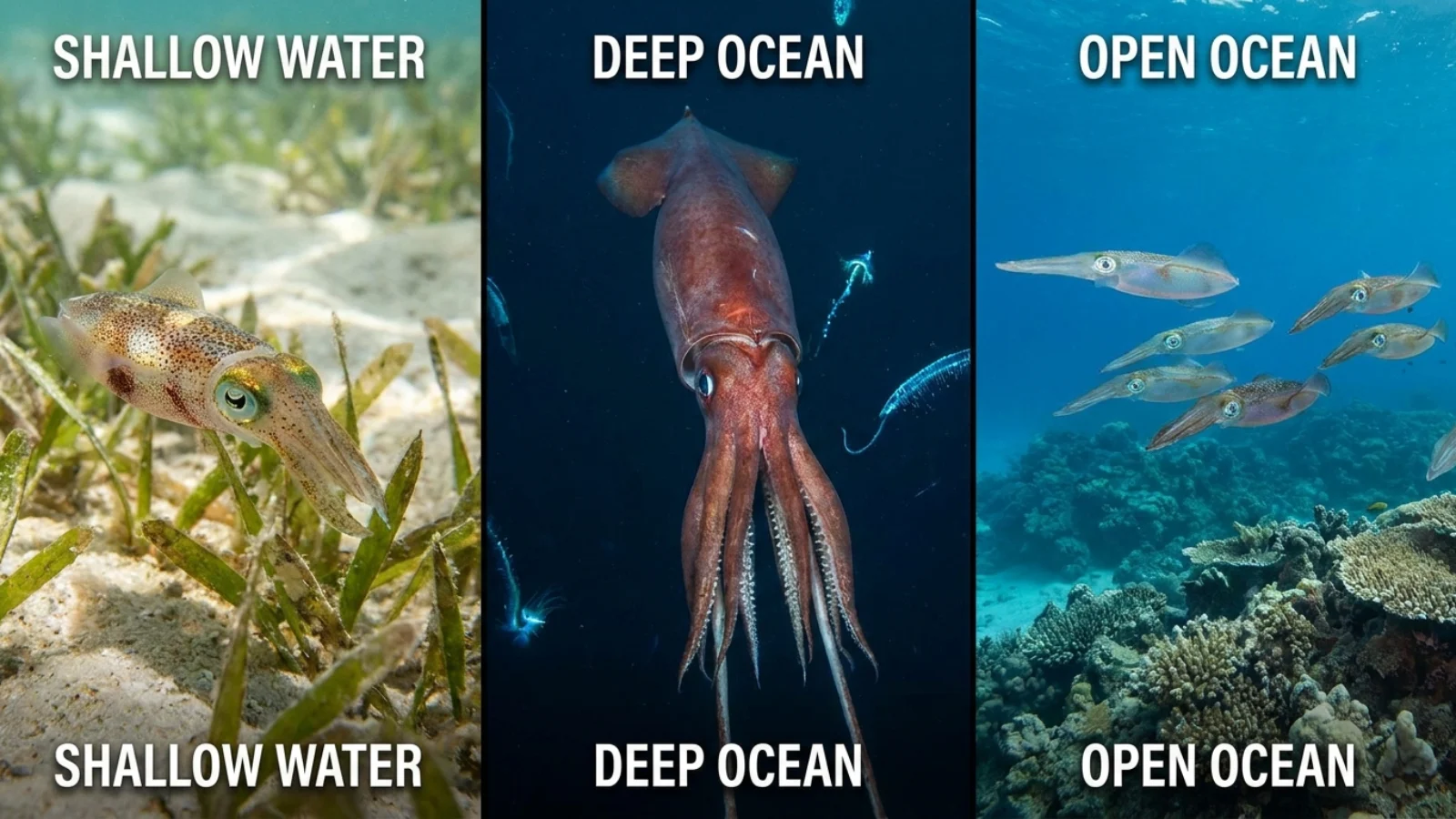
Inshore squid: the coastal species
1. Market squid (Doryteuthis opalescens). The market squid, or opalescent inshore squid, is a small loliginid of the eastern Pacific, found from Baja California in Mexico to Alaska and usually within about 320 km of the coast. Adults reach a total length of about 28 cm, and the mantle is four to five times longer than it is wide. Like other loliginids, market squid gather in huge shoals and move inshore to spawn, and spawning aggregations can number in the millions. For a long time the adults were thought to die after spawning because the egg beds were littered with dead squid. The fishery for it began with Chinese fishermen in Monterey Bay in 1860, and today about 90 percent of landings come from Southern California, mostly around the Channel Islands. Our market squid profile has more on the fishery.
2. Longfin inshore squid (Doryteuthis pealeii). The Atlantic counterpart of the market squid lives in continental shelf and slope waters from Newfoundland to the Gulf of Venezuela, schooling in large numbers. Some males reach a mantle length of 50 cm, although most of the squid harvested commercially are smaller than 30 cm. It is commercially fished, especially between Georges Bank and Cape Hatteras. Its biggest contribution to science came from its giant nerve fibre: Andrew Huxley and Alan Hodgkin used the axons of this species in their studies of how nerve impulses work, research that made it a model organism in neuroscience.
3. Caribbean reef squid (Sepioteuthis sepioidea). This small, torpedo-shaped squid, about 20 cm long, has undulating fins running almost the full length of the body. It lives throughout the Caribbean Sea and off the coast of Florida, usually in small schools of four to thirty animals in the shallows around reefs, which makes it the squid snorkellers and divers in the region are most likely to meet. Reef squid communicate using rapid changes of colour, body shape and skin texture. In 2001 the marine biologist Silvia Macia reported that the species can launch itself out of the water about 2 m and glide roughly 10 m before re-entering. See our Caribbean reef squid profile.
4. Bigfin reef squid (Sepioteuthis lessoniana). In the Indo-Pacific the reef squid niche is filled by the bigfin reef squid, also called the oval squid, tiger squid or northern calamari. A large oval fin runs around the entire edge of its mantle, giving it a passing resemblance to a cuttlefish. Adults range from about 3.8 to 33 cm. Studies since 1993 suggest it may actually be a complex of several very similar cryptic species. Bigfin reef squid perform elaborate mating displays, and their hatchlings already look like miniature adults and can change colour from the moment they hatch.
Open-ocean squid: the fast swimmers
5. Humboldt squid (Dosidicus gigas). The Humboldt or jumbo squid is the largest of the flying squid family. Individuals can reach 1.5 m in mantle length and weigh up to 50 kg. It is named after the Humboldt Current off western South America, where it was first collected, and it lives across the eastern Pacific. It hunts in shoals of up to 1,200 individuals, and when captured it flashes rapidly between red and white, which earned it the nickname diablo rojo, “red devil”, among fishermen in Baja California. In recent decades the species has spread north into the waters of Oregon, Washington, British Columbia and Alaska. Its reputation for attacking divers is covered on our Humboldt squid page.
6. Japanese flying squid (Todarodes pacificus). Also called the Japanese common squid or Pacific flying squid, this ommastrephid lives across the northern Pacific around Japan, along the coast of China up to Russia, and across the Bering Strait towards Alaska and Canada. Like most squid it lives about a year and dies after reproducing. It is one of the most heavily fished squid in the world, caught mainly by Japan, South Korea and, more recently, China.
Glowing squid
7. Firefly squid (Watasenia scintillans). Known in Japan as hotaru-ika, the firefly squid is a tiny squid of about 7.5 cm that spends most of its life at depths of 200 to 400 metres. It is covered in photophores of three types that emit blue light. It uses the light for counter-illumination, matching the brightness and colour of its underside to the light from the surface so that predators below cannot see its silhouette. Every spring it migrates into the coastal waters of Toyama Bay to spawn, which is when it is best known and most often seen. Each lives about a year. Historically it was never eaten raw in Japan because of the risk of a nematode parasite. See our firefly squid profile.
8. Dana octopus squid (Taningia danae). Despite the name, this is a squid whose two tentacles stop growing after the larval stage, leaving adults with eight arms like an octopus. It is one of the largest known squid species: the largest known specimen, a mature female, weighed 161.4 kg. The tips of its second pair of arms carry photophores about the size of a lemon, among the largest light organs known in any animal, with black, eyelid-like membranes that can be closed to make the light blink. In 2005 a Japanese team led by Tsunemi Kubodera filmed what appears to be the species using these flashes as it attacked bait in the deep sea.
Deep-sea and midwater squid
9. Glass squid (family Cranchiidae). The glass squids, also called cockatoo or cranch squid, are a family of about 60 species named for their transparent bodies, which act as camouflage in the dim midwater. Young cranchiids live near the surface and descend as they mature, and some species live more than 2 km down. Their body shape changes so much as they grow that juveniles can be mistaken for different species. Mantle length in the family ranges from about 10 cm to over 3 m, the upper end belonging to the colossal squid, which is a glass squid. See our glass squid page.
10. Bigfin squid (Magnapinna). Among the strangest animals ever filmed, bigfin squid have fins up to 90 percent of the mantle length and extraordinarily long, thin arms and tentacles held at right angles to the body, giving them a distinctive “elbow” shape. Their elastic tentacles have been estimated at 15 to 20 times the mantle length. They are known mostly from submersible footage: the earliest identified video dates from 1988, and the crew of the French submersible Nautile met one off northern Brazil at a depth of 4,735 metres. How they feed is still unknown. See Magnapinna squid.
The giants
11. Giant squid (Architeuthis dux). The giant squid is the longest squid and has the longest tentacles of any cephalopod. Recent estimates put the maximum size at about 12 to 13 m for females and about 10 m for males, measured from the fins to the tip of the two long tentacles. Its eyes reach at least 27 cm across, with a 9 cm pupil, and only the extinct ichthyosaurs are known to have had larger eyes. Evidence from trawled specimens and sperm whale dives suggests it lives at depths of roughly 300 to 1,000 metres. The first photographs of a live giant squid in its habitat were taken on 30 September 2004 by Tsunemi Kubodera of the National Science Museum of Japan and Kyoichi Mori. Our giant squid profile covers its biology in depth.
12. Colossal squid (Mesonychoteuthis hamiltoni). The colossal squid is the heaviest squid and the largest member of the glass squid family. It is confirmed to reach at least 495 kg, the weight of a specimen caught in 2007 and now displayed at the Museum of New Zealand Te Papa Tongarewa, and beaks from sperm whale stomachs suggest the biggest may weigh 600 to 700 kg. It has the largest eyes of any known animal, estimated at 27 cm across, and it is the only cranchiid with hooks on its arms and tentacles. It lives in the circumantarctic Southern Ocean. Shorter but bulkier than the giant squid, it is compared part by part on our colossal squid vs giant squid page.
Squid that are not true squid
13. Bobtail squid (order Sepiolida). Bobtail squid are small, rounded cephalopods more closely related to cuttlefish than to true squid. About seventy species are known, and males typically have a mantle length of only 1 to 8 cm. Many have a light organ in the mantle housing the bioluminescent bacterium Aliivibrio fischeri; the glow from below hides the squid’s silhouette, the same counter-illumination trick the firefly squid uses with its own photophores.
14. Ram’s horn squid (Spirula spirula). This small deep-water cephalopod is named for its internal, chambered, coiled shell, which works as a buoyancy organ. By day it lives in the deep ocean down to about 1,000 m. Few people ever see the animal, but beachcombers know the shell well: it is light, buoyant and durable, and it commonly floats ashore on tropical beaches around the world.
15. Vampire squid (Vampyroteuthis infernalis). The vampire squid is neither squid nor octopus. Two long retractile filaments between its arms set it apart from both and place it in its own order, Vampyromorphida. A web of skin, black on the inside, joins its eight arms into a cloak. It lives at lightless depths of about 600 to 900 metres in the oxygen minimum zone, and when highly agitated it can release a sticky cloud of glowing mucus from its arm tips. Our vampire squid page explains its unusual diet.
The smallest squid
Pygmy squid of the genus Idiosepius deserve an honourable mention as the smallest true squid-like animals: adults are only 10 to 18 mm long. They live in tropical and temperate waters of the Indo-Pacific, often among seagrass and mangrove roots, and carry an adhesive organ on the upper side of the mantle, between the fins, that they use to stick themselves to leaves.
How to tell the types of squid apart
If you see a squid alive in shallow water, you are almost certainly looking at an inshore species such as a reef squid. The fins are the quickest clue: reef squid have fins along nearly the whole body, while market and longfin squid have shorter, triangular fins at the rear. Open-ocean squid such as the Humboldt and flying squids are more muscular and torpedo-shaped, built for speed, and are usually seen only at night under lights or on the end of a fishing line. Deep-sea species are seen almost exclusively on submersible video or as specimens hauled up by trawls and fishing lines.
On the plate, nearly all calamari comes from a few inshore and flying squid species, which grow fast, live about a year and gather in huge shoals that are easy to catch. That short life is a defining feature of squid as a group, and it is one reason fisheries can swing so dramatically from year to year. For a broader look at how squid bodies work, see our guide to squid anatomy.
How many types of squid are there?
Many families and species, sorted into two main groups: inshore squid and open-ocean squid.
What is the biggest type of squid?
The colossal squid is the heaviest, at least 495 kg; the giant squid is the longest.
What is the smallest squid?
Pygmy squid of the genus Idiosepius, which are 10 to 18 mm long as adults.
What type of squid is calamari?
Mostly inshore loliginid squid and flying squid caught in large commercial fisheries.
Which squid glow in the dark?
Firefly squid, Dana octopus squid, bobtail squid and many deep-sea species produce light.
Is the vampire squid a squid?
No. It belongs to its own order, Vampyromorphida, separate from squid and octopuses.
What squid live in Florida?
The Caribbean reef squid lives off Florida, usually in small schools over shallow reefs.
Can squid fly?
Caribbean reef squid can launch about 2 m out of the water and glide about 10 m.
- Wikipedia contributors, “Squid”, “Giant squid”, “Colossal squid”, “Humboldt squid”, “Firefly squid”, “Doryteuthis opalescens”, “Doryteuthis pealeii”, “Caribbean reef squid”, “Sepioteuthis lessoniana”, “Todarodes pacificus” (accessed November 2026).
- Wikipedia contributors, “Cranchiidae”, “Taningia danae”, “Bigfin squid”, “Bobtail squid”, “Spirula”, “Vampire squid”, “Idiosepius” (accessed November 2026).
- Kubodera, T. and Mori, K. (2005), “First-ever observations of a live giant squid in the wild”, Proceedings of the Royal Society B 272.
Blane Perun has been exploring Earth’s oceans and marine life for over 25 years. Founder of TheSea.Org in 1999, underwater photographer, coral aquaculture pioneer, and explorer of 80+ countries.
About Blane Perun →