South Africa Coral Reef Maps — Africa’s Southernmost Reefs at Sodwana Bay
South Africa’s coral reefs lie along the Maputaland coast in the far north-east of KwaZulu-Natal, between the Mozambique border and Cape Vidal. They are the southernmost coral reefs in Africa, kept alive this far from the equator by the warm, south-flowing Agulhas Current. The best-known reefs are off Sodwana Bay, and almost all of them sit inside the iSimangaliso Wetland Park, a UNESCO World Heritage Site. They are small and patchy compared with tropical reef systems, but they are among the most popular dive sites in southern Africa. The map below shows exactly where they are.
Ask most people where to find coral reefs in Africa and they will name the Red Sea, Kenya, Tanzania or Mozambique. Few would think of South Africa, a country better known for cold Atlantic kelp forests, great white sharks and the Cape of Good Hope. Yet in the far north-east of the country, on a remote stretch of subtropical coast, coral grows further south than anywhere else on the continent. These are high-latitude reefs living close to the edge of what coral can tolerate, and that position makes them both fascinating to divers and important to scientists who study how reefs respond to a changing ocean.
South Africa coral reef map
All of South Africa’s coral reefs fit on one short stretch of coast: the Maputaland shoreline of northern KwaZulu-Natal.
On the map, the coral shading forms a narrow band hugging the coast south of the Mozambique border. It runs past Kosi Bay, Black Rock, Rocktail Bay and Mabibi, reaches its best-known section off Sodwana Bay, and fades out towards Cape Vidal and the St Lucia estuary. South of that, the water becomes too cool for reef-building corals to form true reef communities, although scattered corals and rocky reefs continue down the KwaZulu-Natal coast.
The reef outlines come from the global warm-water coral reef dataset compiled by UNEP-WCMC and partners from satellite imagery and field surveys. Because the Maputaland reefs are thin coral veneers on submerged rock rather than thick reef structures, the dataset maps only a small area here, about a square kilometre. That figure understates their importance: on the water, they stretch over many kilometres of coastline as a chain of separate reef patches.
Why coral can grow this far south
The Agulhas Current carries warm tropical water down Africa’s east coast, pushing the coral frontier much further south than latitude alone would allow.
Reef-building corals need warm, clear, well-lit water. At the latitude of northern KwaZulu-Natal, the ocean would normally be too cool for them. What changes the picture is the Agulhas Current, one of the strongest western boundary currents in the world. It flows south from the tropical Indian Ocean along the coasts of Mozambique and South Africa, carrying warm water and tropical larvae with it. Fish, corals and invertebrates that spawn far to the north can drift south on this current and settle on the Maputaland reefs.
Even with that help, the Maputaland reefs live close to their limits. Winter water temperatures are lower than on equatorial reefs, and the growth of hard corals is slower. This is why these reefs are described as marginal, high-latitude reefs: they host true coral communities, but those communities have not built the massive limestone frameworks found on tropical reefs. Instead, corals grow as a living layer on old submerged sandstone ridges, the drowned remains of ancient shorelines and dunes that formed when sea level was lower.
That geology gives the reefs their characteristic shape. They tend to run parallel to the shore as long ridges and pinnacles, separated by sand, rather than forming the lagoons, reef flats and crests of a classic fringing reef.
Sodwana Bay and the named reefs
Sodwana Bay is the heart of South African reef diving, with a series of reefs named for their distance up the coast.
Divers at Sodwana launch boats straight off the beach through the surf, then head to reefs known by simple names such as Two-Mile, Five-Mile, Seven-Mile and Nine-Mile. The names describe roughly how far each reef lies from the launch site. Two-Mile Reef is the most visited and is large enough to offer many separate dive sites, from shallow coral gardens to deeper ledges and overhangs. The more distant reefs are generally quieter and often in better condition because they receive fewer divers.
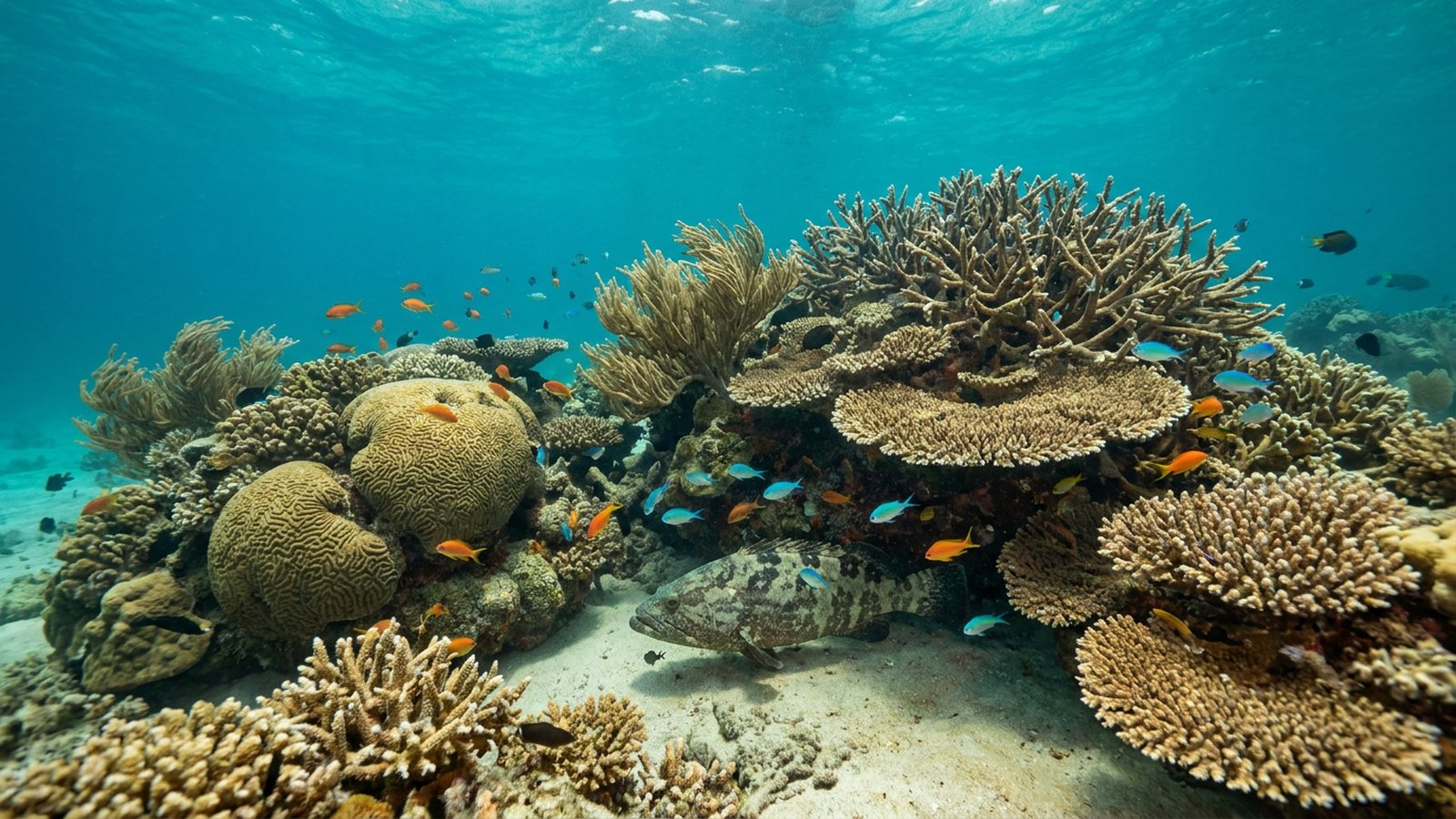
The reefs are notable for how much of the bottom is covered by soft corals, which thrive in the moving, nutrient-carrying water. Hard corals are present too, along with sponges, sea fans and a wide range of invertebrates. The fish life is typical of the western Indian Ocean: butterflyfish, angelfish, surgeonfish, groupers, moray eels, triggerfish and large schools of snappers and fusiliers, with turtles, rays and reef sharks regularly seen.
North and south of Sodwana, the same chain of reefs continues off Mabibi, Rocktail Bay, Black Rock and Kosi Bay. These sites are more remote and less dived, and in places the coral communities are in excellent condition. Some reefs can be reached by snorkelling from the shore on calm days, which makes Maputaland one of the few places in South Africa where it is possible to swim over coral without a boat.
Protection: the iSimangaliso Wetland Park
Almost every coral reef in South Africa lies inside a single protected area, which is unusual anywhere in the world.
The iSimangaliso Wetland Park stretches along the northern KwaZulu-Natal coast from the Mozambique border to south of the St Lucia estuary. It was listed as a UNESCO World Heritage Site for its combination of coral reefs, sandy beaches, coastal dune forests, lakes, swamps and wetlands, and it is one of the most biologically diverse protected areas in southern Africa. Its marine section includes zones where fishing and other extractive activities are restricted or banned, and the coral reefs fall within this protected seascape.
Concentrating almost all of a country’s coral reef inside one park has a clear advantage. Rules on boat launching, the number of dive operators and the activities allowed on the reefs can be applied consistently, and the reefs have avoided the heavy coastal development seen elsewhere in the region. The beaches behind the reefs are also important nesting grounds for loggerhead and leatherback sea turtles, which adds to the conservation value of the whole coast.
Management of diving is a central concern. Sodwana Bay is popular with South African divers, particularly over holiday periods, and repeated contact from fins, hands and anchors can damage slow-growing high-latitude coral. Mooring rules, diver education and limits on operators all help to reduce this pressure.
Marine life beyond the reef
The Maputaland coast sits where tropical and subtropical seas meet, so the reefs host a mix of resident reef life and seasonal visitors.
Besides the coral-reef fish, the area is known for larger animals that pass along the coast at different times of year. Humpback whales migrate past during the southern winter and spring, and whale sharks are sometimes seen in the warmer months. Ragged-tooth sharks, known elsewhere as sand tiger sharks, move along the KwaZulu-Natal coast and gather at certain reefs. Manta rays, dolphins and several species of sea turtle are also part of the picture.
On the reef itself, the variety of smaller life is high. Nudibranchs, shrimps, crabs, octopuses, frogfish and pipefish attract underwater photographers, and the mix of tropical species at their southern limit makes the reefs interesting for naturalists. Some fish and invertebrates that are common on equatorial reefs are rare here, while some subtropical species are more common than they would be further north.
Pressures on South Africa’s reefs
Warming seas are the biggest long-term concern, while diving and storms add local pressure.
Because these reefs live near the cool edge of coral’s range, it might seem that warming would help them. In practice, the bigger danger is short spells of unusually hot water, known as marine heatwaves, that can push corals past their tolerance and cause coral bleaching. High-latitude reefs are watched closely because they may act as refuges for some species as the tropics warm, but they are not immune to heat stress themselves.
Other pressures include physical damage from storms and large swells, sediment from rivers after heavy rain, and wear and tear from divers and boats at the busiest sites. Compared with many reefs in Africa, however, South Africa’s reefs face relatively little pressure from overfishing or pollution, thanks to the protection of iSimangaliso and the low level of development on this coast. That makes them a useful reference point for comparison with more heavily used reefs, a theme explored across our coral reef conservation pages.
Does South Africa have coral reefs?
Yes. South Africa has a small area of coral reefs along the Maputaland coast in north-eastern KwaZulu-Natal, between the Mozambique border and Cape Vidal. They are the southernmost coral reefs in Africa and lie almost entirely within the iSimangaliso Wetland Park.
Where is the best coral reef diving in South Africa?
Sodwana Bay is the best-known coral reef dive destination in South Africa, with reefs such as Two-Mile, Five-Mile, Seven-Mile and Nine-Mile. Quieter reefs lie further north off Mabibi, Rocktail Bay and Kosi Bay.
Why can coral grow so far south in South Africa?
The warm Agulhas Current flows south from the tropical Indian Ocean along Africa’s east coast, raising water temperatures and carrying coral and fish larvae south. Without it, the water off northern KwaZulu-Natal would be too cool for reef corals.
Are Sodwana Bay’s reefs real coral reefs?
They are true coral communities, but they grow as a living layer on old submerged sandstone ridges rather than building thick limestone frameworks like tropical reefs. Scientists describe them as marginal or high-latitude reefs, and soft corals cover much of the bottom.
Can you snorkel on coral reefs in South Africa?
Yes, in calm conditions. Some reefs along the Maputaland coast, including spots near Sodwana Bay, Mabibi and Kosi Bay, are shallow enough to snorkel from the shore. Sea conditions change quickly, so local advice is essential.
What threatens South Africa’s coral reefs?
Marine heatwaves that can cause bleaching are the main long-term threat. Storm damage, river sediment and wear from divers and boats add local pressure. Strong protection inside iSimangaliso keeps fishing and development pressure lower than on many other African reefs.
- UNEP-WCMC, WorldFish Centre, WRI and TNC (2021), Global distribution of warm-water coral reefs, v4.1
- UNESCO World Heritage Centre: iSimangaliso Wetland Park
- iSimangaliso Wetland Park Authority: marine protected area and diving information
Blane Perun has been exploring Earth’s oceans and marine life for over 25 years. Founder of TheSea.Org in 1999, underwater photographer, coral aquaculture pioneer, and explorer of 80+ countries.
About Blane Perun → More Africa Coral Reef Maps →