Sudan Coral Reef Maps — Sanganeb, Sha’ab Rumi and the Wild Red Sea Coast
Sudan’s coral reefs run along its entire Red Sea coast, from the Egyptian border in the north to the Eritrean border in the south. They include long fringing reefs close to shore, a broken line of offshore and barrier reefs, and Sanganeb, an isolated reef rising from deep water off Port Sudan that is often described as the only true atoll in the Red Sea. Sanganeb and the reefs of Dungonab Bay and Mukkawar Island are protected as marine national parks and together form a UNESCO World Heritage Site. With little coastal development and few visitors, Sudan’s reefs are among the least disturbed in the Red Sea.
Sudan has one of the longest stretches of coral coast in the Red Sea, yet it is one of the least visited. While the reefs of Egypt and Jordan see huge numbers of divers every year, Sudan’s coast has stayed remote, lightly developed and largely free of mass tourism. The result is a reef system that divers talk about with a kind of reverence: steep walls, clear water, healthy coral and an abundance of sharks and large fish that has become rare elsewhere. This page maps where those reefs are and explains what makes them special.
Sudan coral reef map
Reef lines the whole Sudanese coast, with the greatest concentrations around Port Sudan, Dungonab Bay in the north and the Suakin archipelago in the south.
On the map, coral shading follows almost every kilometre of Sudan’s shoreline as a continuous fringing reef. Offshore, a second line of reefs, some forming barrier-like chains, runs roughly parallel to the coast. In the north, the coral spreads around Dungonab Bay and Mukkawar Island. Off Port Sudan, the isolated reefs of Sanganeb and Sha’ab Rumi stand out in deep water. In the south, the reef breaks up into the scattered islands and reef platforms of the Suakin archipelago, which continue towards Eritrea.
The outlines come from the UNEP-WCMC global coral reef dataset, which maps roughly 614 square kilometres of reef in Sudanese waters. That makes Sudan one of the more reef-rich countries in Africa. Because few detailed modern surveys have been made along much of this coast, the real extent and condition of the reefs may differ from what the map shows, particularly in the more remote south.
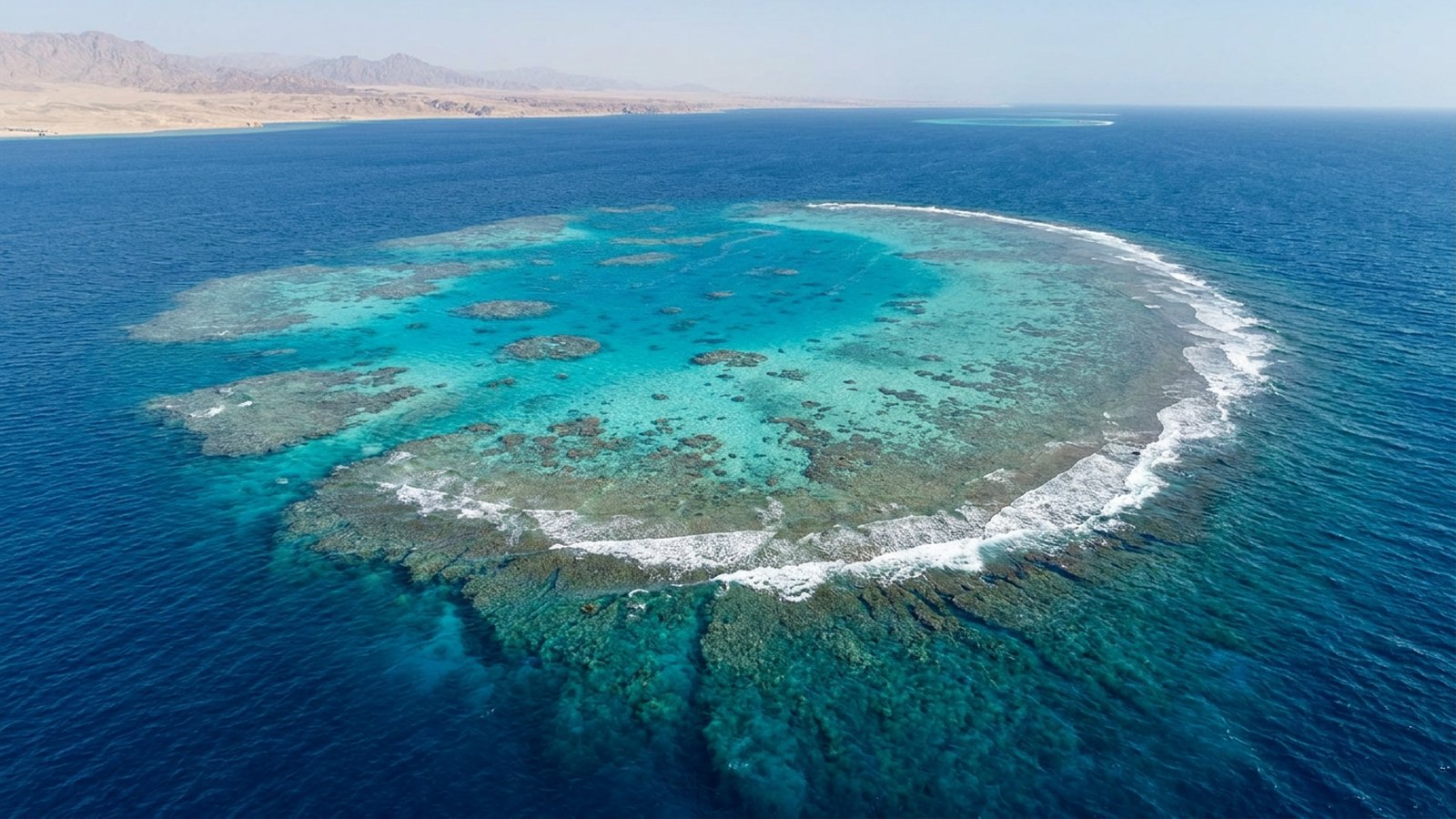
Sanganeb: the Red Sea’s atoll
Sanganeb is an isolated ring of reef that rises from very deep water, with a lagoon in the middle and a lighthouse on its rim.
Sanganeb lies offshore to the north-east of Port Sudan. Unlike the fringing reefs, which grow out from the land, it is a separate reef structure that climbs from the deep sea floor to the surface, enclosing a shallow lagoon. Because of that form, it is widely called the only true atoll in the Red Sea. A lighthouse stands on the reef, and the platform around it gives divers access to some of the most famous walls in the region.
The outer slopes of Sanganeb drop steeply into blue water. Its southern and northern points are known for strong currents and for schooling fish, grey reef sharks and, at times, scalloped hammerhead sharks. The coral on the upper walls is dense and varied, with large table corals, branching corals and sea fans. Sanganeb is protected as a marine national park, and it was the first part of Sudan’s coast to receive that status.
Sha’ab Rumi, Cousteau and the Umbria
Two of the most famous dive sites in the Red Sea lie off Port Sudan, one for its history of undersea living and one for its wreck.
Sha’ab Rumi is an offshore reef south of Sanganeb. In 1963 it hosted Jacques Cousteau’s Conshelf II (Précontinent II) experiment, in which a team of divers lived and worked on the sea floor for weeks in a small underwater village. Parts of that installation, including a garage built for Cousteau’s diving saucer and a tool shed, remain on the reef today, now heavily encrusted with coral. The reef is also known for its shark encounters, especially at its southern plateau.
Closer to Port Sudan, at Wingate Reef, lies the wreck of the Umbria, an Italian cargo ship that was scuttled by its crew in 1940 at the start of Italy’s involvement in the Second World War. The ship carried a large cargo of munitions, much of which still lies in its holds. Resting at shallow to moderate depths, partly on its side, it is one of the most celebrated wreck dives in the Red Sea and is covered in corals and fish.
Dungonab Bay and Mukkawar Island
The northern marine park protects a large bay of reefs, seagrass and islands that supports manta rays, dugongs and seabirds.
North of Port Sudan, Dungonab Bay is a broad, shallow bay fringed by reef, with Mukkawar Island offshore. The area is protected as the Dungonab Bay and Mukkawar Island Marine National Park, and together with Sanganeb it forms a UNESCO World Heritage Site recognised for its outstanding marine life and the condition of its ecosystems.
The bay is known for a seasonal gathering of manta rays, which come to feed on plankton. Its seagrass beds support dugongs, the large plant-eating marine mammals that have become scarce in much of their range. Sea turtles nest on the beaches, and the islands support important breeding colonies of seabirds. Combined with its coral reefs and mangroves, Dungonab Bay is one of the most complete examples of a Red Sea coastal ecosystem still functioning with relatively little human pressure.
Reef life in the central Red Sea
Sudan’s reefs share the high biodiversity of the Red Sea, including many species found nowhere else.
The Red Sea is a semi-enclosed sea with warm, salty water and very little river input. It has a high proportion of endemic species, especially among reef fish, and Sudan’s reefs share that richness. Divers see Red Sea specialities such as the Red Sea bannerfish, masked butterflyfish and Arabian angelfish alongside widespread Indo-Pacific reef fish. Large predators, including grey reef sharks, silvertip sharks, oceanic whitetip sharks in open water and schooling hammerheads, are a large part of what draws divers to Sudan.
Corals in the Red Sea have also attracted scientific attention because some populations, particularly in the north, tolerate high temperatures better than corals in many other seas. Sudan’s central Red Sea reefs are warmer than those in the north, so they are closer to their thermal limits, but they remain an important part of a regional reef system that may prove more resilient than many to ocean warming.
Pressures on Sudan’s reefs
Sudan’s reefs are in better shape than many, but they face growing risks from warming, shipping and coastal change.
The biggest long-term threat is ocean warming and marine heatwaves, which can trigger coral bleaching even on remote reefs. Locally, the busy shipping lanes of the Red Sea bring a risk of oil spills, ship groundings and pollution, especially around Port Sudan, the country’s main port. Port expansion, dredging and coastal construction can smother nearby reefs with sediment.
Fishing is another concern. Shark fishing has reduced shark numbers on some reefs, and unregulated fishing is hard to control along such a long, remote coast. Limited resources for park management and the effects of conflict make monitoring and enforcement difficult. Protecting Sudan’s reefs depends on keeping these pressures in check while the coast is still in good condition, an approach explored across our coral reef conservation pages.
Related on TheSea
Does Sudan have coral reefs?
Yes. Sudan has extensive coral reefs along its whole Red Sea coast, including fringing reefs, offshore and barrier reefs, the atoll-like Sanganeb reef and the reefs of Dungonab Bay. The UNEP-WCMC dataset maps around 614 km² of reef.
What is Sanganeb?
Sanganeb is an isolated reef off Port Sudan that rises from deep water and encloses a shallow lagoon. It is often described as the only true atoll in the Red Sea and is protected as Sanganeb Marine National Park, part of a UNESCO World Heritage Site.
Where did Jacques Cousteau build his underwater village?
At Sha’ab Rumi, an offshore reef near Port Sudan, where his Conshelf II (Précontinent II) experiment took place in 1963. Remains of the structures, now covered in coral, can still be seen by divers.
Is diving in Sudan good?
Sudan is considered one of the finest diving areas in the Red Sea because its reefs are lightly visited, with steep walls, healthy coral and frequent shark encounters. Diving is mostly by liveaboard from Port Sudan, and travellers should check current travel advice first.
Are Sudan’s reefs a World Heritage Site?
Yes. Sanganeb Marine National Park and the Dungonab Bay–Mukkawar Island Marine National Park are listed together as a UNESCO World Heritage Site for their outstanding marine biodiversity and ecosystems.
What threatens Sudan’s coral reefs?
Warming seas and marine heatwaves, shipping and port development around Port Sudan, sediment from coastal works, and fishing pressure, especially on sharks. Limited management resources make these pressures harder to control.
- UNEP-WCMC, WorldFish Centre, WRI and TNC (2021), Global distribution of warm-water coral reefs, v4.1
- UNESCO World Heritage Centre: Sanganeb Marine National Park and Dungonab Bay – Mukkawar Island Marine National Park
- PERSGA, the Regional Organization for the Conservation of the Environment of the Red Sea and Gulf of Aden
Blane Perun has been exploring Earth’s oceans and marine life for over 25 years. Founder of TheSea.Org in 1999, underwater photographer, coral aquaculture pioneer, and explorer of 80+ countries.
About Blane Perun → More Africa Coral Reef Maps →