Whydah Gally — Slave Ship, Pirate Flagship, Cape Cod Wreck
The Whydah Gally was an English slave ship, built in London in 1715–16, that pirate captain Samuel “Black Sam” Bellamy captured in early 1717 and made his flagship. Two months later, on April 26, 1717, a nor’easter drove it onto a sandbar off Wellfleet on Cape Cod, where it broke apart, killing about 144 of the roughly 146 men aboard.
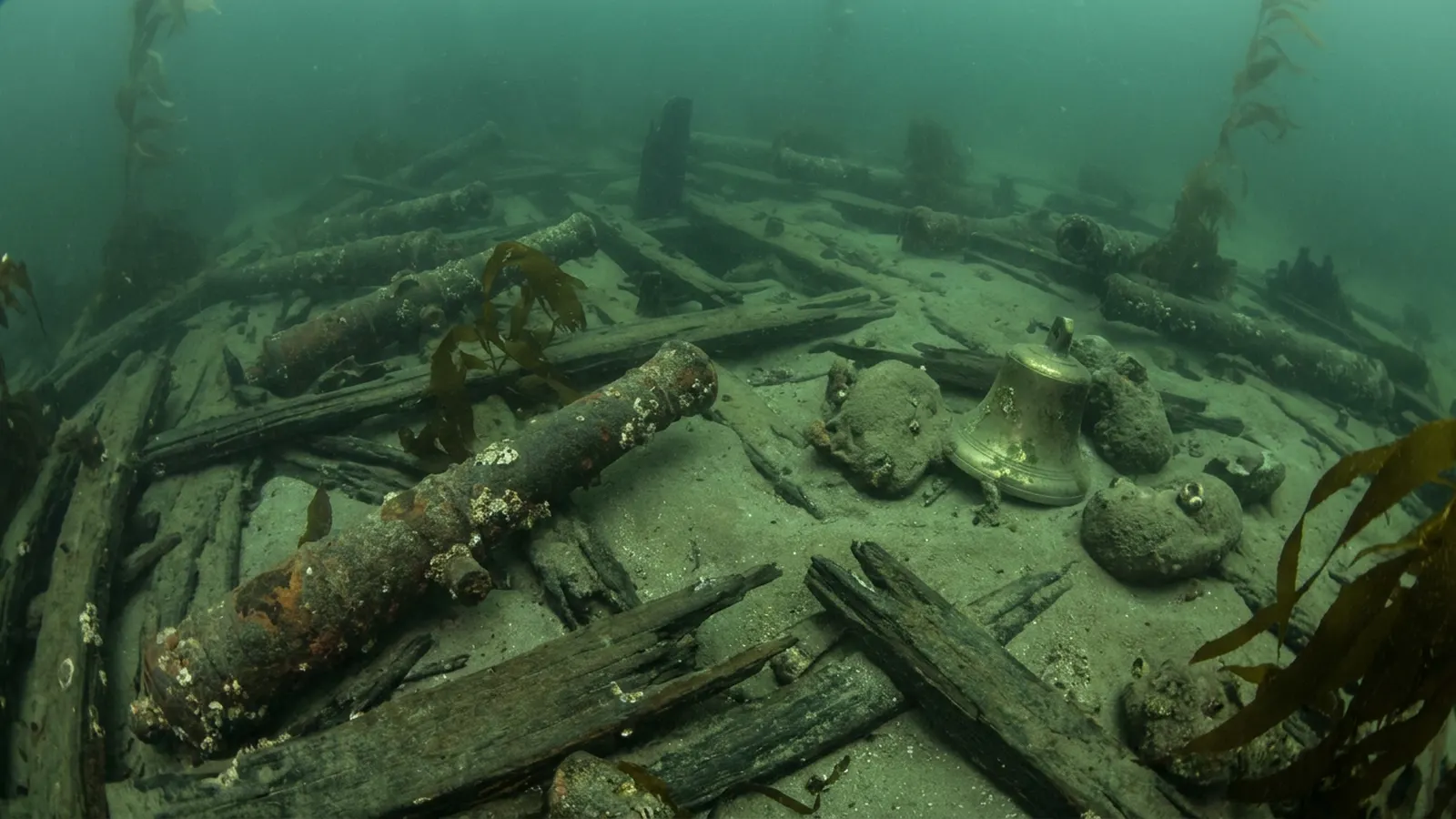
Explorer Barry Clifford found the wreck in 1984, and a bell inscribed with the ship’s name proved its identity in 1985. That makes the Whydah the first fully authenticated pirate shipwreck ever found. This page tells the ship’s whole arc. We cover the details in companion pages: Samuel Bellamy, the artifacts, the treasure, the human remains and the museum.
What was the Whydah Gally built for?
The slave trade. Sir Humphry Morice, a London merchant and member of Parliament, had the Whydah built as a fast three-masted galley of about 300 tons, able to make around 13 knots and fitted for both sail and oars. It was named for Ouidah, a slave-trading port in today’s Benin. On its maiden voyage it carried trade goods to West Africa, took on an estimated 500 enslaved Africans, sold them in the Caribbean and loaded gold, silver, sugar and indigo for the trip home. That cargo is what made it a prize.

How did Bellamy capture the Whydah?
In late February 1717, Bellamy’s pirates chased the Whydah for three days through the Windward Passage between Cuba and Hispaniola. Its captain, Lawrence Prince, surrendered after only a brief exchange of fire. Bellamy took the ship as his flagship and, in an unusual gesture, handed Prince the pirates’ galley Sultana in exchange. The pirates mounted more guns, bringing the Whydah up to about 28, and sailed north along the American coast with a small fleet, taking ships as they went.
| Date | Event |
|---|---|
| 1715–16 | Built in London for Sir Humphry Morice |
| 1716 | Maiden voyage in the Atlantic slave trade |
| Feb 1717 | Captured by Samuel Bellamy in the Windward Passage |
| Apr 26, 1717 | Wrecked off Wellfleet, Cape Cod, in a nor’easter |
| Oct–Nov 1717 | Pirates tried in Boston; six hanged November 15 |
| 1984 | Barry Clifford locates the wreck |
| 1985 | Ship’s bell raised, confirming its identity |
How did the Whydah sink?
On the night of April 26, 1717, the Whydah was off Cape Cod in fog and rising wind when a powerful nor’easter struck. Unable to claw off the lee shore, the ship hit a sandbar near what is now Marconi Beach in Wellfleet. The mainmast went over and the hull broke up in the surf within minutes. Bellamy died with almost all his crew. Only two men from the Whydah survived: John Julian, a teenage pilot probably from the Mosquito Coast of Central America, and Thomas Davis, a carpenter. Across Bellamy’s fleet, nine pirates survived, mostly from a second ship that ran aground nearby.
What happened to the survivors?
Massachusetts authorities tried the surviving pirates in Boston in October 1717. Six were convicted and hanged on November 15, 1717. Thomas Davis and another carpenter, Thomas South, were acquitted because they had been forced into piracy. John Julian was never tried; he was probably sold into slavery, and records suggest he was executed in 1733 after a series of escape attempts.
How was the Whydah found?
Barry Clifford worked from a 1717 map by Cyprian Southack, the salvager and mapmaker the governor sent to recover the treasure. Southack reached the wreck on May 3, 1717, mapped it and recovered almost nothing. In 1984 Clifford’s team found cannon and coins buried in sand off Wellfleet. In 1985 divers raised the ship’s bell, inscribed “THE WHYDAH GALLY 1716,” and in 2013 a brass plate bearing the name was also found. More than 200,000 objects have been recovered so far.
A galley built for speed
“Gally” in the ship’s name is the period spelling of galley, and the Whydah was designed to be driven by oars as well as sail, so she could keep moving when the wind dropped. The Whydah was rated at 300 tons burthen and about 110 ft (34 m) long, with three masts and a reputed top speed of 13 knots. In peacetime she mounted 18 six-pounder guns, and her gun deck could take as many as 28 in time of war.
Those features suited a slave ship working a dangerous coast, where a faster passage and a strong battery were both valued. They also made the ship exactly what a pirate captain wanted: fast enough to catch merchantmen, big enough to carry a large crew, and strong enough to fight.
Her name came from the Kingdom of Whydah on the coast of what is now Benin, whose chief port, today the city of Ouidah, had grown in importance after England’s Royal African Company built a fort there in 1650. By the time the ship arrived, Whydah ranked among the busiest slave ports in West Africa. The kingdom itself did not last long afterwards: in 1727 it was overrun by King Agaja of Dahomey.
The maiden voyage in the triangle trade
The ship left London on its first voyage in early 1716 under Captain Lawrence Prince, loaded with manufactured goods to barter. She worked her way along the West African coast from the Gambia and Senegal region towards the Bight of Benin, and left Africa with an estimated 500 captives, along with gold, including Akan jewellery, and ivory.
In the Caribbean the surviving captives were sold, and the ship took on what the triangle trade called the return cargo: precious metals, sugar, indigo, rum, logwood, pimento, ginger and medicinal ingredients, bound for England. It was on that homeward leg, loaded with the profits of the slaving voyage, that the Whydah met Bellamy. The number of Africans who died during the crossing is not recorded in the sources we could verify.

From slaver to pirate flagship
Once Bellamy had the ship, his crew rebuilt her for a different job. According to accounts of the capture, they razeed the vessel, clearing the upper deck of the pilot’s cabin, tearing out the barricade that had separated the crew from the captives, and removing other weight that made her top-heavy. Ten more guns were mounted, and about 150 of Bellamy’s men were assigned to her.
Bellamy treated Captain Prince with unusual courtesy, giving him the pirates’ old ship Sultana and £20 in silver and gold. Some of the Whydah’s crew stayed aboard and joined the pirates. Pirate crews of the period drew heavily on such recruits: displaced seamen, escaped bondsmen, freed Africans and others with little stake in the merchant system.
With the Whydah as flagship, Bellamy ran a small fleet that at various points included the sloop Marianne, commanded by his partner Paulsgrave Williams, and the captured vessels Anne, Fisher and Mary Anne. The fleet worked north past the Carolinas, taking prizes, and storm damage on the way broke one of the Whydah’s masts, forcing makeshift repairs. Wikipedia’s account adds that Bellamy carried another 30 or more guns below decks, possibly as ballast; two cannon raised by Barry Clifford’s team in 2009 weighed about 800 and 1,500 lb (360 and 680 kg).
The last day: April 26, 1717
The final day began as a success for the pirates. Off Cape Cod they took the Mary Anne, whose hold was full of Madeira wine. When her captain refused to pilot the fleet along the coast, Bellamy brought him and five of his crew aboard the Whydah and put seven of his own men on the prize, among them the reluctant carpenter Thomas South.
Around sunset the wind fell away and a thick fog closed in, and the ships lost sight of one another. The Anne and the Fisher stood out to sea and eventually reached Damariscove Island in Maine, badly damaged. Williams had already taken the Marianne away to Block Island, planning to meet Bellamy later off Maine. That night the calm gave way to a nor’easter, and the Whydah found herself on a lee shore with the storm pushing her towards the shoals.
Around midnight she struck a sandbar bow first, in about 16 ft (5 m) of water some 500 ft (152 m) from the beach at what is now Marconi Beach in Wellfleet. Wikipedia’s account describes winds of around 70 mph and seas of 30 to 40 ft, figures that cannot be checked against instruments from the time. The mainmast went over, the ship was dragged into about 30 ft (9 m) of water and capsized, and the heavy guns smashed down through the overturned decks, breaking the hull apart. Debris, bodies and cargo were spread along some 4 miles (6.4 km) of shore.
The survivor Thomas Davis told the court that within a quarter of an hour of striking the mainmast had gone by the board, and that by morning “she was beat to pieces”. The Mary Anne was wrecked the same night about ten miles to the south, at Pochet Island; all seven pirates aboard her, and her three original crewmen, got ashore.
Southack’s salvage and the moon-cussers
By the next morning local wreckers, known on Cape Cod as “moon-cussers”, were already picking over the beach. Governor Samuel Shute sent Captain Cyprian Southack, a salvager and mapmaker, to recover the “Money, Bullion, Treasure, Goods and Merchandizes” from the wreck. When he arrived a week after the wreck, part of the hull still broke the surface, but most of the wreckage was strewn along the coast.
Southack recorded that 102 of the dead were buried, although, by one account, it was the town coroner who did the burying and then surprised him with the bill. He recovered little of value and concluded that “the riches, with the guns, would be buried in the sand”. He is said never to have been repaid by the governor for his work. His map of the wreck site survived, and more than 260 years later it became the starting point for the modern search.
Who owns a pirate wreck? The 1988 court ruling
The Whydah also made legal history. When Clifford’s company, Maritime Underwater Surveys, began recovering material, the Commonwealth of Massachusetts claimed title to the wreck and argued that any salvage had to follow the state’s permit system and the rules of its Board of Underwater Archaeological Resources.
In Commonwealth v. Maritime Underwater Surveys, decided on December 12, 1988, the Massachusetts Supreme Judicial Court disagreed. It held that a wreck left undisturbed for almost three centuries was abandoned, so the law of finds applied, and that the federal government, not the state, held sovereignty over the marginal sea; the Submerged Lands Act had passed ownership of the seabed to the states but not that sovereign power. The state’s claim therefore failed, title vested in the company, and it could exclude other salvors.
The timing mattered. Congress had passed the Abandoned Shipwreck Act in April 1988, giving states title to abandoned wrecks embedded in their submerged lands, but the act did not apply to legal proceedings begun before it was enacted. The court’s opinion places the company’s find in November 1982, while most accounts, including the museum’s, date the discovery to 1984; the sources we checked do not explain the difference.
Clifford has kept the collection together rather than selling it, and his team holds exclusive rights to dive the site, which the National Park Service and the U.S. Coast Guard patrol. The Massachusetts Board of Underwater Archaeological Resources, once the state’s opponent in court, later described the Whydah Project as a model of underwater archaeology.
Excavating a wreck buried in sand
The Whydah is unusual because it lies close to shore yet stayed hidden for more than 260 years. Wikipedia gives two descriptions of its burial: one says the remains lie under 10 to 50 ft (3 to 15 m) of sand in 16 to 30 ft (5 to 9 m) of water, another that the first finds were in just 14 ft (4.3 m) of water under 5 ft (1.5 m) of sand. Both can be true, since the debris field runs for miles along a shifting sandy coast.
Much of the material comes up as concretion. Iron from guns and fittings reacts with seawater and builds a hard, rock-like crust that swallows nearby objects and, in doing so, protects them. In 2007 the team raised a concretion of about 12,000 lb from beneath roughly 30 ft of sand, believed to hold at least seven iron cannon along with coins and weapons. In 2023 a smaller concretion was imaged with hospital CT scanners and high-definition X-rays at Lahey Medical Center, revealing wood grain inside; conservators planned to free its contents by electrolysis, a process expected to take six months to a year.
Clifford’s divers have worked the site season by season from Provincetown, and recovered objects number more than 200,000. They include more than 60 cannon and many everyday items that show how the crew lived. One of the most poignant is a child-sized leather shoe with a silk stocking and a fibula from a child aged roughly 8 to 11, which researchers have linked to John King, a boy of about 10 who had insisted on joining Bellamy’s crew the previous November.
How sure is the identification?
Few wrecks of this age are named so securely. The bell inscribed “THE WHYDAH GALLY 1716”, raised in 1985, was followed in 2013 by a small brass plate bearing the ship’s name and the date of her maiden voyage. Together with the location matching Southack’s map, the coins and the guns, these make the Whydah the first Golden Age pirate shipwreck to be fully authenticated.
The ship’s double history has also shaped how it is shown to the public. A touring exhibition, “Real Pirates: The Untold Story of the Whydah from Slave Ship to Pirate Ship”, visited museums across the United States from 2007 to 2014. In 2007 a Florida museum cancelled a planned showing after critics said its promotion, tied to a Hollywood pirate film, trivialised the ship’s role in the slave trade. Today artifacts are displayed at the Whydah Pirate Museum in West Yarmouth and at the Real Pirates museum in Salem, which opened in 2022.
Why does the Whydah Gally matter?
It was the first pirate shipwreck whose identity was proven beyond doubt, and its two careers in the slave trade and in piracy tie together two violent parts of the 18th-century Atlantic economy. For other famous pirate ships read about Queen Anne’s Revenge and our list of famous pirate ships.
What was the Whydah Gally?
A London-built slave ship captured by pirate Samuel Bellamy in 1717 and wrecked off Cape Cod the same year.
When did the Whydah sink?
On the night of April 26, 1717, in a nor’easter off Wellfleet, Massachusetts.
How many people died on the Whydah?
About 144 of roughly 146 aboard. Only two survived.
Who found the Whydah Gally?
Underwater explorer Barry Clifford, in 1984.
How do we know the wreck is the Whydah?
Divers raised its bell, inscribed “THE WHYDAH GALLY 1716,” in 1985.
Where is the Whydah wreck?
Off Marconi Beach in Wellfleet, Cape Cod, buried under sand in shallow water.
Where can I see Whydah artifacts?
At the Whydah Pirate Museum in West Yarmouth and the Real Pirates museum in Salem, Massachusetts.
Is the Whydah the only pirate ship ever found?
No, but it was the first Golden Age pirate shipwreck to be fully authenticated, by its inscribed bell and a brass name plate.
- Wikipedia: Whydah Gally (build, capture, wreck, trials, discovery).
- Whydah Pirate Museum, West Yarmouth, MA.
- Clifford, B., Expedition Whydah (1999).
- Commonwealth v. Maritime Underwater Surveys, Inc., 403 Mass. 501 (1988), Massachusetts Supreme Judicial Court.
- Wikipedia: Cyprian Southack; Ouidah; Barry Clifford.
- New York Times via History News Network (August 2007): New material at wreck site of pirate ship.
- CBS News Boston (February 22, 2023): Uncovering history on a 300-year-old pirate ship wreckage off Cape Cod.
Blane Perun has been exploring Earth’s oceans and marine life for over 25 years. Founder of TheSea.Org in 1999, underwater photographer, coral aquaculture pioneer, and explorer of 80+ countries.
About Blane Perun →