Sea Urchins Wearing Hats — The Science Behind the Urchin’s Shell-and-Seaweed Wardrobe
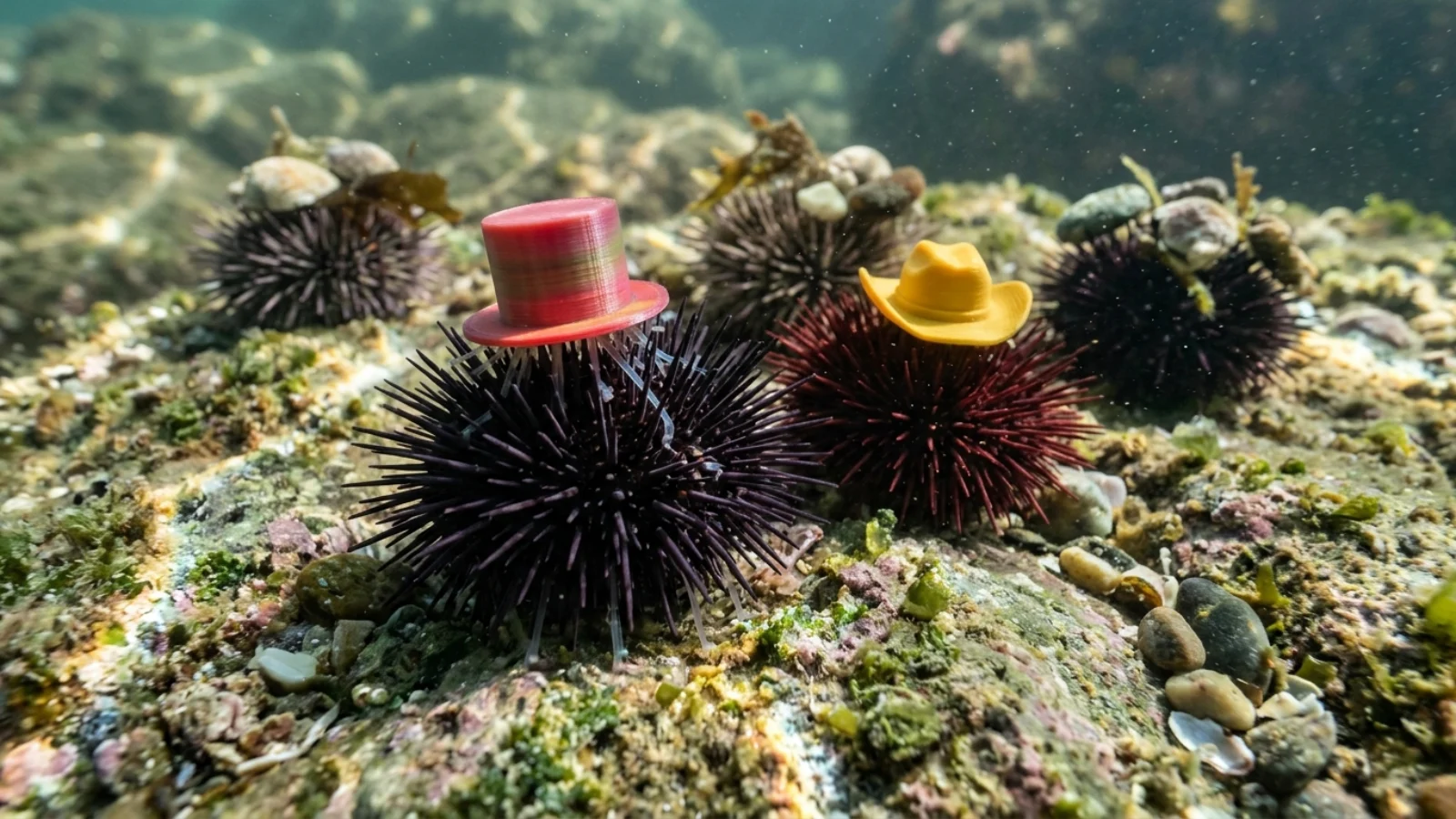
Many sea urchins cover themselves with shells, pebbles, algae and debris, holding them with their tube feet. Divers and aquarists call it “wearing hats”. In shallow tropical species the best-supported reason is shade from strong sunlight and UV: collector urchins preferred UV-blocking red plastic over clear. In the green sea urchin, a 2026 study found wave action, not light, drove covering. Camouflage is often suggested but has weak support.
Partly. Photos of aquarium urchins carrying tiny 3D-printed hats went viral in 2020. They show a real behaviour, but keepers should stick to safe, aquarium-grade materials. In the wild, urchins use whatever is to hand: shell fragments, coral rubble, algae, seagrass and occasionally litter.
Why do sea urchins put things on their heads?
Because a covering does several jobs at once, and which job matters most depends on the species and the place. Shade from strong sunlight, especially ultraviolet, has the longest record of experimental support in shallow tropical urchins. Protection against water movement has the strongest support in a big 2026 study of the green sea urchin. Hiding from predators is often proposed but has weak experimental backing.
Biologists call it covering, or sometimes masking or heaping, and it is one of the oddest habits in the sea. A sea urchin reaches up with dozens of its tube feet, grips fragments of shell, pebbles, seaweed, seagrass blades or coral rubble, and holds them on the upper surface of its shell, the aboral side. Some individuals carry a single scallop shell; others disappear under a heap of debris until they look like a walking pile of gravel. The internet calls these items hats. Scientists have been asking what they are for since at least the 1950s, and the honest answer is that the “why” is still argued over. What has changed in the last twenty years is that the question has been tested properly, with filters, wave tanks and field surveys, and the results point in different directions for different urchins.
This page is about that evidence: who first described covering, how the main hypotheses have been tested, which species do it and with what, and what happens when the material on offer is plastic. For how an urchin walks and grips with its tube feet see how do sea urchins move?; for its light-sensing skeleton see do sea urchins have eyes?
| Hypothesis | Idea | Best evidence so far |
|---|---|---|
| Sunshade (UV) | Cover shades skin and light-sensing tube feet | Strong in shallow species: Adams 2001, Kehas et al. 2004, Ziegenhorn 2016 |
| Mechanical protection | Cover steadies and shields the urchin in moving water | Strong in the green sea urchin: Dumont et al. 2007, Clermont & Gagnon 2026 |
| Hiding from predators | Debris hides the outline from visual hunters | Weak; covering did not reduce crab predation in a 2014 test |
| Food capture | Drifting seaweed is grabbed and later eaten | Described in New Zealand’s kina (Dix 1970) |
Who first studied urchin covering?
Naturalists noticed the habit long before anyone measured it. In 1915 H.N. Milligan published a list of the foreign objects carried by the purple sea urchin of European coasts, Paracentrotus lividus, in the journal The Zoologist. The first experimental work came from Norman Millott, a British zoologist who spent decades on the light sensitivity of urchins. His 1956 paper “The covering reaction of sea urchins” in the Journal of Experimental Biology treated the habit as a response that could be triggered and measured, and his later reviews of echinoid photosensitivity tied it to the urchin’s ability to detect light without eyes.
Other early studies looked at very different explanations. In New Zealand, T.G. Dix described the covering response of the kina, Evechinus chloroticus, in Pacific Science in 1970, and concluded that in that species covering is mainly a way of catching food: pieces of drifting seaweed are grabbed by the tube feet, held, and passed down towards the mouth. In Japan, Y. Yanagisawa wrote in 1972 about the “heaping behaviour” of Hemicentrotus pulcherrimus. In the Caribbean, L.B. Lewis’s 1958 study of the West Indian sea egg in Barbados was later cited as early support for a link with sunlight. By the end of the twentieth century the idea of covering as a sunshade had become the textbook answer, but it rested on observation more than on tests.
What does the evidence say about sunlight and UV?
The first clean test of the ultraviolet idea came in 2001. N.L. Adams, working at the Darling Marine Center in Maine, collected green sea urchins, Strongylocentrotus droebachiensis, by diving at 10 to 15 metres off Crow Island and gave them inert plastic beads one centimetre across. Using beads mattered: unlike seaweed, they carry no taste or smell that might make an urchin pick them up as food. In outdoor tanks under four filters (darkness, visible light only, visible plus UVA, and full sunlight with UVA and UVB) the urchins covered most under full sun and least in darkness or visible light alone. Visible light by itself made no difference compared with darkness. Statistically, covering tracked UVA and UVB but not visible light, and because the water held far less UVB than UVA, each UVB photon appeared to be a much stronger trigger. The paper, published in Marine Ecology Progress Series, concluded that the urchins were responding mainly to UVB, probably to avoid damage.
Three years later, a team working at Discovery Bay, Jamaica, added an elegant twist. A.J. Kehas, K.A. Theoharides and J.J. Gilbert studied the West Indian sea egg, Tripneustes ventricosus, in turtle-grass beds. When they shaded wild urchins to 66 percent or 32 percent of normal sunlight, the animals covered noticeably less. Urchins at a 3.5 metre site, where measured light at the bottom was about two-thirds of that at a 1 metre site, also covered less than their shallow neighbours. The twist was albinism. About 4 percent of the shallow population were albino, lacking the dark pigment of normal urchins, and the albinos covered more than normal urchins in both full and 66 percent sunlight. If the covering is a sunshade, an animal without its own pigment should need more of it, and that is exactly what the team found. Their paper appeared in Marine Biology in 2004.
The study most often quoted online came from a field course. In October and November 2015, M.A. Ziegenhorn, a student on the University of California, Berkeley course at the Gump Station on Moorea in French Polynesia, examined collector urchins, Tripneustes gratilla, at two sites. In the field, urchins only partly under rocks carried more cover, and more algae, than urchins hidden completely beneath them, as if the debris replaced the shade of the rock. In 30-minute laboratory trials with ten urchins, the animals were offered red plastic, which blocks UV, and clear plastic, which does not. Under bright light they strongly preferred the red. Half of each urchin’s spines were then removed, and the animals still covered just as well and still chose the opaque material, showing that the tube feet, not the spines, do the work. Published in PLoS ONE in 2016 under the title “Best Dressed Test”, it is a small study, but it is one of the few to test what urchins choose rather than how much they carry.
Laboratory work in China has since gone looking for the machinery behind the response. C. Zhao and colleagues at Dalian Ocean University showed in 2014 that darkness significantly reduced covering in Strongylocentrotus intermedius and that expression of PAX6, a gene involved in light reception in many animals, fell in urchins that had covered themselves. In 2019 the same group compared the active genes of urchins that covered, urchins that sheltered and urchins left unprotected under UVB, and singled out an opsin and the sensory channel TRPA1 as likely players. None of this proves why urchins cover, but it confirms that light is detected and that the response is wired into the animal’s sensory system.
Does covering protect urchins from waves?
For one of the most studied urchins on Earth, apparently yes, and more than it protects them from light. The green sea urchin ranges around the northern hemisphere and forms dense grazing fronts that strip kelp forests down to bare rock, the urchin barrens of Atlantic Canada, Norway and Maine. In 2007 C.P. Dumont and colleagues reported in Animal Behaviour that several factors together explained its covering, and that wave surge and the whipping of kelp fronds mattered more than ultraviolet light. They also found no significant link between covering and the presence of predators.
The most thorough test to date was published in 2026 in Frontiers in Zoology by C.R. Clermont and Patrick Gagnon of Memorial University of Newfoundland. They paired a wave-tank experiment with a three-month dive survey of an urchin barren at Flatrock Cove in southeastern Newfoundland. In the tank, urchins of two sizes were exposed to every combination of three light conditions (dark, white light, and white light with UVA and UVB) and three water speeds, with broken mussel shell and fragments of rhodolith, a free-living coralline alga, spread evenly as cover. Light made no measurable difference to how many urchins covered or how much. Water speed did. With no waves, 58 percent of urchins covered; at 0.1 metres per second, 65 percent; at 0.2 metres per second, 89 percent. The covered area rose too, from about 7 percent of the upper surface in still water to 11 percent at the higher speed, which suggests a tipping point around 0.1 metres per second.
The field survey told the same story at sea. Across 12,467 urchins counted, covering was most common in the shallowest water, where waves are strongest: 52 percent of urchins at 3 metres, against about 34 to 35 percent at 5 and 9 metres. It peaked in July and August and fell sharply in September. Rhodolith fragments were the favourite material through most of the summer, but urchins also used mussel shell, kelp and assorted other debris, roughly in proportion to what was lying around. The authors concluded that in this species covering mainly serves as mechanical protection against moving water, and they largely ruled out light as a trigger. Their discussion is careful to note that covering in other urchins may have other causes, which is why the sunshade studies on tropical species are not contradicted, simply joined by a competing explanation.
Does a hat cost the urchin anything?
It does, and the Newfoundland study measured it for the first time. Urchins in the wave tank that carried more cover moved less: on average about 9 centimetres less over a 40-minute trial for every extra 10 percent of the upper surface covered. For a grazer whose survival depends on reaching food, that is a real trade-off, and it fits older observations that collector urchins drop their covering at night, when they become more active and go out to feed. A hat is worth wearing when the conditions that make it useful outweigh the burden of carrying it.
Size matters too. Small green sea urchins, one to two centimetres across, covered more often (78 percent against 63 percent of large urchins in the tank) and covered about three times as much of their surface. In the field, the smallest size class covered all summer long, while larger urchins covered mainly in midsummer. Similar trends are known in the European purple sea urchin. Young urchins are more vulnerable to almost everything, from being rolled by waves to being eaten, and they behave more cryptically, sheltering in crevices and under stones; covering seems to be part of the same cautious lifestyle that they gradually abandon as they grow.
Do sea urchin hats hide them from predators?
This is the explanation most people assume, and it is the one with the thinnest experimental support. A covered urchin certainly looks less like an urchin to a human diver, and many urchins are eaten by fish, crabs, lobsters, sea stars and sea otters that hunt partly by sight. Rich Mooi, curator of invertebrate zoology at the California Academy of Sciences, told Snopes in 2022 that he thought camouflage was the best explanation, pointing out that urchins avoid light and that some deep-water urchins also cover, where ultraviolet is not a factor.
Direct tests have been less encouraging. In 2014 a Dalian Ocean University team exposed juvenile Strongylocentrotus intermedius to a predatory swimming crab, Charybdis japonica, for 12 hours. The crabs killed about a third of the young urchins, and covering did not significantly reduce that toll; the authors concluded that the anti-predator value of covering is limited. Dumont’s 2007 work on green sea urchins likewise found no link between covering and the presence of predators. An earlier Japanese study by Y. Agatsuma on juvenile urchins and a spider crab is often cited in support of the camouflage idea, so the question is not closed, but camouflage looks like a side benefit rather than the main purpose for the species tested so far.
Which sea urchins wear hats, and what do they choose?
Covering is common in the regular, round-bodied urchins of shallow water. Well-documented coverers include the collector urchin of the Indo-Pacific and Hawaii, the West Indian sea egg and the variegated urchin of the Caribbean and Florida, the green sea urchin of northern seas, the European purple sea urchin, the Pacific Strongylocentrotus intermedius of Japan and China, and the small tuxedo urchin of aquarium fame. Flower urchins in the genus Toxopneustes cover as well; Toxopneustes roseus was the subject of a 2000 study of its diet, movement and covering in rhodolith beds of the Gulf of California. Ziegenhorn’s mapping of the habit onto an urchin family tree suggested that covering arose once, deep in the group, and was later lost in a few lineages, including the shingle or helmet urchin of surf-swept rocks and its relatives, which clamp flat against the surface instead.
Urchins with long, slender spines, such as Diadema, generally rely on crevices and their spines rather than on carrying debris. Covering is not limited to the shallows, though. In 2013 D.L. and D.J. Pawson described bathyal urchins from the Bahamas and added notes on covering behaviour in deep-sea echinoids, far below the reach of sunlight, which is one reason no single explanation fits every species.
What urchins carry depends on what is available and on their own preferences. At Discovery Bay, Jamaica, a team led by K.R. Amato compared two urchins sharing the same grass beds. The variegated urchin, Lytechinus variegatus, covered more of its body than the West Indian sea egg in all three habitats studied. In the rubble-dominated habitat, where grass covered less than 30 percent of the bottom, the sea egg still built 78 percent of its covering from grass, while the variegated urchin built 92 percent of its covering from rubble. Offered equal amounts of grass and rubble in the laboratory, each species kept to its preference. The study, in the Bulletin of Marine Science in 2008, showed that covering is selective, not simply a matter of picking up whatever the tube feet touch first.
Do sea urchins wear litter?
Increasingly, yes. In 2020 Francisco Barros and colleagues in Brazil examined twenty variegated urchins and the material lying on the seabed around each one. The urchins carried proportionally more litter than natural objects, and the weight of litter they carried was larger than chance would predict. Across the site, the litter was heavier, wider and less opaque than the shells and stones, and the pieces of litter chosen by urchins were wider and more translucent than the natural cover they carried. The authors, writing in Marine Pollution Bulletin under the title “Choosing trash instead of nature”, suggested that plastic may change how well urchins are shaded, hidden or weighed down, and that covering urchins could serve as living indicators of marine debris. The finding is a reminder that an urchin wearing a bottle cap is not making a fashion statement; it is responding to a seabed that has changed. Our page on plastic islands in the oceans covers where that debris comes from.
Where did the internet’s urchin hats come from?
The craze began with a reef aquarist. Wilson Souza, an American hobbyist, posted photographs on the Reef2Reef forum of his urchins carrying objects and, after his wife Sylvia suggested making them something to shade them from the bright lights used for corals, began 3D-printing tiny hats: cowboy hats, Viking helmets, top hats and witches’ hats. He noticed that his urchins dropped much of what they carried at night. The pictures spread widely on social media in 2020 and were picked up by outlets including Newsweek and Bored Panda, and fact-checkers at Snopes later confirmed that the behaviour was real. Interviewed about the trend, Emma Verling, a researcher who has studied covering in the European purple urchin, stressed that the habit has more than one cause and that UV protection is only part of the story.
The science underneath the joke holds up. Urchins really do pick up light objects with their tube feet and hold them for hours, and a light plastic hat is easy for them to carry. What the photographs cannot show is whether the urchin is better off. Any item placed in an aquarium should be chemically inert and free of sharp edges or loose fibres, and natural materials such as clean shell fragments, rubble or a piece of macroalgae offer the same opportunity without the risk of leaching additives.
How do you keep a covering urchin in a reef tank?
Give it things to carry and protect the things it should not. Collector urchins and tuxedo urchins are the species most often kept by aquarists, and both will pick up loose shells, gravel, frag plugs and small corals. Glue coral fragments firmly to rock, leave a few clean shell pieces or a little loose rubble in the open, and expect to find them rearranged every morning. Many keepers read steady covering as a sign of a healthy, active urchin; an urchin that drops everything, stops moving or loses spines is worth checking. Tuxedo urchins are the gentler choice for most tanks, as explained on our tuxedo urchin profile, while collector urchins grow much larger and can bulldoze loose items. Stable salinity, temperature and alkalinity matter more to an urchin’s welfare than anything it wears.
What is the bottom line on urchin hats?
Covering is a real, widespread and still partly mysterious behaviour. In shallow tropical urchins, the best experiments point to protection from strong sunlight: covering rises with ultraviolet, falls in shade, is strongest in pigment-free albinos and favours UV-blocking material. In the cold, wave-washed barrens of Newfoundland, a larger and better-replicated study points to protection against moving water, with light making no measurable difference. Predator avoidance has surprisingly little direct support, and in some species covering is a way of trapping food. The common thread is the tube foot, the same organ that lets an urchin walk, grip, sense light and feed, used here to build a portable shelter from whatever the seabed offers. To explore the animals themselves, start at the sea urchins hub or the guide to types of sea urchins; for how they eat the kelp that some species carry, see sea urchins eating kelp, and for the animals that hunt them, what eats sea urchins?
Why do sea urchins wear hats?
For shade, steadiness and shelter. Shallow tropical urchins cover more in strong sunlight and UV; green sea urchins in Newfoundland covered more in faster-moving water.
What is the scientific name for the behaviour?
Covering, also called masking or heaping. The urchin holds debris on its upper (aboral) surface with its tube feet.
Which sea urchins cover themselves?
Collector urchins, West Indian sea eggs, variegated urchins, green and purple sea urchins, tuxedo urchins, flower urchins and some deep-sea species, among others.
Do urchins choose what to wear?
Yes. Collector urchins preferred UV-blocking red plastic over clear, and two Jamaican species picked different materials from the same seabed.
Does covering protect urchins from predators?
Only weakly, as far as tests show. Covering did not significantly reduce crab predation on juvenile urchins in a 2014 experiment.
Do urchins need their spines to hold a hat?
No. The tube feet do the gripping; collector urchins with half their spines removed still covered themselves.
Is it safe to give an aquarium urchin a 3D-printed hat?
Natural shell fragments or rubble are the safer choice. Any artificial item should be inert, smooth and free of loose fibres.
Why do urchins drop their hats at night?
Carrying cover slows them down, and at night they become active and go out to feed, when shade is no longer needed.
- Clermont, C.R. & Gagnon, P. (2026). Drivers and functional consequences of covering in a pervasive marine grazer (green sea urchin, Strongylocentrotus droebachiensis). Frontiers in Zoology (PMC13386655).
- Ziegenhorn, M.A. (2016). Best dressed test: a study of the covering behavior of the collector urchin Tripneustes gratilla. PLoS ONE 11(4): e0153581.
- Adams, N.L. (2001). UV radiation evokes negative phototaxis and covering behavior in the sea urchin Strongylocentrotus droebachiensis. Marine Ecology Progress Series 213: 87–95.
- Kehas, A.J., Theoharides, K.A. & Gilbert, J.J. (2004). Effect of sunlight intensity and albinism on the covering response of the Caribbean sea urchin Tripneustes ventricosus. Marine Biology 146: 1111–1117.
- Amato, K.R. et al. (2008). Covering behavior of two co-occurring Jamaican sea urchins: differences in the amount of covering and selection of covering material. Bulletin of Marine Science 82(2): 255–261.
- Dumont, C.P. et al. (2007). Multiple factors explain the covering behaviour in the green sea urchin. Animal Behaviour 73: 979–986.
- Zhao, C. et al. (2014). Effects of covering behavior and exposure to a predatory crab Charybdis japonica on survival and HSP70 expression of juvenile sea urchins. PLoS ONE 9(5): e97840.
- Barros, F. et al. (2020). Choosing trash instead of nature: sea urchin covering behavior. Marine Pollution Bulletin 155: 111188.
- Millott, N. (1956). The covering reaction of sea urchins. Journal of Experimental Biology 33: 508–523; Dix, T.G. (1970). Covering response of the echinoid Evechinus chloroticus. Pacific Science 24: 187–194.
- Snopes (2022), “Why do sea urchins wear ‘hats’?”; Interesting Engineering (2020), on Wilson Souza’s 3D-printed urchin hats.
Blane Perun has been exploring Earth’s oceans and marine life for over 25 years. Founder of TheSea.Org in 1999, underwater photographer, coral aquaculture pioneer, and explorer of 80+ countries.
About Blane Perun →