Reef Rays — Stingrays, Eagle Rays and Mantas: the Flattened Cousins of Sharks That Fly Over the Reef
Cartilaginous fish closely related to sharks, with gill slits on the underside and pectoral fins fused to the head to form a disc or “wings”. There are roughly 630–650 species of rays and skates. Reef species belong mainly to the whiptail stingrays (Dasyatidae), eagle rays (Aetobatidae/Myliobatidae), devil and manta rays (Mobulidae), electric rays (Torpediniformes) and guitarfish and wedgefish (Rhinopristiformes).
What kinds of rays live on coral reefs?
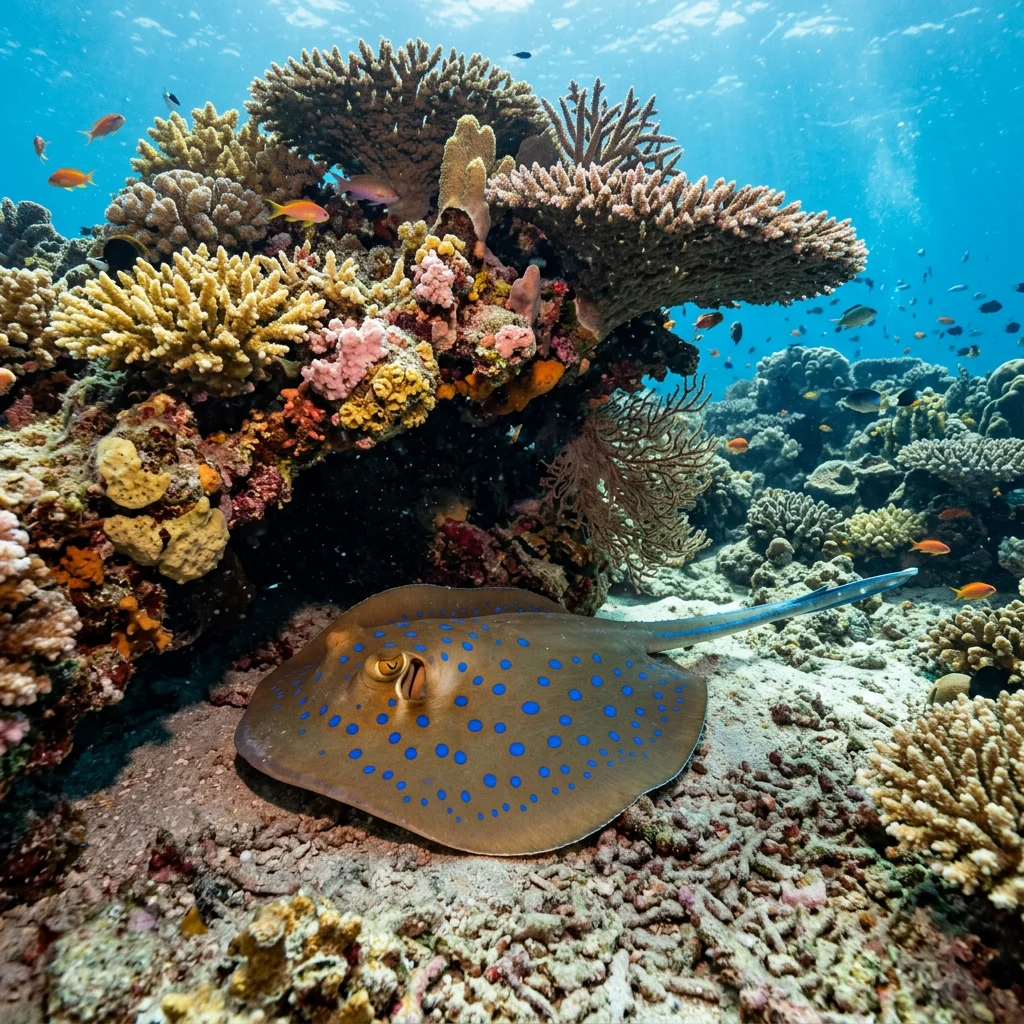
Five groups cover nearly all of them.
| Group | Lifestyle | Reef examples | Size |
|---|---|---|---|
| Stingrays (Dasyatidae) | Rest on sand, dig for prey | Blue-spotted ribbontail ray, southern stingray, cowtail stingray | 30 cm–2 m wide |
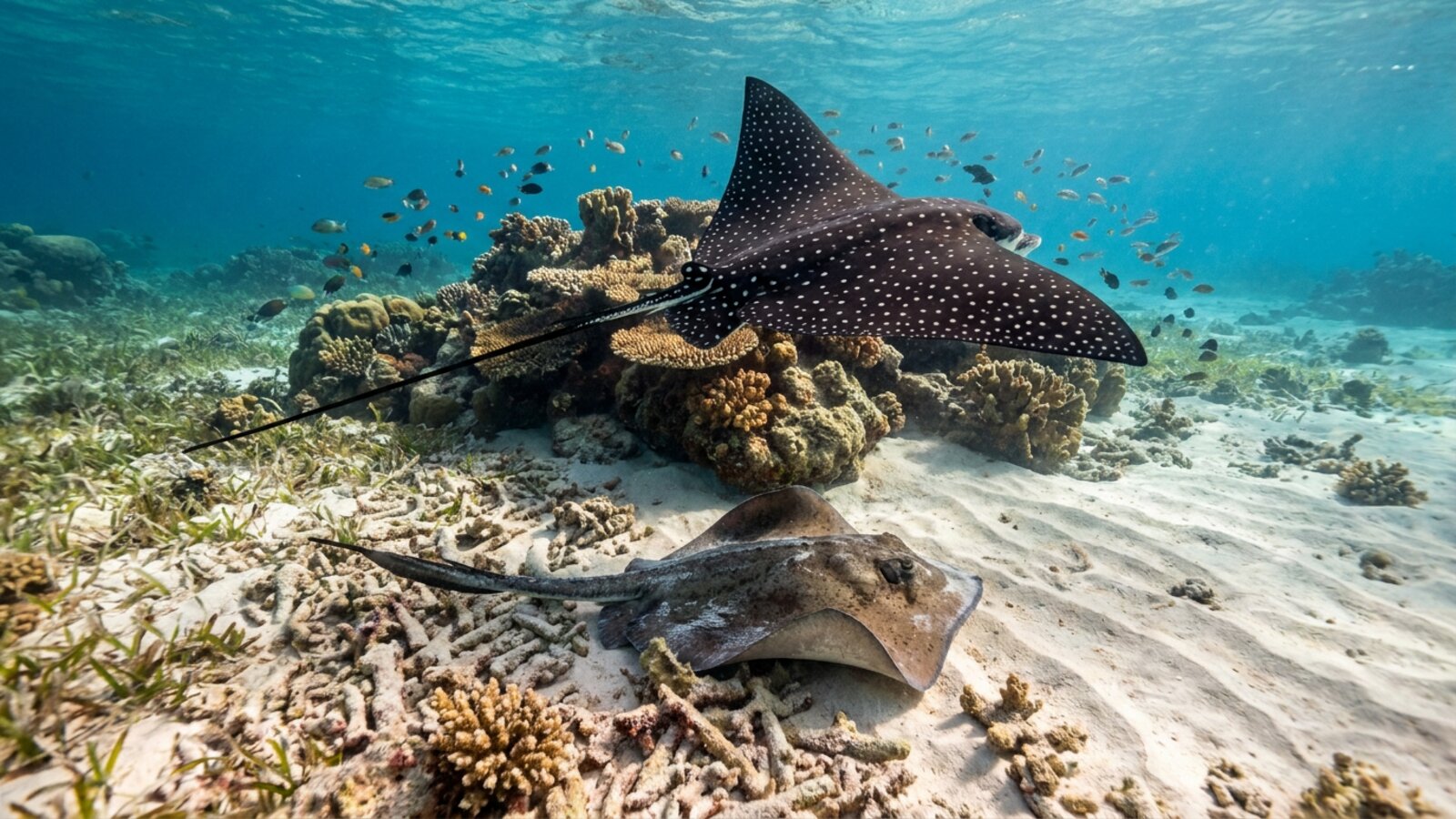
| Eagle rays | Swim in open water over the reef, dig for shellfish | Spotted eagle ray | to ~3 m wide |
| Manta and devil rays | Filter-feed on plankton | Reef manta (Mobula alfredi), oceanic manta | 1–7 m wide |
| Electric rays | Stun prey with electric organs | Marbled and leopard torpedo rays | 20 cm–1.8 m |
| Guitarfish & wedgefish | Shark-like body, flattened head | Bottlenose wedgefish, giant guitarfish | to ~3 m long |
Rays are elasmobranchs, like sharks; see our coral reef sharks for their cousins.
What makes a ray a ray?
Rays and skates make up the Batoidea, the largest group of cartilaginous fishes, with well over 600 species in 26 families; the 2016 reference book Rays of the World recognised about 633. Like sharks they have skeletons of tough, flexible cartilage rather than bone, skin covered in tiny tooth-like placoid scales, and electrosensory pores called ampullae of Lorenzini. What sets them apart is the body plan. In a ray the pectoral fins are fused to the sides of the head, forming a flat disc or a pair of wings, and the gill slits, usually five pairs but six in the sixgill stingray, open on the underside rather than along the sides as in sharks. The eyes sit on top of the head and the mouth underneath, an arrangement suited to life on the seabed.
Most batoids are bottom dwellers in coastal waters, though some live as deep as 3,000 metres, and most prefer tropical and subtropical seas. Their teeth reflect their diets. The majority have heavy, rounded teeth arranged in pavements for crushing snails, clams, oysters, crabs and other armoured prey, while the plankton-feeding mantas and devil rays have tiny teeth that play no part in feeding. Because they rest on the bottom, bottom-living rays breathe through spiracles behind the eyes, as described below, which keeps sand out of their gills.
What is the difference between a ray and a skate?
Skates are batoids too, and in many places the two words are used loosely. Strictly, skates belong to the order Rajiformes, with the family Rajidae alone containing about 150 or more species, and they are the most species-rich group of cartilaginous fishes, making up more than a fifth of all known species. The easiest difference is reproduction. Skates lay eggs in tough, rectangular cases with a horn at each corner, the “mermaid’s purses” often found washed up on beaches, while most stingrays and their relatives give birth to live young. Skates also have a stiff snout and, unlike stingrays, lack a venomous tail spine, relying instead on rows of thorns along the back and tail.
Reef rays you are likely to meet
The bluespotted ribbontail ray (Taeniura lymma) is one of the most familiar rays on Indo-Pacific and Red Sea reefs. It is small, with a disc no more than about 35 cm across, and is easily recognised by the bright neon-blue spots on its yellowish-brown or green back and the two blue stripes along its tail. It lives from the intertidal zone to about 30 metres and spends the day tucked under coral ledges. At night, small groups follow the rising tide onto sandy flats to dig for worms, crabs, shrimps and small fish, then retreat to the reef as the tide falls. Females give birth to litters of up to seven pups, and known predators include hammerhead sharks and bottlenose dolphins. The species is listed as Least Concern.
The southern stingray (Hypanus americanus) ranges through the western Atlantic from New Jersey to southern Brazil, including the Caribbean. It has a flat, diamond-shaped disc that is olive-brown to grey above and white below, and it feeds on a wide variety of buried prey including small fish, worms, crustaceans and bivalves. It is the ray of Stingray City in Grand Cayman, a string of shallow sandbars in the North Sound. The gathering probably began decades ago when fishermen cleaned their catch in the calm water behind the reef; rays learned to associate boat engines with food, and hand-feeding by divers grew into one of the Caribbean’s most famous wildlife attractions. The species is listed as Near Threatened.
The spotted eagle ray is the classic open-water ray of tropical reefs, with a dark back covered in white spots or rings, a pointed, duck-like snout and a long tail bearing several venomous barbs near its base. It feeds on shellfish, crustaceans and small fish, sometimes digging into sand with its snout. What was once considered a single worldwide species has been split on genetic and anatomical evidence: Aetobatus narinari is now restricted to the Atlantic, Caribbean and Gulf of Mexico, while the Indo-Pacific population is A. ocellatus and the eastern Pacific one A. laticeps. Females give birth to up to four pups after a pregnancy of about a year, and the newborns already measure 17 to 35 cm across.
The bottlenose wedgefish (Rhynchobatus australiae) shows how varied rays can be. It looks more like a shark than a ray, with a long, thick body, a wedge-shaped snout and tall fins, and reaches about 3 metres. Young animals are greyish or brownish with sparse white spots and a black spot above each pectoral fin. It lives from shallow water to at least 60 metres across the Indo-Pacific, from East Africa and the Red Sea to Taiwan, the Philippines and Australia, and it is listed as Critically Endangered because its large fins are among the most valuable in the shark-fin trade.
The reef manta (Mobula alfredi) is the largest ray most reef divers will see, typically 3 to 3.5 metres across and up to about 5.5 metres. Unlike the wide-ranging oceanic manta it is coastal and fairly resident, returning repeatedly to the same reefs to be cleaned by wrasses and butterflyfish and to feed on plankton. Feeding mantas unroll their cephalic fins to funnel water into their wide mouths, and in places with rich plankton, such as Hanifaru Bay in the Maldives, dozens to more than a hundred can gather, sometimes forming spiralling “cyclones” of feeding rays. Each manta’s belly carries a unique pattern of dark spots, which researchers use to identify individuals from photographs. The species is listed as Vulnerable.
How do stingrays sting?
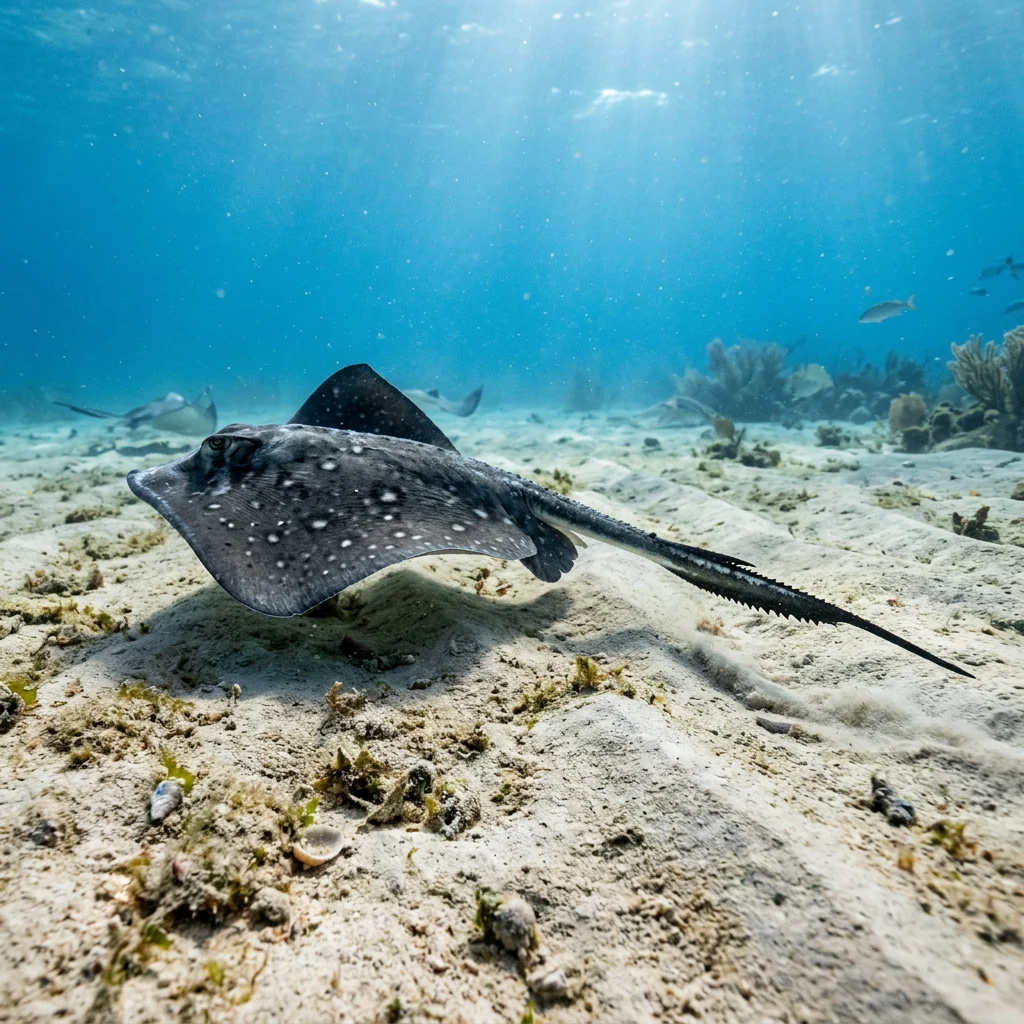
With a defensive spine, not an attack.
Stingrays and eagle rays carry one or more serrated spines (barbs) on the tail, wrapped in a sheath of venom-producing tissue. When stepped on or pinned, a ray whips its tail up, driving the spine into the threat. The venom causes intense pain and the serrations tear tissue. Nearly all injuries are to the feet of waders. Fatalities are extremely rare; the most famous, Steve Irwin in 2006, involved a short-tail stingray spine to the chest.
Mantas and devil rays have no functional sting. More in can manta rays hurt you.
Encounters with reef rays are overwhelmingly safe when a few rules are followed. Stingrays are not aggressive and will move off if given the chance, so the best protection when wading over sand is to shuffle the feet rather than step down blindly. Divers should avoid hovering directly over a ray resting on the bottom, never touch or grab one, and keep their hands away from the tail. At feeding sites such as Stingray City, where rays are used to people, the animals can be gently handled under the guidance of operators, but feeding changes their natural behaviour and the practice is best left to regulated tours.
What do reef rays eat?
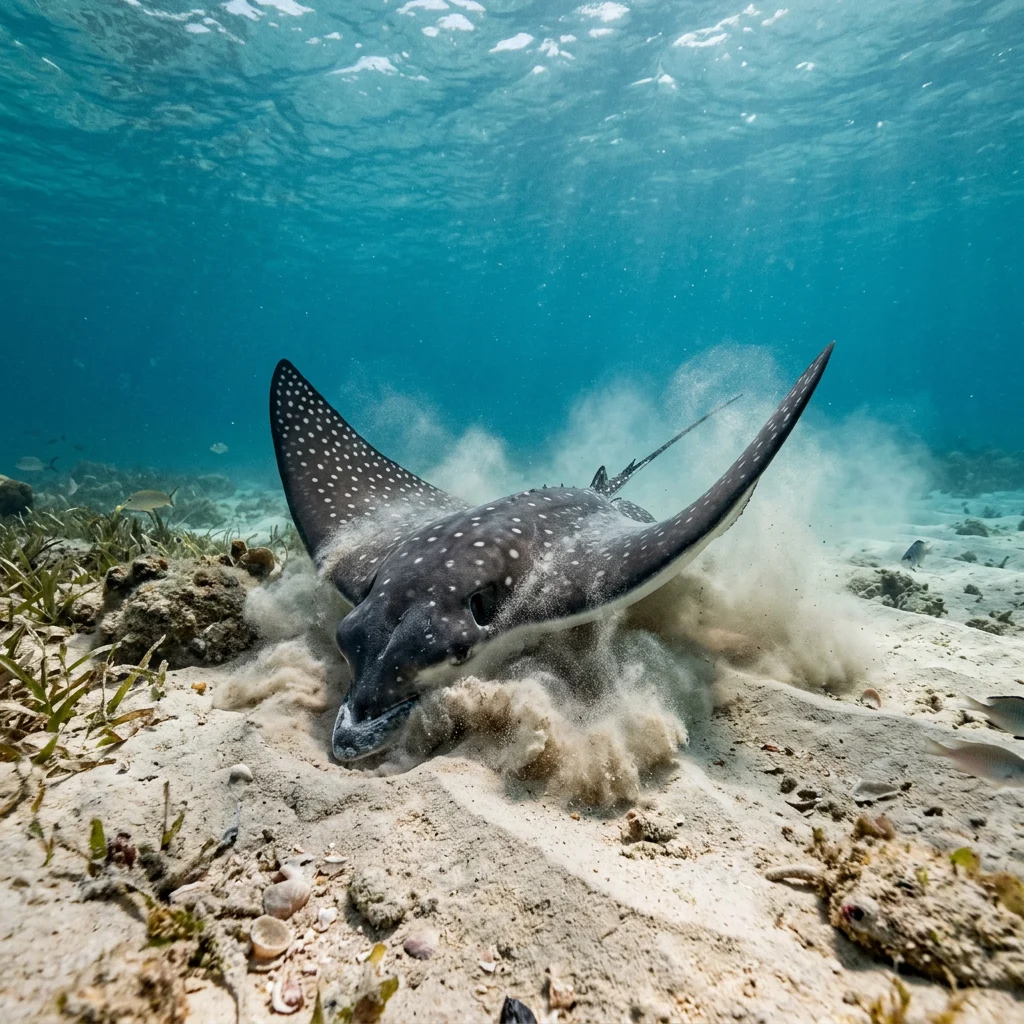
Buried shellfish, fish and plankton.
Stingrays and eagle rays hunt with electroreceptors (ampullae of Lorenzini) that detect the tiny electric fields of buried prey. Stingrays blow jets of water to excavate clams, worms, crabs and shrimp, leaving feeding pits in the sand; eagle rays crush hard-shelled molluscs with plate-like teeth. Mantas and devil rays filter zooplankton with gill rakers, often somersaulting or forming feeding chains. Electric rays stun fish with discharges of up to about 200 volts in the largest species.
How do electric rays work?
Electric rays, the order Torpediniformes, are the least obvious rays on a reef because they spend much of the day buried in sand. About 69 species are recognised in four families. Their bodies are thick and flabby, with soft, loose skin lacking the denticles and thorns of other rays, and unlike most rays they swim with a stout, muscular tail rather than their pectoral fins. On either side of the head sits a large, kidney-shaped electric organ made of stacks of modified muscle cells, wired so that current flows from the lower to the upper surface of the body. Depending on the species, the discharge ranges from about 8 to 220 volts. The torpedo rays use it to stun relatively large prey, which they then swallow whole, while the numbfishes specialise in small animals on or in the seabed. Both groups use their shocks in defence, which is why divers should never touch a ray buried in sand.
People have known about these shocks for thousands of years. The ancient Greeks used electric rays to numb pain during childbirth and surgery, and the Roman physician Scribonius Largus recorded their use against headaches. In Plato’s dialogue Meno, Socrates is compared to a torpedo fish for the way his questions leave people stunned. In the 1770s, papers on the torpedo’s electric organs by John Walsh and John Hunter for the Royal Society influenced the work of Luigi Galvani and Alessandro Volta, so these sluggish reef fish played a small part in the birth of the science of electricity.
How do rays reproduce?
Slowly, which makes them vulnerable.
Reef rays are mostly aplacental viviparous: embryos develop inside the mother, nourished first by yolk and then by a protein-rich “uterine milk”. Litters are small: stingrays may have a handful of pups, and a female manta usually gives birth to a single pup after a pregnancy of 12–13 months, with gaps of a year or more between pregnancies. Slow reproduction means populations recover poorly from fishing.
Are reef rays endangered?
Many are, and wedgefish are among the most threatened fish on Earth.
An IUCN global assessment published in 2021 found that more than one-third of all sharks and rays are threatened with extinction, mainly from overfishing. Reef mantas and oceanic mantas are listed as Vulnerable and Endangered respectively, driven by demand for gill plates, and both are on CITES Appendix II. Wedgefish and giant guitarfish, prized for their fins, are mostly Critically Endangered. Rays are worth far more alive: manta tourism is estimated to generate well over US$100 million a year worldwide.
Rays are particularly exposed to fishing for several reasons. Most live in shallow coastal waters where fishing is intense, many are caught incidentally in trawls and gillnets set for other species, and their slow reproduction means losses are replaced only slowly. Stress during capture can make matters worse: capture-induced premature birth or abortion has been recorded in at least 12% of live-bearing sharks and rays, so a pregnant female that is caught and released may still lose her young. The 2021 assessment led by Nicholas Dulvy found that overfishing was the main threat to every threatened species, and that rays, especially the wedgefishes, giant guitarfishes and sawfishes known as rhino rays, were among the most threatened groups of all.
Where can you dive with rays?
Some of the best encounters in diving.
- Mantas: Kona, Hawaii (night manta snorkel), the Maldives (Hanifaru Bay), Raja Ampat, Komodo, Yap, Mozambique. See manta night snorkel Hawaii.
- Southern stingrays: Stingray City, Grand Cayman, where hundreds gather on sandbars.
- Spotted eagle rays: Bahamas, Cozumel, Galapagos and the Maldives, often in squadrons.
- Blue-spotted ribbontail rays: under coral overhangs throughout the Red Sea and Indo-Pacific.
How do rays breathe and swim?
Through holes behind the eyes, and on wings.
A ray lying on sand would clog its gills if it breathed through its mouth, which is on the underside. Instead, bottom-dwelling rays draw water in through spiracles, two openings just behind the eyes, and pump it out through gill slits on the belly. Watch a resting stingray and you will see the spiracles open and close. Open-water rays such as mantas and eagle rays breathe by swimming with the mouth open (ram ventilation), so they must keep moving.
Stingrays swim by sending waves along the edges of their disc (undulation), which gives precise control just above the bottom. Eagle rays and mantas flap their pectoral fins like wings (oscillation), a more efficient stroke for cruising long distances. Mantas regularly leap clear of the water, possibly to communicate, court or shed parasites, and both mantas and eagle rays visit cleaning stations where wrasses and butterflyfish pick off parasites. For anatomy details see anatomy of a manta ray. Mantas also have among the largest brain-to-body ratios of any fish.
What rays live on coral reefs?
Stingrays, eagle rays, manta and devil rays, electric rays, guitarfish and wedgefish.
Are rays sharks?
No, but they are close relatives. Both are cartilaginous elasmobranchs.
Do all rays sting?
No. Stingrays and eagle rays have venomous tail spines; mantas and electric rays do not sting.
What is the biggest ray?
The oceanic manta ray, with a wingspan up to about 7 m.
What do stingrays eat?
Buried clams, worms, crabs, shrimp and small fish.
How do rays give birth?
Most reef rays give birth to live young after developing inside the mother.
Are manta rays endangered?
Reef mantas are Vulnerable and oceanic mantas Endangered on the IUCN Red List.
What should I do if stung by a stingray?
Soak the wound in hot water to relieve pain and seek medical care.
- Dulvy, N. K. et al. (2021). Overfishing drives over one-third of all sharks and rays toward a global extinction crisis. Current Biology 31: 4773–4787.
- Last, P. R. et al. (2016). Rays of the World. CSIRO Publishing.
- O’Malley, M. P., Lee-Brooks, K. & Medd, H. B. (2013). The global economic impact of manta ray watching tourism. PLoS ONE 8: e65051.
- IUCN Red List of Threatened Species. Species assessments. iucnredlist.org.
- Kyne, P.M. et al. (2020). The thin edge of the wedge: extremely high extinction risk in wedgefishes and giant guitarfishes. Aquatic Conservation 30: 1337–1361.
Blane Perun has been exploring Earth’s oceans and marine life for over 25 years. Founder of TheSea.Org in 1999, underwater photographer, coral aquaculture pioneer, and explorer of 80+ countries.
About Blane Perun → More on Coral Reef Fish →