Pirate Guns: Flintlocks, Blunderbusses, and Muskets
Pirates of the Golden Age used the same firearms as their contemporaries in the Royal Navy and merchant marine — primarily flintlock pistols for close combat, muskets for longer-range fire from rigging, and blunderbusses for close-range boarding actions. No specifically pirate firearm existed. What distinguished pirate use was carrying multiple pistols simultaneously — Blackbeard’s documented bandoliers of three to six pistols solved the single-shot reloading problem in close combat — and the consistent prioritisation of psychological impact over firepower accuracy.
Pirate firearms were standard military and naval hardware of the early 18th century, not specialised pirate equipment. Understanding them requires understanding the technological constraints of the period — single-shot weapons with slow reloading, significant limitations in wet conditions, and ranges and accuracy that were modest by modern standards. Within those constraints, pirates made specific tactical choices about which weapons to carry and how to use them.
The flintlock pistol: the primary pirate sidearm
The flintlock pistol was the dominant pirate sidearm of the Golden Age, and its prevalence in pirate accounts reflects both its genuine utility and its considerable limitations.
The flintlock mechanism operated by holding a piece of flint in a spring-loaded cock. When the trigger was pulled, the cock snapped forward, striking the flint against a steel frizzen. The resulting sparks fell into a small pan of priming powder, which ignited through a touch hole into the main powder charge behind the ball, propelling it down the barrel. The entire sequence took a fraction of a second when functioning correctly, which it did not always do — flints wore out, priming powder was sensitive to moisture, and misfire rates in the damp conditions of maritime environments were significant.
A flintlock pistol of the period typically fired a ball of .60 to .75 calibre (roughly the diameter of a finger) with substantial stopping power at close range but rapidly declining accuracy and energy at distances beyond 15 metres. Effective combat with a flintlock pistol required getting close, which in a boarding action was unavoidable. The single-shot limitation — reloading required approximately 30 to 60 seconds even for an experienced loader under ideal conditions — was the critical tactical constraint that Blackbeard’s multiple-pistol bandolier approach directly addressed.
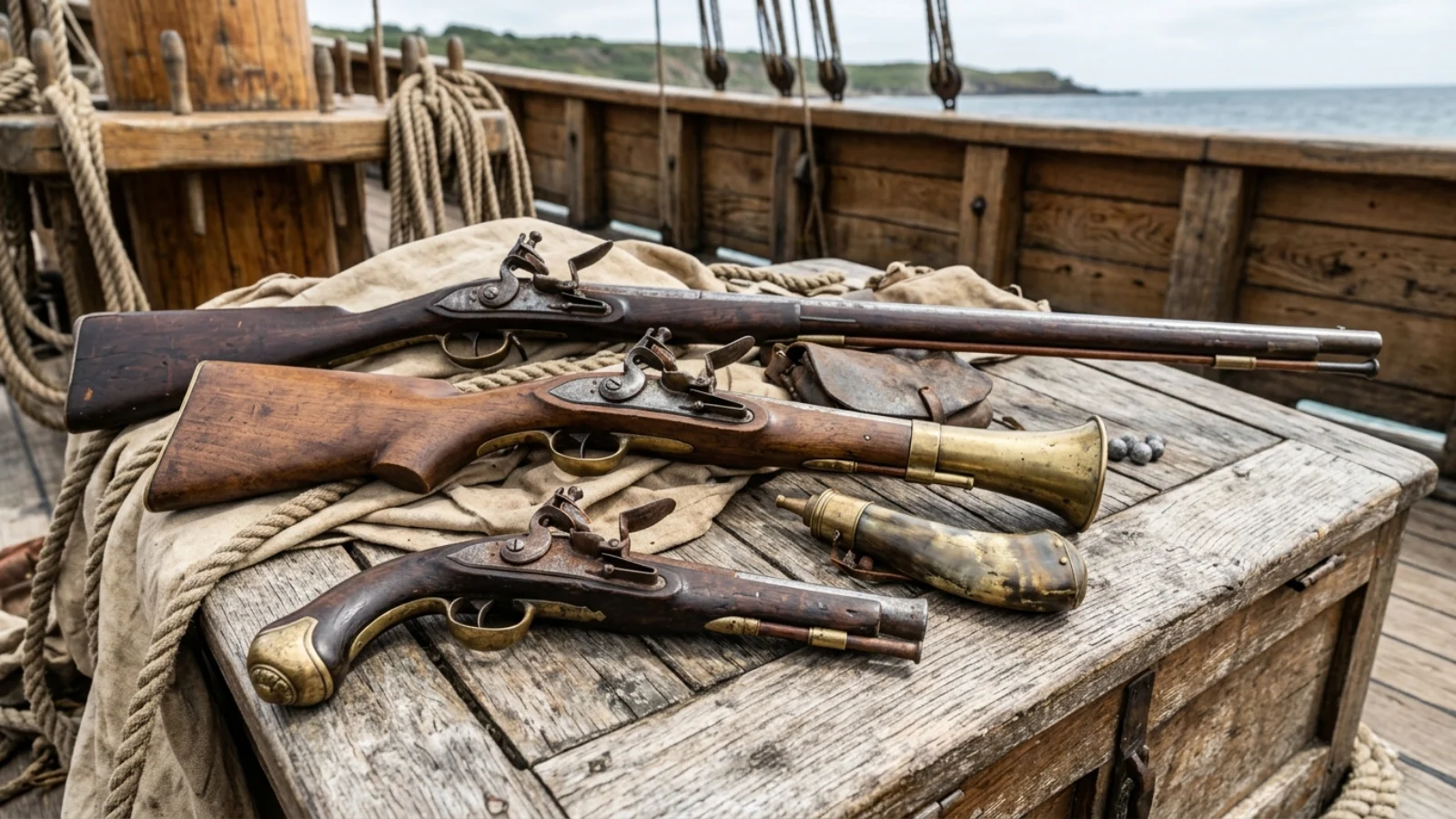
The blunderbuss: boarding weapon of choice
The blunderbuss was a short-barrelled firearm with a distinctive flared or bell-shaped muzzle, designed to be loaded with multiple small shot or improvised projectiles. It was particularly well suited to the specific conditions of pirate boarding actions.
The flared muzzle of the blunderbuss served both a functional and a psychological purpose. Functionally, it made loading faster — shot poured into the wide muzzle rather than rammed down a tight bore. Psychologically, the wide opening was visually intimidating at close range. The spread of multiple shot meant that precise aiming was less critical than with a single-ball weapon, which was important in the chaotic conditions of hand-to-hand combat on a moving deck.
The blunderbuss could be loaded with lead shot, nails, glass, small stones, or any other available material — a flexibility that made it genuinely adaptable in supply-constrained pirate operations. Its effective range was very short (10 to 15 metres maximum), which limited its use to boarding actions and close deck fighting rather than pre-engagement fire. Pirates who needed to hit targets at longer ranges used muskets, positioning experienced marksmen in the rigging to fire down onto enemy decks before the ships came alongside.
Blackbeard’s multiple-pistol solution
Blackbeard’s documented practice of wearing multiple loaded pistols in crossed bandoliers represents the most historically specific documented solution to the single-shot problem in Golden Age pirate personal armament.
Contemporary accounts describe Blackbeard entering combat with three to six flintlock pistols pre-loaded and ready in bandoliers across his chest, in addition to his cutlass and other weapons. This gave him effectively three to six shots before reloading became necessary — a significant advantage in the confined, fast-moving conditions of boarding combat where the time to reload a single pistol could be fatal.
The multiple-pistol approach was not unique to Blackbeard — other pirates and naval officers of the period carried spare pistols — but his version of it, combined with the slow-burning fuses in his beard and the deliberate theatrical presentation of his battle appearance, was distinctive enough to be specifically recorded by contemporaries. The practical and the theatrical were not separate in Blackbeard’s approach; both served the same ultimate goal of preventing combat by making its outcome appear predetermined.
Firearms in the pre-engagement phase
Before boarding, pirate firearms served a specific pre-engagement function: demonstrating combat capacity sufficient to make the target vessel’s captain calculate that resistance was unwise.
Muskets fired from the rigging could hit crew members on an opposing vessel’s deck at ranges of 50 to 75 metres, reducing the target’s fighting capacity before the ships came alongside. Swivel guns — small breech-loading cannon — provided a bridge between personal firearms and the main battery, capable of firing small shot at ranges intermediate between pistols and cannon.
But the most important function of pirate firearms in the pre-engagement phase was not their actual firepower but their visible threat. A pirate crew with visible firearms, a menacing flag, and a reputation for using both effectively was often more persuasive than the same crew actually firing. The goal remained prize acquisition without combat, and firearms that were seen but not used were in some ways more valuable than firearms that were fired — they preserved ammunition, preserved the prize, and preserved the crew.
What firearms did pirates use?
The same firearms as their contemporaries: flintlock pistols as primary sidearms, blunderbusses for close-range boarding, and flintlock muskets for longer-range fire from the rigging. No specifically pirate firearm existed. What distinguished pirate use was carrying multiple pistols simultaneously and the consistent prioritisation of psychological impact alongside firepower.
How did the flintlock mechanism work?
A spring-loaded cock held a flint. When triggered, the cock snapped forward, striking the flint against a steel frizzen. Sparks fell into priming powder in a pan, which ignited through a touch hole into the main charge, propelling the ball. The mechanism was reliable under dry conditions but sensitive to moisture — a significant problem in maritime environments.
Why did Blackbeard carry multiple pistols?
To solve the single-shot reloading problem. A flintlock pistol required 30–60 seconds to reload — impossible in the fast-moving conditions of boarding combat. Pre-loading three to six pistols and wearing them in bandoliers gave Blackbeard multiple shots before reloading became necessary, a significant tactical advantage in close combat.
What was a blunderbuss and why did pirates use it?
A short-barrelled firearm with a flared muzzle, designed to fire multiple shot or improvised projectiles. Its wide muzzle made loading faster and its spread of shot reduced the need for precise aiming — both advantages in chaotic close-quarters boarding combat. Its effective range was short (10–15m), limiting it to boarding actions rather than pre-engagement fire.
How did pirates maintain firearms at sea?
Through regular oiling of metal components to prevent salt air corrosion, keeping priming powder in sealed containers, and storing main powder charges in the sealed magazine. Flints wore out and required replacement. Barrel bores needed cleaning after firing. The maintenance discipline required to keep flintlocks functional in maritime conditions was a genuine operational skill.
Blane Perun has been exploring Earth’s oceans and marine life for over 25 years. Founder of TheSea.Org in 1999, underwater photographer, coral aquaculture pioneer, and explorer of 80+ countries.
About Blane Perun →