Pink See-Through Fantasia — The Swimming Deep-Sea Cucumber You Can See Through
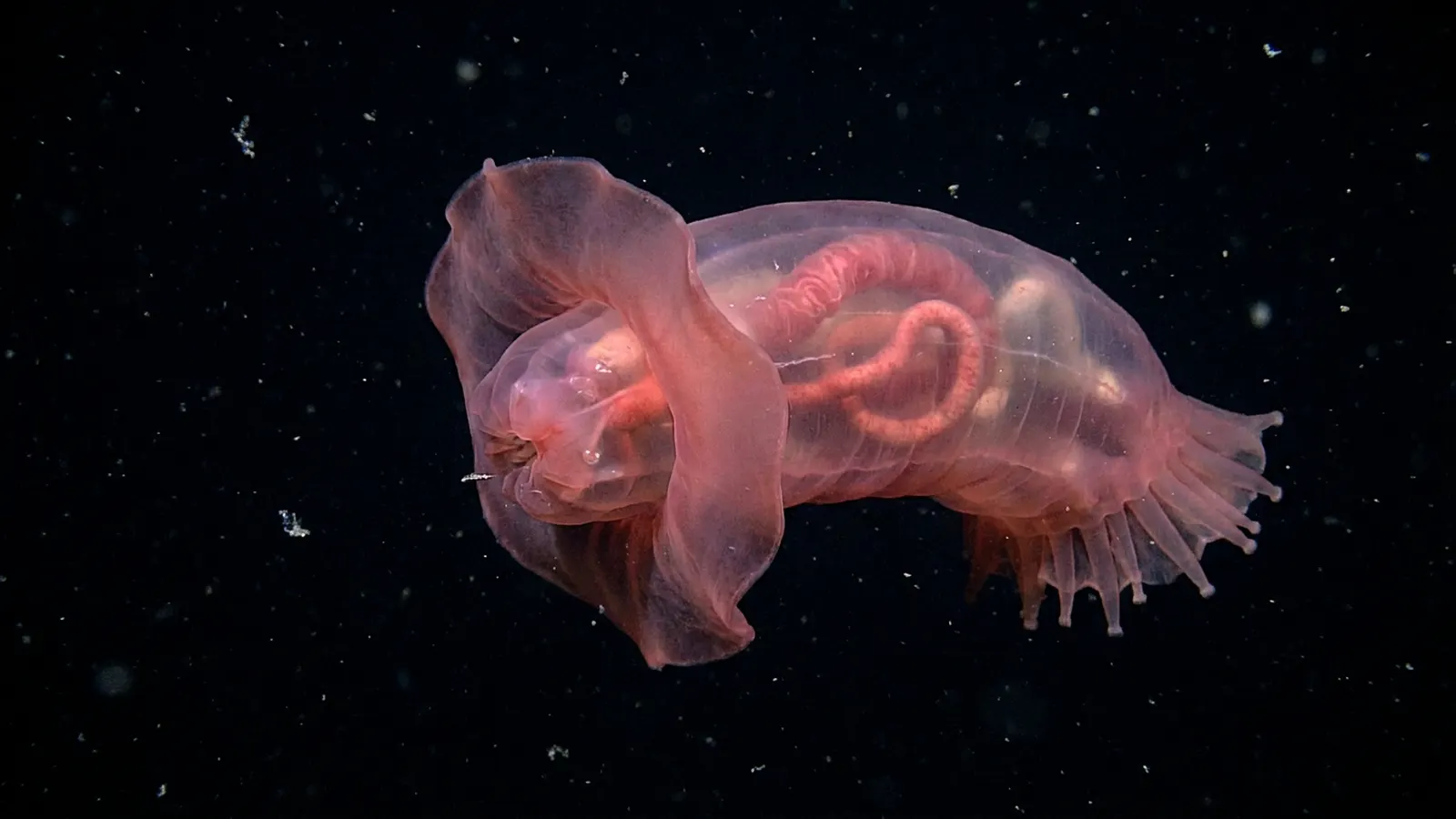
“Pink see-through fantasia” is a nickname for Enypniastes eximia, a translucent deep-sea sea cucumber that can swim. The name became famous after a 2007 Census of Marine Life expedition photographed one in the Celebes Sea at about 2.5 km (1.5 miles) deep, but the species itself was described in 1882 from specimens collected by HMS Challenger. It lives in all the world’s oceans, usually below about 500 m, grows to roughly 11–25 cm, and is also called the swimming sea cucumber, the Spanish dancer and the headless chicken monster.
Most sea cucumbers spend their lives crawling slowly across the seabed. Enypniastes eximia is one of the exceptions. Its jelly-like, almost weightless body lets it lift off the bottom, row through the water with a frilled veil and settle somewhere new to feed. Seen in the lights of a submersible, the pink, see-through animal, with its gut visible inside and a skirt-like veil waving in front, looks more like a ghost than a relative of starfish and sea urchins. Its scientific name suits it: Enypniastes eximia has been translated as “remarkable dreamer”.
Where did the name “pink see-through fantasia” come from?
The name comes from a 2007 deep-sea expedition to the Celebes Sea, between the southern Philippines and Indonesia, carried out as part of the Census of Marine Life, a ten-year international project to catalogue ocean life. Scientists on the expedition, including biologists from the Woods Hole Oceanographic Institution, sampled and photographed life in the deep basin. Among the animals they photographed at about a mile and a half deep was a transparent pink sea cucumber, and the images, released with the playful label “pink see-through fantasia”, spread widely online.
Many reports described the animal as a new discovery from 2007. In fact the swimming sea cucumber had been known to science for well over a century. The Swedish zoologist Hjalmar Théel described Enypniastes eximia in 1882 in his report on the sea cucumbers dredged by HMS Challenger during its 1873–76 round-the-world voyage, the expedition that founded modern oceanography. Later researchers named several more species and genera that turned out to be the same animal, and the genus Enypniastes is now regarded as containing only this one species. What was new in 2007 was the quality of the photographs of a living animal in its natural setting.
The 2007 cruise, titled “Exploring the Inner Space of the Celebes Sea”, worked from the Philippine research vessel BRP Hydrographer Presbitero near the Tawi-Tawi islands and used the remotely operated vehicle Global Explorer to film animals living in the deep water just above the seafloor. The same dives produced the squidworm, Teuthidodrilus samae, a free-swimming worm with ten long head appendages that was collected at depths of about 2,000 to 2,900 m and formally described a few years later. The wider Census of Marine Life, which ran for ten years until its final report in 2010, involved more than 2,700 researchers from over 80 nations and is estimated to have cost around US$650 million. It was one of the largest efforts ever made to record what lives in the ocean, and the pink see-through fantasia became one of its most recognizable faces.
What does it look like?
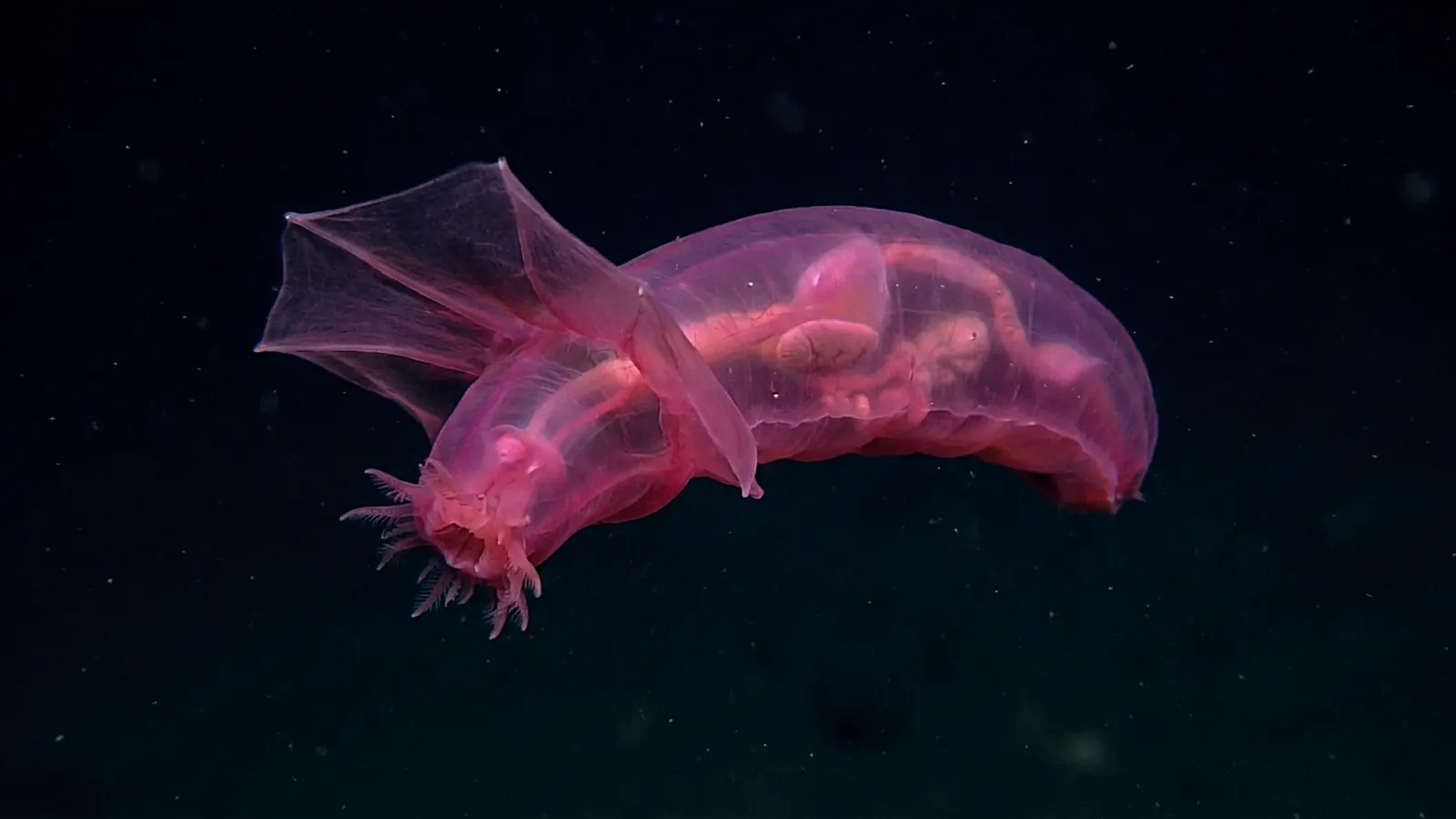
Enypniastes has a rounded, bulbous body made mostly of soft, gelatinous tissue. At the front end, a large webbed veil, sometimes described as a sail or umbrella, spreads out around and above the mouth. Below it is a ring of branched feeding tentacles. At the back is a smaller fin-like web. The animal’s colour changes with size: small individuals are bright, translucent pink, while larger ones are a deeper reddish brown. The body wall is thin enough that the long, looping gut is visible through it, especially after a meal when it is packed with dark sediment.
The front end can look a lot like a neck, and the animal as a whole like a plucked bird with its head cut off, which is how it earned the nickname headless chicken monster. Another name, Spanish dancer, refers to the way the veil swirls like a flamenco dancer’s skirt. Like other sea cucumbers it has a skeleton of tiny calcium carbonate pieces, called ossicles, scattered in its skin, but these are reduced in the swimming species, and the body is mostly water held in jelly-like tissue.
How does a sea cucumber swim?
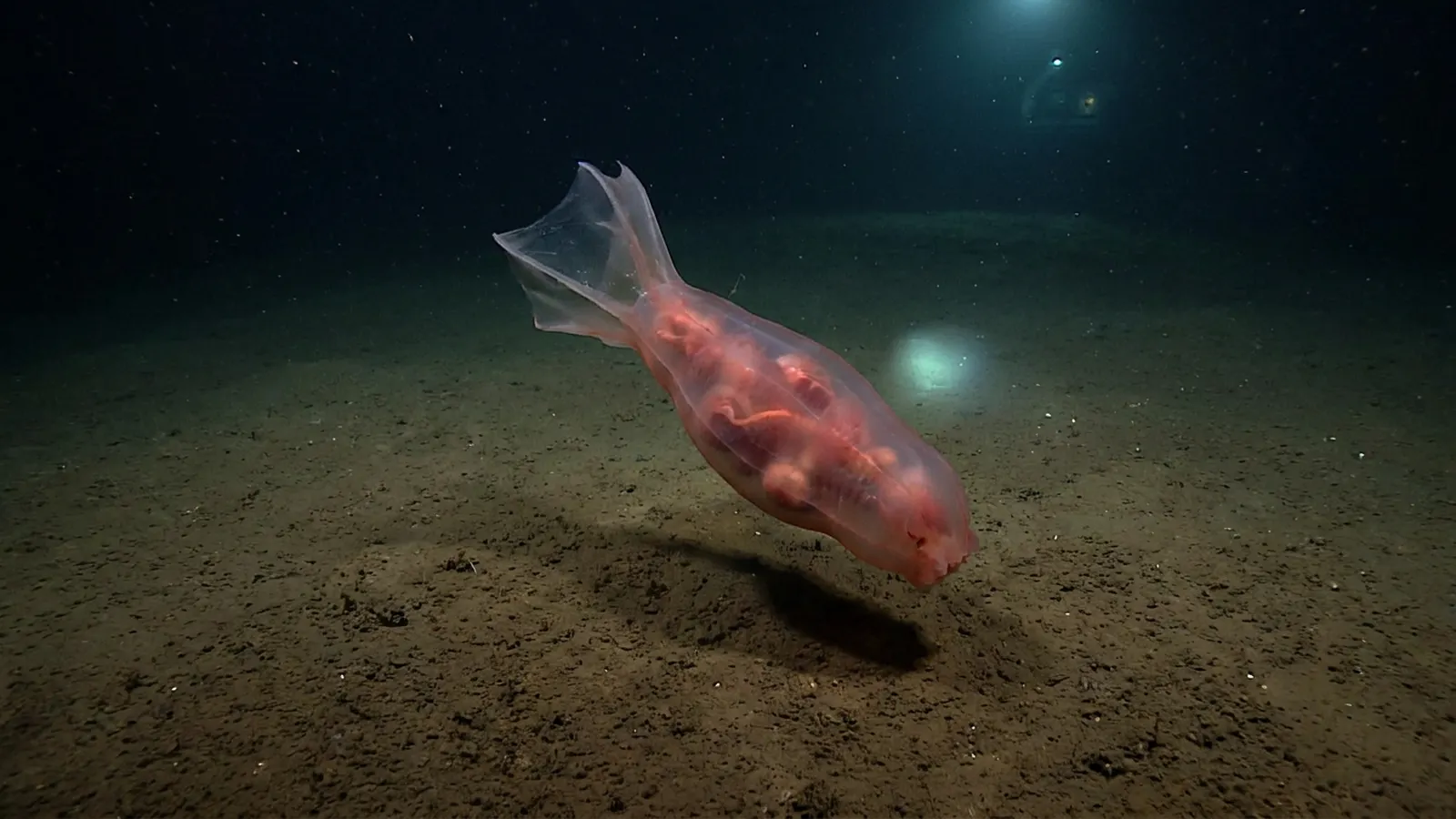
The key is buoyancy. In several deep-sea sea cucumbers, including Enypniastes eximia, the body is made of a tough gelatinous tissue that is very close to the density of the surrounding seawater. Such an animal weighs almost nothing in water, so it can rise off the bottom with little effort. Many benthopelagic sea cucumbers, as these bottom-and-water-column species are called, make long hops off the seabed and drift slowly back down.
To move, Enypniastes rows with its front veil, sweeping it backward like an oar, and it can also use its tentacles to push or pull itself along, letting a current carry it. A 1990 survey of swimming sea cucumbers by J.E. Miller and David Pawson, published by the Smithsonian Institution, analysed this kind of swimming behaviour in several deep-water species. Bruce Robison of the Monterey Bay Aquarium Research Institute, working with the species in deep Caribbean waters, found that after feeding on the bottom it typically returns to the water column within about 50 m of the seafloor, while other sources describe these sea cucumbers rising as much as 1,000 m. Swimming is thought to help it move between feeding patches and escape predators that hunt on the bottom.
What does it eat?
Despite its life in midwater, Enypniastes eats like most sea cucumbers: it feeds on the seafloor. The surface layer of deep-sea sediment is enriched with marine snow, the steady fall of dead plankton, faecal pellets and other organic particles from the sunlit ocean above, together with the bacteria that colonize it. When the sea cucumber lands, it uses its branched tentacles to shovel this soft surface layer into its mouth. Feeding is quick and episodic. Published observations suggest that individuals stay on the bottom for only about a minute at a time before lifting off again.
Marine biologist Helen Scales, writing for BBC Science Focus, notes that this sea cucumber often empties its gut just before it takes off, squeezing out a load of cleaned sediment, a little like a hot-air balloon dropping ballast. By swallowing sediment in one place and depositing it in another, it helps mix and recycle the seabed, a role similar to that of earthworms in soil. Because the gut contents show through the body, an animal that has just fed is visibly darker than one that has not.
The glowing “burglar alarm” defence
Enypniastes eximia is bioluminescent, and its light seems to be a defence. In a study published in the Journal of the Marine Biological Association of the UK, Bruce Robison combined direct observations from submersibles with laboratory work on living animals. He found that a light touch produces a local glow, while a broad impact makes the whole body light up. The skin is extremely fragile, and strong contact causes it to come away in a glowing cloud. The brightness of the response increases with how hard the animal is struck. In the laboratory, the skin, along with its ability to glow, grew back quickly.
Robison interpreted this as a “burglar alarm” strategy. Near the dark seafloor, a fish or crustacean that bites the sea cucumber triggers a flash of light and may be left coated in glowing skin. That light reveals the attacker to its own predators, which hunt by sight. The idea is that a predator that has just made itself visible has good reason to let go. It is an indirect defence: the light does not harm the attacker, but it turns the attacker into a target. The same burglar alarm idea has been proposed for the glow of some planktonic dinoflagellates and deep-sea jellyfish.
Why is it see-through?
Transparency is common among animals of the open ocean, where there is nowhere to hide. Jellyfish, comb jellies, salps and many larval animals have watery, glass-clear bodies that let light pass through, so they cast little shadow and show little outline. For a mostly gelatinous animal like Enypniastes, transparency also comes partly with the body plan: tissue that is mostly water, with few pigments and little skeletal material, tends to be translucent. The gut, which holds dark sediment, is the most visible part of the animal.
In the deep sea, where little or no sunlight reaches, the colour red is also effectively invisible, because red light is absorbed near the surface. A pink or reddish animal that lives below the reach of sunlight looks dark to most predators, unless someone switches on a light. That is part of why these animals look so striking in the beams of submersibles and remotely operated vehicles.
Where does it live?
The swimming sea cucumber has a worldwide distribution in deep water. BBC Science Focus gives its depth range as below about 500 m to at least 6,000 m. It has been recorded from the Caribbean to the Celebes Sea. A first record for Peruvian waters was published in 2012. In October 2018, Australian government scientists released footage of the species from a camera deployed in the sea near East Antarctica, the first sighting in the Southern Ocean. The images made the “headless chicken monster” nickname famous in the press.
Because it lives so deep and is so fragile, Enypniastes is rarely collected intact. Trawled specimens usually arrive at the surface damaged, so much of what is known comes from submersible observations and video. That makes it hard to estimate how common it is, but repeated sightings in many oceans suggest it is widespread rather than rare.
How it compares with other deep-sea sea cucumbers
Sea cucumbers are among the most successful animals of the deep ocean. Worldwide there are around 1,700 to 1,800 species, and on parts of the deep seafloor sea cucumbers make up the majority of the animal biomass. Several groups have adapted to deep water in ways shallow-water species have not. The sea pig, Scotoplanes, walks across the abyssal plain on enlarged tube feet, while species of Peniagone and Psychropotes share Enypniastes’ ability to swim, the latter using a long lobe on its back. Only one sea cucumber, Pelagothuria natatrix, is thought to spend its whole life in open water without returning to the bottom. It belongs to the same family as Enypniastes, the Pelagothuriidae, and is the only fully pelagic echinoderm known.
Some sea cucumbers have been found deeper than 9,500 m in ocean trenches, making them the echinoderms best adapted to extreme depths. Enypniastes sits in the middle of this range, a benthopelagic animal that has kept the sea cucumber’s sediment-eating habit while taking to the water between meals. Like other sea cucumbers it breathes using internal “respiratory trees” that draw water in and out through the rear end.
Sea cucumber anatomy, inside the glass
Because its body is translucent, Enypniastes offers an unusual view of sea cucumber anatomy. Sea cucumbers are echinoderms, related to starfish and sea urchins, and like them they have a water vascular system: a network of fluid-filled canals that works hydraulically to move the tube feet and tentacles. The feeding tentacles around the mouth are in fact modified tube feet, extended and retracted by changes in fluid pressure. A separate haemal system of small vessels runs alongside the gut, and in many species the blood and body fluid are red. Instead of gills, sea cucumbers breathe with a pair of branched “respiratory trees” inside the body, filling them by pumping water in through the anus and squeezing it out again. The trees also help remove waste.
The gut is a long tube that loops through the body cavity from the mouth to the anus. In a sediment eater it is usually full of mud, and in a see-through animal like Enypniastes it stands out as a dark coil inside the pink body. The skin, which in most sea cucumbers is stiffened with thousands of microscopic ossicles of calcium carbonate, is thin and soft in this species, reflecting its swimming life. The fragile skin is also the source of its glowing defence.
How scientists study an animal this fragile
Almost everything known about the living animal comes from cameras and crewed submersibles rather than from specimens. Trawls and dredges, which were the only way to sample the deep sea in the Challenger era, shred gelatinous animals like this one. Modern remotely operated vehicles and baited or towed cameras let researchers watch it swim, feed and glow without touching it. Exploration cruises such as those of NOAA’s ship Okeanos Explorer regularly film swimming sea cucumbers on their live-streamed dives, and these recordings have given the public, as well as scientists, a much better idea of how the animal behaves. The same technology is now used to survey deep-sea communities before activities such as deep-sea fishing or proposed seabed mining, which could disturb the sediment that sea cucumbers depend on.
Reproduction
Very little is known about how Enypniastes reproduces. Most sea cucumbers have separate sexes and release eggs and sperm into the water, where the fertilized eggs develop into free-swimming larvae. Many deep-sea species instead produce fewer, larger, yolk-rich eggs that develop without feeding in the plankton. Which pattern this species follows has not been well documented, and its spawning has not, to our knowledge, been observed. As with many deep-sea animals, basic facts such as growth rate and lifespan remain unknown.
Related on TheSea
What is the pink see-through fantasia?
A nickname for the swimming deep-sea sea cucumber Enypniastes eximia, photographed in the Celebes Sea in 2007.
Was it discovered in 2007?
No. The species was described in 1882 from HMS Challenger specimens. The 2007 photos made it famous.
Can sea cucumbers swim?
A few deep-sea species can. Enypniastes rows with a webbed veil and is almost neutrally buoyant.
Why is it called the headless chicken monster?
Its front end and body shape resemble a plucked, headless chicken, a name popularized by 2018 Southern Ocean footage.
Does it glow?
Yes. When touched it glows, and hard contact makes it shed luminous skin that can mark an attacker.
What does it eat?
Organic-rich sediment on the seafloor, scooped up with its tentacles during brief landings.
How deep does it live?
Usually below about 500 m, down to at least about 6,000 m.
- Robison, B.H. Bioluminescence in the benthopelagic holothurian Enypniastes eximia. Journal of the Marine Biological Association of the UK 72 (1992).
- Miller, J.E. & Pawson, D.L. (1990). Swimming sea cucumbers (Echinodermata: Holothuroidea): a survey, with analysis of swimming behavior in four bathyal species. Smithsonian Contributions to the Marine Sciences 35.
- Théel, H. (1882). Report on the Holothurioidea dredged by HMS Challenger during the years 1873–76, Part I.
- Scales, H. (2024). Why this poop-propelled ‘headless chicken monster’ is the ninja of the deep sea. BBC Science Focus.
- University of Texas Marine Science Institute, Science and the Sea: Fantasia (2018)
- Solís-Marín, F.A. et al. (2012). First record of the swimming sea cucumber Enypniastes eximia in Peruvian waters. Revista Peruana de Biología 19: 95–96.
- World Register of Marine Species (WoRMS), Enypniastes Théel, 1882
Blane Perun has been exploring Earth’s oceans and marine life for over 25 years. Founder of TheSea.Org in 1999, underwater photographer, coral aquaculture pioneer, and explorer of 80+ countries.
About Blane Perun → More on Bizarre Sea Creatures →