Horseshoe Crab — The 445-Million-Year-Old Survivor With Blue Blood
A horseshoe crab is a hard-shelled marine arthropod that is not a crab at all — it is more closely related to spiders and scorpions. Its fossil lineage goes back about 445 million years, earlier than the dinosaurs by some 200 million years. The Atlantic horseshoe crab (Limulus polyphemus) lives from Nova Scotia to Mexico’s Yucatán, grows to about 60 cm, has copper-based blue blood, and is listed as Vulnerable by the IUCN. Its blood is used to safety-test vaccines, IV drugs and medical implants worldwide.
Every spring on a high tide around the new and full moons, Delaware Bay’s beaches fill with hundreds of thousands of helmet-shaped animals crawling out of the surf to spawn. It is one of the great wildlife events on the Atlantic coast, and it has been happening in some form since long before there were fish with jaws on Earth. The horseshoe crab is one of the most successful designs in the history of animal life — and in the last 50 years it has also become one of the most important animals in modern medicine.
Is a horseshoe crab actually a crab?
No. A horseshoe crab is a chelicerate, the same arthropod group as spiders, scorpions and ticks. True crabs are crustaceans, a completely separate branch of the arthropod tree.
The clue is in the mouthparts and legs. Horseshoe crabs have pincer-like chelicerae in front of the mouth, no antennae, and walking legs that feed food toward a mouth set between them — a layout shared with arachnids, not crabs. Some genetic studies go further and place horseshoe crabs inside the arachnids, making them essentially marine relatives of spiders. Either way, “crab” is a misnomer that stuck because of the hard shell and beach habitat.
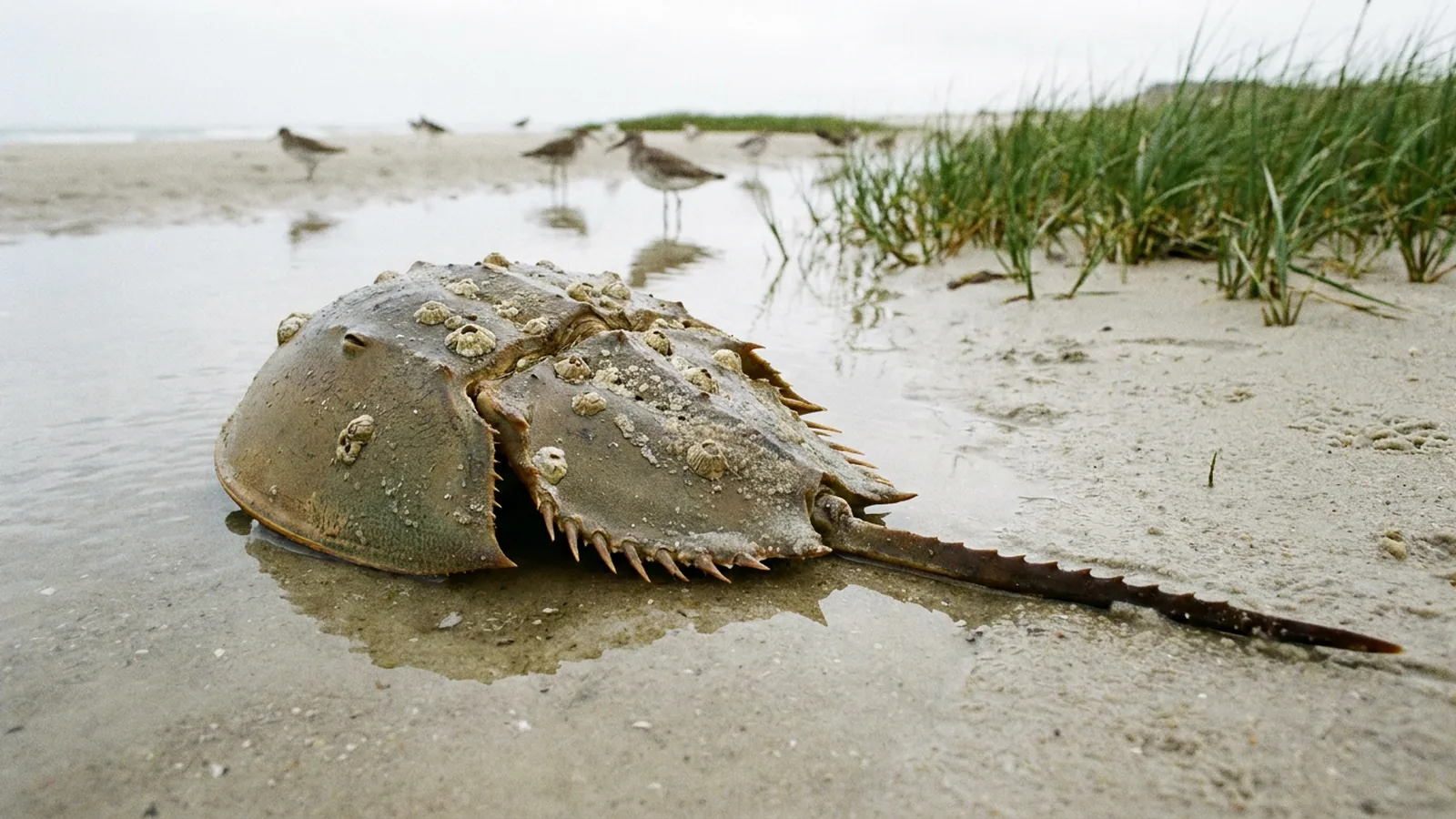
The body has three parts: a domed horseshoe-shaped front shield (the prosoma) that protects the legs and organs; a hinged middle section (the opisthosoma) carrying the book gills; and a long spike-like tail called the telson. The telson looks dangerous but is not a weapon. It is a lever the animal uses to steer and to flip itself back over when a wave rolls it on its back.
How old are horseshoe crabs?
Horseshoe crab relatives appear in the fossil record about 445 million years ago, in the Ordovician period, and the basic body plan has changed remarkably little since.
That is why horseshoe crabs are often called living fossils. They predate the dinosaurs by roughly 200 million years, predate trees, and have come through all five of Earth’s major mass extinctions. Modern Limulus is not identical to its Ordovician ancestors — species have come and gone — but the shield, segmented abdomen and telson have been a winning combination for an extraordinarily long time.
Individually they are long-lived too. An Atlantic horseshoe crab takes about 9 years (males) to 11 years (females) to reach maturity, molting around 16–17 times on the way, and can live to around 19–20 years. Each molt increases body length by roughly 25 percent. After the final molt the shell stops growing and slowly collects barnacles, slipper shells and algae — a rough way to judge an adult’s age on the beach.
Why is horseshoe crab blood blue?
Horseshoe crab blood is blue because it carries oxygen with hemocyanin, a copper-based protein. Copper turns blue when it binds oxygen, the way iron in our hemoglobin turns red.
The color is a curiosity; the cells floating in that blood are the real story. Horseshoe crab blood contains amebocytes, immune cells that clot almost instantly around bacterial endotoxins — the toxic fragments of bacterial cell walls. In an animal with an open circulatory system and no antibodies, sealing off an infection immediately is life or death.
In the 1960s researchers discovered they could extract those cells and turn them into a test. The result, Limulus amebocyte lysate (LAL), gels when it meets even trace amounts of endotoxin. It replaced an older, less sensitive test that involved injecting rabbits, and the US Food and Drug Administration requires endotoxin testing for injectable drugs, vaccines and implanted devices. If you have had a vaccine, an IV drip or a joint replacement, its safety almost certainly depended on horseshoe crab blood.
Are horseshoe crabs killed for their blood?
Horseshoe crabs are not killed on purpose for their blood. They are caught, about a third of their blood is drawn, and they are returned to the sea — but a significant share die afterwards.
According to reporting on Atlantic States Marine Fisheries Commission (ASMFC) data, almost 700,000 Atlantic horseshoe crabs were collected for biomedical bleeding in 2020, up from about 480,000 in 2010. Fishery managers have long assumed that around 15 percent of bled crabs die afterwards; independent studies have put the figure closer to 30 percent, and bled females may spawn less. The ASMFC estimated that more than 100,000 crabs died from the process in 2020.
There is an alternative. Recombinant Factor C (rFC) is a synthetic version of the key clotting protein, made without crabs. Regulators accept it case by case, and at least one large drug maker reports using it for most of its endotoxin testing. Wider adoption is the clearest path to taking pressure off wild horseshoe crabs.
When and where do horseshoe crabs spawn?
Atlantic horseshoe crabs spawn on sheltered sandy beaches from late spring into early summer, peaking on high tides around new and full moons. Delaware Bay hosts the largest spawning population in the world.
Females crawl up to the high-tide line with one male clasped to the back of the shell and often several “satellite” males crowding alongside. She digs shallow nests and lays clusters of roughly 3,600–4,000 small green eggs in each, laying many clusters over a season. Eggs hatch in about two to four weeks, and the larvae look like tiny tail-less horseshoe crabs.
The rest of the year adults live in bays, estuaries and on the continental shelf, moving into deeper water around 30 metres in winter. They plow through the sediment eating small clams, worms, crustaceans and dead fish, crushing food between the spiny bases of their legs because they have no jaws.
Why are horseshoe crab eggs so important to birds?
Horseshoe crab eggs are a critical fuel stop for migrating shorebirds, most famously the red knot, which times its spring migration to the Delaware Bay spawning.
Red knots fly about 9,300 miles each spring from southern South America to the Canadian Arctic. On Delaware Bay they gorge on surplus crab eggs churned up by the surf, and can put on roughly half their body weight in a short stopover before the final leg north. When horseshoe crab numbers crashed from overharvest for bait in the 1990s, red knot numbers fell sharply too; the rufa red knot is now protected under the US Endangered Species Act.
That link is why horseshoe crab management on the Atlantic coast is managed around shorebirds as well as fisheries. Some states ban harvest entirely; others cap bait landings and restrict harvest of females.
How many eyes does a horseshoe crab have?
A horseshoe crab has two large compound eyes on the sides of its shell plus several simpler light-sensing organs, often counted as up to ten eyes and photoreceptors in total.
The lateral compound eyes are big and easy to see; smaller median eyes on top of the shell detect ultraviolet light, and further photoreceptors sit on the underside and along the tail. The lateral eyes are about a million times more sensitive to light at night than during the day, helping males find females on dark spawning beaches.
Those eyes changed neuroscience. Studying single nerve fibers from the horseshoe crab eye, physiologist H. Keffer Hartline worked out how neighboring visual cells inhibit each other to sharpen contrast. He shared the 1967 Nobel Prize in Physiology or Medicine for this work on vision.
Are horseshoe crabs endangered?
The Atlantic horseshoe crab is listed as Vulnerable on the IUCN Red List. Of the three Asian species, the tri-spine horseshoe crab is Endangered.
| Species | Range | Status |
|---|---|---|
| Limulus polyphemus (Atlantic) | Nova Scotia to Yucatán, Gulf of Mexico | Vulnerable |
| Tachypleus tridentatus (tri-spine) | China, Japan, SE Asia | Endangered |
| Tachypleus gigas | South and SE Asia | Data Deficient |
| Carcinoscorpius rotundicauda (mangrove) | South and SE Asia | Data Deficient |
Threats are a stack of human pressures: harvest for eel and whelk (conch) bait, losses after biomedical bleeding, coastal development and seawalls that remove spawning beaches, and sea-level rise that squeezes the remaining sand. In Asia, horseshoe crabs are also eaten and harvested for their own version of the blood test (TAL). Because females take a decade to mature, populations recover slowly once they fall.
If you find a horseshoe crab on its back on a beach, turn it over by the edge of the shell. It is the simplest conservation action there is. For more ancient survivors, see our profiles of the chambered nautilus, the frilled shark and the Pacific hagfish.
Is a horseshoe crab a crab?
No. Horseshoe crabs are chelicerates, related to spiders, scorpions and ticks. True crabs are crustaceans. The name comes from the hard, horseshoe-shaped shell.
Why is horseshoe crab blood blue?
Their blood uses hemocyanin, a copper-based protein, to carry oxygen. Copper turns blue when it binds oxygen, much as iron in human hemoglobin makes our blood red.
Why is horseshoe crab blood so valuable?
Its amebocyte cells clot on contact with bacterial endotoxins. The extract, Limulus amebocyte lysate (LAL), is used to test vaccines, injectable drugs and medical devices for contamination.
Do horseshoe crabs sting or bite?
No. Horseshoe crabs have no venom, no stinger and no jaws. The tail (telson) is used for steering and flipping over, not for defence. They are harmless to people.
How old do horseshoe crabs get?
Atlantic horseshoe crabs take about 9 to 11 years to mature and can live roughly 19 to 20 years.
How long have horseshoe crabs existed?
Their fossil relatives date back about 445 million years, around 200 million years before the first dinosaurs.
How many eyes does a horseshoe crab have?
Two large compound eyes plus several simpler light-sensing eyes and photoreceptors on the top, underside and tail, often counted as up to ten in total.
Are horseshoe crabs endangered?
The Atlantic horseshoe crab is listed as Vulnerable by the IUCN, and the Asian tri-spine horseshoe crab is Endangered. Threats include bait harvest, biomedical bleeding and loss of spawning beaches.
What do horseshoe crabs eat?
Mainly small clams, plus marine worms, small crustaceans and dead fish. They have no jaws and grind food between the spiny bases of their legs.
Where can you see horseshoe crabs spawning?
Delaware Bay hosts the largest spawning population in the world, peaking on high tides around new and full moons in May and June. They also spawn along the US Atlantic and Gulf coasts, including Florida.
Blane Perun has been exploring Earth’s oceans and marine life for over 25 years. Founder of TheSea.Org in 1999, underwater photographer, coral aquaculture pioneer, and explorer of 80+ countries.
About Blane Perun → More on Bizarre Sea Creatures →