Marine Mammals in Florida — Manatees, Dolphins and Rare Whales
The best-known marine mammals in Florida are the Florida manatee, the state marine mammal, and the common bottlenose dolphin, the state saltwater mammal. Florida waters also host Atlantic spotted dolphins, calving North Atlantic right whales off the northeast coast, the rare Rice’s whale in the Gulf, deep-water whales such as sperm whales and pilot whales, and once the now-extinct Caribbean monk seal.
Florida sits between the Atlantic Ocean and the Gulf of Mexico, with the Florida Keys stretching toward the Caribbean. That position gives it an unusual mix of marine mammals: warm-water species from the tropics, deep-water whales that live along the continental slope, and a few cold-water visitors that come south for the winter. Most people will only ever see two of them, manatees and bottlenose dolphins, but the full list is much longer and includes some of the rarest whales in the world. This page covers which marine mammals live in Florida, where and when you might see them, and what threatens them. For the bigger picture, see our marine mammals guide.
Florida’s state marine mammal: the manatee
The Florida manatee was named the state marine mammal in 1975, and it is the animal most people associate with Florida’s waters.
The Florida manatee is a subspecies of the West Indian manatee. Adults are typically around 3 metres long and can weigh well over 500 kilograms. They graze on seagrass and other aquatic plants in shallow bays, rivers, canals and springs, and they move freely between salt water and fresh water. In summer, manatees spread out along both coasts and some travel far beyond Florida. In winter, they cannot tolerate water much below about 20°C for long, so they gather at warm-water refuges: natural springs such as Crystal River, Blue Spring and Homosassa, and the warm-water outflows of power plants.
Manatees are protected under federal and state law. Their main threats are boat strikes, cold stress and the loss of seagrass, which caused a major die-off of manatees on Florida’s Atlantic coast in 2021 and 2022 after seagrass collapsed in the Indian River Lagoon. For much more on these animals, see our manatee guide.
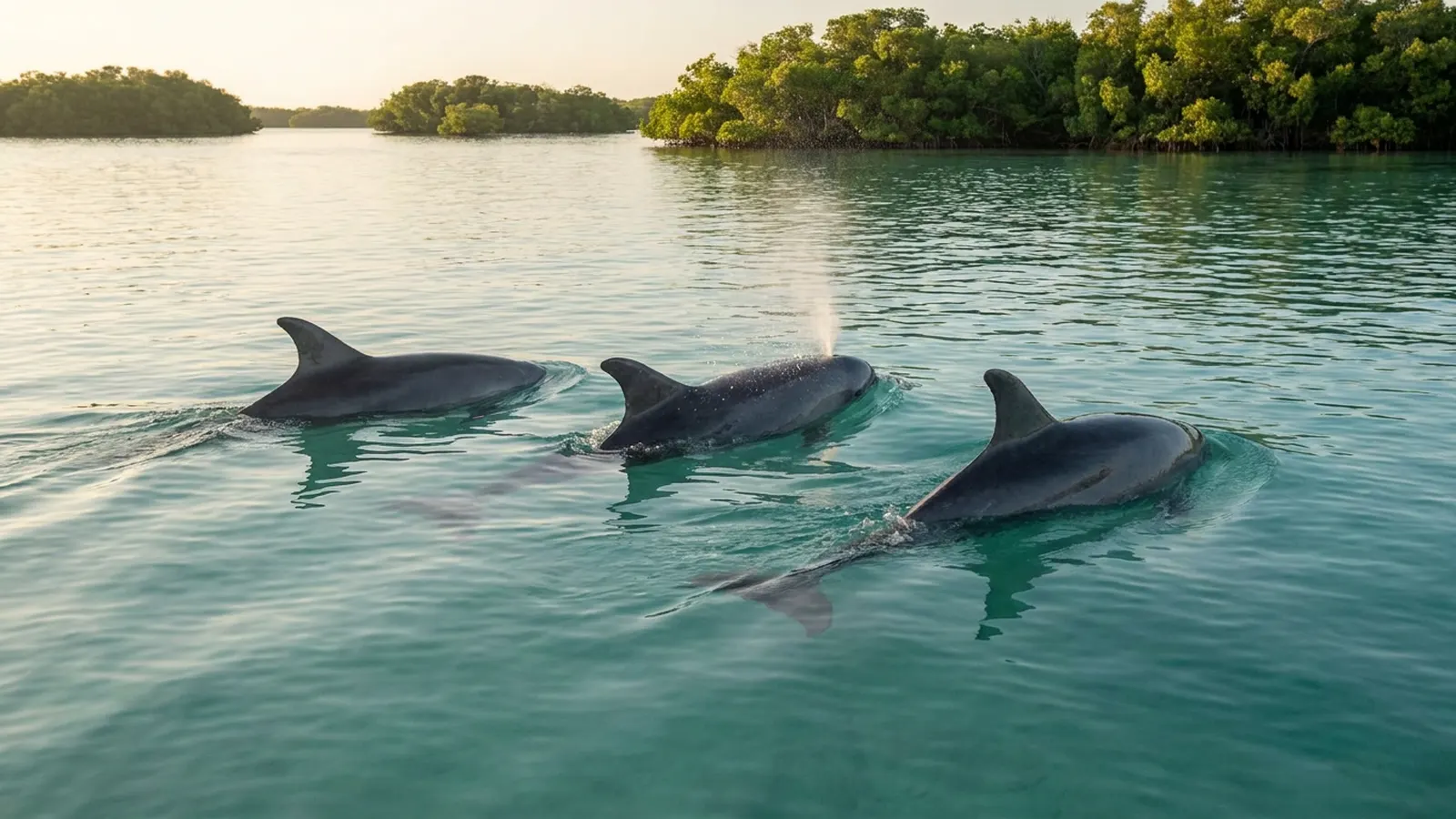
Dolphins: the state saltwater mammal
Florida also has an official state saltwater mammal, designated in 1975 as the “porpoise”, meaning the dolphin. In practice, that is the common bottlenose dolphin, by far the most commonly seen marine mammal in the state. Bottlenose dolphins live in bays, estuaries, passes and nearshore waters all around Florida, and many coastal communities have resident groups that stay in the same areas for years. Sarasota Bay on the Gulf coast is home to one of the longest-running studies of wild dolphins anywhere, following the same community across generations.
Offshore, Florida waters hold a much wider range of dolphins. Atlantic spotted dolphins are common over the continental shelf, especially in the Gulf and off the Atlantic coast. Further out, in deep water, are pantropical spotted dolphins, spinner dolphins, Clymene dolphins, striped dolphins, rough-toothed dolphins and Risso’s dolphins. Most visitors never see these offshore species unless they are on a boat well beyond the reef.
Whales in Florida waters
Florida is not known as a whale-watching destination, but whales are there. The most famous is the North Atlantic right whale. Each winter, pregnant females travel south from feeding grounds off New England and Canada to give birth in the shallow coastal waters off northeast Florida and Georgia, the species’ only known calving ground. With the population now only around a few hundred animals, every calf matters, and boats in the area must follow speed rules and keep their distance during calving season, roughly from December to April.
In the Gulf of Mexico lives one of the world’s rarest whales: Rice’s whale. Long thought to be a population of Bryde’s whale, it was described as a separate species in 2021. It lives mainly along the continental slope in the northeastern Gulf, including the De Soto Canyon area off the Florida Panhandle, and the population is estimated at only around a few dozen animals. It is listed as endangered.
Deep-water whales are also present offshore. Sperm whales live in the deep Gulf and along the Atlantic slope. Short-finned pilot whales are found offshore and are known for mass strandings on Florida beaches, including in the Keys. Pygmy and dwarf sperm whales, small deep-diving whales that are rarely seen alive, are among the most frequently stranded whales in Florida. Humpback whales occasionally pass along the Atlantic coast during migration, and beaked whales live in the deep canyons. For more on the Gulf side, see marine mammals of the Gulf of Mexico.
| Species | Where in Florida | How often seen | Status |
|---|---|---|---|
| Florida manatee | Bays, rivers, springs, canals; both coasts | Common, especially winter springs | Threatened (US) |
| Common bottlenose dolphin | Bays, estuaries, nearshore, Keys | Very common | Protected; not endangered |
| Atlantic spotted dolphin | Continental shelf, Gulf and Atlantic | Common offshore | Protected |
| North Atlantic right whale | Northeast Florida coast, winter | Rare; seasonal | Endangered |
| Rice’s whale | Northeastern Gulf slope | Very rare | Endangered |
| Sperm whale | Deep Gulf and Atlantic slope | Rarely seen | Endangered |
| Short-finned pilot whale | Offshore; strandings | Occasional | Protected |
| Caribbean monk seal | Formerly the Keys and Caribbean | Extinct | Declared extinct 2008 |
Are there seals in Florida?
Not anymore. Florida once had its own seal, the Caribbean monk seal, which lived on islands and sandbars across the Caribbean, the Bahamas and the Gulf of Mexico, including the Florida Keys. Spanish explorers recorded these seals in the 1490s, and over the following centuries they were killed in huge numbers for their oil and meat. The last confirmed sighting was in 1952 at Serranilla Bank, between Jamaica and Nicaragua, and the US government formally declared the species extinct in 2008. It is the only seal known to have been driven to extinction by people in modern times.
Today, the only seals that turn up in Florida are rare strays from the north, such as young hooded seals or harp seals that wander far south of their normal range. They are occasional events rather than residents. There are no sea lions or sea otters in Florida’s wild waters.

Where to see marine mammals in Florida
For manatees, winter is the time and springs are the place. From November to March, manatees gather at warm-water sites such as Blue Spring State Park, Crystal River and Homosassa Springs, and at power-plant outflows such as the one at Apollo Beach near Tampa. Viewing platforms let you see them without disturbing them. In Crystal River, regulated in-water viewing is allowed under strict rules.
For dolphins, almost any boat trip in Florida’s bays and inshore waters has a good chance of finding bottlenose dolphins, from the Panhandle to the Keys. Responsible operators keep their distance and do not feed or chase them, which is illegal under federal law. Spotted dolphins and other offshore species are best seen on trips that head well offshore. Right whales are protected by strict approach limits, and the best way to help them is to report sightings to the official hotline rather than to approach.
Threats to Florida’s marine mammals
Florida’s marine mammals share the water with millions of residents, tourists and boats, and the pressures add up. Boat strikes are the leading human-caused threat to manatees and a major threat to right whales. Seagrass loss from nutrient pollution and algal blooms has starved manatees and reduced fish for dolphins. Red tide blooms of the dinoflagellate Karenia brevis on the Gulf coast release toxins that have killed both manatees and dolphins in large numbers. Entanglement in fishing gear, ingestion of fishing line and hooks, illegal feeding of wild dolphins and noise from shipping and offshore activities are other ongoing problems.
The 2010 Deepwater Horizon oil spill in the northern Gulf also affected dolphins and whales, including the already tiny Rice’s whale population. Federal protection under the Marine Mammal Protection Act and the Endangered Species Act, along with Florida state law, makes it illegal to harass, feed or harm any of these animals.
What to do if you find a stranded marine mammal
Florida has one of the busiest marine mammal stranding networks in the country, because its long coastline and many offshore species mean dolphins, whales and manatees regularly wash ashore, alive or dead. Strandings provide much of what scientists know about rare deep-water species such as pygmy and dwarf sperm whales, which are almost never seen alive.
If you find a stranded or injured marine mammal, don’t push it back into the water and don’t try to handle it. Keep people and pets back, note the location, and call the FWC Wildlife Alert hotline or the NOAA stranding hotline for the region. Trained responders will assess the animal. A live stranding is often a sign of illness or injury, and returning a sick animal to the sea without treatment usually means it strands again.
From my dives in the Florida Keys
I’ve dived Key Largo and Key West, and the Florida Keys are a good reminder that marine mammals are part of the reef story even when you’re focused on coral. The shallow seagrass flats and channels between the islands and the reef are the kind of habitat bottlenose dolphins and manatees use, and they sit right next to the reefs and wrecks divers come for. When you plan a Keys trip around the reef, you’re also passing through their home.
If I were advising someone who wants to see Florida’s marine mammals, I’d split it by season. Come in winter for manatees at the springs, and pick any time of year for dolphins on a small, responsible boat tour. And if you’re a boater, I’d say the single most useful thing you can do is obey the slow-speed zones, because the manatee and right whale numbers in this state depend on it. For reef planning in the Keys, our best snorkeling in the Florida Keys guide is a good place to start.

What is Florida’s state marine mammal?
The Florida manatee, designated in 1975. The dolphin is the state saltwater mammal.
What marine mammals live in Florida?
Manatees, bottlenose and spotted dolphins, offshore dolphins, pilot whales, sperm whales, Rice’s whales and visiting right whales.
Are there whales in Florida?
Yes. Right whales calve off northeast Florida in winter, Rice’s whales live in the Gulf, and deep-water whales live offshore.
Are there seals in Florida?
No resident seals. The Caribbean monk seal once lived in the Keys but is extinct; rare northern seals sometimes stray south.
When is the best time to see manatees in Florida?
November to March, when they gather at warm springs and power-plant outflows.
Is it legal to swim with dolphins in Florida?
Feeding or harassing wild dolphins is illegal; keep a respectful distance and let them choose to approach.
What is the rarest marine mammal in Florida?
Rice’s whale, found in the northeastern Gulf of Mexico, with only a few dozen animals estimated.
- Florida Fish and Wildlife Conservation Commission (FWC): Manatee and marine mammal pages.
- NOAA Fisheries: North Atlantic right whale, Rice’s whale and Caribbean monk seal species profiles.
- Rosel, P.E., Wilcox, L.A., Yamada, T.K. & Mullin, K.D. (2021). A new species of baleen whale (Balaenoptera) from the Gulf of Mexico. Marine Mammal Science 37: 577–610.
- Florida Department of State: Florida state symbols.
Blane Perun has been exploring Earth’s oceans and marine life for over 25 years. Founder of TheSea.Org in 1999, underwater photographer, coral aquaculture pioneer, and explorer of 80+ countries.
About Blane Perun → More marine mammals →