DeSoto Canal: A Winter Sanctuary for Manatees — Satellite Beach, the Indian River Lagoon and the Search for Warm Water
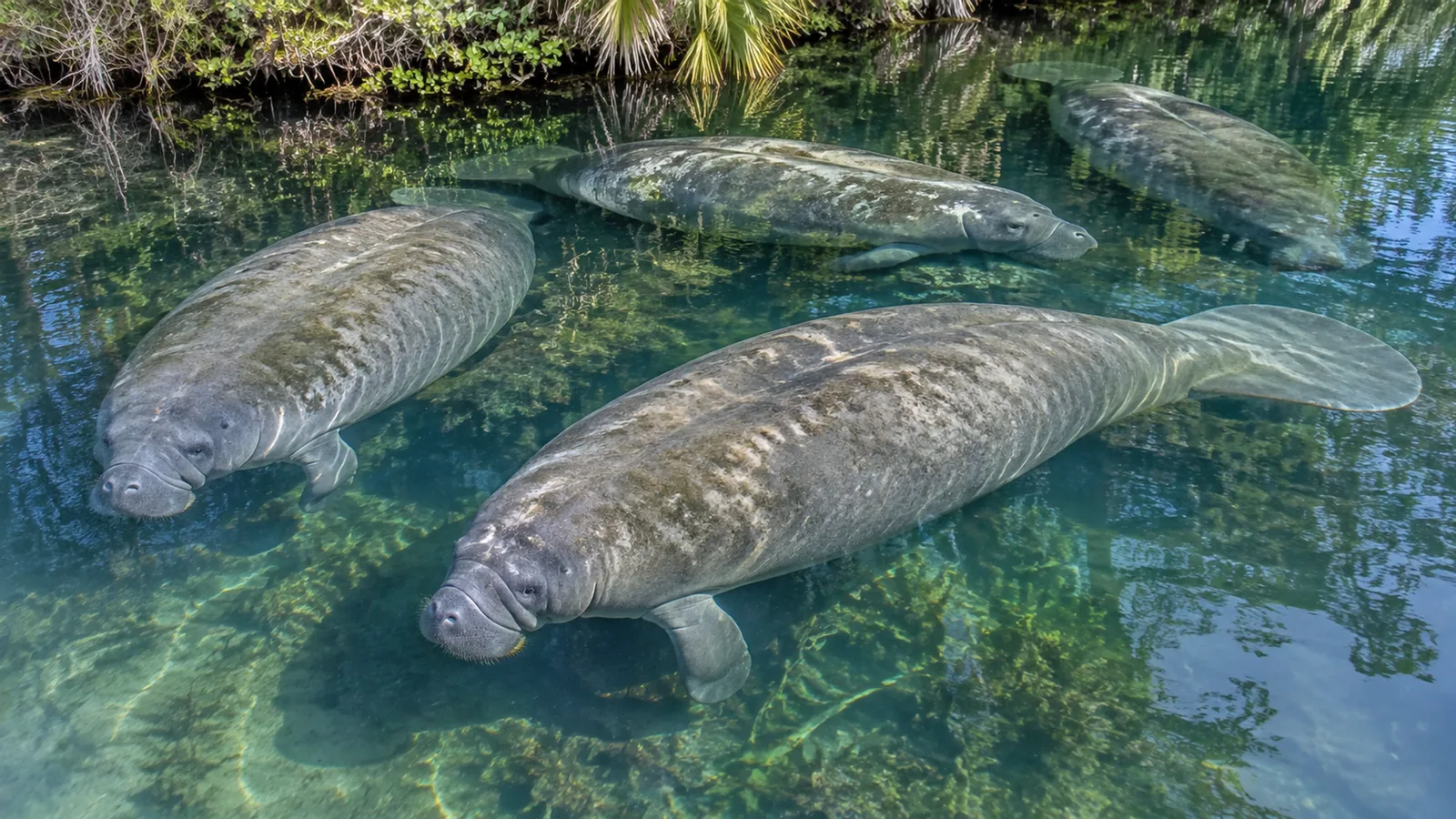
In early February 2024, cold weather cooled the Indian River Lagoon in Brevard County into the mid-60s °F, and manatees again gathered in the DeSoto Park canal in Satellite Beach, where the water was about 70–72 °F. Manatees struggle in water at or below about 68 °F, so in winter they seek out canals, springs and power-plant outfalls. The gathering was a hopeful sign after the lagoon’s seagrass collapse caused mass starvation in 2021, but it also left the animals crowded and vulnerable to boats.
Unlike Blue Spring or Crystal River, the DeSoto canal has no warm spring feeding it. It is an ordinary residential canal off the lagoon that, during cold snaps, holds water a few degrees warmer than the open lagoon. For a cold manatee, those few degrees can be the difference between health and cold stress.
When a cold front reaches Florida’s Space Coast, the manatees of the Indian River Lagoon start to move. In early February 2024, as the lagoon dropped into the mid-60s °F, dozens of them made their way into the DeSoto Park canal in Satellite Beach, a familiar winter gathering spot. Local residents and visitors lined the canal to watch, and wildlife officials asked boaters to keep away. This page explains why the manatees come to the canal, what the lagoon has been through and what the gathering says about the state of Florida’s manatees.
What happened in the DeSoto canal?
Spectrum News 13 reported on February 7, 2024, that recent cold snaps had cooled the waters of Central Florida and pushed manatees into the shallower, warmer canals off the Indian River Lagoon. The DeSoto Park canal in Satellite Beach, a well-known hotspot, was holding water at about 70 to 72 °F, while the lagoon itself had fallen into the mid-60s.
Visitors came to see the animals. One, Lisa Atwood, brought friends visiting from Connecticut straight to the canal, and described the manatees as “very majestic, very docile”. She said she had been hearing that “the fatalities are starting to decrease and the numbers are starting to increase”. The Florida Fish and Wildlife Conservation Commission urged boaters to stay away from areas where manatees were gathering for warmth.
Why do manatees need warm water?
Manatees are large mammals, but they carry little insulating fat and have a low metabolic rate for their size, a consequence of a diet of seagrass and algae that provides relatively little energy. They cannot keep warm in cold water for long. The FWC notes that manatees begin to struggle when water temperatures fall to about 68 °F or below.
Long exposure to cold leads to cold stress syndrome, which damages the skin, weakens the immune system, disrupts digestion and can be fatal. To avoid it, manatees move in winter to warmer places: natural springs, the warm-water outfalls of power plants, and smaller pockets of warmer water such as deep basins, marinas and residential canals. The DeSoto canal is one of these smaller refuges.
Why is the canal warmer than the lagoon?
The Indian River Lagoon is broad and shallow, and when a cold front passes, wind and cold air chill it quickly. Residential canals are sheltered from the wind, and many are deeper than the surrounding lagoon flats, so they lose heat more slowly. Dark, muddy bottoms absorb sunlight, and on sunny days after a cold night, canal water can warm faster than the open lagoon.
Some canals in Florida also hold a layer of warmer, saltier water near the bottom beneath cooler surface water, which helps them act as passive thermal refuges. Whatever the exact mechanism in a particular canal, manatees learn where these warm spots are and return to them year after year. Mothers lead their calves to the same places, passing on the knowledge of where to survive the winter. Residents who live along these canals often notice the first manatees arriving within a day or two of a cold front, and see them drift back out into the lagoon to feed as soon as the weather warms again.
Where else do Space Coast manatees go?
On the Atlantic coast, the most important winter refuges are power-plant outfalls. Florida Power & Light’s Cape Canaveral Clean Energy Center, on the Indian River near Port St. John, discharges warm water that attracts hundreds of manatees in cold weather. Other plants along the coast play a similar role. Because these refuges depend on industrial operations, regulators and utilities have worked to maintain warm-water discharges for manatees when plants are modernised.
The canals of Satellite Beach, Cocoa Beach and other lagoon communities provide smaller, scattered refuges. They are especially important for manatees that do not travel all the way to a power plant, or that need somewhere to rest during a short cold snap. The DeSoto canal has been reported as a manatee gathering spot in many winters, including 2018 and 2022.
How do manatees know where the warm water is?
Manatee calves stay with their mothers for roughly one to two years, and during that time they learn the routes between feeding grounds and winter refuges. A calf that spends its first winters in a particular canal or at a particular power plant is likely to return there as an adult. This learned fidelity to warm-water sites is one reason the same canals fill with manatees year after year.
It is also a weakness. If a refuge disappears, because a power plant closes or a canal is altered, the manatees that depend on it may not know where else to go, and some may stay in water that is dangerously cold. Wildlife managers therefore treat traditional warm-water sites as critical habitat and plan carefully before any change that might affect them.
How do scientists count lagoon manatees?
Biologists use several methods to follow manatees on the Atlantic coast. In winter, when manatees gather at warm-water sites, aerial surveys flown over refuges and along the coast give a minimum count of the animals present. Statistical models that combine aerial surveys with information on how visible manatees are produce the population estimates that the FWC publishes.
Researchers also identify individual manatees from the scars and markings on their backs, and some animals carry tracking tags that record where they travel. Carcass recovery is a third source of information: every manatee found dead in Florida is examined to determine the cause of death where possible, which is how scientists recognised the starvation crisis in the lagoon.
What happened to the Indian River Lagoon?
The Indian River Lagoon, which stretches about 156 miles along Florida’s Atlantic coast, was once one of the most biologically diverse estuaries in North America, with extensive seagrass meadows that fed manatees, fish and other wildlife. Over the past two decades, a series of algal blooms, fed by nutrient pollution from septic systems, fertilisers and stormwater, clouded the water and blocked the sunlight that seagrass needs.
The result was a collapse in seagrass across much of the lagoon. Without seagrass, manatees that wintered near the lagoon’s warm-water refuges had little to eat. In the winter of 2020–21, they began to starve. In 2021, more than 1,000 manatees died in Florida, the highest number on record, and many of those deaths were linked to starvation on the Atlantic coast. Federal officials declared an unusual mortality event.
What was done to help?
In response, state and federal agencies took steps that would once have been unthinkable. In the winter of 2021–22, wildlife officials ran an experimental supplemental feeding programme at the Cape Canaveral power plant, providing large quantities of romaine lettuce to manatees gathered at the warm-water outfall. Rescue teams pulled sick and starving manatees from the lagoon for treatment at zoos and aquariums around the state.
Longer-term efforts focus on restoring the lagoon itself: upgrading septic systems and wastewater treatment, reducing nutrient runoff, and replanting seagrass. Governor Ron DeSantis committed $50 million to manatee programmes, including rescue, rehabilitation and habitat restoration in areas such as the Indian River Lagoon. Recovery of seagrass is slow, and the lagoon’s health remains a long-term challenge.
Are manatee numbers improving?
The news from early 2024 was more hopeful. The FWC estimated Florida’s manatee population at about 8,300, and reported that mortality was the lowest it had been since 2017. Visitors at the DeSoto canal were hearing that deaths were falling and numbers rising, and the crowds of healthy-looking manatees in the canal seemed to bear that out.
That does not mean the danger has passed. The Atlantic coast population was badly hit by the starvation of 2021 and 2022, and the long-term health of the Indian River Lagoon is still uncertain. A single severe winter or a new algal bloom could reverse recent gains, which is why scientists continue to monitor manatee health and the state of the lagoon’s seagrass closely.
What is the manatee’s legal status?
The Florida manatee is a subspecies of the West Indian manatee. It was listed as endangered under the federal Endangered Species Preservation Act in 1967, and later protected under the Endangered Species Act and the Marine Mammal Protection Act. In 2017, the U.S. Fish and Wildlife Service reclassified the West Indian manatee from endangered to threatened, citing population growth and improved habitat protection.
The decision was controversial, and after the mass deaths of 2021, conservation groups petitioned to restore endangered status. Whatever the federal classification, manatees remain protected under federal and state law, and it is illegal to harass, harm or feed them.
Why are boaters asked to stay away?
Watercraft collisions are one of the leading known causes of manatee deaths in Florida, and most adult manatees carry propeller scars. When manatees crowd into a canal, they are concentrated in a small space, often in shallow water near the surface, where they are difficult to see and slow to move out of the way of boats. Cold manatees are also sluggish, which makes them even more vulnerable.
For that reason, the FWC asks boaters to avoid canals and other areas where manatees are gathering for warmth during cold weather, and to obey slow-speed and idle-speed zones. Paddlers and kayakers should also keep their distance, because disturbance can drive manatees out of a warm refuge into colder water, putting them at risk of cold stress.
How can visitors watch manatees responsibly?
Watching manatees from the shore or a dock is the best way to see them without causing harm. Stay quiet, keep a respectful distance and never try to touch, feed or give water to a manatee. Feeding or giving fresh water to manatees is illegal and can change their behaviour, drawing them into dangerous places such as busy marinas.
Polarised sunglasses help cut the glare on the water and make it easier to see manatees below the surface. Look for the round, grey backs and the circular ripples, called footprints, that manatees leave when they move their tails. Anyone who sees a manatee that appears injured, sick, cold-stressed or in distress should report it to the FWC Wildlife Alert hotline and avoid approaching the animal.
What does cold stress look like?
Cold-stressed manatees often show white patches or lesions on their skin, which may appear as blotchy or peeling areas. They may be thin, with a visible neck or a sunken area behind the head, and they are often lethargic, floating at the surface or lying on the bottom without moving much. Young manatees and those already weakened by poor nutrition are the most vulnerable.
Rescue teams from the FWC and its partners respond to reports of cold-stressed manatees, capturing animals that need treatment and taking them to critical-care facilities. Many recover and are released back into the wild. Prompt reports from the public are one of the main ways that rescue teams learn about animals in trouble.
What does the DeSoto canal gathering tell us?
The sight of dozens of manatees resting in a quiet canal in Satellite Beach is a reminder of how adaptable these animals are, and how much they depend on a few warm places in winter. It is also a sign that, after the disaster of 2021, the manatees of the Indian River Lagoon are still there in good numbers.
The gathering carries a message too. Manatees will continue to need warm water, healthy seagrass and protection from boats. As long as the lagoon’s seagrass recovers, warm refuges remain available and people give the animals space, canals like DeSoto will keep offering a winter sanctuary and a chance for people to see Florida’s gentlest giants up close.
Why do manatees gather in the DeSoto canal?
It stays a few degrees warmer than the Indian River Lagoon during cold snaps.
How warm was the DeSoto canal in February 2024?
About 70–72 °F, while the lagoon was in the mid-60s.
At what temperature do manatees get cold?
They begin to struggle at about 68 °F or below.
Why did manatees starve in the Indian River Lagoon?
Algal blooms killed much of the seagrass they depend on.
How many manatees died in 2021?
More than 1,000, a record for Florida.
Are manatees endangered?
They were reclassified as threatened in 2017 but remain protected.
Can I feed manatees?
No. Feeding or giving water to manatees is illegal.
What should I do if I see a sick manatee?
Report it to the FWC Wildlife Alert hotline and do not approach it.
- Spectrum News 13, “Manatees huddle for warmth” (February 7, 2024)
- Florida Fish and Wildlife Conservation Commission, manatee mortality and cold-stress information
- U.S. Fish and Wildlife Service, West Indian manatee reclassification (2017)
- NOAA Fisheries, Florida manatee unusual mortality event, Atlantic coast (2020–2022)
- St. Johns River Water Management District, Indian River Lagoon seagrass monitoring
Blane Perun has been exploring Earth’s oceans and marine life for over 25 years. Founder of TheSea.Org in 1999, underwater photographer, coral aquaculture pioneer, and explorer of 80+ countries.
About Blane Perun →