Caulastrea — The Candy Cane Coral Every Beginner Can Grow
Caulastrea, correctly spelled Caulastraea, is a genus of large-polyp stony corals in the family Merulinidae, sold as candy cane, trumpet or bullseye coral. Each fleshy polyp sits on the tip of its own tubular stalk, so a colony looks like a bouquet of round, often striped heads. The World Register of Marine Species now accepts only two species, C. furcata and C. echinulata, and the second of them was listed as Endangered by the IUCN in 2023.
Candy cane coral is one of the most widely kept stony corals in reef aquariums, and for good reason: it is peaceful, tolerant of modest light, quick to respond to feeding and almost trivially easy to propagate. In the wild it is a quieter presence, forming dense thickets on sheltered, sandy reef slopes and lagoon floors across the Indo-Pacific. This page covers the confusing name, the recent taxonomic split that halved the genus, how to recognise the two species, where and how they live, their conservation status, and a practical care guide.
Caulastrea or Caulastraea: which spelling is right?
The American naturalist James Dwight Dana named the genus Caulastraea in 1846, in his report on the corals and other “zoophytes” collected by the United States Exploring Expedition. The variant spelling Caulastrea, also attributed to Dana, is treated by taxonomists as a lapsus, an accidental misspelling with no standing of its own. The aquarium trade adopted the shorter form, which is why most shops, forums and care guides, including the address of this page, use “Caulastrea”. Scientific databases use Caulastraea. The name joins the Greek for a stalk or stem with the “-astraea” ending used for star-shaped corals, a neat description of star-like corallites perched on stalks.
The common names cause their own problems. “Candy cane” and “bullseye” refer to the striped or ringed oral discs of many aquarium colonies, and “trumpet” to the flared tubes of the skeleton. Some shops also label the coral “torch coral”, which belongs to an entirely different genus, Euphyllia glabrescens, with long flowing tentacles. If in doubt, look at the tentacles: candy cane polyps have only short ones.
How many species of Caulastraea are there?
Until recently most references listed five species: C. furcata, C. echinulata, C. curvata, C. tumida and C. connata. The World List of Scleractinia, which feeds WoRMS, now accepts only Caulastraea furcata Dana, 1846 and Caulastraea echinulata (Milne Edwards & Haime, 1849). The other three have been moved to Astraeosmilia Ortmann, 1892, a genus name that only a few years ago was treated as a synonym of Caulastraea and has since been revived. They are now listed as Astraeosmilia curvata, A. tumida and A. connata. Several further old names, including C. distorta, C. aiharai, C. multiseptata and C. yokoyamai, are junior synonyms, while C. simplex and C. undulata are names of uncertain application.
Shifts like this are the result of the molecular revolution in coral taxonomy. A 2011 study by Danwei Huang and colleagues, memorably titled “Cleaning up the ‘Bigmessidae’”, used DNA to untangle the old families Faviidae, Merulinidae, Pectiniidae and Trachyphylliidae, whose boundaries had been drawn from skeleton shape. The Indo-Pacific members of those families, including Caulastraea, were later grouped in an expanded Merulinidae, and finer-scale work has continued to redraw genus boundaries within it. For hobbyists the practical effect is small, since nearly all candy canes in the trade are sold as C. furcata, but older books and labels may carry names that are no longer used.
| Name today | Corallites | Typical habitat | IUCN (Oct 2023) |
|---|---|---|---|
| Caulastraea furcata | Up to about 19 mm, striped | Protected sandy slopes, lagoons | Least Concern |
| Caulastraea echinulata | Under 10 mm, closely packed | Horizontal turbid substrates | Endangered |
| Astraeosmilia curvata (ex-Caulastraea) | Small colonies | Flat substrates, often with C. furcata | Least Concern |
| Astraeosmilia tumida (ex-Caulastraea) | Phaceloid | Shallow reefs, subtropical rocky shores | Least Concern |
What does candy cane coral look like?
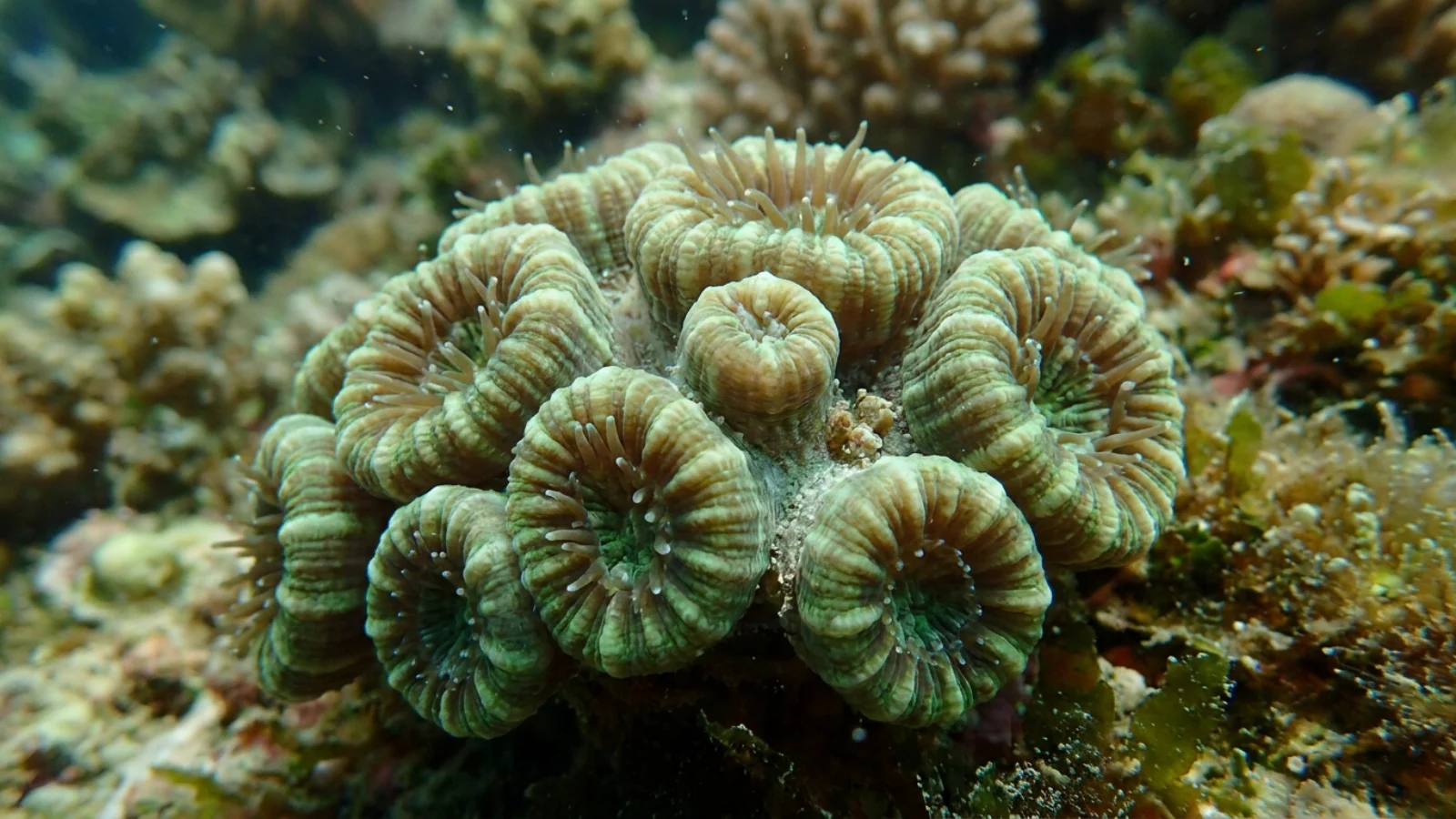
Both species are phaceloid: the colony consists of separate tubular corallites that branch from a common base and stand apart from one another, rather than sharing walls. At the end of each tube is a single round corallite with exsert septa, the radiating skeletal plates that project above the rim. In life, a fleshy polyp covers the top of each tube, with a central mouth and a ring of short tentacles that extend mostly at night or when food is in the water.
In C. furcata the corallites are irregular, become crowded where space is limited, and reach up to about 19 mm across according to the descriptions summarised by SeaLifeBase. Its septa vary in thickness, and the thick ones show through the tissue as bold radiating stripes on the upper surface of each polyp, the origin of the candy cane look. Wild colonies are usually brown or green with green oral discs; aquarium selections include neon green, yellow and bicoloured forms with contrasting rings. C. echinulata has smaller corallites, under 10 mm across and often tightly packed, with septa of roughly uniform width hidden beneath a thicker layer of tissue. Its colour runs from tan to dark brown with pale oral discs, so it lacks the striking stripes of its relative.
Several other stalked large-polyp corals look superficially similar. Duncan coral (Duncanopsammia axifuga) also has one polyp per tube, but it belongs to the Dendrophylliidae and has long, wispy tentacles. Blastomussa polyps are puffy and smooth, without stripes, and the genus is in the Lobophylliidae. Torch and frogspawn corals (Euphyllia) also grow as phaceloid colonies, but their long tentacles hide the skeleton entirely. The dwarfed, crowded colonies of Astraeosmilia curvata grow alongside C. furcata in the wild and can be hard to tell apart without a close look at the corallites.
Where does Caulastraea live?
Sources differ on how far west C. furcata extends. One commonly cited account gives its range as the Indo-Pacific from Fiji to Australia and possibly west toward Thailand, while the species summary in SeaLifeBase, based on Philippine and regional coral guides, describes a much larger range from Somalia and Madagascar east to the Samoan Islands, north to the Ryukyu Islands and south to New Caledonia, roughly 30°N to 27°S. The wider range is the better supported one, but coral distribution records still depend heavily on where specialists have looked. C. echinulata is recorded from the Ryukyu Islands south to Australia, roughly 28°N to 23°S.
Both species are creatures of calm water. C. furcata typically grows on protected reef slopes with a partly sandy bottom and in lagoons, and it can form extensive single-species stands sometimes more than 5 m across. Depth records run from the surface to about 40 m in SeaLifeBase, with other sources giving at least 30 m. C. echinulata favours horizontal surfaces in turbid water away from wave action. Neither is a coral of the surf zone: their branching tubes and large fleshy polyps are suited to places where sediment settles, light is diffuse and food drifts by in gentle currents.
How does candy cane coral feed?
Like most reef-building corals, Caulastraea gets most of its energy from zooxanthellae, single-celled symbiotic algae living in its tissues that photosynthesise and share the products with the host. It also hunts. The short tentacles around each mouth catch zooplankton and other small particles, which pass into the gut, or gastrovascular cavity, to be digested. In the turbid, sheltered places where the genus is common, captured food probably makes up a meaningful share of the diet, which helps explain why aquarium colonies respond so strongly to target feeding.
That gut is turning out to be more interesting than it looks. In a 2026 microsensor study, Zhang, Bollati and Kühl probed the gastrovascular cavity of Astraeosmilia curvata, until recently called Caulastraea curvata. They found active anaerobic microbial metabolism, including production of hydrogen and nitric oxide, that changed after the polyps fed. In healthy corals the cavity became oxygen-rich in the light, whereas in bleached corals it stayed low in oxygen and acidic around the clock. A commentary in the same journal described the coral gut as a discrete, gut-like microbial ecosystem in its own right, a reminder that even well-known aquarium corals still hold surprises.
How does Caulastraea reproduce?
SeaLifeBase records C. furcata as hermaphroditic. Like many stony corals, each colony produces both eggs and sperm, which are released through the polyp mouths during spawning; fertilised eggs develop into free-swimming planula larvae that eventually settle and found new colonies. Detailed spawning observations for the genus are sparse, so the timing of spawning across its range is not well documented.
Asexual growth is easier to see. A colony enlarges as tubes divide at their tips, so one corallite becomes two and the stalks fork, which is where the species name furcata, meaning forked, comes from. Over time this branching builds the dense, bushy thickets seen on sandy slopes. Broken branches can reattach and continue growing, and this is exactly what aquarium propagators exploit when they cut a colony into single-headed fragments.
What lives in candy cane coral?
Caulastraea hosts at least one specialist tenant. In 2017 the Dutch biologist Sancia van der Meij described a new gall crab, Lithoscaptus tuerkayi, from Caulastraea colonies collected off Kudat in Malaysian Borneo and at Okinawa in Japan, with additional material from Nha Trang in Vietnam. Gall crabs of the family Cryptochiridae live in pits or galls in the skeletons of living corals, and this was the first record of the genus as a host. The species was named in memory of the German crustacean expert Michael Türkay. The open, branching structure of a candy cane thicket also shelters small fishes and invertebrates among its stalks.
Is candy cane coral endangered?
The two species have very different statuses. In the IUCN Red List reassessment dated 24 October 2023, Caulastraea furcata, the familiar aquarium species, was classed as Least Concern. Caulastraea echinulata was listed as Endangered under criterion A3ce, meaning the assessors projected a population decline of at least 50 percent over the coming three generations, driven by declining habitat quality and by factors such as disease and pollution. Its preference for turbid, sheltered inshore habitats places it close to coastal development, sedimentation and nutrient runoff, on top of the warming that affects all reef corals.
Bleaching sensitivity varies. SeaLifeBase cites a Palau survey in which no bleaching of C. furcata was observed, which is consistent with the species’ reputation as a hardy coral, but a single survey says little about how it will cope with the stronger and more frequent marine heatwaves of recent years. All stony corals, including both Caulastraea species, are listed on CITES Appendix II, so international trade requires permits. Today most candy canes sold to hobbyists are aquacultured fragments rather than wild-collected colonies, which reduces collection pressure on wild stands.
How do you care for candy cane coral?
Candy cane coral is routinely recommended as a first stony coral. It tolerates a wide range of tank sizes and does not demand intense light. Low to moderate reef lighting is usually enough, and very intense light, or a sudden jump in intensity, is one of the most common causes of bleaching and shrinking heads. Many keepers place it low in the tank, on the sand bed or on low rock toward the edge of the light field, which mirrors its natural home on sheltered sandy slopes. Once it is settled, avoid moving it repeatedly.
Flow should be low to moderate. Gentle water movement lets the polyps inflate fully and clears waste and detritus from between the stalks, while strong direct flow keeps them retracted and can damage tissue. Typical reef parameters suit it: temperatures of roughly 23 to 29 °C, a pH around 8.1 to 8.4, alkalinity of about 8 to 12 dKH and calcium around 400 ppm are commonly recommended, and stability matters more than hitting exact numbers. Rapid alkalinity swings are a frequent cause of tissue receding from the top of the tubes.
Feeding makes a visible difference. Small, meaty, zooplankton-sized foods offered a few times a week, when the polyps have their tentacles out, usually speed up growth and the production of new heads. Remove uneaten food so that it does not foul the base of the colony. Candy cane is one of the more peaceful large-polyp corals. Its sweeper tentacles are short, so it can sit closer to other corals than most LPS, but it should be kept clear of aggressive neighbours such as torch coral, Galaxea or other Euphyllia, which can sting it.
Problems usually show up as tissue pulling back from the skeleton, heads shrinking or fading colour. The common causes are too much light, poor acclimation, starvation, unstable chemistry and detritus building up between the stalks. Brown jelly disease, a fast-moving infection that turns polyps into a brown slime, is the most serious; affected heads should be removed or the colony isolated, and flow increased, before it spreads.
How do you frag Caulastrea?
It is about the easiest stony coral to frag. Choose a branch with one or more healthy, fully extended heads, then cut through the stalk a centimetre or so below the head with bone cutters or a rotary tool, and glue the piece to a plug or small rock. Each head grows into a new colony, and the mother colony fills the gap quickly. Many keepers wait a few days before resuming target feeding on new frags, and keep them in modest light and flow while they heal. This ease of propagation is why candy canes are among the most common corals swapped between hobbyists and why aquacultured colonies now dominate the trade.
Is candy cane coral good for beginners?
Yes. It tolerates moderate light and flow, is peaceful, responds well to feeding and is easy to frag.
What is the scientific name of candy cane coral?
Caulastraea furcata. The trade spelling Caulastrea is an old misspelling of the genus name.
How many Caulastraea species are there?
WoRMS now accepts two, C. furcata and C. echinulata. Three former species were moved to Astraeosmilia.
Is candy cane coral endangered?
C. furcata is Least Concern, but C. echinulata was listed as Endangered by the IUCN in October 2023.
Does candy cane coral need feeding?
It photosynthesises, but small meaty foods a few times a week noticeably speed up growth.
Is candy cane coral aggressive?
It is one of the most peaceful LPS corals, with very short sweeper tentacles.
Where should I place candy cane coral?
Low in the tank, on sand or low rock, under low to moderate light and gentle flow.
Is candy cane coral the same as torch coral?
No. Torch coral is Euphyllia glabrescens, with long tentacles; candy cane has short tentacles.
- World Register of Marine Species: Caulastraea Dana, 1846, and Astraeosmilia Ortmann, 1892 (World List of Scleractinia, accessed November 2026).
- SeaLifeBase species summaries: Caulastraea furcata, C. echinulata and former Caulastraea species; morphology, range, depth and IUCN status (assessed October 2023).
- Huang, D., Licuanan, W.Y., Baird, A.H. & Fukami, H. (2011). Cleaning up the ‘Bigmessidae’. BMC Evolutionary Biology 11: 37. doi:10.1186/1471-2148-11-37
- van der Meij, S.E.T. (2017). The coral genus Caulastraea as a new host for gall crabs, with the description of Lithoscaptus tuerkayi. Crustaceana. doi:10.1163/15685403-00003607
- Zhang, Q., Bollati, E. & Kühl, M. (2026). Heterotrophic feeding and symbiotic state shape the chemical microenvironment of the coral gastrovascular cavity. Applied and Environmental Microbiology. doi:10.1128/aem.02441-25
- Wikipedia: Caulastraea furcata and Caulastraea (2023 snapshot); description, range and habitat.
- Saltwater Aquarium Blog: Candy cane coral care guide (citing Borneman 2001).
- Borneman, E. (2001). Aquarium Corals. TFH Publications.
Blane Perun has been exploring Earth’s oceans and marine life for over 25 years. Founder of TheSea.Org in 1999, underwater photographer, coral aquaculture pioneer, and explorer of 80+ countries.
About Blane Perun →