Jellyfish — Biology, Reproduction & Life Cycle
Jellyfish reproduce both sexually and asexually, alternating between two completely different body forms across their life cycle. The medusa stage — the familiar bell-shaped jellyfish — reproduces sexually, releasing eggs and sperm into the water. Fertilised eggs develop into larvae that settle and transform into polyps, which then reproduce asexually by budding off new medusae. This alternation of generations is one of the most remarkable reproductive strategies in the animal kingdom.
Jellyfish are among the most ancient animals on Earth — fossil evidence places them in the ocean over 500 million years ago, predating fish, insects, and dinosaurs by hundreds of millions of years. There are approximately 2,000 recognised species, ranging from the 2 mm Irukandji to the lion’s mane jellyfish with a bell up to 2 metres across and tentacles extending 36 metres. Despite their simplicity — no brain, no heart, no bones — jellyfish have one of the most complex and biologically interesting reproductive strategies of any animal.
The jellyfish life cycle — two stages, two strategies
Jellyfish live two entirely different lives in sequence: first as a polyp (asexual), then as a medusa (sexual). These two stages look so different that early scientists thought they were separate species.
The life cycle begins when a fertilised jellyfish egg develops into a free-swimming planula larva. The planula settles on a hard surface — rock, shell, or coral — and transforms into a polyp: a small, stationary, anemone-like cylinder attached to the substrate. The polyp feeds and grows, then begins reproducing asexually by a process called strobilation — the polyp stacks into disc-like segments that pinch off one by one as tiny juvenile medusae called ephyrae. Each ephyra grows into a full adult medusa — the bell-shaped, swimming jellyfish. The adult medusa then reproduces sexually, releasing gametes, and the cycle begins again.
Adult medusae release eggs and sperm into the water. Most jellyfish are separate sexes — males release sperm, females release eggs, and fertilisation occurs in the water column or inside the female’s body. Fertilised eggs develop into planula larvae that eventually settle and become polyps.
Polyps reproduce asexually in multiple ways: strobilation (budding off ephyrae), budding (producing new polyps from the body wall), and podocyst formation (creating dormant cysts that survive unfavourable conditions). A single polyp can produce hundreds of medusae across its lifespan.
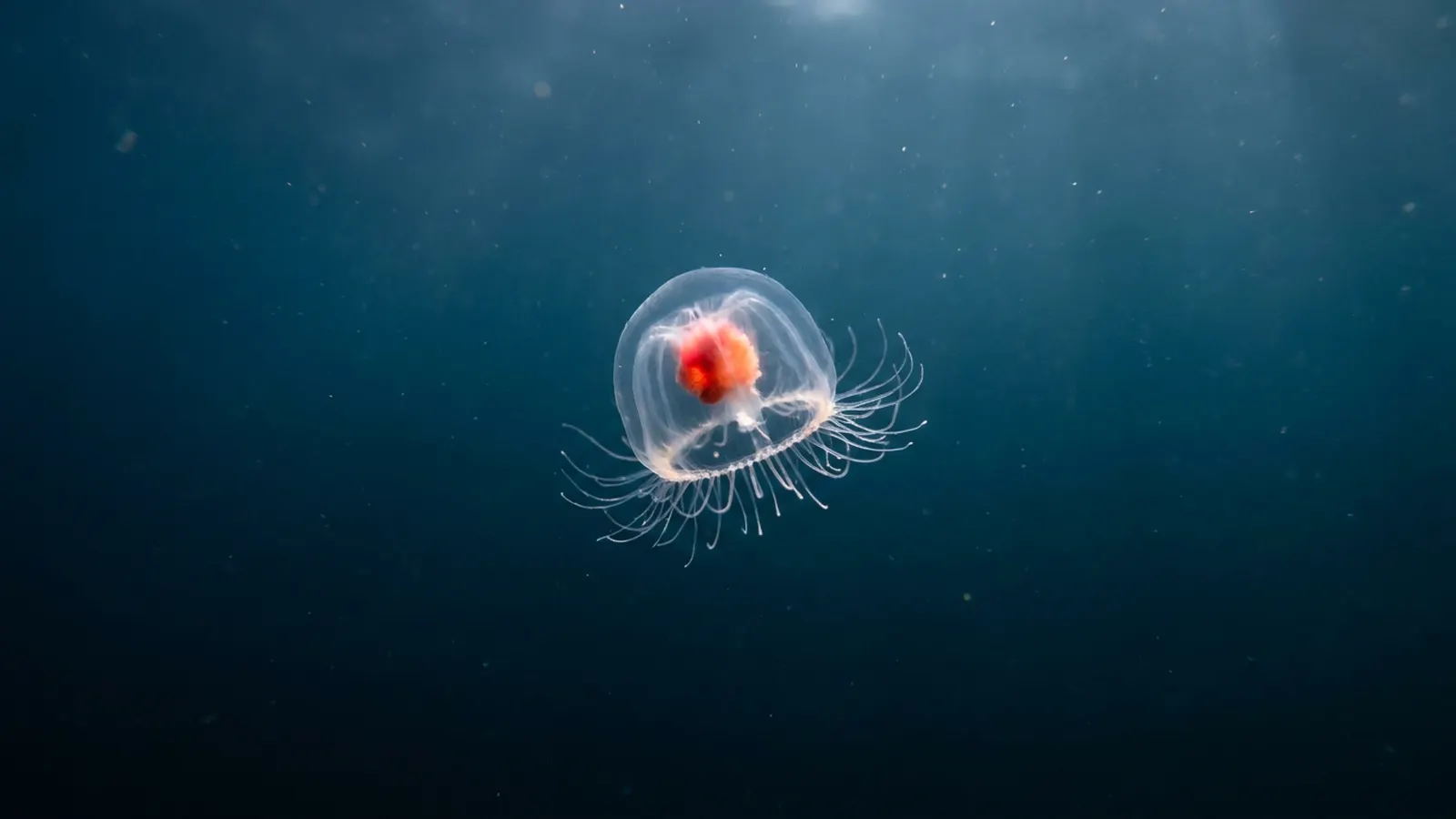
The immortal jellyfish — a life cycle with no end
Turritopsis dohrnii, the immortal jellyfish, can reverse its life cycle entirely — reverting from a sexually mature medusa back to a polyp and starting over indefinitely.
Under stress — physical damage, starvation, age, or environmental change — Turritopsis dohrnii undergoes transdifferentiation: its cells revert to an earlier developmental state and the medusa transforms back into a polyp. The polyp then re-initiates strobilation, producing new medusae. In theory, this process can repeat indefinitely. In practice, Turritopsis dohrnii faces all the normal predation and environmental threats that kill most jellyfish — the “immortality” is a biological capability, not a guarantee of survival. It is, however, the only multicellular animal known to be capable of this complete developmental reversal.
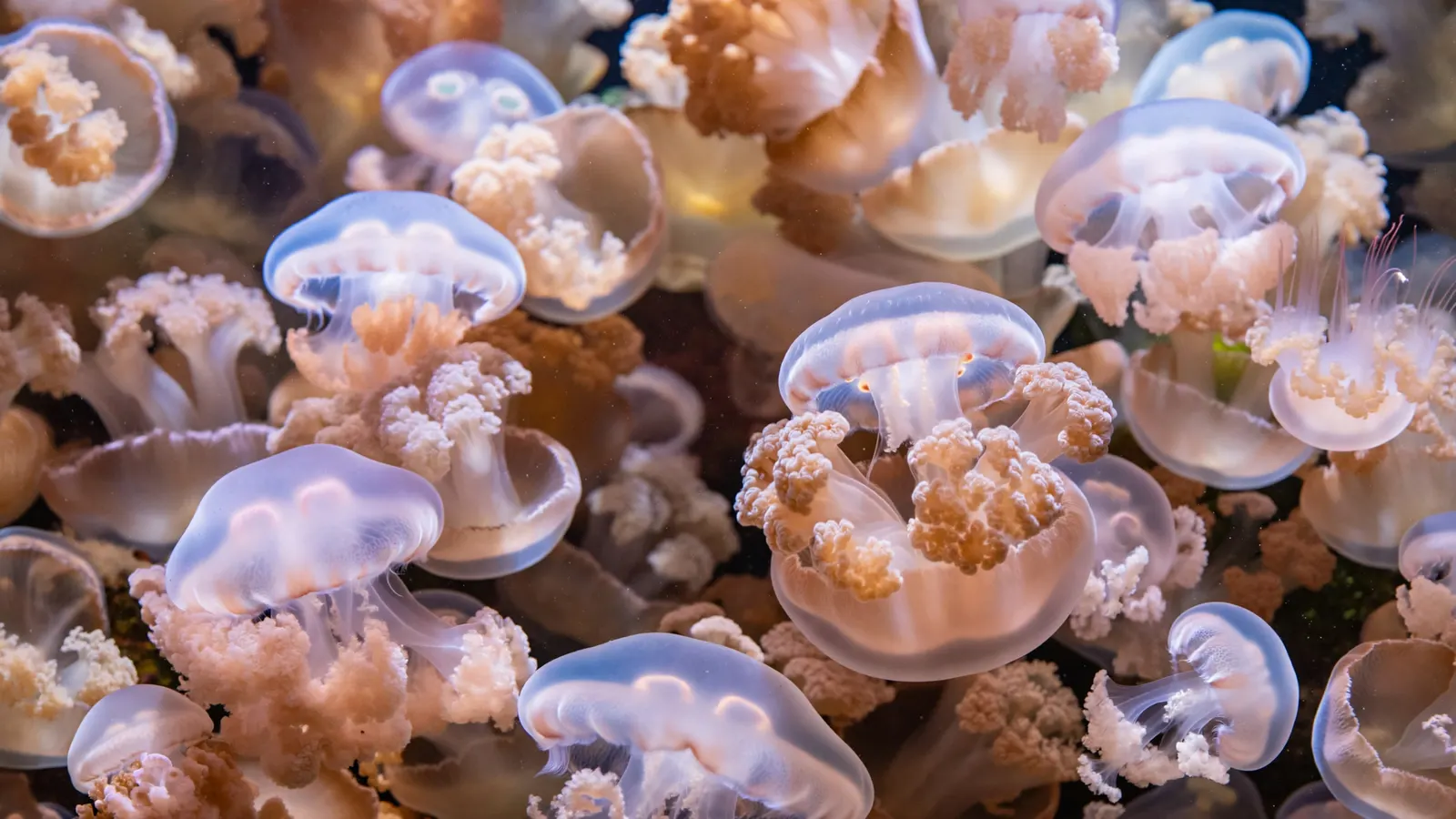
Jellyfish blooms — why populations explode
Jellyfish bloom when conditions align: warm water, abundant food, and the absence of predators. The polyp’s asexual reproduction allows a single individual to produce hundreds of medusae very rapidly.
Jellyfish populations are increasing globally, linked to overfishing (removing their predators and competitors), ocean warming (speeding their metabolism and reproduction), and coastal eutrophication (increasing the plankton they feed on). A single bloom can contain billions of individuals. Some species form blooms so dense they clog power plant cooling intakes and collapse fishing nets — economic impacts worth hundreds of millions of dollars annually.
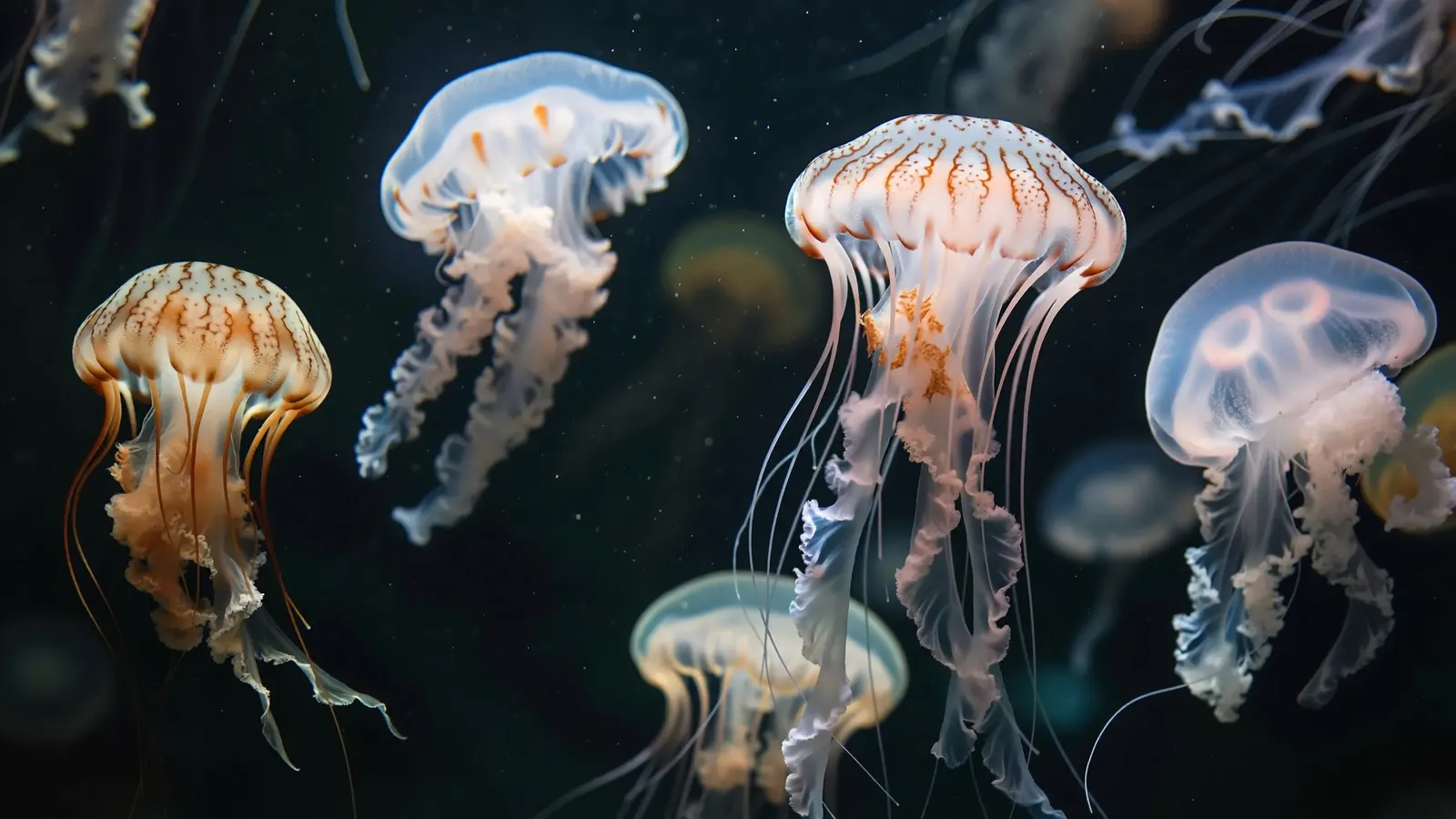
How do jellyfish reproduce?
Jellyfish alternate between sexual and asexual reproduction. Adult medusae (the familiar bell-shaped form) reproduce sexually, releasing eggs and sperm into the water. Fertilised eggs develop into larvae that settle as polyps. Polyps reproduce asexually by strobilation — budding off disc-like juvenile medusae called ephyrae that grow into adults.
Do jellyfish lay eggs?
Most jellyfish release eggs and sperm directly into the water where fertilisation occurs externally. Some species retain eggs inside the female’s body or in specialised structures until they develop into planula larvae. Jellyfish do not lay eggs in the conventional sense — there is no hard shell or discrete egg deposited somewhere.
What is strobilation in jellyfish?
Strobilation is the asexual reproduction process by which a jellyfish polyp produces new medusae. The polyp stacks into horizontal disc-like segments, then releases them one by one from the top — each disc is an ephyra that develops into a full adult jellyfish. A single polyp can produce dozens of ephyrae in one strobilating event.
Is there an immortal jellyfish?
Yes — Turritopsis dohrnii can revert from a mature medusa back to the polyp stage through a process called transdifferentiation. It is the only multicellular animal known to do this. In theory this could repeat indefinitely, though in practice most individuals succumb to predation or disease.
Why are jellyfish increasing in the ocean?
Jellyfish blooms are increasing globally due to overfishing (removing predators like sea turtles and tuna), ocean warming (accelerating their reproduction), and coastal eutrophication (increasing plankton food). Their simple biology and powerful asexual reproduction make them extremely adaptable to changing ocean conditions.
Do jellyfish have brains?
No. Jellyfish have no brain, heart, blood, or bones. Their nervous system is a simple diffuse nerve net spread throughout the body. Some species have basic light-sensing organs and balance receptors. Despite this simplicity, they are effective predators and have survived unchanged for over 500 million years.
The vivid violet medusa of the northeastern Atlantic and North Sea.
The transparent Arctic predator that looks angelic and hunts with evertible hooks.
Every species that defies what you thought you knew about marine life.
Vinegar, Hot Water and When to Get Help.
No — here’s what actually works.
Marks, Rashes and Signs by Species.
Cannonball Jellies and Asian Cuisine.
A smack, a bloom and more.
Blane Perun has been exploring Earth’s oceans and marine life for over 25 years. Founder of TheSea.Org in 1999, underwater photographer, coral aquaculture pioneer, and explorer of 80+ countries.
About Blane Perun →