Crustaceans, Worms & Invertebrates — The Animals That Run the Ocean Floor
This group covers the strangest non-vertebrate animals in the ocean — the crustaceans that farm bacteria on their own fur at hydrothermal vents, the worms with neurotoxic bristles, the snails armoured in iron sulphide, the sponges that eat shrimp, and the tiny crustaceans that quietly support the entire marine food web. They live everywhere from coral reefs to hadal trenches, and they include some of the oldest, hardiest, and most metabolically unusual animals on Earth. Where the fish and jellies get the glamour shots, this is the group doing the actual work of nutrient cycling, sediment turnover, and energy transfer in the world’s oceans.
If you removed every fish from the ocean tomorrow, the ecosystem would survive in some form. Remove the crustaceans, worms, and invertebrates, and the ocean stops functioning. They are the recyclers, the scavengers, the prey base, and the engineers of the seafloor. They are also, individually, some of the most bizarre animals on Earth: a crab that farms bacteria on its own arms, a sponge that traps shrimp, a worm 300 million years old that produces a litre of slime in seconds, a tiny lobster with a serrated claw nearly the size of its body. Fifteen of them are profiled here. The ocean does not run on charisma. It runs on these.
Hydrothermal vent specialists — the chemosynthesis crowd
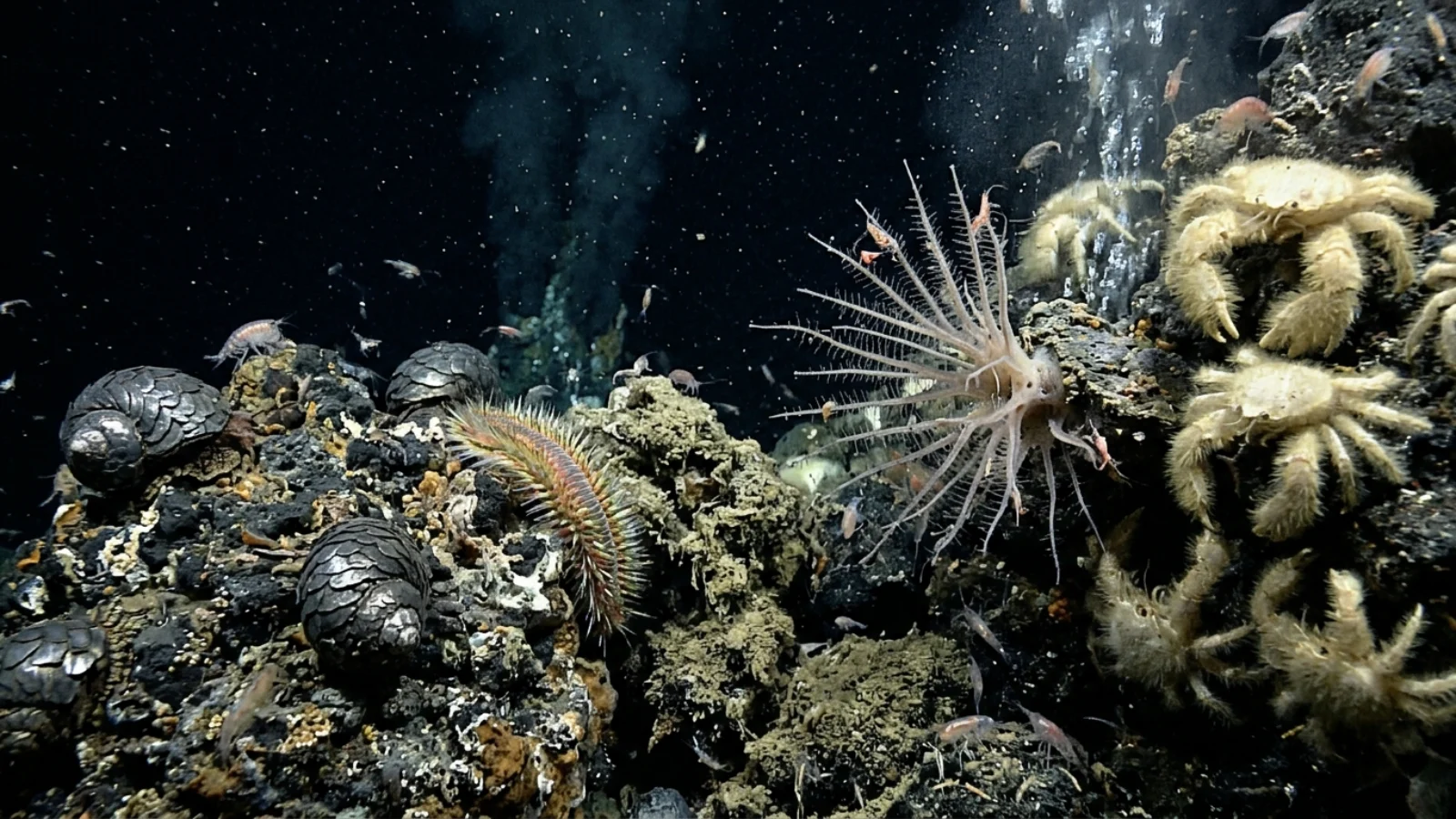
At hydrothermal vents on the deep seafloor, an entirely different food web operates — one based not on sunlight but on chemicals dissolved in superheated vent fluid. The animals that live there have evolved adaptations no surface organism would need.
The yeti crab (Kiwa hirsuta) farms chemosynthetic bacteria on the dense setae covering its claws and underside. The bacteria oxidise hydrogen sulphide and methane from vent fluids; the crab grazes them. The armoured snail (Chrysomallon squamiferum) takes a different approach: it incorporates iron sulphide precipitated from the vent fluid into its shell and into protective sclerites on its foot, becoming the only animal known to wear armour made from a mineral it absorbs from its environment. These animals live in conditions that would dissolve most marine life — temperatures above 400°C at the vent throat, pH values below 4, and concentrations of toxic metals that would kill anything else. They are not surviving despite the chemistry. They are running on it.
The unglamorous backbone — krill, amphipods, isopods, ostracods
The most numerous animals in the ocean are not the photographed giants. They are the small crustaceans — krill, amphipods, isopods, ostracods, copepods, cumaceans — that move through the water column and the seafloor in numbers that defy intuition.
Antarctic krill alone are estimated at roughly 379 million tonnes of biomass, making them collectively the largest single-animal biomass on Earth. Amphipods are the most species-rich crustacean group, found from mountain lakes to the bottom of the Mariana Trench. Isopods, the order that contains the giant deep-sea isopod, also contains the common pill bug; the deep-sea version simply got large. Ostracods, the “seed shrimps” with bivalve shells around their bodies, can survive being eaten alive: they are routinely swallowed by fish and passed through unharmed. Cumaceans, the “comma shrimps,” turn sediment over on the seafloor. None of these animals appear in nature documentaries. They are what the documentaries are eating.
The carnivores you don’t expect — sponges, worms, transparent cucumbers
Some of the strangest animals in this group are not crustaceans at all — they are sponges, worms, and echinoderms that have evolved into hunters, swimmers, or transparent oddities.
The carnivorous harp sponge (Chondrocladia lyra), discovered in 2012 off the California coast at 3,500 m depth, abandoned the typical sponge filter-feeding life and instead traps small crustaceans on velcro-like hooks across its vertical “harp strings.” The bearded fireworm is a reef bristleworm with neurotoxin-tipped white bristles that break off in the skin of anything that touches it. The pink see-through fantasia is a swimming sea cucumber so transparent its intestines are visible through the body wall. The bobbit worm is an ambush predator that buries itself in reef sediment and snaps prey in half with five jaws. The diving bell spider is the only spider known to live underwater for its entire life, carrying its own air supply in a silken bell. These are not edge cases. These are the diversity of a phylum — sponge, worm, echinoderm, arthropod — once you stop assuming what a sponge or a worm is supposed to do.
Are bizarre crustaceans and worms dangerous to humans?
Mostly not. The deep-sea species in this group — yeti crabs, giant isopods, armoured snails, harp sponges — live at depths inaccessible to swimmers and divers. The only real hazards for divers are the surface and reef species: the bearded fireworm’s neurotoxic bristles can cause a burning rash that lasts days if touched, and the bobbit worm’s ambush bite can sever fingers if a hand goes into the wrong sediment hole on a tropical reef. Krill, amphipods, isopods, and ostracods are harmless and microscopic in most contexts. The hagfish’s slime is more of an inconvenience than a threat — it suffocates fish in buckets but not air-breathing humans.
Why are marine crustaceans and worms so important to the ocean ecosystem?
They form the prey base for almost every fish, marine mammal, and seabird in the ocean — krill alone may be the largest single-animal biomass on Earth. They also recycle organic matter on the seafloor, turn over sediment, and fix carbon at hydrothermal vents through chemosynthetic bacteria. Removing fish from the ocean would damage the ecosystem; removing crustaceans, worms, and invertebrates would collapse it.
How does the yeti crab farm bacteria on its own body?
It grows dense setae — hair-like bristles — on its claws and underside that act as a substrate for chemosynthetic bacteria. The bacteria metabolise hydrogen sulphide and methane from hydrothermal vent fluids. The crab waves its claws through the vent flow to keep the bacteria fed, then grazes the bacterial mat off its own bristles. It is one of the few animals known to actively cultivate its own food.
Why is the bearded fireworm dangerous to divers?
Its white bristles are hollow and contain a neurotoxin. On contact with skin, the bristles break off and embed in the surface, releasing the toxin and causing a painful burning rash that can persist for days. The worm itself is not aggressive and is easy to avoid — the danger is from accidentally brushing or grabbing one, which is most common when divers reach for handholds without looking.
How can a sponge be carnivorous?
Most sponges filter water through pores in their bodies and capture microorganisms. The harp sponge does something different: it grows tall vertical branches lined with hooked spicules that function like velcro, snagging small crustaceans that drift past in the deep-sea current. The sponge then envelops the prey with cells and digests it externally. It is a complete departure from typical sponge biology, possible only in low-prey deep-sea conditions where active capture is more efficient than passive filtration.
How does a giant isopod survive 5 years without food?
By dropping its metabolism close to a standstill. Deep-sea isopods evolved in an environment where meals are unpredictable — a whale fall might provide food for years, but the next meal may be a decade away. Their bodies are adapted to compress their metabolic rate to a tiny fraction of normal between feedings. A documented captive isopod in Japan refused all food for over five years and was still alive when it died.
Blane Perun has been exploring Earth’s oceans and marine life for over 25 years. Founder of TheSea.Org in 1999, underwater photographer, coral aquaculture pioneer, and explorer of 80+ countries.
About Blane Perun → More on Bizarre Sea Creatures →