Corallimorphs — Mushroom Corals, False Corals and Their Kin
Corallimorphs are soft-bodied anthozoans in the order Corallimorpharia, known in the aquarium world as mushroom corals, mushroom anemones and false corals. They look and work much like stony coral polyps but never build a skeleton. The World Register of Marine Species lists about 46 species in 11 genera and four families. Most live on tropical reefs, where many host symbiotic algae and catch prey by folding their discs shut; a few, such as the jewel anemones of the genus Corynactis, live in cooler seas. They range from discs a few centimetres across to the giant elephant ear, Amplexidiscus, at around 40–45 cm.
This page is the index for TheSea.Org’s corallimorph section. It summarises what unites the order and then links to every guide, from the genus profiles of Discosoma, Rhodactis and Ricordea to species pages and the colour and care guides used by reef keepers.
What is a corallimorph?
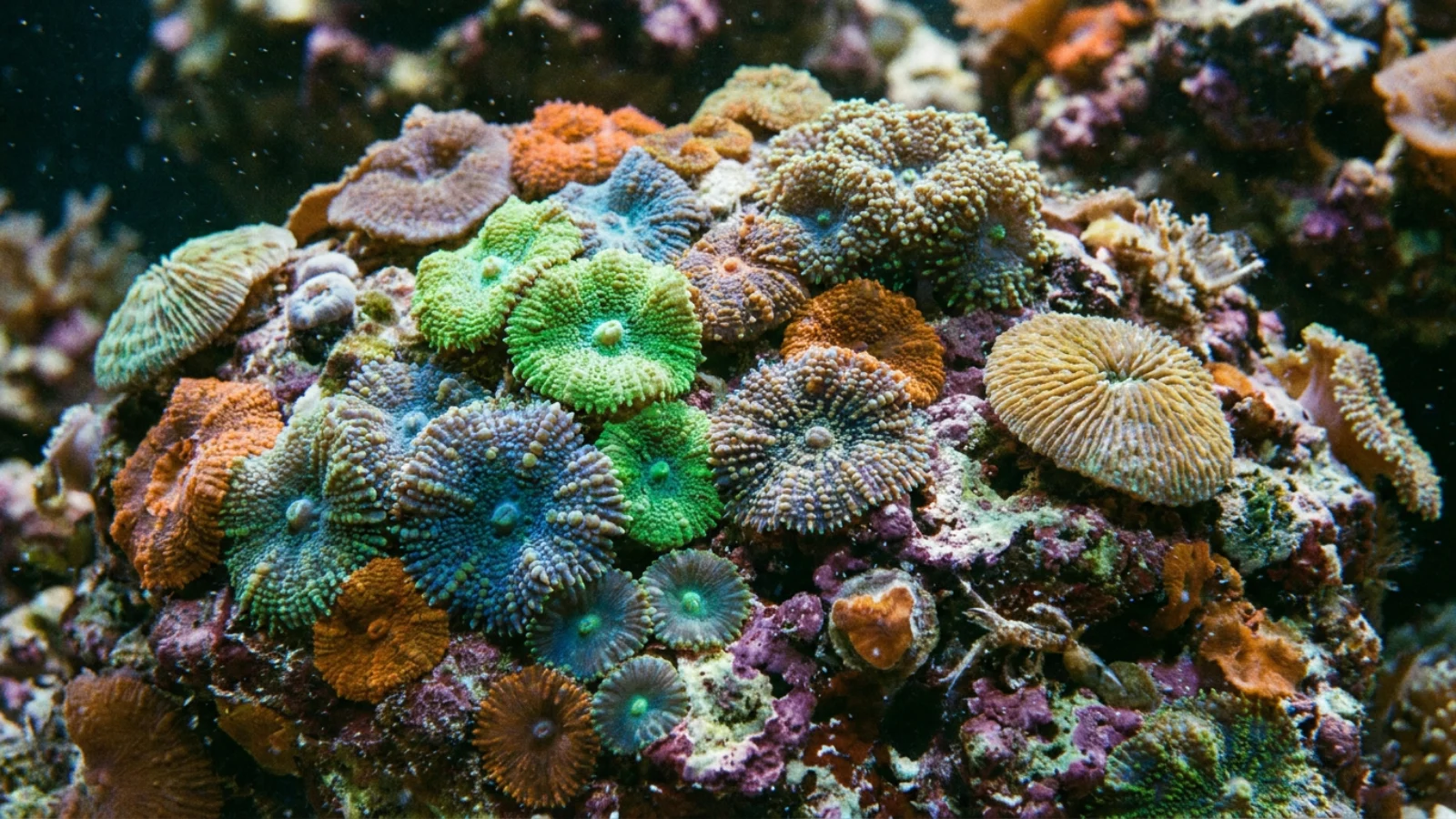
A corallimorph is a single polyp, usually living in clumps of clones. Each polyp has a flat foot attached to rock, a short column, and a broad oral disc with a central mouth. The disc is covered in tentacles, but in most tropical species these are so short that the disc looks smooth, bumpy or fuzzy rather than tentacled. Inside, the anatomy is strikingly coral-like: a single gut cavity partitioned by sheets of tissue called mesenteries, stinging cells of similar types, and a mouth that serves for both feeding and spawning. What is missing is the limestone cup that a stony coral polyp sits in.
That likeness raised an old question. Were corallimorphs simply corals that had lost their skeletons, perhaps during episodes in Earth’s history when ocean chemistry made calcification hard? This idea, the naked coral hypothesis, was tested with genome-scale data by Wang and colleagues in 2017, who placed corallimorphs as a sister group to the stony corals rather than a branch nested inside them. Corallimorphs and stony corals share a common ancestor, but corallimorphs did not descend from skeleton-building corals.
How are corallimorphs classified?
The order is small. Four families are currently recognised. Corallimorphidae, with about 21 species, includes many of the cooler-water and deeper forms, such as Corynactis, with a longer column and more obvious knobbed tentacles. Discosomidae, also about 21 species, contains the familiar tropical mushrooms: Discosoma, Rhodactis, Amplexidiscus and their relatives. Ricordeidae contains a single genus, Ricordea, with two species. Sideractinidae contains two small, little-known species. The boundaries between some genera and species, particularly among the large-disc Rhodactis-type mushrooms, remain unsettled, and several animals have carried three or more names since the nineteenth century.
How do corallimorphs feed?
Most tropical corallimorphs are mixotrophs. Their tissues hold zooxanthellae, single-celled algae that photosynthesise and pass sugars to the host, and they add to that energy by catching food. Their hunting method is unusual. In a 1980 study on the Great Barrier Reef, William Hamner and Daphne Dunn showed that several corallimorphs feed by envelopment: when prey touches the disc, its edges rise and close over it like a purse. The giant Amplexidiscus fenestrafer could close completely within about three seconds and, in aquariums, captured anemonefish. The researchers found that these species lack stinging cells on the outer surface of their disc tentacles, carrying them instead inside the body, and that enclosed prey was subdued by a substance that stopped it moving.
How do corallimorphs reproduce?
Both sexually and asexually. Sexually, corallimorphs release eggs and sperm, and the resulting planula larvae drift before settling as new polyps; in the Florida false coral, Ricordea florida, research in the Florida Keys found separate male and female polyps that spawn in late June to early July. Asexually, they clone in several ways: splitting lengthwise through the mouth, budding new polyps from the disc edge or column, and pedal laceration, in which fragments of the foot left behind as the animal creeps across rock grow into new polyps. Cloning is what turns a single polyp into a patch, and it is also what makes corallimorphs so easy to propagate in aquariums.
Why do corallimorphs matter on reefs?
Because they can take over space. Corallimorphs clone quickly, by splitting, budding and pedal laceration, and they do not spend energy on a skeleton. When reefs are disturbed by storms, bleaching or pollution, corallimorph carpets can spread over dead coral and hold that space against returning coral larvae. The best-documented example is at Palmyra Atoll in the central Pacific, where Rhodactis howesii spread across about a square kilometre of reef around a fishing vessel wrecked in 1991, reaching an average of 288 polyps per square metre near the wreck, where coral cover fell below 1%. Iron leaching from the steel hull was proposed as a possible trigger.
Why do corallimorphs matter in science?
Their colours have transformed biology. In 1999 Mikhail Matz and colleagues isolated a red fluorescent protein, DsRed, from a Discosoma mushroom, which emits light at about 583 nm. Engineered descendants, including the widely used mCherry described in 2004, are now standard tools for tracking proteins inside living cells. Other corallimorph proteins, such as the cyan dsFP483 from Discosoma striata, help researchers understand how small changes in a protein shift its colour. Corallimorphs are also studied as models of how cnidarians partner with algae, and, because they are so close to stony corals, as a comparison group for understanding how corals build skeletons and respond to warming.
Why are corallimorphs popular in aquariums?
They combine colour, hardiness and easy propagation. Most Discosoma mushrooms tolerate a wide range of water conditions and modest lighting, and they grow well without the calcium and alkalinity that stony corals need. Rhodactis hairy mushrooms add texture and a visible feeding response, and Ricordea offer some of the brightest multicoloured polyps in the hobby. All can be propagated by cutting or by letting them clone, so most corallimorphs in the trade today are aquacultured. Their main drawbacks are their ability to spread across rock and to sting and shade neighbouring corals, so they need planned placement. The guides below cover each group in depth, from wild biology to tank care.
How should you use this section?
Start with the overview of what aquarists call mushroom corals, which also explains the confusion with the stony Fungiidae mushroom corals of the reef. Then read the genus pages for the animals you keep or want to keep. Species pages go deeper into individual animals, including the Florida Keys research on Ricordea florida and the long naming history of Platyzoanthus mussoides. The colour pages explain the protein science behind red, blue and green mushrooms, and the care and propagation guides cover practical husbandry.
What are corallimorphs?
Skeleton-free anthozoans of the order Corallimorpharia, known as mushroom corals or false corals.
How many corallimorph species are there?
About 46 in 11 genera and four families, according to WoRMS.
Are corallimorphs corals?
Not true corals. Genome studies show they are a sister group to stony corals.
Are corallimorphs anemones?
No. They are a separate order, though often called mushroom anemones.
What is the largest corallimorph?
Amplexidiscus fenestrafer, with a disc of about 40 to 45 cm.
Can corallimorphs harm reefs?
They can spread over disturbed reefs, as at Palmyra Atoll.
Where does mCherry come from?
It was engineered from DsRed, a red protein of a Discosoma corallimorph.
Are corallimorphs good for beginners?
Discosoma mushrooms especially are hardy and easy to keep.
- World Register of Marine Species: Corallimorpharia (species, genera and families).
- Wang, X. et al. (2017). Phylogenomic study of Corallimorpharia and Scleractinia rejecting the naked coral hypothesis.
- Hamner, W.M. & Dunn, D.F. (1980). Tropical Corallimorpharia: feeding by envelopment. Micronesica 16(1).
- Work, T.M., Aeby, G.S. & Maragos, J.E. (2008). Phase shift from a coral to a corallimorph-dominated reef associated with a shipwreck on Palmyra Atoll. PLoS ONE 3(8): e2989.
- Matz, M.V. et al. (1999). Fluorescent proteins from nonbioluminescent Anthozoa species. Nature Biotechnology 17: 969–973.
Blane Perun has been exploring Earth’s oceans and marine life for over 25 years. Founder of TheSea.Org in 1999, underwater photographer, coral aquaculture pioneer, and explorer of 80+ countries.
About Blane Perun →