Anemone Shrimp — The Glass Cleaners That Live Among Stinging Tentacles
Anemone shrimp are small, mostly transparent shrimp that live among the stinging tentacles of sea anemones. Most are only a couple of centimetres long; Pederson’s cleaner shrimp, the Caribbean classic, measures about 1.8–2.5 cm. The best known belong to the family Palaemonidae, in the genera Ancylomenes and Periclimenes, and many of them run cleaning stations, picking parasites and dead tissue off fish that come to the anemone. The anemone gives the shrimp a fortress few predators will enter.
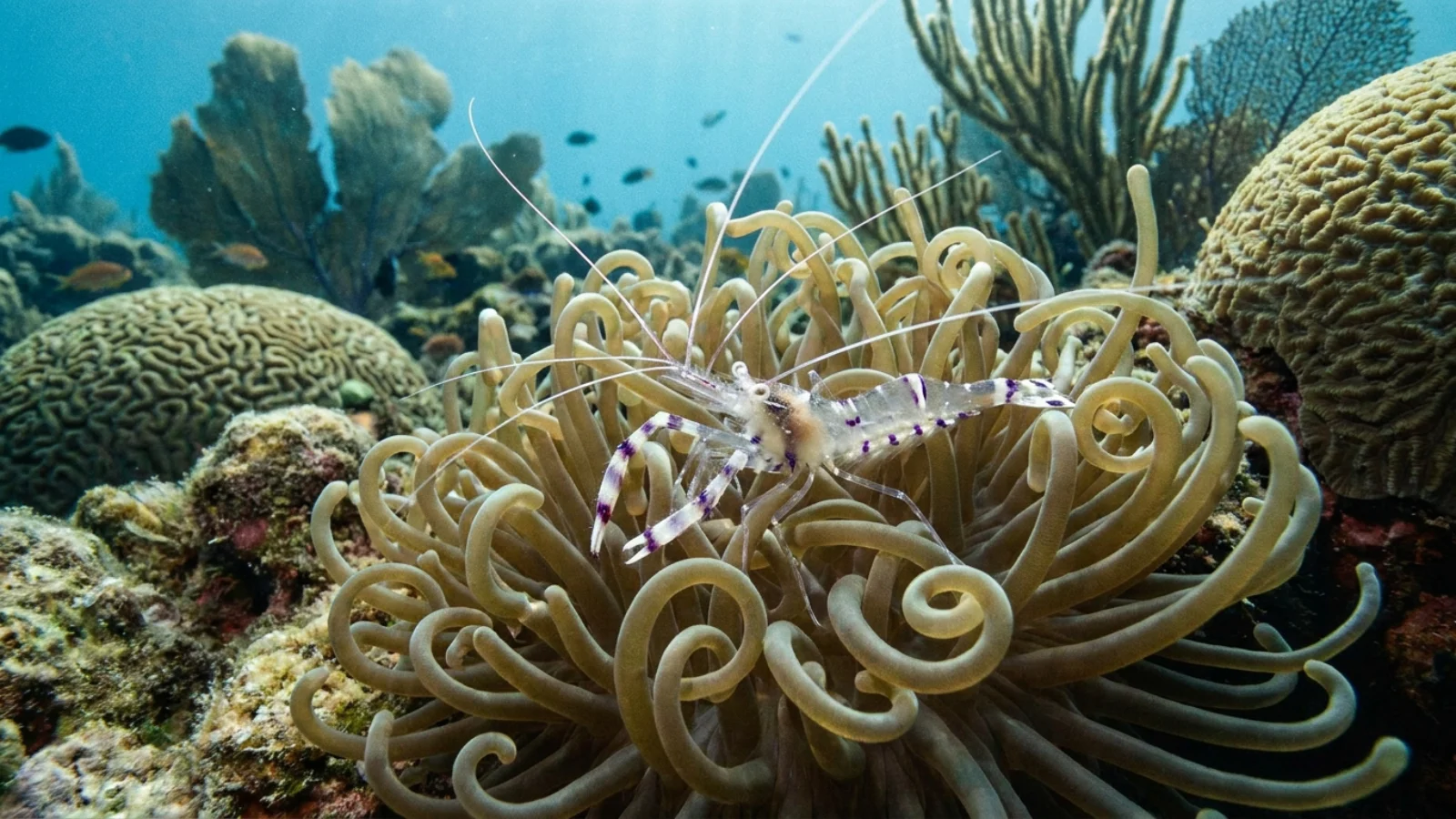
Divers who slow down beside a corkscrew or giant anemone in the Caribbean will often see a nearly invisible shrimp waving its long white antennae at passing fish. That small scene is one of the best-studied partnerships on the reef, involving three parties: the shrimp, its host anemone and the fish that come to be cleaned.
Which shrimp are anemone shrimp?
“Anemone shrimp” describes a lifestyle shared by several genera, not a single species. Most are pontoniine shrimps of the family Palaemonidae. For a long time nearly all of them were placed in the big genus Periclimenes, which the World Register of Marine Species (WoRMS) still credits with 110 accepted species. In 2010 Okuno and Bruce split off a new genus, Ancylomenes, for the so-called Periclimenes aesopius species group, defined by details of the eye socket and the base of the antenna. Fourteen species already belonged to that group, and three more, including the Caribbean Pederson’s shrimp, were moved into it. WoRMS now lists 22 accepted Ancylomenes species. A third, unrelated genus, Thor, in the family Thoridae, includes the popular “sexy shrimp”.
| Species | Region | Usual hosts | Notes |
|---|---|---|---|
| Pederson’s cleaner, Ancylomenes pedersoni (Chace, 1958) | Caribbean | Corkscrew anemone, giant anemone | Dedicated cleaner |
| Spotted cleaner, Periclimenes yucatanicus (Ives, 1891) | Caribbean | Corkscrew and giant anemones | Brief, hesitant cleaner |
| Holthuis’s anemone shrimp, Ancylomenes holthuisi (Bruce, 1969) | Indo-Pacific | Anemones and some corals | Popular in aquariums |
| Magnificent anemone shrimp, Ancylomenes magnificus (Bruce, 1979) | Indo-Pacific | Large anemones | Cleaner |
| Sexy shrimp, Thor amboinensis (De Man, 1888) | Tropical seas worldwide | Anemones, corals | A complex of several species |
The names show how long it took to sort these animals out. The spotted cleaner was described in 1891, but Pederson’s shrimp was only named in 1958, by Fenner A. Chace Jr., as Periclimenes pedersoni; a shrimp described in 1964 as P. anthophilus later proved to be the same species. Many of the Indo-Pacific species were named by Bruce between the 1960s and 1980s, and new ones are still being described.
Is the sexy shrimp one species?
Probably not. Thor amboinensis, the small brown shrimp with white spots that holds its tail cocked over its back and sways it, has long been treated as a single species found in tropical seas around the world. In 2018 Titus and colleagues tested that idea with DNA from 83 individuals collected at 30 localities. They found at least five deeply separated lineages, differing by 9% to 22% in a mitochondrial gene: four in the Indo-West Pacific and one in the tropical western Atlantic. Surprisingly, lineages found only in Japan and the south-central Pacific were more closely related to the Atlantic lineage than to a widespread Indo-West Pacific lineage living alongside them. In the Atlantic, by contrast, 303 shrimp from ten localities showed little genetic structure across more than 3,000 km. The “sexy shrimp” in aquarium shops may therefore belong to any of several species that look almost identical.
What is Pederson’s cleaner shrimp like?
Pederson’s shrimp is a small, transparent shrimp with bluish and violet markings on its body and long white antennae; within its range it is unlikely to be confused with other species. Reef guides give its length as about 1.8–2.5 cm (0.75–1 in). It lives in the Caribbean in shallow water, recorded at about 1 to 15 m in some sources and 3 to 18 m in others, almost always on a sea anemone: the corkscrew anemone, Bartholomea annulata, or the giant Caribbean anemone, Condylactis gigantea.
The corkscrew anemone is one of the commonest anemones on Caribbean reefs. Fully extended it can reach 30 cm across, with an oral disc up to 12 cm wide and about two hundred long, translucent tentacles ringed with spirals of stinging cells, which give it its name. Up to 26 Pederson’s shrimp have been found on one anemone, but usually there are just one or two. A shrimp fish want to visit announces itself by lashing its white antennae and swaying its body. Clients that come in hold still while the shrimp removes and eats their external parasites, and it will even work inside the gill covers and the mouth. If a neon goby sets up a cleaning station nearby, shrimp and goby may clean the same fish at the same time.
How do anemone shrimp run a cleaning station?
Much of what is known comes from studies by Huebner and Chadwick in St Thomas, US Virgin Islands. In a paper published online in 2011 they recorded Pederson’s shrimp cleaning clients from at least 16 fish families, three of them never before reported as shrimp clients. Most cleaning bouts lasted less than 20 seconds. Surgeonfish were cleaned most often, but lizardfish and groupers received the longest cleans. The shrimp lived in social groups on their anemones, and both the number and the duration of cleans at a station rose with the number of resident shrimp. Most anemones hosted fewer than four shrimp, and larger groups of up to nine were rare. Some client fish chased others away and monopolised a station, so the fish themselves help shape who gets cleaned.
The anemone matters as much as the shrimp. In a 2012 study the same researchers showed that reef fishes use sea anemones as visual cues for cleaning interactions with shrimp. A large, conspicuous anemone works like a sign over a shop door, and the larger the anemone, the more likely fish are to visit it. Because the shrimp are almost transparent, the anemone is what a passing fish actually sees.
Do anemone shrimp really remove parasites?
For Pederson’s shrimp, the answer is yes. Cleaner shrimps were long assumed to remove parasites, but this was only demonstrated experimentally relatively recently. A 2010 study by McCammon, Sikkel and Nemeth tested the effects of three Caribbean cleaner shrimps on parasitic flatworms called monogeneans on fish held in a semi-natural setting. Later work has reinforced Pederson’s shrimp’s special status. In a stable isotope study posted in 2023, Titus and colleagues analysed six crustaceans that live together around corkscrew anemones and found that they occupy very different feeding niches, spanning three trophic levels. Only Pederson’s shrimp had nitrogen isotope signatures consistent with a dedicated cleaning lifestyle. Other species reported to clean fish, including the spotted cleaner shrimp, the banded coral shrimp and the arrow crab, fed at clearly lower trophic levels.
The spotted cleaner shrimp, Periclimenes yucatanicus, had long been a puzzle. Only one cleaning interaction had been seen in the wild, and in the one test of its effectiveness it did not reduce parasite loads on surgeonfish, so some researchers suggested it was a mimic that looked like a cleaner without really cleaning. In 2017 Titus, Vondriska and Daly filmed both species in Curaçao. The spotted shrimp did signal to fish, received regular visits and genuinely cleaned them, so the mimic idea was rejected. But its stations received significantly fewer visits and cleans than those of Pederson’s shrimp, and half of all its cleaning interactions lasted less than 10 seconds in total. The authors described it as a true but hesitant cleaner.
What does the anemone get out of it?
The benefits to the host are harder to measure. A 2.5-year study of corkscrew anemones and their crustacean partners at two reef sites in St Thomas, published in 2019 by Huebner and colleagues in Marine Ecology Progress Series, found that larger anemones were more likely to be occupied, especially at an offshore site where anemones were smaller and scarcer. Four anemone shrimp species divided the anemone’s body into separate zones. Anemone survival depended mostly on the anemone’s own size, with smaller effects of site and shrimp species. At the inshore site, one cleaner shrimp helped small anemones survive but reduced the presence of another, occasional cleaner, evidence of both mutualism and competition on the same host. The associations shifted between seasons, years and sites.
For the shrimp, the host clearly matters. A 2015 study in Panama by McKeon and O’Donnell measured the number of eggs carried by spotted cleaner shrimp on two different anemone species. Fecundity varied between hosts, but the difference was explained largely by host size rather than species, suggesting that shrimp on bigger anemones simply do better, which could favour choosy shrimp.
Which anemones host anemone shrimp?
In the Caribbean, the two main hosts are the corkscrew anemone and the giant Caribbean anemone. The corkscrew anemone ranges from Bermuda, Florida and Texas to the northern coast of South America. It lives on reefs and on rubble or sand down to about 40 m, usually in a hole or crevice or under a rock, and pulls back out of sight if disturbed. Besides Pederson’s and spotted cleaner shrimps, it shelters other small crustaceans, including an opossum shrimp, Heteromysis actiniae; one isotope study counted six crustacean species living together around these anemones. The giant Caribbean anemone is much bigger, with a disc that can reach roughly 40 cm in nature and 100 or more tentacles, often tipped purple or pink. It shelters several fish and cleaner shrimp species and serves as a base station for fish cleaning.
In the Indo-Pacific, the big anemones that host clownfish often host shrimp too. The magnificent sea anemone, Heteractis magnifica, shelters a dozen or more clownfish species, the threespot dascyllus and various commensal shrimps. The bubble-tip anemone, Entacmaea quadricolor, which can grow to 30 cm across and hosts 14 clownfish species, about half of all of them, also associates with shrimps such as Periclimenes brevicarpalis. On these reefs a single anemone can therefore be home to clownfish, damselfish and shrimps at once, each with its own way of avoiding the stinging cells.
How do anemone shrimp avoid being stung?
Like clownfish and the anemone crab, anemone shrimp have to acclimatise to their hosts. A Pederson’s shrimp does this by pressing its body and legs against the tentacles for progressively longer periods. After that it can move among the tentacles without being stung, but if it is separated from its host for a few days it has to repeat the process. Exactly how the protection works is not fully understood. It is thought that the shrimp’s surface chemistry, perhaps including mucus picked up from the host, stops the anemone’s stinging cells from firing.
What do anemone shrimp eat?
Dedicated cleaners such as Pederson’s shrimp eat parasites, dead skin and mucus from client fish. Anemone shrimp in general also scavenge particles, take scraps from the anemone’s meals and pick at the host’s mucus, and the isotope work shows that species sharing one anemone can feed very differently. In aquariums they accept small frozen foods. They do not harm their anemones under normal conditions.
Can you keep anemone shrimp in a reef tank?
Yes. Species such as Holthuis’s anemone shrimp and the sexy shrimp are popular in nano and mixed reef tanks. Give them a host, either an anemone or, for some species, a large-polyp coral, and keep them away from fish large enough to eat small shrimp. Like other invertebrates they need stable water conditions, especially when moulting. Small groups of the same species usually live together on one large host, and in the wild several species may share an anemone, each in its own zone. Because some “species” in the trade, notably the sexy shrimp, are really groups of look-alikes, aquarium specimens are best labelled by collection locality as well as by name. For hosts, see sea anemones and carpet anemone.
How can divers see anemone shrimp?
In the Caribbean, look for corkscrew anemones in holes and crevices and for giant anemones on shallow reefs, then check the tentacles closely for transparent bodies and white antennae. Hold position just outside arm’s reach and wait rather than moving in. Shrimp at the tentacle tips often start waving, and with patience a client fish, often a surgeonfish, the family cleaned most often in the St Thomas study, may slide in and hold still to be cleaned. Never touch the anemone or the shrimp; handling stresses both.
How are anemone shrimp related to other cleaners?
Anemone shrimp are palaemonids, a different family from the Lysmata cleaner shrimps, such as the fire shrimp, and from the banded coral shrimp. Cleaner shrimps are found in at least five families: Lysmatidae (formerly part of Hippolytidae) and Palaemonidae contain most of them, while Alpheidae, Pandalidae and Stenopodidae each include at least one cleaning species. Cleaning has evolved several times in shrimp, so similar behaviour hides very different family trees. For more species, see cleaner shrimp and the reef shrimp hub.
What is an anemone shrimp?
A small, mostly transparent shrimp that lives among the tentacles of a sea anemone, often working as a cleaner of fish.
Do anemone shrimp need an anemone?
In the wild most species live on hosts. In aquariums some accept corals, but an anemone is the most natural host.
How big do anemone shrimp get?
Most are only a couple of centimetres long. Pederson’s cleaner shrimp is about 1.8–2.5 cm.
Do anemone shrimp clean fish?
Many do. Pederson’s cleaner shrimp has been recorded cleaning fish from at least 16 families.
Why don’t anemones sting anemone shrimp?
The shrimp acclimatise by pressing against the tentacles for longer and longer periods; separated for a few days, they must repeat it.
Is the spotted cleaner shrimp a real cleaner?
Yes. A 2017 study confirmed it cleans fish, but its cleans are brief and its stations get far fewer visits than Pederson’s.
Is the sexy shrimp an anemone shrimp?
It lives on anemones and corals but is a Thor shrimp, not a dedicated cleaner, and genetics show it is a complex of several species.
- Huebner & Chadwick (2012). Patterns of cleaning behaviour on coral reef fish by the anemoneshrimp Ancylomenes pedersoni. Journal of the Marine Biological Association of the UK. doi:10.1017/S0025315411001822; and (2012). Reef fishes use sea anemones as visual cues for cleaning interactions with shrimp. JEMBE. doi:10.1016/j.jembe.2012.01.004
- Huebner et al. (2019). Crustacean symbiosis with Caribbean sea anemones Bartholomea annulata: occupancy modeling, habitat partitioning, and persistence. Marine Ecology Progress Series 631:99–116. doi:10.3354/meps13160
- Titus, B.M., Vondriska, C. & Daly, M. (2017). Comparative behavioural observations demonstrate the ‘cleaner’ shrimp Periclimenes yucatanicus engages in true symbiotic cleaning interactions. Royal Society Open Science. doi:10.1098/rsos.170078
- Titus, B.M. et al. (2023, preprint). Stable isotopes disentangle niche partitioning and species co-occurrence in a multi-level marine mutualism. bioRxiv. doi:10.1101/2023.11.22.568307
- Titus, B.M. et al. (2018). Global species delimitation and phylogeography of the circumtropical ‘sexy shrimp’ Thor amboinensis. Journal of Biogeography. doi:10.1111/jbi.13231
- McCammon, A., Sikkel, P.C. & Nemeth, D. (2010). Effects of three Caribbean cleaner shrimps on ectoparasitic monogeneans in a semi-natural environment. Coral Reefs. doi:10.1007/s00338-009-0583-8; McKeon, C.S. & O’Donnell, J.L. (2015). Variation in partner benefits in a shrimp–sea anemone symbiosis. PeerJ. doi:10.7717/peerj.1409
- Okuno, J. & Bruce, A.J. (2010). Designation of Ancylomenes gen. nov. for the ‘Periclimenes aesopius species group’. Zootaxa 2372. doi:10.11646/zootaxa.2372.1.11; WoRMS genus lists for Ancylomenes, Periclimenes and Thor (checked November 2026).
- Wikipedia: Ancylomenes pedersoni; Bartholomea annulata; Cleaner shrimp. Florent’s Guide to the Tropical Reefs: Pederson cleaner shrimp (size, depth).
Blane Perun has been exploring Earth’s oceans and marine life for over 25 years. Founder of TheSea.Org in 1999, underwater photographer, coral aquaculture pioneer, and explorer of 80+ countries.
About Blane Perun →