Fire Shrimp — The Scarlet Cleaner of Indo-Pacific Caves
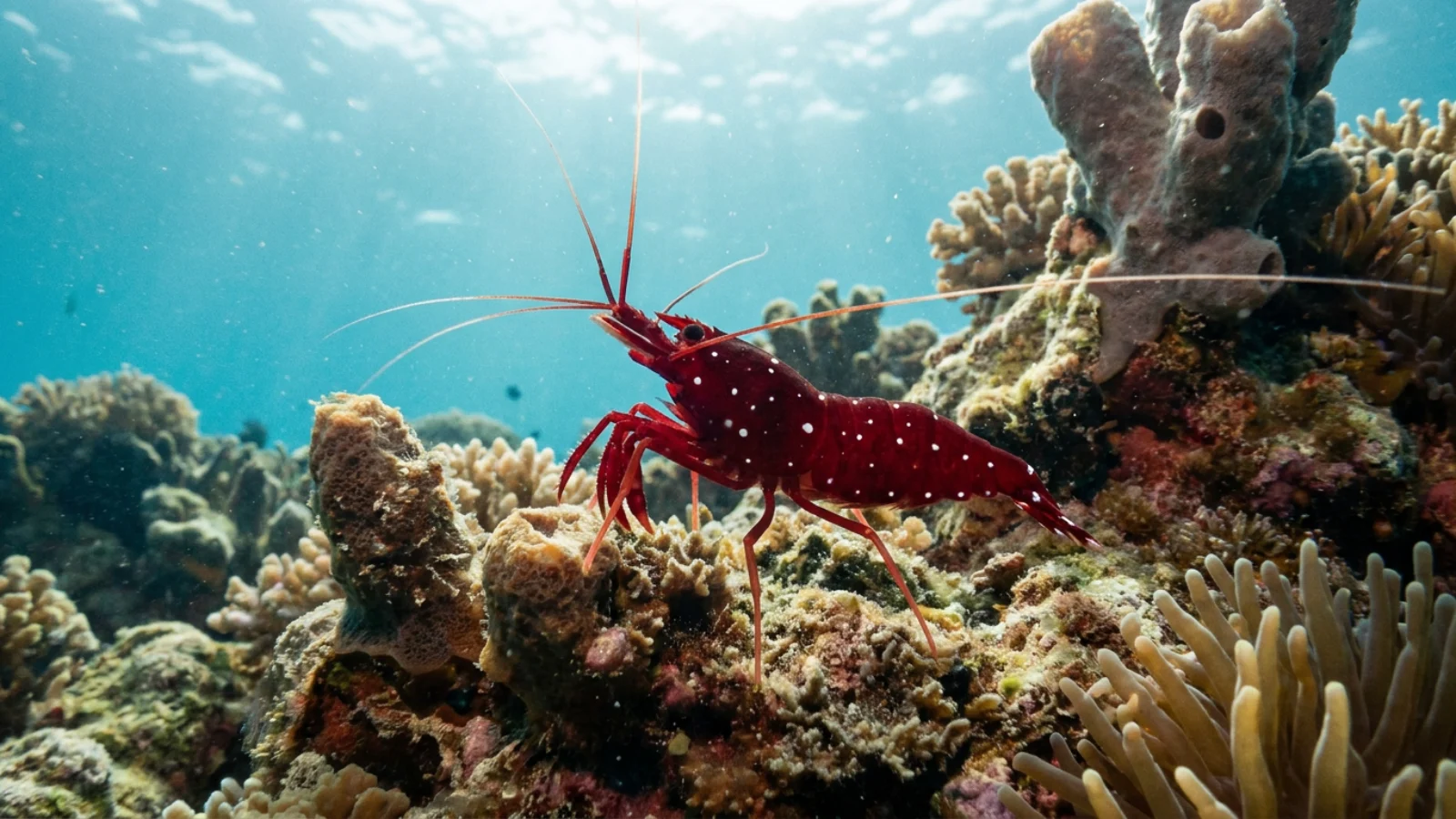
The fire shrimp (Lysmata debelius) is a small Indo-Pacific cleaner shrimp, up to about 3 cm long, colored deep scarlet with white spots on the body and white legs and antennae. It lives in caves and under ledges, recorded at about 20–30 m, cleans parasites and dead skin from fish, and is one of the most popular invertebrates in the reef aquarium hobby.
It is the same animal sold as the blood shrimp; our blood shrimp page covers the naming confusion and its relatives. This page focuses on biology and care. Compared with the open, bold skunk cleaner shrimp, the fire shrimp is shyer, prefers darker overhangs, and spends more of its time hidden.
What does a fire shrimp look like?
The body is a rich blood red with a scattering of small white spots on the carapace. The walking legs are white, and the long antennae are white, which makes the shrimp visible to fish looking for a cleaner in a dark cave. The species was described by A. J. Bruce in 1983 and named after Helmut Debelius, the German underwater photographer and author (see below).
Where do fire shrimp live?
Fire shrimp live on Indo-Pacific reefs, mostly in deeper water than many cleaner shrimp. They are recorded at about 20 to 30 m (SeaLifeBase), in caves, crevices and beneath ledges, often in pairs or small groups and sometimes alongside moray eels. SeaLifeBase lists the species from the Indo-Pacific, including French Polynesia. Its preference for dim, deeper habitats is one reason aquarists recommend giving it shaded rockwork.
What do fire shrimp eat?
Fire shrimp are facultative cleaners. They pick parasites, dead skin and mucus from fish that visit their station, and they scavenge detritus and leftovers the rest of the time. In aquariums they accept frozen mysis, brine shrimp, pellets and flakes, and they often climb onto a diver’s or aquarist’s hand to “clean” it. Some individuals eat Aiptasia anemones, but they are not reliable for it; peppermint shrimp are the usual choice.
| Cleaner shrimp | Color | Habitat preference | Boldness |
|---|---|---|---|
| Fire shrimp (L. debelius) | Scarlet, white spots | Deeper caves, ~20–30 m | Shy at first |
| Skunk cleaner (L. amboinensis) | Red-and-white stripe on yellow | Open reef, cleaning stations | Very bold |
| Peppermint (L. wurdemanni complex) | Translucent with red lines | Rubble and rock | Nocturnal |
| Banded coral shrimp | Red-and-white bands | Crevices, often in pairs | Territorial |
How do fire shrimp reproduce?
Like other Lysmata, fire shrimp are protandric simultaneous hermaphrodites. Each young shrimp first matures as a male; later it becomes a “female-phase” adult that can produce eggs and still fertilize other shrimp. That means any two adults can mate. A female-phase shrimp mates right after molting and carries the green-to-bronze eggs under its abdomen. The larvae usually hatch at night, shortly before the parent’s next molt.rsquo;s next molt.
Aquarium breeding of fire shrimp is well established. Pairs spawn regularly in home tanks, and the larvae have been reared to settlement by hobbyists and commercial breeders, though the long larval period makes it challenging.
How the fire shrimp was discovered and named
The fire shrimp is a relatively recent addition to science. The carcinologist A. J. Bruce described it in 1983 from type specimens collected at Polillo Island in the Philippines. The species name honors Helmut Debelius, the German underwater photographer and author who collected the specimens and sent them to be identified. That makes the fire shrimp one of a number of reef animals that first reached scientists through divers and the aquarium world rather than through formal expeditions.
The name also covers a close look-alike. A divergent population from Ari Atoll in the Maldives was later described as a separate species, Lysmata splendida, by the Russian zoologist Rudolf Burukovsky. The two are best separated by the white dots: L. debelius has white dots on the front part of the body (the cephalothorax) and on the legs, while L. splendida also has white dots on the abdomen. Anyone photographing a “fire shrimp” in the Maldives is therefore worth a second look.
Fire shrimp, blood shrimp, scarlet cleaner shrimp and cardinal shrimp are all trade names for L. debelius. Our blood shrimp page covers the naming tangle in more detail, while this page concentrates on biology, behavior and breeding.
Size, color and how to recognize one
Species accounts give a maximum length of about 3 centimeters, not counting the antennae, with males and hermaphrodite-phase adults looking alike. The body is a deep red. The long antennae are white, and the third to fifth pairs of walking legs have white tips. Small white dots are scattered over the front of the body and the legs.
Those white antennae matter. Fire shrimp live in dim caves and under overhangs, where a red body is hard to see, because red light is filtered out quickly with depth. White, by contrast, stays visible. Research on other cleaner shrimps has shown that full-time cleaners can have specially structured antennae that reflect more light than those of non-cleaners, and waving them is how many cleaners announce their services; our cleaner shrimp page covers that work.
Depth and range
Published depth records for the fire shrimp are limited. SeaLifeBase gives a depth range of about 20 to 30 meters, based on records from French Polynesia, and aquarium references often quote a slightly wider band from around 10 meters down. Across its Indo-Pacific range it is most often found in caves, crevices and under ledges, typically in pairs or small groups, and sometimes alongside moray eels. Its preference for darker and deeper places than the skunk cleaner shrimp means many divers never see one, even on reefs where it is common. The species has not been evaluated for the IUCN Red List.
Pairs that recognize each other by smell
Fire shrimp in the wild and in aquariums usually live as pairs, and a 2021 study by X. Liu and colleagues explored how a pair holds together. They tested shrimp in a Y-shaped maze that blocked sight and touch, so only waterborne chemicals could pass between them. A focal shrimp, acting in the male role, chose between chambers holding its own partner and a stranger in different reproductive states.
When the stranger was not in a receptive female state, the focal shrimp spent more time near its partner. When the stranger was a receptive female and the partner was not, it preferred the stranger. When both were receptive females, it still spent more time near the stranger. The researchers concluded that fire shrimp recognize each other through individual-specific odors rather than sight, and that chemical cues help maintain their social monogamy, although a partner can be overridden by an attractive newcomer.
The same study recorded the fire shrimp’s mating behavior for the first time. Unlike its relatives, it showed no courtship at all. The peppermint shrimp L. wurdemanni, which lives in dense aggregations, has the most elaborate courtship rituals of the three species compared; the skunk cleaner L. amboinensis, which lives at lower densities, has less; and the fire shrimp, living in pairs, has none. The authors suggested that the amount of courtship falls as population density falls, because a shrimp with only one available partner has little need to compete for attention.
For aquarists, the study adds a reason to keep fire shrimp as a single pair. Because every adult can act as both sexes, any two fire shrimp can form a pair, but a third shrimp is a potential rival for a partner that can be lured away by the scent of a receptive stranger, and groups of three or more in a small tank are the ones most often reported to fight. Adding both shrimp at the same time, or adding a mate to an established single shrimp, gives the pair the best start.
One pair, a steady stream of larvae
Every fire shrimp first matures as a male and later becomes a hermaphrodite that can both produce eggs and fertilize another shrimp’s eggs. Mating takes place right after the egg-bearing partner molts, and that shrimp then carries the eggs under its abdomen until they hatch, usually at night, shortly before its next molt. In a pair, both shrimp can brood eggs, each on its own molting cycle. Accounts describe the hatching, molting and mating cycle as matching that of the peppermint shrimp L. wurdemanni, and with two hermaphrodites alternating, a single pair can release batches of larvae roughly every week.
Farming fire shrimp instead of collecting them
Because fire shrimp are in high demand for aquariums, they have been a focus of efforts to replace wild collection with captive breeding. An early report by Fletcher and colleagues (1995) on fire shrimp, skunk cleaners and banded coral shrimp noted that collecting these animals can involve direct damage to coral reefs, and concluded that they could be raised using standard methods developed for farming food shrimp.
Later work refined those methods. In Portugal, R. Calado and colleagues (2007) designed a recirculating system for breeding pairs of ornamental decapods, including fire shrimp, skunk cleaners, banded coral shrimp and camel shrimp. It allowed breeders to collect larvae without capturing the egg-bearing adults, avoided disrupting established pairs, separated newly hatched larvae so the adults could not eat them, and made it possible to feed the larvae as soon as they hatched. Other studies, including one by Simões and colleagues (2002), worked out how to feed the earliest larval stages, which is the main bottleneck for raising Lysmata shrimp.
Genetic resources are growing too. In 2021, J. Chen and colleagues published the complete mitochondrial genome of the fire shrimp, 16,757 base pairs long and containing 37 genes. In their family tree of 42 shrimp species, the three Lysmata species analyzed grouped together, supporting the idea that Lysmata forms its own lineage.
Better tanks for tiny larvae
Raising fire shrimp larvae is as much an engineering problem as a feeding problem. Newly hatched larvae are fragile, drift constantly and must be kept with live food without being trapped against screens or smothered by uneaten prey. In a 2008 study, R. Calado and colleagues compared two tank shapes for rearing the larvae of ornamental decapods, using the fire shrimp, the Monaco shrimp (Lysmata seticaudata), the banded coral shrimp, the yellowline arrow crab (Stenorhynchus seticornis) and a hermit crab as test species. Tanks with a rounded, near-spherical bottom produced a gentle upwelling that kept larvae suspended, while cone-bottomed tanks pushed water abruptly to the surface. In the rounded tanks, survival of Monaco shrimp larvae to metamorphosis averaged about 97 percent. The team also designed a filter that cut the time needed to flush uneaten prey from about 30 seconds to about 5 seconds per tank, a small saving that adds up across a hatchery.
How much does a fire shrimp really clean?
The fire shrimp is usually listed among the cleaner species of Lysmata, alongside the skunk cleaner L. amboinensis, the Atlantic L. grabhami and its own look-alike L. splendida. Divers and aquarists generally describe it as a more cautious, part-time cleaner. It readily picks at fish that pose at its cave, and at divers’ hands, but it also scavenges a large share of its food, and it does not run the busy open stations typical of the skunk cleaner. Field studies of its cleaning are scarce, so most of what is known comes from divers’ observations and aquariums.
That has a practical consequence. Fire shrimp can help keep fish free of some external parasites, but they are not a treatment. Fish with a serious infection need proper quarantine and treatment, and a reef tank’s shrimp should never be exposed to copper-based medications, which are toxic to invertebrates.
Getting fire shrimp safely to an aquarium
Ornamental shrimp are shipped long distances, often in small bags of water, and the journey is one of the most stressful parts of their lives. A 2026 review by S. Conway Holroyd and colleagues argued that applying ecophysiology, the study of how an animal’s body copes with changing conditions, could improve the health and survival of tropical ornamental shrimp during trade and transport, and highlighted how little research has been done on the subject.
For buyers, the practical points follow from the fire shrimp’s biology. Choose captive-bred animals when they are available. Look for a shrimp with all its legs and both antennae, active and red rather than pale. Acclimate it slowly to the tank’s salinity and temperature, since shrimp handle sudden changes poorly, and release it near a cave so it can hide straight away. A newly added fire shrimp may stay out of sight for days before it starts to explore or set up a cleaning station.
How do you care for a fire shrimp?
Fire shrimp are reef safe with corals and most fish, and they are relatively hardy once settled. Provide caves and shaded overhangs, stable salinity (about 1.024–1.026), stable temperature (about 24–27°C) and enough iodine, calcium and magnesium for clean molts. Acclimate slowly, especially for salinity, and avoid copper medications, which are lethal to invertebrates.
Keep them away from predators of small crustaceans: large wrasses, hawkfish, triggerfish, puffers, dottybacks and large arrow crabs. Two fire shrimp usually pair successfully, but three or more in a small tank can fight.
Do fire shrimp clean fish in aquariums?
Yes, but more cautiously than skunk cleaners. A settled fire shrimp will set up a station at a cave mouth and clean groupers, angelfish and tangs that pose for it. Some fish never learn to visit, especially in tanks without a natural cleaning culture, so do not rely on cleaner shrimp alone to control fish parasites. For a broader comparison, see the reef shrimp hub.
How big do fire shrimp get?
Up to about 3 cm (1.2 in) long, not counting the antennae. Published species accounts do not support the larger 4–5 cm figures sometimes quoted in the aquarium trade.
Are fire shrimp reef safe?
Yes. They do not eat corals and are safe with most fish, but they may be eaten by wrasses, hawkfish, triggers and puffers.
Is a fire shrimp the same as a blood shrimp?
Yes. Both names refer to Lysmata debelius, also called the scarlet cleaner or cardinal shrimp.
Do fire shrimp clean fish?
Yes. They remove parasites and dead tissue from fish, usually from a station at a cave or overhang.
Can you keep two fire shrimp together?
Usually yes. Because every adult can act as male and female, any two adults can form a breeding pair.
Why is my fire shrimp hiding?
Fire shrimp naturally prefer dim caves. New shrimp and freshly molted shrimp hide more until they feel secure.
Do fire shrimp eat Aiptasia?
Some do, but not reliably. Peppermint shrimp are the more common choice for Aiptasia control.
Where do fire shrimp live in the wild?
On Indo-Pacific reefs in caves and under ledges, usually around 10–30 m deep.
- SeaLifeBase: Lysmata debelius Bruce, 1983, blood red fire shrimp.
- Adventure Aquarium: Fire shrimp animal profile.
- Bauer, R.T. (2000). Simultaneous hermaphroditism in caridean shrimps. Journal of Crustacean Biology 20: 116–128.
- Wikipedia: Lysmata debelius (type locality, L. splendida, size, breeding cycle).
- SeaLifeBase: Lysmata debelius Bruce, 1983 (depth 20–30 m; IUCN not evaluated).
- Liu, X. et al. (2021). Chemical cues mediate social monogamy in a marine caridean shrimp, Lysmata debelius. Journal of Ethology.
- Fletcher et al. (1995). Preliminary observations on the reproductive biology of ornamental cleaner prawns Stenopus hispidus, Lysmata amboinensis and Lysmata debelius. International Zoo Yearbook. doi:10.1111/j.1748-1090.1995.tb00661.x
- Calado, R. et al. (2007). A recirculated maturation system for marine ornamental decapods. Aquaculture. doi:10.1016/j.aquaculture.2006.10.013
- Calado, R. et al. (2008). Technical improvements of a rearing system for the culture of decapod crustacean larvae. Aquaculture. doi:10.1016/j.aquaculture.2008.08.019
- Simões et al. (2002). Feeding early larval stages of fire shrimp Lysmata debelius. Aquaculture International. doi:10.1023/a:1023366423144
- Chen, J. et al. (2021). Complete mitochondrial genome of Lysmata debelius. Mitochondrial DNA Part B. doi:10.1080/23802359.2021.1942269
- Conway Holroyd, S. et al. (2026). An ecophysiological approach to improving health outcomes of ornamental shrimp during aquarium trade and transportation. Conservation Physiology. doi:10.1093/conphys/coag046
Blane Perun has been exploring Earth’s oceans and marine life for over 25 years. Founder of TheSea.Org in 1999, underwater photographer, coral aquaculture pioneer, and explorer of 80+ countries.
About Blane Perun →