Why Are Manatees Endangered? — Status, Threats and How Populations Are Doing
Manatees are at risk because they reproduce slowly and face many human-caused threats: boat strikes, loss of seagrass and warm-water habitat, pollution, entanglement and, historically, hunting. In the US the West Indian manatee was listed as endangered in 1967 and reclassified as threatened in 2017. All three manatee species are listed as Vulnerable by the IUCN.
For decades, the manatee has been one of the best-known symbols of endangered wildlife in the United States. Florida license plates, school projects and countless boat-ramp signs have taught generations that manatees need protection. But are manatees still endangered? The short answer is that their legal status has changed, but the threats haven’t gone away. The West Indian manatee is now listed as threatened in the US rather than endangered, while the species as a whole, and the other two manatee species, remain vulnerable to extinction worldwide. This guide explains what those labels mean, why manatees are at risk, how their populations are doing and what is being done to protect them.
Are manatees still endangered?
It depends on which list, and which manatee.
In the United States, the West Indian manatee, including the Florida manatee, was among the first animals protected as endangered, in 1967, under the law that preceded the Endangered Species Act. In 2017, after decades of recovery efforts and rising population counts in Florida, the U.S. Fish and Wildlife Service reclassified it from endangered to threatened. “Threatened” means a species is likely to become endangered in the foreseeable future; it is still protected by federal law, and harming or harassing a manatee remains illegal.
That decision was controversial, and it looked very different after 2021, when a record die-off on Florida’s Atlantic coast killed more than 1,000 manatees, as described on our page about manatee deaths in Florida. Conservation groups have since pushed for the manatee to be returned to endangered status, and the federal government has continued to review its listing. For the current legal status, check the U.S. Fish and Wildlife Service.
Internationally, the IUCN Red List classifies all three manatee species, the West Indian manatee, the Amazonian manatee and the African manatee, as Vulnerable. The Antillean subspecies of the West Indian manatee, found in the Caribbean and Central and South America, is assessed as Endangered, reflecting its small, scattered populations.
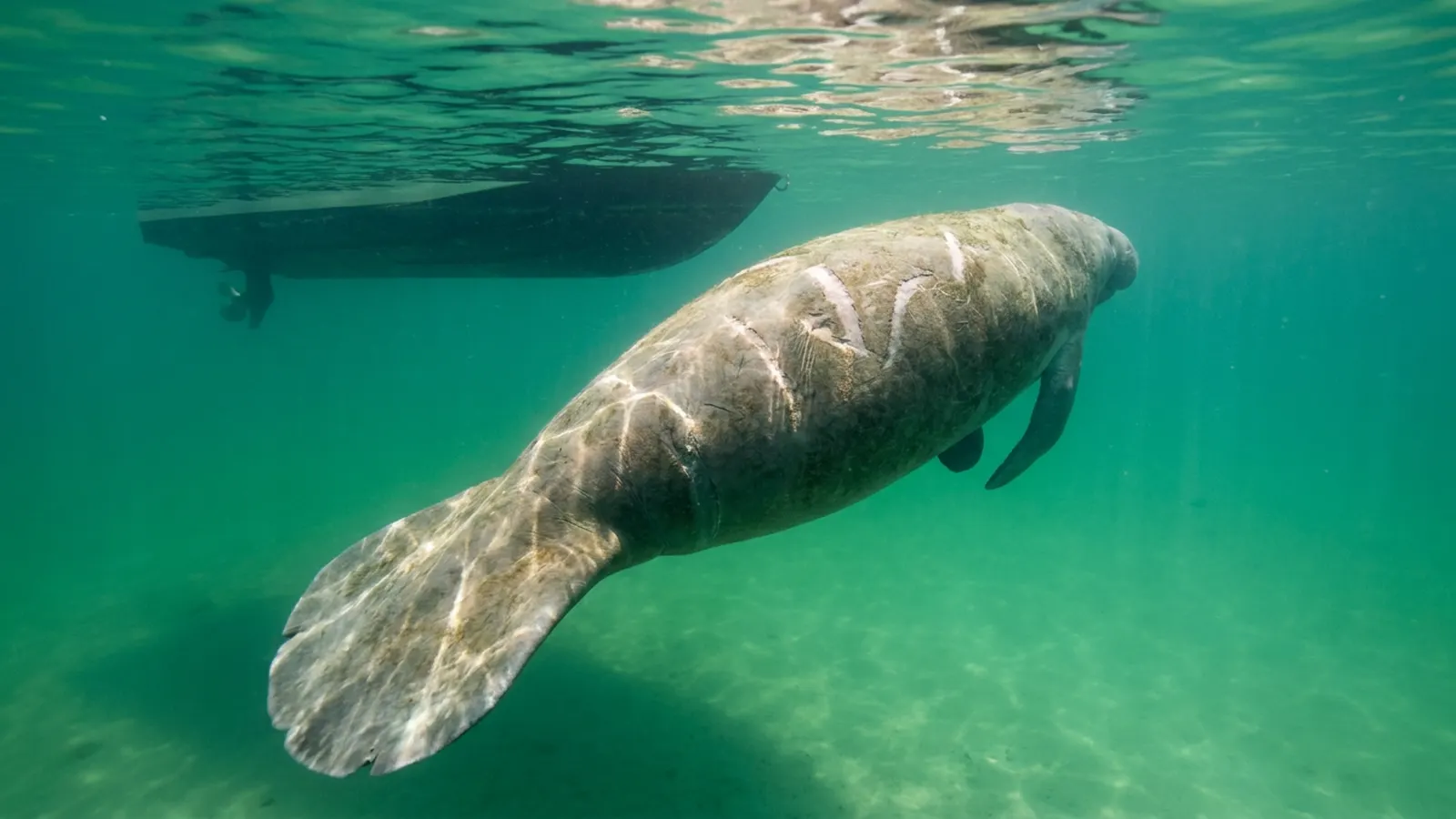
Threat 1: Boat strikes
The leading human-related cause of death in Florida.
Manatees live in shallow coastal waters where boat traffic is heavy, and they spend much of their time just below the surface. Collisions with hulls and propellers kill many manatees in Florida each year and injure many more; most adult Florida manatees carry scars from boats. With the number of registered boats in Florida continuing to grow, reducing collisions is a constant challenge. Speed zones, explained on our page about manatee protection zones, are the main tool for reducing these deaths.
Threat 2: Loss of seagrass and starvation
No pasture, no manatees.
Manatees depend on seagrass and other aquatic plants for food, eating a large share of their body weight every day, as described in our manatee diet guide. When nutrient pollution from fertilizer, septic systems and stormwater fuels algal blooms, the water clouds over and seagrass dies from lack of light. That’s what happened in the Indian River Lagoon, where large areas of seagrass disappeared over the 2010s and manatees starved in large numbers in 2021 and 2022. Our page on seagrass meadows explains why these underwater pastures are so important and so vulnerable.
Threat 3: Loss of warm-water refuges
A long-term problem waiting to happen.
Florida manatees can’t survive long in cold water, and in winter they depend on warm springs and the warm discharges of power plants. Many springs have reduced flow because of groundwater pumping, and some have been blocked or degraded by development. At the same time, many manatees have come to rely on power plants that won’t operate forever. As older plants are retired, wildlife agencies need to make sure manatees have natural alternatives. Our page on manatees and power plants explains this challenge, and our manatee habitat page explains why temperature matters so much.
Threat 4: Red tide, cold and other natural stresses
Natural events hit harder in a stressed population.
Some threats are natural, but human activity can make them worse. Red tide, a toxic algal bloom common on Florida’s Gulf coast, has killed many manatees in severe years; our page on red tide in Florida explains the blooms. Severe cold snaps cause deaths from cold stress, especially when manatees can’t reach warm water. A healthy, large population can absorb these events; a stressed one may not.
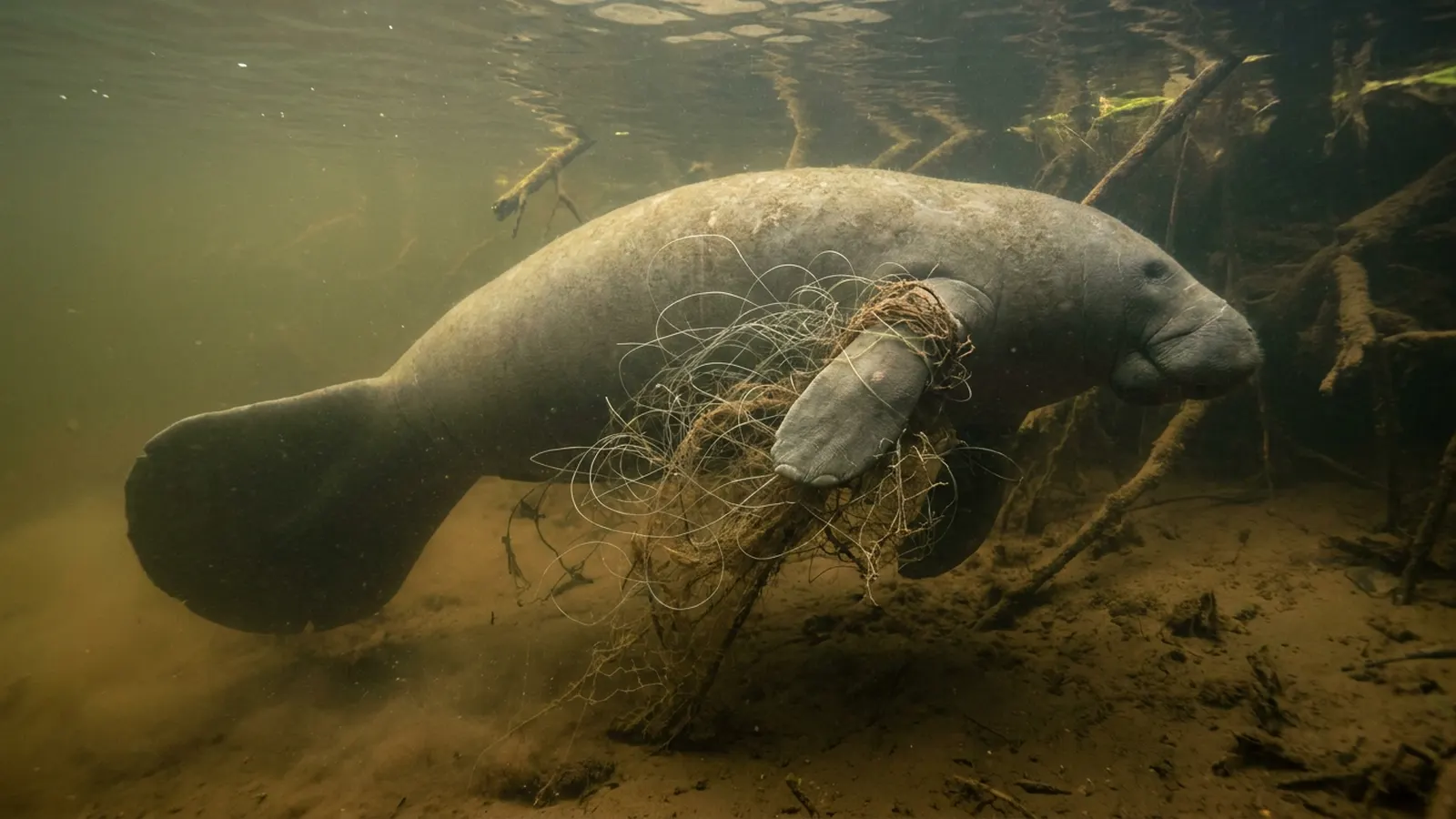
Threat 5: Entanglement, hunting and habitat loss beyond Florida
Different threats in different places.
Fishing line, crab trap lines and nets entangle manatees, sometimes cutting off flippers, and manatees swallow hooks, line and plastic. Water control structures such as flood gates and canal locks have also killed manatees, though protective devices have greatly reduced those deaths.
Outside the US, threats differ. In parts of the Caribbean, Central and South America and West Africa, manatees are still hunted illegally for meat, caught accidentally in fishing nets, or affected by dams that fragment rivers. Habitat loss from coastal development, mangrove clearing and pollution affects manatees across their range. The African manatee is among the least studied large mammals in Africa, and the Amazonian manatee has a long history of commercial hunting. Our page on manatees in Puerto Rico looks at one Caribbean population.
| Species or population | IUCN status | US status | Main threats |
|---|---|---|---|
| West Indian manatee (species) | Vulnerable | Threatened (since 2017) | Boats, habitat loss, cold, red tide |
| Florida manatee (subspecies) | Assessed under West Indian manatee | Threatened | Boats, seagrass loss, warm-water loss |
| Antillean manatee (subspecies) | Endangered | Threatened (Puerto Rico) | Hunting, bycatch, boats, habitat loss |
| Amazonian manatee | Vulnerable | Listed as endangered | Hunting, habitat change, dams |
| African manatee | Vulnerable | Listed as threatened | Hunting, bycatch, dams, habitat loss |
Why manatees recover so slowly
The biology behind the risk.
The underlying reason manatees are vulnerable is their slow life history. A female typically has her first calf at around three to five years old and then has one calf every two to three years after a pregnancy of about a year, as explained on our page about the manatee life cycle. That means a population can grow only slowly, and it depends heavily on adults surviving year after year. A few bad years of high adult mortality can erase a decade of growth. Adult manatees have almost no natural predators, as our page on manatee predators explains, so nearly all of the pressure on them comes from people and environmental change.
How manatee populations are doing
Real progress, with real setbacks.
In Florida, the story since the 1970s has been one of genuine recovery. When Florida’s first statewide aerial count was flown in 1991, observers counted around 1,300 manatees. Later counts regularly found several thousand, and more rigorous survey methods have produced population estimates in the high thousands. That growth reflects decades of protection: speed zones, sanctuaries, rescue programs and the protection of springs. Our page on manatee tracking explains how those numbers are produced.
The die-off of 2021 and 2022 was a serious setback, especially on the Atlantic coast, and it showed that habitat loss can undo progress quickly. Outside Florida, the picture is more worrying. Many Antillean manatee populations are small, isolated and poorly monitored, and the Amazonian and African manatees are hard to count at all.
It helps to remember how close the Florida manatee came to disappearing. In the 1970s, biologists were seriously worried that the population might not survive, and a later population viability analysis suggested a real chance of long-term extinction without better protection. Today, federal modeling paints a far more hopeful picture, as long as current protections hold. That turnaround is one of the genuine success stories of American wildlife conservation, and it was achieved not by any single measure but by decades of steady work on many fronts. The lesson of the early 2020s is that this success is conditional. If the habitat that supports manatees deteriorates, the gains of the past half century can be lost much faster than they were won.
My view on the manatee’s status
Labels matter less than habitat.
I have been working with reef systems and growing corals since 1996, and one of the clearest lessons from that work is that recovery is fragile until the underlying conditions are fixed. You can nurse a struggling coral back, but if the water quality problem is still there, it will decline again. Manatees are the same. Whether the official label says endangered or threatened, the population will only stay healthy if the seagrass is healthy, the springs keep flowing and boats slow down where manatees live.
That’s why I’d encourage anyone who cares about manatees to focus less on the listing debate and more on the practical things: cleaner water, less fertilizer runoff, protected springs, respect for speed zones and support for rescue programs. Those are what actually keep manatees alive.
How manatees are protected and how you can help
Laws, programs and personal choices.
Manatees in the US are protected by the Endangered Species Act, the Marine Mammal Protection Act and, in Florida, the Florida Manatee Sanctuary Act. Together, these laws make it illegal to harm, harass or kill manatees and give agencies the authority to create speed zones and sanctuaries. Rescue and rehabilitation programs, run by state and federal agencies with zoos, aquariums and nonprofits, save injured and orphaned animals each year.
You can help by obeying manatee zones when boating, wearing polarized sunglasses on the water, disposing of fishing line properly, never feeding or giving water to manatees, reducing fertilizer use at home and reporting injured or dead manatees to FWC. If you want to see manatees without disturbing them, the land-based viewing sites listed in our guide to the best time to see manatees in Florida are a great place to start.
Are manatees still endangered?
In the US the West Indian manatee has been listed as threatened since 2017. Internationally, all three manatee species are Vulnerable, and the Antillean subspecies is Endangered.
Why are manatees endangered?
Slow reproduction combined with boat strikes, seagrass and warm-water habitat loss, pollution, entanglement and, outside the US, hunting.
When were manatees listed as endangered?
In 1967, under the federal law that preceded the Endangered Species Act.
How many manatees are left?
Florida has several thousand. Global numbers for all species are uncertain, especially for the Amazonian and African manatees.
What is the biggest threat to manatees?
In Florida, boat collisions are the leading human-related cause of death, with seagrass loss a major growing threat.
Is it illegal to touch a manatee?
Yes. Harassing, touching, feeding or harming manatees is illegal under federal and Florida law.
Is the manatee population increasing?
Florida’s population grew substantially from the 1990s, but the 2021–2022 die-off was a major setback.
- U.S. Fish and Wildlife Service: West Indian manatee species status and 2017 reclassification.
- IUCN Red List: Trichechus manatus, Trichechus inunguis and Trichechus senegalensis.
- Florida Fish and Wildlife Conservation Commission: manatee population and mortality data.
- NOAA Fisheries: Marine Mammal Protection Act.
- Save the Manatee Club: manatee threats and status.
Blane Perun has been exploring Earth’s oceans and marine life for over 25 years. Founder of TheSea.Org in 1999, underwater photographer, coral aquaculture pioneer, and explorer of 80+ countries.
About Blane Perun → More on Manatees →