American Eel — From the Sargasso Sea to Florida Springs and the Great Lakes
No. The American eel (Anguilla rostrata) is a shy, mostly nocturnal fish with small, bristle-like teeth. It may bite if handled, but the bite is minor. It lives in rivers, lakes and estuaries from Greenland to Venezuela, hatches in the Sargasso Sea, and is listed as Endangered by the IUCN.
The American eel is the only freshwater eel native to North America, and it may be the most widely travelled fish on the continent. Every American eel in a Florida spring, a Virginia creek or a Canadian lake hatched in the Sargasso Sea, drifted for months as a transparent larva, swam into fresh water as a glass eel and spent years growing before heading back to sea to spawn and die. Along the way it became a staple food for Indigenous peoples and early colonists, a bait fish, a valuable export, and, more recently, a species in serious decline. Here’s a full profile, starting with the question many people ask first.
Are American eels dangerous?
Not to people. They’re far more likely to hide than bite.
American eels are secretive and mostly active at night. During the day they hide under rocks, logs and banks or bury themselves in mud, and swimmers and waders rarely see them. Their teeth are small and arranged in bands, designed for gripping worms, insects and small fish, not for injuring large animals. An eel that’s been caught on a hook may twist and bite at a hand, and the bite can scratch or nick the skin, but it isn’t a serious injury. Clean any scratch from a fish like any other minor wound.
The other thing to know is that eel blood contains a toxin that’s destroyed by cooking, so eels should never be eaten raw, and people cleaning eels should avoid getting blood in cuts or eyes. In some polluted rivers, wild eels also carry PCBs and mercury, and health departments may advise limiting how many you eat. For more on bite risks across all eels, see eel bites.

What does an American eel look like?
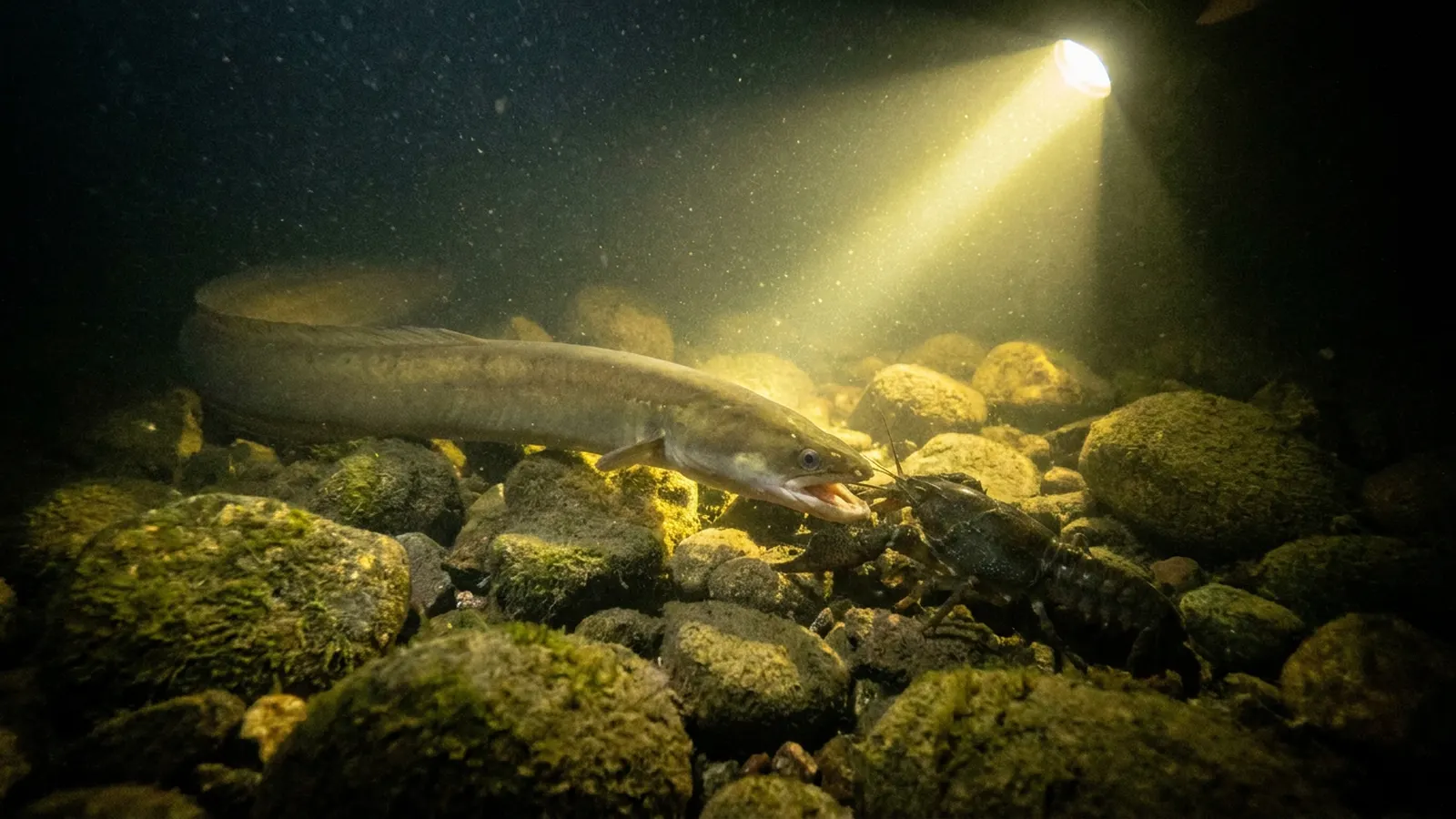
Long, slimy and olive-brown, with a jaw that juts slightly forward.
American eels have a long, snake-like body with a single fin that runs along the back, around the tail and along the underside. They have small pectoral fins just behind the head and a gill opening on each side. The lower jaw is slightly longer than the upper. The skin feels smooth and slimy; the tiny scales are buried in it. During the growth phase, called the yellow eel stage, the back is olive, brown or greenish and the belly yellowish. Mature eels heading to sea, called silver eels, turn darker above and silvery below, and their eyes enlarge.
Females grow much larger than males. Big females can reach about 1.2 m or a little more, while males rarely get beyond about half a metre. The IGFA all-tackle record American eel weighed a little over 9 lb. If you’re comparing the American eel with the invasive rice field eel in Florida, look for the pectoral fins and side gill openings, which the swamp eel lacks.
The American eel life cycle
An ocean birth, a freshwater childhood and a one-way trip home.
American eels spawn in the Sargasso Sea, in the western North Atlantic, probably in late winter and spring. Their spawning area overlaps with that of the European eel, slightly to the west. The eggs hatch into leptocephali, flat, transparent larvae that ride the Gulf Stream and other currents toward North America. Their trip is shorter than that of European eel larvae, and they reach the coast in less than a year.
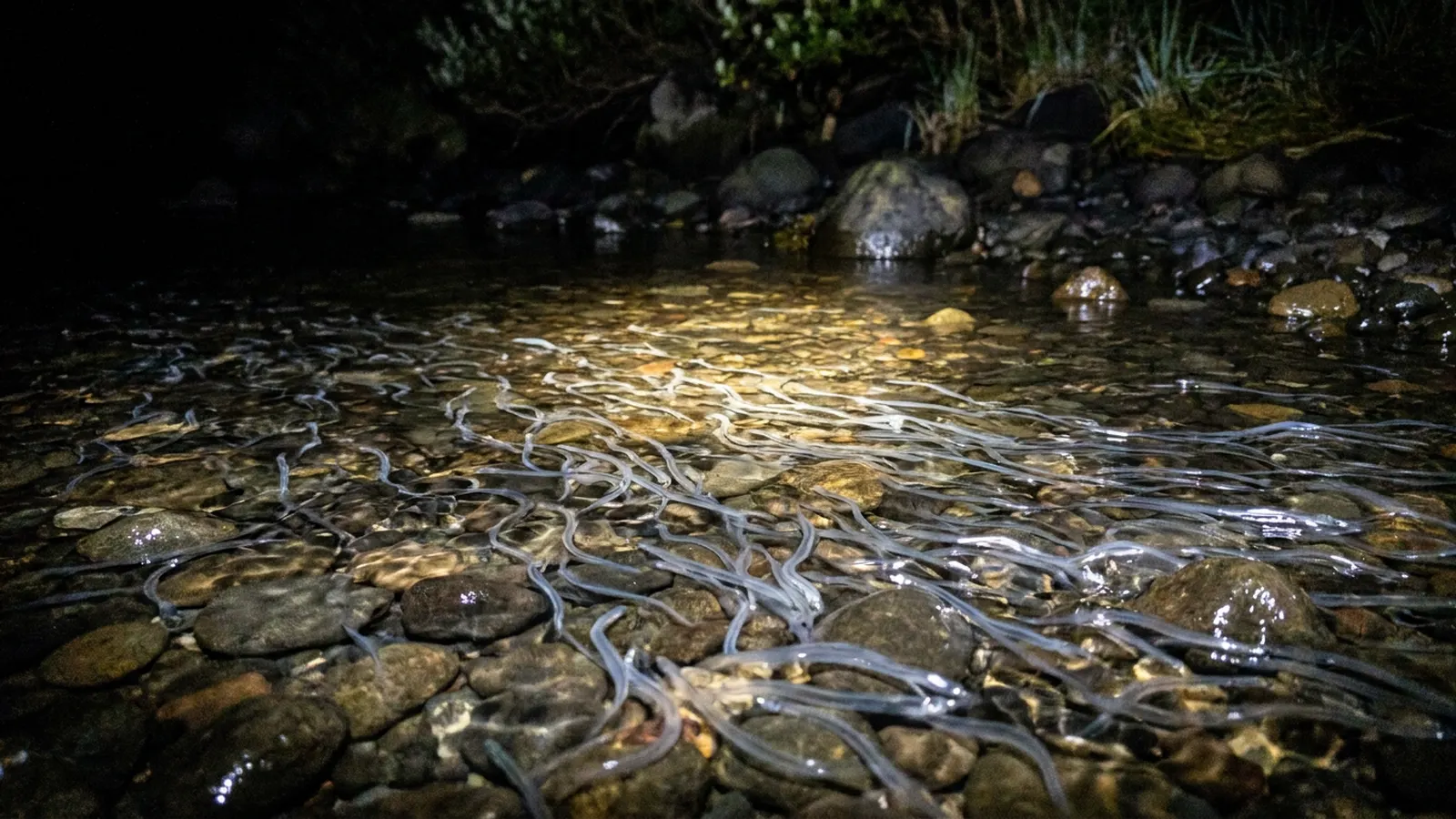
Near the continental shelf the larvae transform into glass eels, which move into estuaries and rivers in late winter and spring, gaining colour and becoming elvers. Some head far upstream, climbing past waterfalls and dams; others stay in estuaries and coastal waters their whole lives. They grow as yellow eels for anywhere from a few years in the south to 20 years or more in the north, then become silver eels and swim back to the Sargasso to spawn once and die. The full sequence is explained in our eel life cycle guide and how eels reproduce.
| Stage | Where | When / how long |
|---|---|---|
| Egg and leptocephalus | Sargasso Sea and Gulf Stream | Several months adrift |
| Glass eel | Atlantic and Gulf coasts | Arrives late winter to spring |
| Elver | Estuaries, lower rivers | First year inshore |
| Yellow eel | Rivers, lakes, estuaries, coastal bays | About 3 to 20+ years |
| Silver eel | Migrating downstream and offshore | Autumn, final migration |
Where American eels live
Almost anywhere water connects to the Atlantic.
The American eel has one of the largest ranges of any North American fish. It’s found from southern Greenland and Labrador down the Atlantic coast, around Florida and the Gulf of Mexico, through the Caribbean and Central America to northern South America. It moves far inland too, up the St. Lawrence River into Lake Ontario and up the Mississippi system. It lives in rivers, streams, lakes, ponds, marshes, estuaries and even coastal saltwater.
In Florida, American eels live in rivers and spring runs throughout the state, and they’re one of the native fish you may see on a night snorkel in clear spring water. In the Florida Keys and the Caribbean, where I’ve done most of my diving, the eels on the reef are morays rather than American eels, but the freshwater eel is never far away in the coastal mangroves and estuaries. Our guide to freshwater eels covers the other species around the world.
What do American eels eat?
Almost anything they can find in the dark.
American eels are opportunistic, mostly nocturnal predators and scavengers. Young eels eat insect larvae, small worms and tiny crustaceans. Larger eels add crayfish, snails, mussels, frogs and small fish, and they readily eat dead animals. They hunt mainly by smell, which is excellent, and by feeling vibrations through the lateral line. In turn, eels are eaten by striped bass, herons, ospreys, eagles, otters and other predators. For comparisons with other eels, see what eels eat.
American eels and people
A food fish for thousands of years.
Indigenous peoples of eastern North America caught eels with weirs, traps and spears for thousands of years, and smoked eel was an important food. Colonial accounts from Plymouth describe the Wampanoag guide Tisquantum (Squanto) showing settlers how to catch eels from the mud in 1621. Eels remained a common food along the East Coast into the 20th century and were widely used as bait for striped bass and other sport fish.
Today, the most valuable eel fishery in the United States is for glass eels, called elvers, in Maine and South Carolina, where tiny eels are netted as they enter rivers and shipped live to eel farms in Asia. In good years elvers have fetched extraordinary prices per pound, and the fishery is tightly regulated with quotas and licences. Poaching and smuggling of glass eels have led to federal prosecutions.
Why the American eel is in trouble
Dams, turbines, fishing and changing oceans all take a toll.
The IUCN lists the American eel as Endangered. Numbers of young eels reaching some parts of the range, especially Lake Ontario and the upper St. Lawrence, fell dramatically in the late 20th century. Dams block eels from much of their historical habitat, hydropower turbines kill migrating silver eels, fishing removes eels at every life stage, and an introduced parasite of the swim bladder may weaken spawners. Changes in ocean conditions may also affect how many larvae reach the coast. In the US, the species is managed by the Atlantic States Marine Fisheries Commission, and federal reviews have so far concluded that listing under the Endangered Species Act isn’t warranted, while calling for continued management.
Solutions include eel ladders and passes at dams, safe downstream passage for silver eels, turbine shutdowns on key migration nights, and careful limits on fishing. If you live near a river with an eel ladder, it’s worth watching in spring, when the elvers climb. Few fish make a more remarkable journey to get there.
How to see an American eel
Patience, darkness and clear water help.
Because they’re nocturnal and secretive, American eels are seen far less often than they’re present. The best chances come at night, with a torch, along the edges of clear streams and springs, where eels leave their hiding places to forage over the bottom. In spring, elvers can sometimes be seen massing below dams and climbing eel ladders, and some river restoration projects run public viewing days during the migration. Snorkelers in clear Florida spring runs occasionally spot eels tucked under limestone ledges or among eelgrass during the day.
If you see one, give it space. Eels are easily stressed and, like any wild animal, shouldn’t be chased or handled for photos. Shine your light to the side rather than directly into the eel’s eyes, and you’ll usually get a longer look. And if you fish, consider releasing eels you catch, especially large females, which are the ones that carry the next generation to the Sargasso Sea.
Are American eels dangerous to humans?
No. They are shy and have small teeth. A handled eel may bite, but the bite is minor.
Do American eels bite?
Only when handled or hooked, and the bite usually just scratches the skin.
What do American eels eat?
Insect larvae, worms, crayfish, snails, mussels, frogs, small fish and dead animals.
Where do American eels live?
In rivers, lakes, estuaries and coastal waters from Greenland to Venezuela, including Florida and the Gulf of Mexico.
Where do American eels spawn?
In the Sargasso Sea in the western North Atlantic. They spawn once and die.
Are American eels endangered?
The IUCN lists them as Endangered. In the US they are managed by the Atlantic States Marine Fisheries Commission but not listed under the Endangered Species Act.
How big do American eels get?
Large females reach about 1.2 m or slightly more. Males are much smaller.
- U.S. Fish and Wildlife Service, American eel species profile and status reviews.
- Atlantic States Marine Fisheries Commission, American eel stock assessment and management.
- IUCN Red List: Anguilla rostrata (Jacoby et al. 2014).
- Chesapeake Bay Program, American eel field guide.
- Winslow, E. (1622). Mourt’s Relation (account of eel fishing at Plymouth).
Blane Perun has been exploring Earth’s oceans and marine life for over 25 years. Founder of TheSea.Org in 1999, underwater photographer, coral aquaculture pioneer, and explorer of 80+ countries.
About Blane Perun → More on Eels →