Scuba Diving Dangers — What Actually Hurts Divers, and How to Avoid It
The biggest scuba diving dangers are not sharks. In a Divers Alert Network (DAN) analysis of 947 recreational diving deaths from 1992 to 2003, the most common trigger was running out of gas (41%), followed by entrapment (20%) and equipment problems (15%), and the causes of death were drowning (70%), arterial gas embolism from rapid ascents (14%) and cardiac events (13%). Decompression sickness (the bends) is uncommon, roughly 1 to 3 cases per 10,000 dives for typical recreational divers in DAN’s Project Dive Exploration. Most risks are managed through training, gas planning, slow ascents, fitness and staying within limits.
The data on diving accidents tell a consistent story: the dangerous moments come from low air, rushed ascents, poor buoyancy and undiagnosed health problems far more often than from sharks or other wildlife. Most of those risks can be reduced with good training, honest medical screening and conservative habits.
What are the main dangers of scuba diving?
- Running out of gas. The most common starting point for fatal accidents. Prevented by gas planning, checking your gauge and turning the dive on time.
- Rapid ascent and gas embolism. Holding your breath or shooting up can rupture lung tissue and send bubbles into the arteries. Slow ascents and normal breathing prevent it.
- Decompression sickness. Nitrogen bubbles forming after a dive. See scuba diving and the bends.
- Heart problems. Cardiac events account for a large share of deaths, especially in older divers with undiagnosed heart disease.
- Entrapment and entanglement. Wrecks, caves, kelp and fishing line. Stay within training limits and carry a cutting tool.
- Barotrauma. Ear and sinus squeezes, worse when congested.
- Marine life. Stings, cuts and rare bites, usually from touching animals. See stinging sea anemones.
The list above is the short version. What makes diving different from most sports is that problems tend to chain together underwater. A diver who runs low on air may panic, bolt for the surface, hold their breath and suffer a lung injury, then lose consciousness and drown. The death certificate says “drowning”, but the real story started minutes earlier with a gauge nobody checked. The sections below follow that chain from the evidence.
How dangerous is scuba diving statistically?
The best large dataset on recreational diving deaths comes from Divers Alert Network (DAN), a diving safety organisation founded at Duke University in Durham, North Carolina, in 1980. In a study published in 2008, Denoble and colleagues analysed 947 deaths among recreational open-circuit scuba divers from 1992 to 2003. Where enough information was available, they broke each death into a sequence: the trigger, the disabling agent, the disabling injury and the final cause of death.
Insufficient gas was the most frequent trigger, at 41%, followed by entrapment at 20% and equipment problems at 15%. The most common disabling agents were emergency ascents (55%), insufficient gas (27%) and buoyancy problems (13%). The most frequent disabling injuries were asphyxia (33%), arterial gas embolism (29%) and cardiac incidents (26%). Drowning was recorded as the cause of death in 70% of cases, arterial gas embolism in 14% and cardiac arrest in 13%. The authors concluded that the disabling injury was more informative than the official cause of death, because drowning was usually the end result of something else.
Rates matter more than counts. A second DAN study of insured members from 2000 to 2006 found about 16.4 deaths per 100,000 members per year, similar to the 14.4 per 100,000 recorded for members of the British Sub-Aqua Club (BSAC) over the same period. That is comparable to the per-person death rates often quoted for jogging and for motor vehicle accidents. Measured per dive, the risk looks smaller: in a 2018 study in Public Health, Buzzacott and colleagues estimated that US residents made about 306 million recreational dives between 2006 and 2015, with 563 recreational diving deaths in that group, a rate of about 1.8 deaths per million dives. The same study found 47 deaths for every 1,000 emergency department visits for scuba injuries, which the authors described as a sign of how unforgiving the underwater environment is when something does go wrong.
Why is running out of air so dangerous?
Running low on gas is the single most common starting point for fatal accidents, and it is almost entirely preventable. A diver who suddenly finds an empty cylinder at depth has only a few options: reach a buddy and share air, use an independent backup supply if one is carried, or make an emergency swimming ascent. Each of those is a trained skill, and each becomes much harder under stress. Training agencies teach divers to share air from a buddy’s secondary regulator, which is simpler and lower-risk than the older practice of passing one mouthpiece back and forth, and to perform a controlled emergency swimming ascent, exhaling continuously and keeping the ascent under control.
The prevention is simple and unglamorous: agree a turn pressure and a reserve with your buddy before the dive, check the gauge often, and start the ascent with gas still in the cylinder. A common rule is to begin the ascent with a reserve, often a fixed pressure set by the agency or operator, so that a delay or a problem near the surface does not become an emergency. Gas consumption rises with depth, cold, effort and anxiety, so the same cylinder lasts far less time at 30 m than at 10 m.
What happens if you ascend too fast or hold your breath?
Pressure in water rises by roughly one atmosphere for every 10 m of depth, so at 10 m the gas in a diver’s lungs is compressed to about half its surface volume. If a diver ascends while holding their breath, that gas expands as the pressure falls and can overstretch and tear the lung. Pulmonary barotrauma can happen in very shallow water; a collapsed lung has been reported in divers breathing compressed air who rose just 1 m while holding a full breath. Torn lung tissue can let gas into the arteries, where bubbles can block blood flow to the brain or heart. This is arterial gas embolism, the second most common recorded cause of death in the DAN fatality study.
The CDC Yellow Book advises that arterial gas embolism should be suspected in any diver who loses consciousness within 10 minutes of surfacing. The protection is the first rule every diver learns: never hold your breath on scuba, and ascend slowly. Decompression models assume a limited ascent rate, typically in the order of 10 m per minute for the deeper part of a dive, and dive computers warn when a diver rises faster than their algorithm allows. Many divers also slow down further over the last few metres, where the relative pressure change is largest.
How common is decompression sickness?
Decompression sickness, the bends, happens when nitrogen absorbed by the body at depth comes out of solution as bubbles during or after the ascent. It can cause joint pain, skin rashes, numbness, weakness, breathing problems and, in serious cases, paralysis. Symptoms usually appear within hours: reference tables of symptom onset show about 42% of cases beginning within 1 hour of surfacing, 60% within 3 hours, 83% within 8 hours and 98% within 24 hours.
It is uncommon in typical recreational diving. DAN’s Project Dive Exploration, which recorded dive profiles from more than 4,000 divers between 1998 and 2002, found about 1.0 case per 10,000 dives among liveaboard divers and about 3.2 per 10,000 among shore and day-boat divers. Rates were far higher in more demanding diving: about 28 per 10,000 among divers on the cold, deep wrecks of Scapa Flow in Scotland, and about 9 to 10 per 10,000 among dive guides in Cozumel making many dives a day (the published rate and the raw numbers in that group differ slightly). The message is that risk climbs with depth, cold, workload and repetitive diving, not that the bends is common. The causes and symptoms are explained in more detail on the page about the bends.
| Group (DAN PDE, 1998–2002) | Dives | DCS cases | Per 10,000 dives |
|---|---|---|---|
| Liveaboard divers | 19,882 | 2 | ~1.0 |
| Shore and day-boat divers | 15,695 | 5 | ~3.2 |
| Cozumel dive guides | 5,050 | 5 | ~9–10 |
| Scapa Flow wreck divers | 4,987 | 14 | ~28 |
What should you do if you suspect a diving injury?
The CDC Yellow Book (2026 edition, last reviewed April 2025) recommends giving 100% oxygen as soon as possible to a diver with suspected decompression illness, and notes that the definitive treatment is recompression with oxygen in a hyperbaric chamber. Oxygen first aid is most valuable early; reference reviews note that oxygen given within the first four hours of surfacing improves the results of later recompression and can reduce the number of chamber treatments needed. A diver with suspected gas embolism should be taken to a hyperbaric facility even if they seem to recover, because symptoms can relapse.
The practical steps are to stop diving, give oxygen if it is available and you are trained to use it, keep the diver lying down and monitored, and get medical help. DAN runs a 24-hour emergency line at +1-919-684-9111 that accepts collect calls and can advise on diving injuries and evacuation. Do not try to treat symptoms by going back underwater; in-water recompression is a specialised technique that carries its own serious risks. Anyone with unusual symptoms after a dive, especially neurological ones such as numbness, weakness, confusion or vision changes, should be assessed by a doctor familiar with diving medicine.
Which health conditions make diving more dangerous?
About a quarter of diving deaths are associated with cardiac events, mostly in older divers. Cardiac arrest risk is higher for older divers and higher for men than women, although the risk evens out by about age 65. Many of these divers had heart disease that was never diagnosed. The CDC recommends that divers with risk factors for coronary artery disease, such as diabetes, high blood pressure or a history of smoking, have a cardiovascular fitness assessment before diving, which may include an ECG, lung function tests, an exercise stress test or an echocardiogram.
Other conditions of concern listed by the CDC include asthma, chronic lung disease, chest infections and a history of spontaneous pneumothorax; seizures and other conditions that affect consciousness; and anxiety, claustrophobia and substance misuse. Medications deserve review too, as there is little scientific data on how drugs behave under pressure. Training agencies screen students with a medical questionnaire; the revised RSTC Medical Declaration Form and accompanying guidance for physicians were published in 2020 after a three-year review by a panel of diving medicine specialists. A “yes” answer does not automatically rule someone out, but it does mean a doctor must sign off before in-water training. Many people with well-controlled conditions dive safely after a proper evaluation; the key is to have that conversation before the trip, not on the boat.
Immersion pulmonary edema, in which fluid leaks into the lungs during a dive or swim, is a less familiar risk that is increasingly recognised. It causes coughing and breathlessness, sometimes with frothy or blood-tinged sputum, and a diver who keeps switching regulators or rejects a working air supply may be suffering from it. Cold water, high blood pressure and heart muscle stiffness are suspected risk factors, and there is evidence that it may be a leading but under-recognised cause of death among recreational divers.
What are barotrauma, narcosis and oxygen toxicity?
Middle ear barotrauma, the “ear squeeze”, is the most common diving injury according to the CDC. It happens when a diver fails to equalise pressure during descent, and congestion from a cold or allergy makes it much more likely. Mild cases may settle within one to two weeks, but all symptoms should resolve, and any perforated eardrum should heal, before diving or flying again. The sinuses are vulnerable in the same way. The fix is to equalise early and often, descend slowly, and abort the dive if the ears will not clear rather than forcing them.
Nitrogen narcosis, sometimes called the “martini effect”, is a reversible change in consciousness caused by breathing nitrogen under pressure. It can occur on shallow dives but does not usually become noticeable shallower than about 30 m, and its effect is to slow thinking and impair judgement, which is dangerous precisely because divers often do not notice it. Oxygen itself becomes toxic at high partial pressures and can cause seizures underwater, where a convulsion often leads to drowning. Divers using enriched-air nitrox are taught to keep oxygen partial pressure within set limits, commonly below 1.4 bar, and to respect the maximum operating depth printed on the cylinder.
How deep is too deep for recreational divers?
Entry-level divers are expected to limit themselves to about 18 to 20 m. The major recreational training agencies consider 40 m to be the limit for recreational diving, while some British and European agencies, including BSAC, allow deeper limits with appropriate training. Depth matters for almost every hazard on this page: gas runs out faster, narcosis becomes stronger, decompression obligations grow, and the way back to the surface is longer if something goes wrong. Training should come before depth, and the step from one level to the next is described in scuba certification levels. Divers returning after a long break should consider a refresher; the page on how long scuba certification lasts explains why skills fade even though cards do not expire.
What about flying after diving?
Flying too soon after diving raises the risk of decompression sickness, because commercial aircraft cabins are pressurised to the equivalent of a mountain altitude, and the lower pressure lets residual nitrogen form bubbles. The CDC and DAN guidance is a minimum surface interval of 12 hours after a single no-decompression dive and 18 hours after multiple dives or multiple days of diving, with substantially longer waits, the CDC suggests 24 to 48 hours, after dives that required decompression stops. Those intervals reduce but do not eliminate the risk. Driving over high mountain passes after diving raises the same concern.
How do divers reduce the risks?
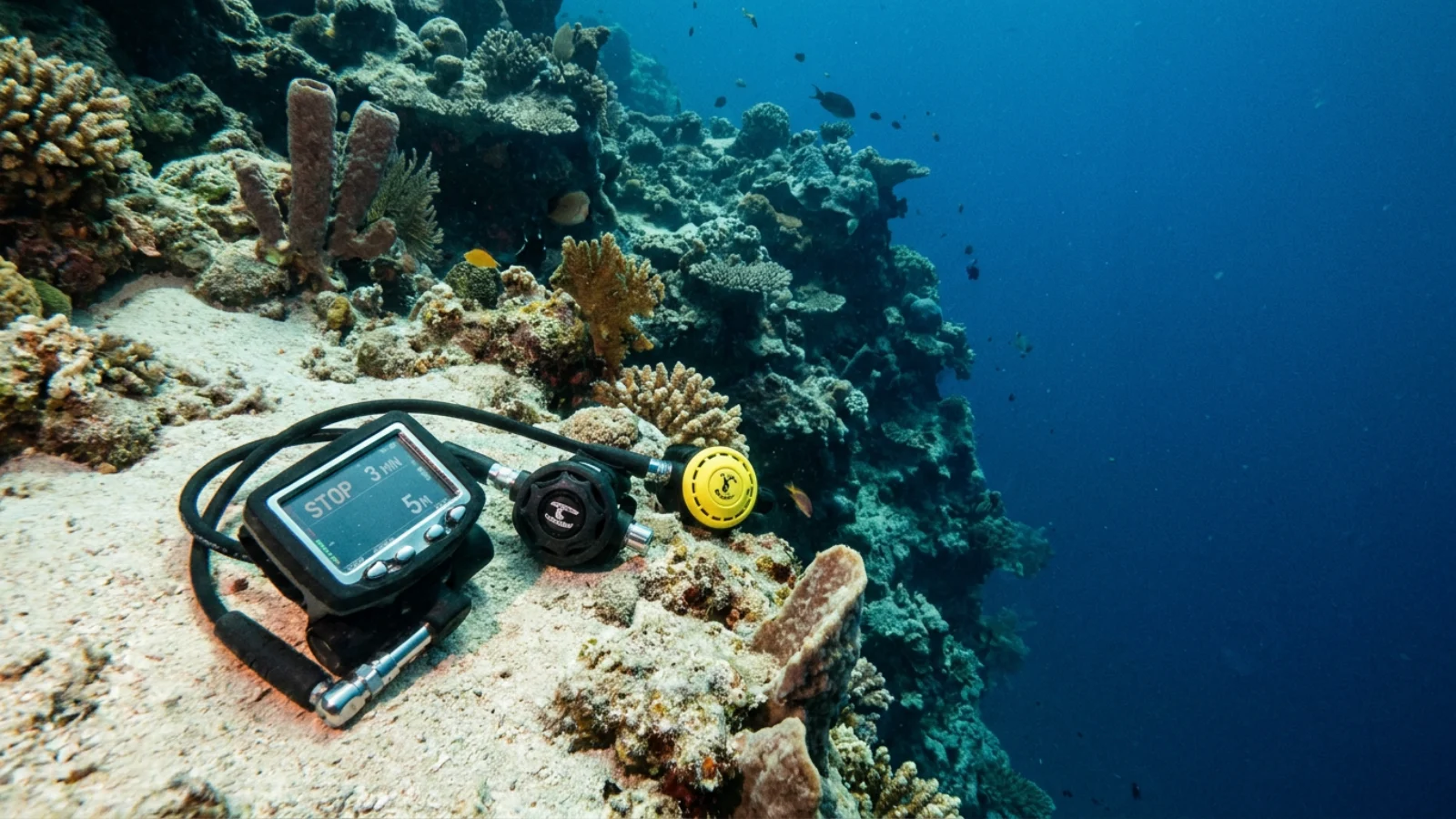
Most of the precautions are habits rather than equipment. Agree on a plan and a turn pressure with your buddy, stay close enough to help each other, and practise air-sharing and emergency ascents in training until they are automatic. Make a slow, controlled ascent and a safety stop at the end of every dive: three minutes at about 5 m (15 ft) is what most training agencies teach, and reference texts give a range of about one to five minutes at 3 to 6 m. Keep buoyancy under control so that you are not fighting to stay down or drifting upward. Stay within the depth and type of diving you are trained for, and treat wrecks, caves and overhead environments as separate specialities. Keep fit, get a medical check if you have risk factors, and do not dive with a cold, a hangover or any doubt about your health.
None of this makes diving risk-free, and nobody should pretend it does. But the evidence shows that the accidents that kill divers are dominated by a handful of preventable chains of events. For an honest look at how demanding learning to dive really is, see is scuba diving hard; for younger divers and their particular limits, see how old you have to be to scuba dive.
Section index: diving dangers explained
What is the most common cause of scuba diving deaths?
Drowning is the most commonly recorded cause (70% of deaths in a DAN study of 947 deaths), but it usually follows something else, most often running out of gas.
Is scuba diving dangerous?
It carries real risks, but per dive the death rate is low, about 1.8 per million US recreational dives in 2006–2015. Most accidents are preventable with training, planning and fitness.
How common is the bends?
Uncommon: around 1–3 cases per 10,000 dives for typical recreational diving in DAN data, but much higher on deep, cold or repetitive dives.
What is the most common diving injury?
Middle ear barotrauma (ear squeeze), caused by failing to equalise during descent.
Are sharks a major danger to divers?
No. Shark injuries to divers are rare compared with gas, ascent and health problems.
What should I do if I think a diver has the bends?
Give 100% oxygen if available, keep them lying down, call emergency services and DAN (+1-919-684-9111), and arrange evaluation for recompression.
How long should I wait to fly after diving?
At least 12 hours after a single no-decompression dive and 18 hours after multiple dives or days of diving; longer after decompression dives.
Who should not scuba dive?
People with certain heart and lung conditions, seizure disorders, active congestion or pregnancy should not dive without medical advice.
- Denoble, P.J. et al. (2008). Common causes of open-circuit recreational diving fatalities. Undersea & Hyperbaric Medicine.
- Denoble, P.J. et al. (2008). Scuba injury death rate among insured DAN members. Diving and Hyperbaric Medicine 38(4): 182–188.
- Buzzacott, P. et al. (2018). Epidemiology of morbidity and mortality in US and Canadian recreational scuba diving. Public Health. doi:10.1016/j.puhe.2017.11.011
- DAN Project Dive Exploration 1998–2002, reported by Undercurrent (May 2005).
- CDC Yellow Book 2026: Scuba Diving: Decompression Illness and Other Dive-Related Injuries (last reviewed 23 April 2025).
- Divers Alert Network: Guidelines for Flying After Diving (workshop proceedings, 2004).
- RSTC Medical Declaration Form and Notes for Physicians (revised 2020).
- Reference summaries on scuba fatalities, decompression sickness, pulmonary barotrauma, immersion pulmonary edema, nitrogen narcosis and decompression practice (Wikipedia, 2023 edition).
Blane Perun has been exploring Earth’s oceans and marine life for over 25 years. Founder of TheSea.Org in 1999, underwater photographer, coral aquaculture pioneer, and explorer of 80+ countries.
About Blane Perun →