Middle East Coral Reef Maps — Reefs of the Red Sea, the Gulf and Arabia
The Middle East’s coral reefs lie in three seas: the Red Sea, which holds the large majority of the region’s reef along the coasts of Saudi Arabia and Egypt; the shallow, extremely hot Persian Gulf, home to heat-hardened patch reefs off Bahrain, Qatar, Kuwait and the wider Gulf; and the Gulf of Aden and Arabian Sea, with reefs off Yemen, Socotra, Djibouti and Oman. This hub maps the reefs of ten countries and links to a detailed coral reef map for each.
Few people think of the Middle East as a coral reef region, yet it holds some of the most remarkable reefs on Earth. The Red Sea’s fringing reefs are among the world’s best-known dive destinations, the corals of the Persian Gulf survive temperatures that would kill reefs almost anywhere else, and the remote reefs of Socotra mix species from the Red Sea and the Indian Ocean. This page maps where the region’s reefs lie, compares the ten countries covered on TheSea.Org, and explains why these desert-fringed reefs matter for the future of coral everywhere.
The Middle East’s three reef seas
Geography explains almost everything about the region’s reefs.
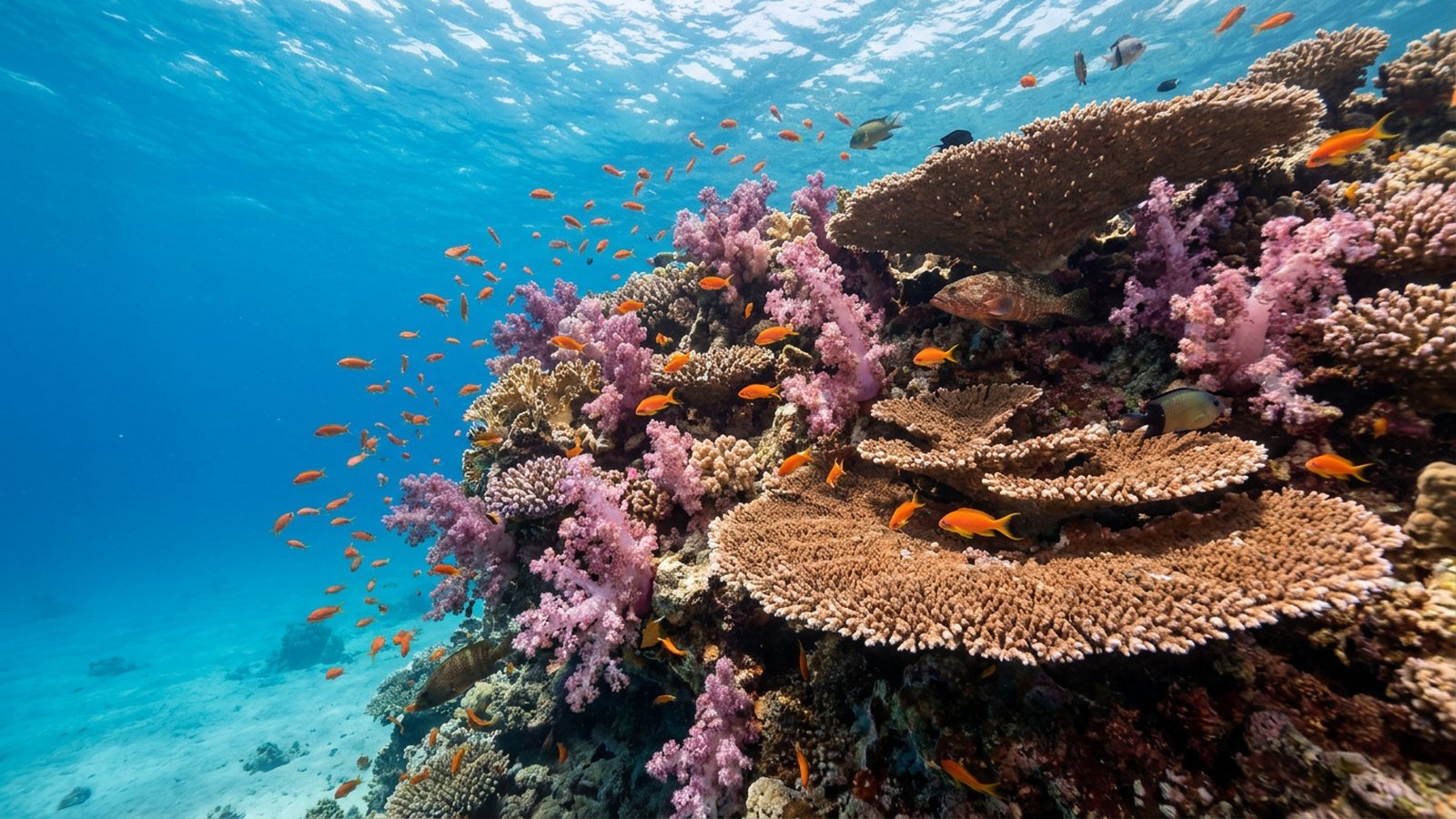
The Red Sea, along the region’s western edge, is a long, narrow rift between Africa and Arabia. It is warm, clear and salty, with almost no rivers flowing into it and steep coasts that carry rich fringing reefs from the Gulf of Aqaba in the north to the Bab-el-Mandeb strait in the south. It holds the great majority of the region’s coral and a high proportion of species found nowhere else.
The Persian Gulf (also called the Arabian Gulf), to the east, is shallow, nearly enclosed and brutally hot in summer, with high salinity and cool winters. Coral survives here as hardy, heat-adapted patch reefs, shoals and island fringes around the Gulf states — the toughest reefs on Earth, but among the most affected by coastal development.
The Gulf of Aden and the Arabian Sea are cooler and more productive, fed by seasonal monsoon upwelling. Their reefs, off Yemen, Djibouti and southern Oman, mix Red Sea and Indian Ocean species and include the isolated reefs of Socotra. The chart below shows how mapped reef area is split between the ten countries.
Middle East coral reefs by country
Ten country maps, from the vast Saudi Red Sea to Israel’s tiny stretch of Eilat coast.
| Country | Main sea | Relative reef extent | Known for |
|---|---|---|---|
| Saudi Arabia | Red Sea (and Gulf) | Largest in the region | Longest Red Sea coast; Farasan Islands |
| Egypt | Red Sea | Very large | Sinai, Ras Mohammed, Hurghada, Marsa Alam |
| Yemen | Red Sea / Gulf of Aden | Moderate | Socotra; high biodiversity |
| Djibouti | Gulf of Aden | Moderate | Gulf of Tadjoura; whale sharks |
| Oman | Arabian Sea / Gulf of Oman | Moderate | Musandam, Daymaniyat Islands, upwelling reefs |
| Bahrain | Persian Gulf | Small | Offshore shoals; pearling heritage |
| Qatar | Persian Gulf | Small | Offshore patch reefs; Halul Island |
| Kuwait | Persian Gulf | Small | Island reefs such as Kubbar |
| Jordan | Gulf of Aqaba | Very small | Aqaba Marine Park |
| Israel | Gulf of Aqaba | Very small | Eilat coral reserve; reef research |
The Red Sea: the region’s reef heartland
Near-continuous fringing reefs line both shores, and Saudi Arabia and Egypt hold most of them.
By far the most reef in the Middle East lies along the Red Sea. With little rainfall and almost no river runoff, the water is exceptionally clear, and fringing reefs grow right up to the desert shore. The combined coasts of Saudi Arabia and Egypt account for roughly four-fifths of all the reef mapped in this section. Further south, the Red Sea widens and shallows, with broad reef platforms and island groups such as Saudi Arabia’s Farasan Islands.
Egypt’s reefs, around the Sinai Peninsula and down the coast past Hurghada and Marsa Alam, are world-famous for diving, with sites such as Ras Mohammed National Park at the tip of Sinai. At the northern end, the short coasts of Jordan and Israel share the Gulf of Aqaba. Corals here have attracted intense scientific interest because they appear to tolerate temperatures well above those they normally experience, possibly because their ancestors colonised the Red Sea through the hotter waters of the south. That makes the northern Red Sea a candidate refuge for corals as the world warms, giving it importance well beyond its tourism value. The Red Sea is also shared with Africa; see the Africa coral reef maps for Sudan and Eritrea.
The Persian Gulf: reefs at the extreme
A small share of the region’s reef, but reef of a remarkable kind.
On the other side of Arabia, the Persian Gulf holds only a small fraction of the region’s reef area. Its corals endure summer water temperatures well above 33°C, high salinity and cool winters — conditions that would kill reef corals almost anywhere else. They survive as offshore patch reefs, shoals and island fringes around Bahrain, Qatar and Kuwait, along Saudi Arabia’s eastern coast, and around the United Arab Emirates and Iran.
These Gulf reefs are scientifically priceless because they already live in the heat that climate change threatens to bring to other reefs. But even they have limits: repeated bleaching events have killed much of the Gulf’s coral since the late 1990s, and the reefs are squeezed by dredging, land reclamation, desalination and coastal industry along some of the fastest-growing coastlines on Earth. Bahrain’s shoals once underpinned the Gulf’s great pearl industry, and Kuwait’s island reefs carry the legacy of the 1991 Gulf War oil spills.
Gulf of Aden, Arabian Sea and Socotra
Cooler, upwelling-fed waters and some of the least-disturbed reefs in the region.
South and east of Arabia, the Gulf of Aden and Arabian Sea hold a third kind of reef. Yemen spans all three seas, from its Red Sea islands to the Gulf of Aden and the isolated Socotra archipelago, a UNESCO World Heritage Site whose reefs are among the most biodiverse in the region because they sit where Red Sea, Arabian and Indian Ocean species meet.
Oman faces the open Arabian Sea, with reefs ranging from the fjord-like Musandam Peninsula on the Strait of Hormuz to the Daymaniyat Islands near Muscat and the upwelling-cooled coasts of the south, where corals grow alongside kelp-like seaweeds during the monsoon. Djibouti, at the mouth of the Red Sea, packs rich reefs and seasonal whale-shark gatherings into the sheltered Gulf of Tadjoura. Because many of these coasts are remote or lightly developed, they include some of the healthiest reefs left in the region.
Reading the reef data
One shared global dataset makes every country map comparable.
The chart and country maps on this page are based on the global coral reef distribution compiled by UNEP-WCMC, the standard reference used by scientists and conservation bodies worldwide, which combines satellite mapping with survey data. Because every country page in this section draws on the same source, the reef shapes and area figures are directly comparable from coast to coast. Area figures can differ between datasets depending on mapping resolution and how reef is defined, so treat them as approximate. The grouping by sea reflects each country’s main reef coast; Saudi Arabia and Oman also have reefs in a second sea. For the global picture, return to the coral reef maps hub.
Shared threats across the region
Coastal development is the most immediate pressure; warming is the biggest.
For all their variety, the Middle East’s reefs face a common set of pressures. Coastal development — resorts on the Red Sea, land reclamation and industry in the Gulf, ports along every coast — buries and disturbs reefs as the region builds. Overfishing, heavy shipping traffic, oil and brine pollution add to the strain, and conflict has limited monitoring and management in parts of Yemen. Large new tourism developments along the Saudi Red Sea coast have put reef protection in the spotlight.
Above it all sits warming. The Gulf already runs at coral’s thermal limit, and even the resilient Red Sea has bleached in its hottest years, especially in the south. Yet the region also holds real hope: the heat-tolerant corals of the northern Red Sea and the cool upwelling refuges of the Arabian Sea may prove unusually able to endure. Sustaining them depends on the measures covered in coral reef conservation.
Seeing the Middle East’s reefs
Some of the world’s easiest reef access, right off desert beaches.
Because Red Sea fringing reefs grow right against the shore, many can be reached by simply walking in from the beach, from Aqaba and Eilat in the north to Dahab, Sharm el-Sheikh and Marsa Alam in Egypt. Liveaboard boats reach the remote offshore reefs of southern Egypt, Sudan and the Saudi coast. In Oman, the Daymaniyat Islands near Muscat and the Musandam Peninsula are the main dive areas. Summer brings the warmest water but also the greatest bleaching risk, and northern Red Sea water can be surprisingly cool in winter. Whatever the season, using moorings, keeping off the reef and avoiding souvenirs made from coral or shells help protect these reefs.
Related on TheSea
Where are the coral reefs in the Middle East?
In three seas: the Red Sea, which holds most of the region’s reef along Saudi Arabia and Egypt; the Persian Gulf, with heat-tolerant patch reefs off the Gulf states; and the Gulf of Aden and Arabian Sea, with reefs off Yemen, Socotra, Djibouti and Oman.
Which Middle Eastern country has the most coral reef?
Saudi Arabia, thanks to its long Red Sea coastline and offshore island groups such as the Farasan Islands. Egypt is a close second; together they hold roughly four-fifths of the region’s mapped reef.
Why are Red Sea corals so heat-tolerant?
Corals in the northern Red Sea and Gulf of Aqaba appear to tolerate temperatures well above their usual summer maximum. One leading explanation is that their ancestors colonised the Red Sea through hotter southern waters, selecting for heat tolerance.
Are there coral reefs in the Persian Gulf?
Yes. The Gulf has patch reefs, shoals and island reefs off Bahrain, Qatar, Kuwait, Saudi Arabia, the UAE and Iran. They survive some of the hottest sea temperatures of any reef, but have suffered from bleaching and coastal development.
Where is the best diving in the Middle East?
The Egyptian Red Sea, including Sinai and the coast around Hurghada and Marsa Alam, is the best-known destination. Jordan’s Aqaba, Saudi Arabia’s Red Sea coast and Oman’s Daymaniyat Islands and Musandam are also popular.
Where does the reef map data come from?
From the UNEP-WCMC global coral reef dataset, which combines satellite mapping and survey data. Using one source keeps the country maps comparable, although exact area figures vary between datasets.
Blane Perun has been exploring Earth’s oceans and marine life for over 25 years. Founder of TheSea.Org in 1999, underwater photographer, coral aquaculture pioneer, and explorer of 80+ countries.
About Blane Perun → More Coral Reef Maps →