Dolphins — Every Species, From River Botos to Orcas
Dolphins are toothed whales (Odontoceti) that hunt by echolocation and live in every ocean and in several of the world’s great rivers. There are about 40–45 living species: roughly 37–38 oceanic dolphins in the family Delphinidae, which includes the orca and pilot whales, plus a handful of river dolphins in four older families. They range from Hector’s dolphin at about 1.2 m to the orca at over 9 m.
This is TheSea.Org’s index of dolphins: every species profile we have written, from the Amazon’s pink boto to the scarred Risso’s dolphin, plus answers to the questions people ask most. Start with the overview below, or jump straight to the species grid.
How many species of dolphin are there?
About 40–45 living species, with the exact number changing as genetic studies split or merge species.
The oceanic dolphin family, Delphinidae, holds about 37–38 species (see oceanic dolphins). River dolphins belong to four separate, older lineages: the South American Inia botos, the South Asian Platanista (two species since 2021), the franciscana and the almost certainly extinct baiji. Porpoises are close relatives but a different family; see dolphin vs porpoise.
| Group | Family | Species on TheSea.Org |
|---|---|---|
| Oceanic dolphins | Delphinidae | Bottlenose, common, spinner, spotted, Risso’s, Hector’s, Irrawaddy and more |
| South American river dolphins | Iniidae | Amazon, Bolivian, Orinoco botos |
| South Asian river dolphins | Platanistidae | Ganges and Indus dolphins |
| Franciscana | Pontoporiidae | La Plata dolphin |
| Baiji | Lipotidae | Yangtze river dolphin |
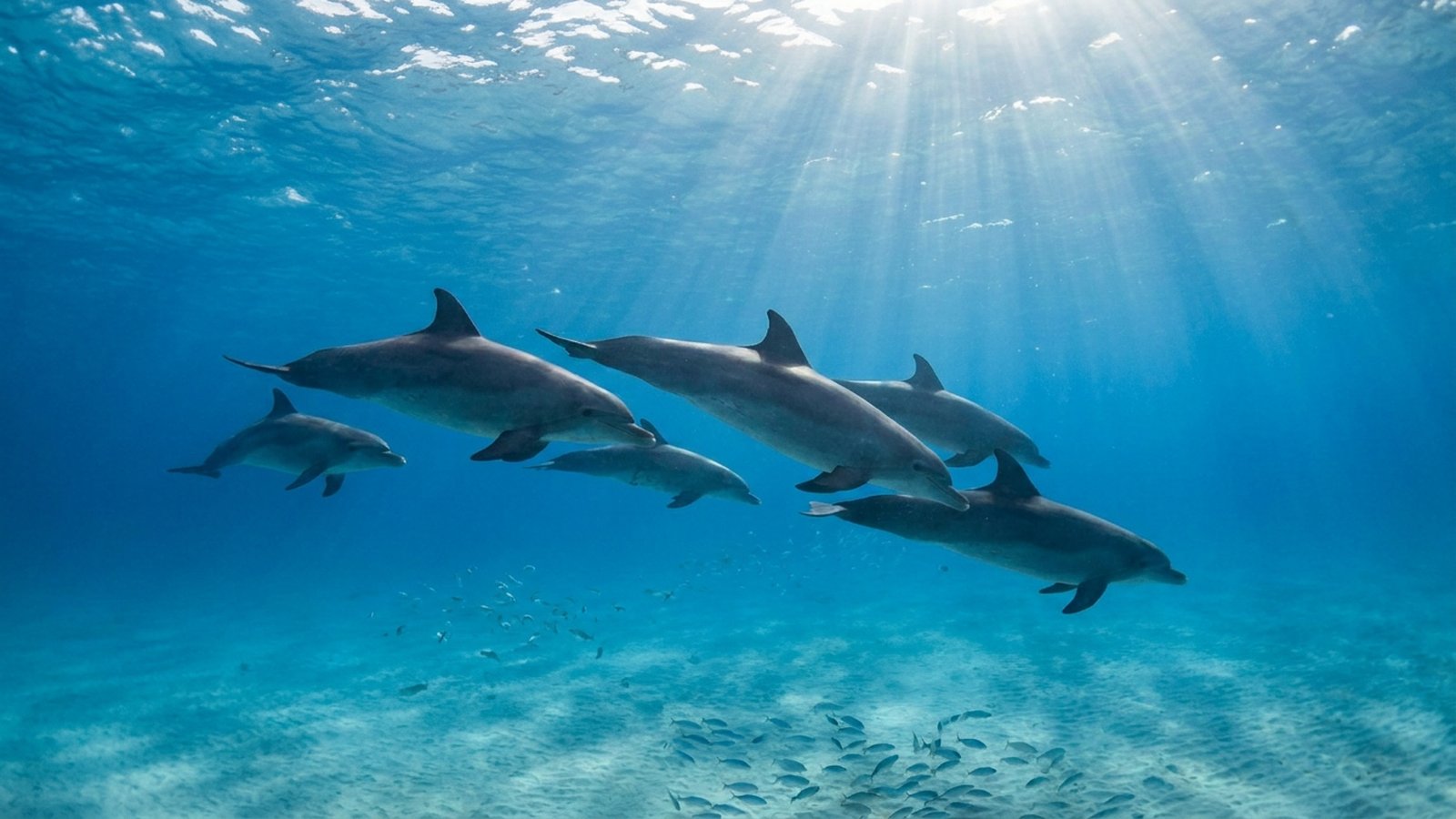
How intelligent are dolphins?
Very. Dolphins have large brains relative to body size, recognise themselves in mirrors, use tools and remember each other’s signature whistles for more than 20 years.
Bottlenose dolphins develop individual signature whistles that work much like names. Shark Bay dolphins carry sponges as foraging tools, a habit passed from mother to daughter. Many dolphins also play, blowing bubble rings or surfing waves, though play is not unique to dolphins and people: many mammals and birds play. Measuring dolphin intelligence against ours is difficult, but they consistently rank among the most cognitively complex animals. See the smartest animal in the ocean.
Where do dolphins live?
In every ocean from the tropics to polar ice edges, in coastal bays and estuaries, and in rivers of South America and South Asia.
Some species, like the spinner and pantropical spotted dolphins, roam warm open oceans; others, like Hector’s dolphin, stay within a few kilometres of one coastline. River dolphins live up to thousands of kilometres from the sea. For local viewing, see dolphins in the Gulf of Mexico and dolphins in India.
What threatens dolphins?
Bycatch in fishing nets kills more dolphins than any other human activity; habitat loss, pollution, dams, noise and hunting add pressure.
The baiji was declared functionally extinct in 2006, and the Māui dolphin numbers about 54. River dolphins are the most threatened group, because rivers are dammed, polluted and heavily fished. Read which dolphins are endangered and how many dolphins are left in the world.
How do dolphins find food in the dark?
Most dolphins hunt with sound. They produce rapid clicks with a pair of structures in the nasal passages called the phonic lips, just below the blowhole. The clicks are focused into a beam by the melon, the rounded fatty organ in the forehead, and sent ahead of the animal. When the sound hits a fish, a rock or the sea floor, echoes return and are picked up mainly through fat-filled channels in the lower jaw, which conduct the sound to the inner ear.
By timing and analysing the echoes, a dolphin can judge the distance, size, shape and even the internal structure of objects. Experiments with captive bottlenose dolphins have shown that they can tell apart objects made of different materials and detect small targets at surprising distances. As a dolphin closes in on prey, its clicks speed up into a rapid buzz, giving it constantly updated information during the final strike.
Echolocation matters most where vision fails. River dolphins live in water so muddy that eyesight is almost useless, and the South Asian river dolphins have tiny eyes that lack a proper lens, relying almost entirely on sound. Oceanic species that hunt at night or in deep water, such as Risso’s dolphins and pilot whales, also depend on it. Coastal species often combine echolocation with good eyesight both above and below the water.
How do dolphins sleep without drowning?
Dolphins are conscious breathers: they have to decide to surface and take each breath, so they cannot simply fall unconscious as land mammals do. Their solution is unihemispheric sleep. Studies of brain activity in captive dolphins, beginning with work by Lev Mukhametov and colleagues in the Soviet Union in the 1970s, showed that dolphins put one half of the brain into deep slow-wave sleep while the other half stays awake, then switch sides.
During these periods, a dolphin may rest motionless near the surface, swim slowly alongside others or keep one eye open, usually the eye opposite the sleeping half of the brain. This allows it to keep breathing, stay in contact with its group and watch for predators. Mothers and newborn calves seem to stay active almost continuously in the first weeks after birth, an extreme example of how flexible dolphin sleep can be.
How do dolphins live together?
Dolphin societies vary widely. Many coastal bottlenose dolphins live in fission-fusion societies, in which group membership changes from hour to hour as individuals join and leave. Within that fluid system, long-term bonds still matter. In Shark Bay in Western Australia, males form alliances of two or three that cooperate to herd females, and these alliances join into larger second-order alliances that compete with rival groups.
Other species live in much larger groups. Common dolphins and spinner dolphins can gather in hundreds or even thousands in the open ocean, where safety in numbers helps against sharks and large predatory fish. At the other extreme, orcas and pilot whales live in stable family groups built around mothers and their offspring, in which sons and daughters may stay with their mother for life.
Long-term studies have been essential to understanding this social life. The Sarasota Dolphin Research Program in Florida, which began in 1970, has followed several generations of bottlenose dolphins in the same bay. It has documented lifespans of several decades in wild females, the importance of mother-calf bonds, and the effects of pollution, fishing gear and boat traffic on individual animals.
Which dolphins are closest to extinction?
Some dolphins are among the most threatened mammals on Earth. The baiji, the Yangtze River dolphin of China, is almost certainly gone: an intensive six-week survey of its range in 2006 found no animals, and it was declared functionally extinct. It was the first whale or dolphin species to be lost largely because of human activity, through a combination of bycatch, electrofishing, dam building, pollution and boat traffic.
The Māui dolphin, a subspecies of Hector’s dolphin found only off the west coast of New Zealand’s North Island, numbers only a few dozen adults. The New Zealand government’s most recent survey estimated about 54 individuals over one year of age. Set nets and trawl nets are the main threat, and fishing restrictions across much of its range have been expanded in an effort to save it.
Other species, such as the Atlantic humpback dolphin of West Africa, the South Asian river dolphins and several populations of Irrawaddy dolphins, are also in serious trouble. Their stories share a common theme. Dolphins that live close to the coast or in rivers overlap with the busiest human activity, and their slow breeding, with a single calf every few years, makes it hard for populations to recover from losses.
How many species of dolphins are there?
About 40–45 living species: roughly 37–38 oceanic dolphins plus several river dolphins.
Is an orca a dolphin?
Yes. The orca, or killer whale, is the largest member of the oceanic dolphin family.
What is the smallest dolphin?
Hector’s dolphin, at about 1.2–1.7 m long.
Are dolphins mammals?
Yes. Dolphins breathe air, are warm-blooded, give birth to live young and nurse them with milk.
What is the rarest dolphin?
The Māui dolphin of New Zealand, with about 54 adults; the baiji is probably extinct.
Are there dolphins in rivers?
Yes, in South America (Amazon and Orinoco) and South Asia (Ganges, Brahmaputra and Indus), plus Irrawaddy dolphins in some Asian rivers.
How long do dolphins live?
Most live 20–50 years; some bottlenose females exceed 60. See how long do dolphins live.
Are dolphins dangerous to humans?
Rarely, but wild dolphins can bite, especially when fed or harassed.
- Society for Marine Mammalogy, Committee on Taxonomy: List of marine mammal species and subspecies.
- IUCN Red List: Cetacea assessments.
- Perrin, W. F., Würsig, B. & Thewissen, J. G. M. (eds) (2009). Encyclopedia of Marine Mammals. Academic Press.
Blane Perun has been exploring Earth’s oceans and marine life for over 25 years. Founder of TheSea.Org in 1999, underwater photographer, coral aquaculture pioneer, and explorer of 80+ countries.
