Why Is the Bottom Layer of the Ocean the Coldest? — Cold Water Is Dense, So It Sinks
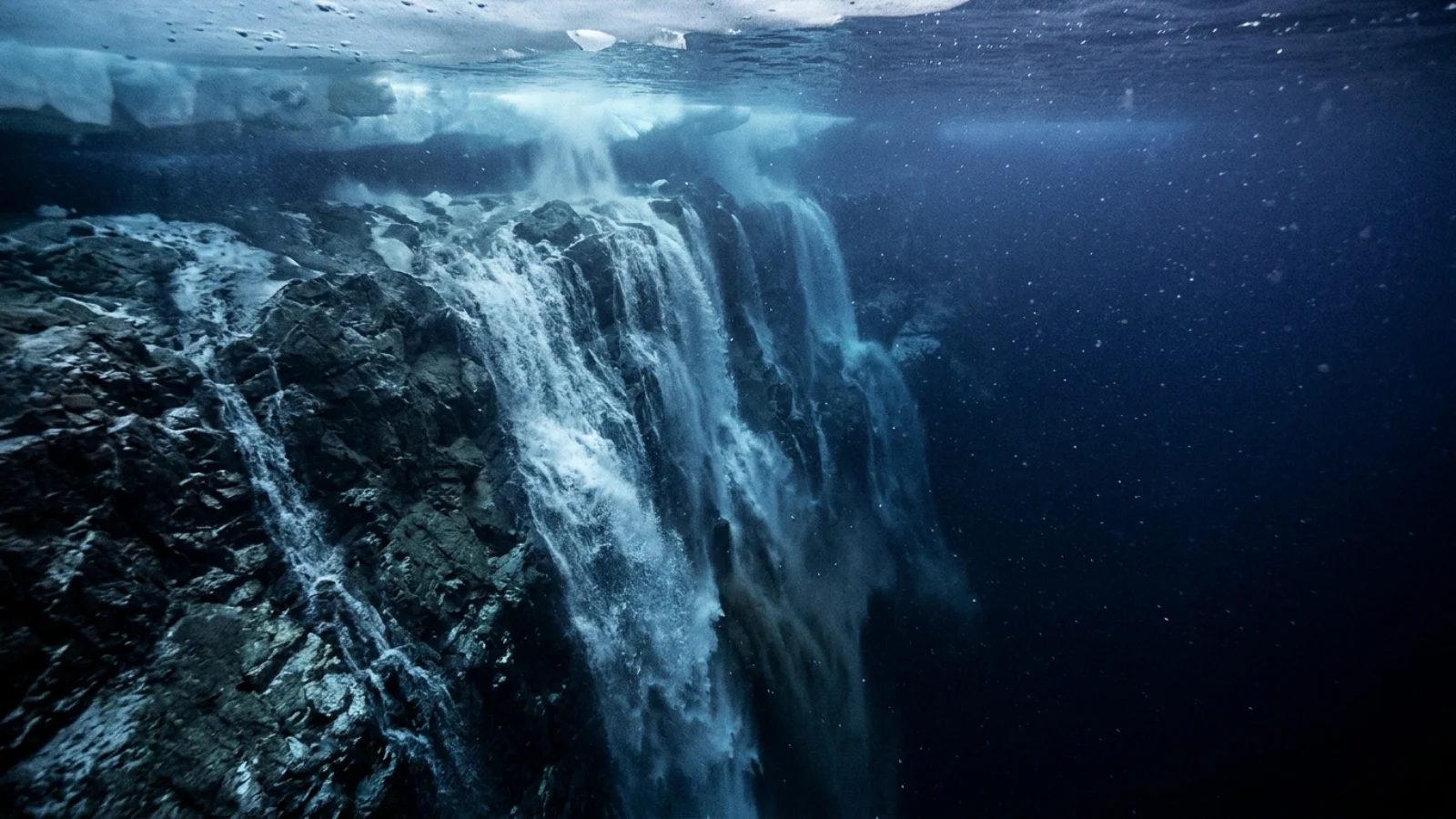
Because cold water is denser than warm water, so it sinks. The Sun heats only the top few hundred metres. Near Antarctica and in the North Atlantic, surface water becomes so cold and salty that it sinks to the seafloor and spreads through the ocean basins, keeping the deep ocean at roughly 0–3°C. The ocean is therefore layered, with warm, light water floating on cold, heavy water.
Seawater density rises as temperature falls and salinity increases. At high latitudes, winter air chills surface water to near its freezing point of about −1.9°C, and sea-ice formation leaves extra salt behind. This very dense water sinks thousands of metres and flows along the bottom toward the equator. Because sunlight cannot penetrate far and warm water floats, nothing replaces that cold layer with warmth, and the deep ocean stays near freezing.
How does water density control ocean layers?
Denser water sinks beneath lighter water, so the ocean arranges itself in layers by temperature and salinity.
The surface mixed layer is warmed by the Sun and stirred by wind. Below it, the thermocline is a zone where temperature drops quickly with depth, typically from around 200 to 1,000 m. Beneath that lies the deep ocean, filled with cold water that originally sank near the poles. This layering, called stratification, is very stable: it takes a lot of energy to mix the warm surface water down.
| Layer | Approx. depth | Typical temperature |
|---|---|---|
| Surface mixed layer | 0–200 m | −2 to 30°C+ (varies with latitude) |
| Thermocline | ~200–1,000 m | Drops rapidly |
| Deep water | 1,000–4,000 m | ~1–4°C |
| Bottom water | 4,000 m to seafloor | ~−0.5 to 2°C |
Where does the coldest water come from?
Mostly from the Antarctic continental shelf and the North Atlantic.
Antarctic Bottom Water forms mainly in the Weddell and Ross seas, where katabatic winds blow sea ice away from the coast, constantly exposing new water to freeze. Salt rejected by the ice makes the remaining water extremely dense. It cascades down the continental slope and spreads northward along the seafloor into all three major ocean basins. North Atlantic Deep Water, formed in the Nordic and Labrador seas, is slightly warmer and lighter and flows above it. Together these drive the global conveyor; see how ocean currents form.
Isn’t the seafloor heated by the Earth’s interior?
Only slightly. Geothermal heat flow is tiny compared with the cooling effect of polar water.
Earth’s average geothermal heat flow is only about a tenth of a watt per square metre, compared with hundreds of watts per square metre of sunlight at the surface. The exception is hydrothermal vents, where water reaches 350–400°C, but this heat is extremely localised and quickly dissipated; see vent water can be incredibly hot. In fact, geothermal heat slightly warms the bottom-most water in some basins, but not enough to change the overall pattern.
Why seawater keeps sinking as it cools
Most people learn at school that water is densest at about 4°C. That is true for fresh water, whose maximum density is reached at 3.98°C. Below that temperature fresh water becomes lighter again, which is why lakes freeze from the top and the bottom of a deep lake in winter often sits at about 4°C. If the ocean behaved the same way, the deep sea would be no colder than about 4°C.
Seawater is different. Dissolved salt lowers both the freezing point and the temperature of maximum density, and the second falls faster than the first. In water saltier than about 24.7 grams of salt per kilogram, the temperature of maximum density falls below the freezing point. Open-ocean water averages about 35 g/kg, so it never reaches a density peak before it freezes. As seawater cools, it simply keeps getting denser all the way down to its freezing point of about -1.9°C. This is the main reason the deep ocean can be colder than the bottom of any deep freshwater lake. The coldest, densest water at the poles can always sink beneath slightly warmer water.
Salt adds a second push. When sea ice forms, the ice is nearly pure fresh water and the salt is left behind in the water below. This process, called brine rejection, makes the remaining water both colder and saltier, and therefore denser still. That dense brine sinks and is replaced by more surface water, which is then exposed to the cold air in its turn. In places where winds keep pushing new ice away from the coast, the process can continue all winter.
How the cold water reaches the deep sea
The densest water in the open ocean is Antarctic Bottom Water. It has temperatures of roughly -0.8 to 2°C and occupies the depth range below about 4,000 m in every ocean basin connected to the Southern Ocean at that depth. It forms in a few places around Antarctica, mainly the Weddell and Ross seas, off the Adélie Coast and near Cape Darnley. These sites share one feature: very cold winds blowing off the continent. The winds push sea ice offshore and open stretches of water called polynyas, which keep freezing, rejecting salt and producing dense water. The water then flows down the continental slope and northward along the seafloor. The Weddell Sea Bottom Water is the densest part of this water mass.
On its way north, the bottom water follows deep channels in the seafloor. In the South Atlantic, the Vema Channel through the Rio Grande Rise is one of its main routes. At the equator, about a third of the northward-flowing bottom water enters the Guiana Basin, and part of the rest passes through the Romanche Fracture Zone into the eastern Atlantic. In the Pacific, the water spreads slowly northward over thousands of kilometres. The oldest deep water, with a transit time of about 1,000 years, finally returns to the upper ocean in the North Pacific.
Bottom-water formation is not steady. Sediment cores from the Antarctic shelf show that individual production sites have switched on and off over the past several thousand years as the conditions that create polynyas changed. A sudden change can have a big effect. When a large iceberg calved from the Mertz Glacier on 12-13 February 2010, it changed the pattern of sea ice off Adélie Land and reduced bottom-water export from that region by up to 23%.
Open water in the ice: the Weddell Polynya
One of the most dramatic examples of deep convection is the Weddell Polynya, a large patch of open water that sometimes appears in the middle of the winter sea ice near Maud Rise. Between 1974 and 1976 it opened each winter and reached about the size of New Zealand. These were the first winters that satellites could observe Antarctic sea ice with microwave sensors. When the polynya is open, relatively warm water at the surface, still at the freezing point of about -1.9°C, meets air that is far colder. The ocean loses huge amounts of heat, and convection can stir the water to depths of 1,000 to 2,000 m.
After 1976 the polynya was rarely seen for about four decades. It returned in 2016 and again in 2017, when it covered about 80,000 square kilometres, roughly the size of Maine. Researchers linked the 2017 opening to intense cyclones over the pack ice. The long absence may itself be a sign of change: since the 1970s, the surface waters of the polar Southern Ocean have become fresher and more stratified, probably because of human-caused climate change. That fresher surface layer is lighter, which makes it harder for cold water to sink and may suppress events like the Weddell Polynya.
Why trench water gets slightly warmer at depth
In the deepest trenches, thermometers show something surprising: near the bottom, the measured temperature can start to rise slightly with depth. The water is not being heated. It is being squeezed. Seawater is slightly compressible, and as it sinks under immense pressure, the compression raises its temperature a little, just as air warms when it is compressed in a bicycle pump.
Oceanographers deal with this by using potential temperature, the temperature a parcel of water would have if it were brought up to the surface without gaining or losing heat. Potential temperature removes the effect of pressure, so it shows where water came from and how it moves. In a deep trench, the measured temperature can increase with depth while the potential temperature stays almost unchanged. The bottom water is still the same cold water that sank near Antarctica.
The problem caught out the first deep-sea scientists. The thermometers used on the HMS Challenger expedition of 1872-76 recorded the maximum and minimum temperatures they passed through, on the assumption that water always grows colder with depth. Challenger also tried out reversing thermometers that could record the temperature at a chosen depth, and these became the standard instrument until the second half of the twentieth century. After the voyage, the physicist Peter Tait was asked to work out how much the high pressure of the deep sea distorted the thermometer readings. That work led him to the Tait equation for the compressibility of liquids. The expedition made 263 serial temperature observations, which helped establish that the deep ocean is cold almost everywhere.
Where the bottom of the sea is not cold
There are notable exceptions to the rule, and they help prove it. The deepest water in the Mediterranean Sea is about 13.2°C, far warmer than the 0-3°C of the open ocean at similar depths. The reason is that the Mediterranean is cut off from the cold Atlantic deep water by the shallow sill at the Strait of Gibraltar. Its deep water forms locally, in winter, from water that is warm by polar standards but very salty because of high evaporation, so it is dense enough to sink. Mediterranean deep water also turns over relatively quickly, and its temperature rose by about 0.12°C between 1959 and 1989.
The Red Sea is warmer still. It is one of the warmest and saltiest seas in the world, with very little rainfall and evaporation of up to about 2,050 mm a year. Its entrance at the Bab-el-Mandeb strait is too shallow to let cold Indian Ocean deep water in. In the central Red Sea, deep basins hold hot, salty brines that reach about 60°C, fed by an active rift beneath the seafloor. These pockets are an extreme example, but they show the general principle: a basin’s deep water is only as cold as the water that can sink into it. Where the cold polar water cannot get in, the bottom stays warm.
How much heat comes up from below?
Earth’s interior does leak heat into the ocean. The total heat flow from the planet’s interior is estimated at about 47 terawatts, based on more than 38,000 measurements. The average heat flow through oceanic crust is about 105 milliwatts per square metre, higher than through continents, and it is greatest at the young mid-ocean ridges. That sounds like a lot until it is compared with the Sun: Earth’s internal heat makes up only about 0.03% of the energy reaching the planet’s surface, which receives about 173,000 terawatts of sunlight.
Spread over the seafloor, that geothermal heat would warm the deep ocean only very slowly. The steady supply of new cold water from the poles carries it away long before it can build up. In some isolated deep basins where the water moves slowly, the bottom few hundred metres are slightly warmer than the water above because of this heat. On the whole, though, the deep ocean is cold because of what sinks into it from above, not because of what rises from below.
Is the deep ocean warming?
For most of the twentieth century, the abyss was assumed to change very slowly. Repeated ship surveys along the same lines have shown that it does change. Sarah Purkey and Gregory Johnson compared measurements from the 1990s and 2000s and found that abyssal waters and deep Southern Ocean waters had warmed, adding to the planet’s heat budget and to sea-level rise. In a 2013 study they found that Antarctic Bottom Water was also becoming fresher. Other studies have linked a period of fresher bottom water between 2011 and 2015, especially in the Weddell Sea region, to increased ice melt from the early 2000s. Some of that freshening has since reversed as melting slowed. Because bottom water carries oxygen into the deep sea and stores carbon, scientists watch these trends closely. A fresher, lighter surface layer around Antarctica could reduce how much cold water sinks, which would slowly change the deep ocean over centuries.
Why does the cold deep ocean matter?
It stores heat and carbon for centuries, supplies nutrients to upwelling zones and supports cold-adapted deep-sea life.
Sinking polar water carries dissolved CO2 and oxygen into the deep, slowing climate change and ventilating the abyss. When deep water eventually upwells, it brings nutrients that fuel some of the richest fisheries on Earth. Deep-sea animals live slowly in this cold, high-pressure world, with long lifespans; see deep-sea predators. Warming and freshening at the poles could reduce bottom-water formation, which scientists are monitoring closely; see ocean warming.
Why is the bottom of the ocean the coldest?
Cold water is denser than warm water, so it sinks to the bottom; sunlight warms only the surface.
How cold is the bottom of the ocean?
Usually about 0–3°C, and slightly below 0°C near Antarctica.
Why doesn’t the deep ocean freeze?
Salt lowers the freezing point to about −1.9°C, and high pressure and constant flow keep it liquid.
Where does cold bottom water form?
Mainly around Antarctica (Weddell and Ross seas) and in the North Atlantic.
Is the bottom of the ocean ever hot?
Only at hydrothermal vents, where water can reach about 400°C locally.
What is the thermocline?
The layer where temperature drops quickly with depth, separating warm surface water from cold deep water.
- NOAA Ocean Service: Why is the deep ocean cold?
- Talley, L. D. et al. (2011). Descriptive Physical Oceanography. Academic Press.
- Purkey, S. G. & Johnson, G. C. (2013). Antarctic Bottom Water warming and freshening. Journal of Climate 26.
- Purkey, S. G. & Johnson, G. C. (2010). Warming of global abyssal and deep Southern Ocean waters between the 1990s and 2000s. Journal of Climate 23.
- Davies, J. H. & Davies, D. R. (2010). Earth’s surface heat flux. Solid Earth 1: 5-24.
- Matsumoto, K. (2007). Radiocarbon-based circulation age of the world oceans. Journal of Geophysical Research 112.
Blane Perun has been exploring Earth’s oceans and marine life for over 25 years. Founder of TheSea.Org in 1999, underwater photographer, coral aquaculture pioneer, and explorer of 80+ countries.
