What Naval Tactics Made Charles Vane Stand Out Among His Peers
Vane’s most tactically distinctive documented action was the fireship escape from Nassau in July 1718 — setting a captured prize ablaze to create covering chaos while The Ranger broke through a naval blockade at night. Beyond that specific event, his tactical approach was characterised by the use of sloop speed and shallow draft to operate where larger vessels could not follow, the deliberate cultivation of reputation as a pre-engagement psychological tool, and a consistent willingness to disengage rather than fight under unfavourable conditions. This last quality is what his crew cited as cowardice in November 1718 when they voted him out, but it is also tactically defensible.
Assessing Vane’s naval tactics requires working carefully with the available evidence. The historical record provides specific documented events that illuminate his tactical approach, and it provides general patterns that can be inferred from his operational history. What it does not provide is the kind of detailed battle account that would allow a precise reconstruction of his tactical methods. What follows is an analysis grounded in the documented record rather than the elaborated tactical analysis that popular treatments often apply to figures for whom the evidence is actually quite limited.
The fireship escape: the most tactically sophisticated documented action
The single most tactically sophisticated action in Vane’s documented career is also one of the most specifically evidenced: his escape from Nassau in July 1718 using a fireship to penetrate Woodes Rogers’ naval blockade.
The tactical logic of the action was straightforward but required precise execution. Vane had a captured French prize available. Rogers had deployed his naval force to blockade the Nassau harbour entrance. Vane set the French vessel alight and directed it toward the blockading ships, which were forced to take emergency evasive action to avoid the burning hull. In the resulting chaos and darkness, The Ranger slipped through the gap created by the disruption. The action succeeded completely: Vane escaped, Rogers’ blockade was penetrated without a direct naval engagement, and the captured prize — which could not have escaped anyway — was deployed usefully rather than abandoned.
The fireship was a well-established naval weapon used in formal naval warfare throughout the 17th and 18th centuries. Its application in this context was tactically intelligent: it converted a liability (a prize vessel Vane could not take with him) into an asset (a psychological and physical disruption to the blockade), and it avoided direct combat with a superior force that Vane could not have defeated. Whether Vane conceived this plan independently or drew on knowledge of formal naval tactics is not documented, but the execution shows tactical thinking that went beyond simple predation of merchant vessels.
Sloop-based operational tactics: speed, draft, and coastal access
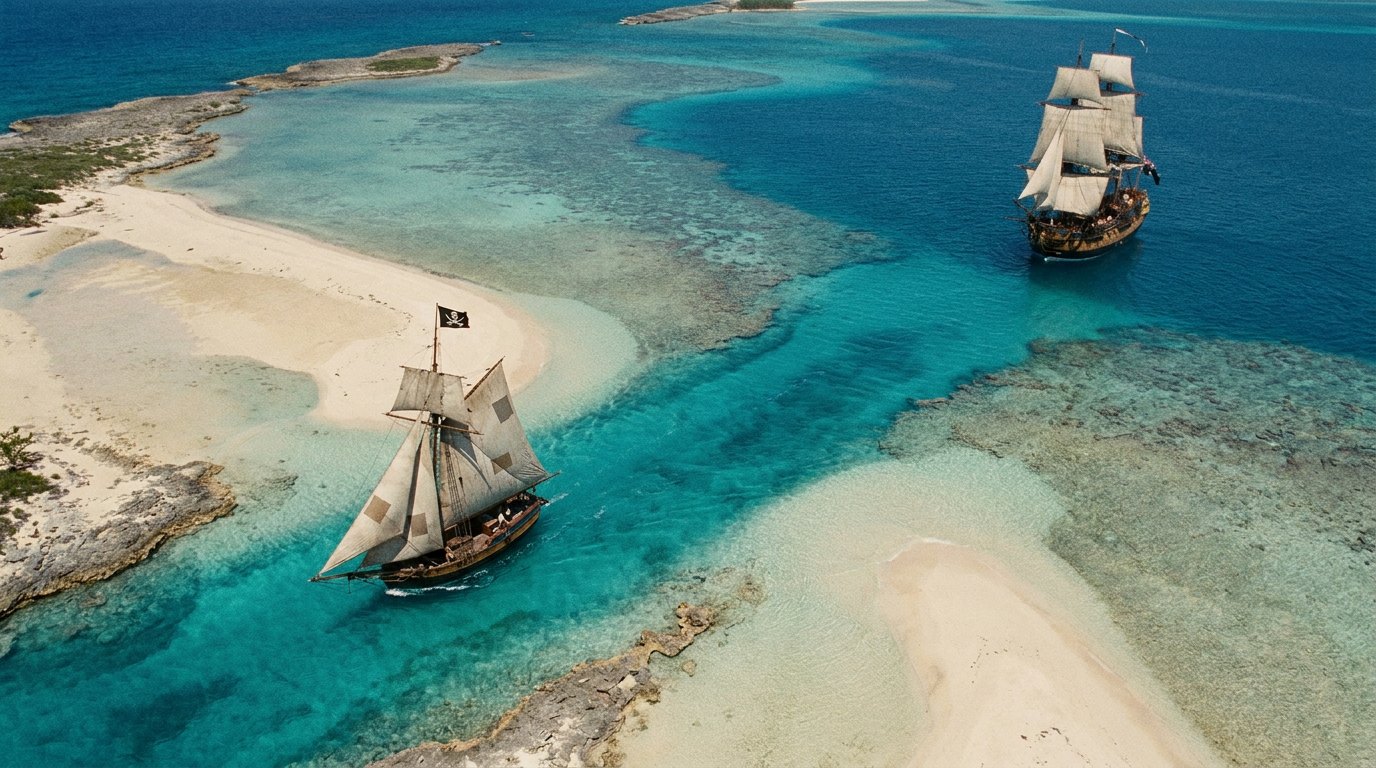
The Ranger’s characteristics as a Caribbean sloop defined the tactical options available to Vane and determined how he operated throughout his post-Nassau career. Understanding those characteristics is essential for understanding his tactical approach.
A sloop’s shallow draft allowed operation in coastal inlets, coves, and channels inaccessible to larger naval vessels. This was not incidental to pirate tactics but central to them: it meant a pursuing frigate or warship could not follow a sloop into shallow water, providing an effective escape route that relied on geography rather than outrunning the pursuer in open water. Vane’s operations along the Carolina coast in 1718 exploited exactly this geography — the barrier islands, inlets, and shallow coastal channels of the Outer Banks region provided numerous opportunities for a sloop to disappear from naval pursuit.
Speed relative to merchant vessels was the offensive complement to shallow-draft evasion. A sloop that could close with a merchant vessel quickly, before an escort could intervene, and then withdraw equally quickly if an armed escort appeared, had a significant tactical advantage in the prize-taking business. The combination of offensive speed against merchant targets and defensive geographic access to shallow water created the operational envelope within which Vane’s tactics functioned.
Pre-engagement reputation as tactical preparation
Vane’s use of reputation as a pre-engagement tactical tool is one of the more analytically interesting aspects of his career because it reflects an understanding that the goal of piracy was prize acquisition rather than combat, and that combat was best avoided.
A merchant vessel whose captain had heard of Vane was more likely to surrender without resistance than one whose captain had not. Surrender without resistance meant an intact prize, full cargo, no casualties, and no damage to The Ranger. Combat meant the opposite risk profile. The economic logic strongly favoured reputation-based pre-engagement pressure over actual fighting, and Vane appears to have understood this. Johnson’s account describes his treatment of captive crews as severe, and that severity served a tactical purpose: stories of harsh treatment travelled through port networks and preceded Vane to subsequent targets, doing preparatory work for each new engagement.
His flag — the skeleton with hourglass and spear — functioned as a visible component of this pre-engagement system. A target vessel that could read the flag before any verbal communication had occurred was already receiving a specific threat message. The flag’s symbolism — time running out, violence promised for non-compliance — was designed to move the merchant captain’s calculation toward surrender in advance of any direct interaction. This is a tactical function rather than mere theatrics, and Vane’s apparent understanding of it places him within a broader Golden Age pirate tradition of deliberate reputation management as operational preparation.
What made Vane tactically distinctive versus his contemporaries
Comparing Vane’s documented tactics to those of contemporaries like Blackbeard and Bartholomew Roberts helps locate what was specifically distinctive about his approach rather than common to Golden Age Caribbean pirates generally.
Blackbeard’s tactical distinctiveness was primarily psychological and theatrical. He cultivated a specific presentation — the lighted fuses in his beard, the smoke, the deliberate terror performance — that amplified his reputation through spectacle. His actual tactical engagements relied on the same sloop-based speed and intimidation that other pirates used, but his personal presentation added an additional layer of psychological pressure. Roberts, the most tactically sophisticated of the major Golden Age pirates, operated on a much larger scale with multiple vessels and conducted complex multi-ship engagements that Vane’s single-sloop operations did not approach.
What was distinctively Vane’s was the combination of tactical intelligence demonstrated in the fireship escape, the willingness to disengage rather than fight at tactical disadvantage, and the deliberate cultivation of a reputation that was effective precisely because it seemed genuine rather than performed. He was not the most theatrically impressive pirate of the period, and he was not the most operationally successful. But his documented tactical decision-making — particularly the fireship — shows a capacity for unconventional thinking under pressure that was genuinely distinctive.
The limits of what the record allows us to conclude
Popular treatments of Vane’s tactics often elaborate beyond what the historical evidence supports, describing specific manoeuvres, detailed battle plans, and sophisticated strategic thinking that the primary sources do not document. Intellectual honesty requires acknowledging these limits.
Johnson’s General History provides narrative accounts of key events in Vane’s career without detailed tactical analysis. Colonial correspondence documents his activities in general terms. The trial records list charges without tactical detail. What we can document specifically is: the fireship escape, the pattern of sloop-based coastal operations, the use of reputation as a pre-engagement tool, and the refusal to attack the French man-of-war. Everything beyond this represents inference from the vessel type, the operational geography, and the general practices of Golden Age Caribbean pirates.
Those inferences are reasonable and historically grounded, but they should be understood as the most probable account of how Vane operated rather than as documented fact. The fireship escape is the one tactical action in his career where we have enough documentary evidence to say with confidence that this is specifically what he did and how he thought. Everything else is the product of reasoning from the available evidence, and the available evidence is, as with so much of his biography, significantly incomplete.
What was Vane’s most tactically sophisticated documented action?
The fireship escape from Nassau in July 1718. Setting a captured French prize ablaze to disrupt Woodes Rogers’ naval blockade, then slipping through the gap in the chaos and darkness, converted a liability into an asset and avoided direct combat with a superior force. It is the most specifically documented and tactically interesting action in his career.
How did sloop characteristics define Vane’s tactical options?
The Ranger’s shallow draft allowed operation in coastal inlets inaccessible to naval frigates, providing geographic escape routes. Its speed relative to merchant vessels enabled rapid prize approaches. Together these created the tactical envelope within which Vane operated: offensive speed against merchant targets, defensive geographic access against naval pursuit.
Was Vane’s reputation management a deliberate tactical tool?
Yes. Stories of his treatment of captive crews served a practical purpose: they preceded him to subsequent targets and moved merchant captains’ calculations toward surrender before any direct engagement. His flag’s symbolism reinforced this pre-engagement pressure. The goal was prize acquisition without combat, and reputation management served that goal directly.
Was Vane’s refusal to attack the French man-of-war tactical cowardice?
His crew voted him out for cowardice under the articles, and that democratic judgment was legally valid. The tactical case for his decision is actually defensible: a sloop attacking a heavily armed man-of-war risked catastrophic loss for uncertain gain. Whether the crew’s judgment or Vane’s was more tactically sound is a question historians have noted without resolving definitively.
How did Vane’s tactics compare to Blackbeard’s?
Blackbeard’s distinctiveness was theatrical — the spectacle of his personal presentation amplified his reputation. Vane’s was more operationally grounded: the fireship escape, geographic evasion, reputation cultivated through consistent conduct rather than performance. Both used intimidation effectively; they did so through different mechanisms.
Blane Perun has been exploring Earth’s oceans and marine life for over 25 years. Founder of TheSea.Org in 1999, underwater photographer, coral aquaculture pioneer, and explorer of 80+ countries.
About Blane Perun →