Treasure of the SS Gairsoppa — Wartime Silver Raised From Nearly 5 km Down
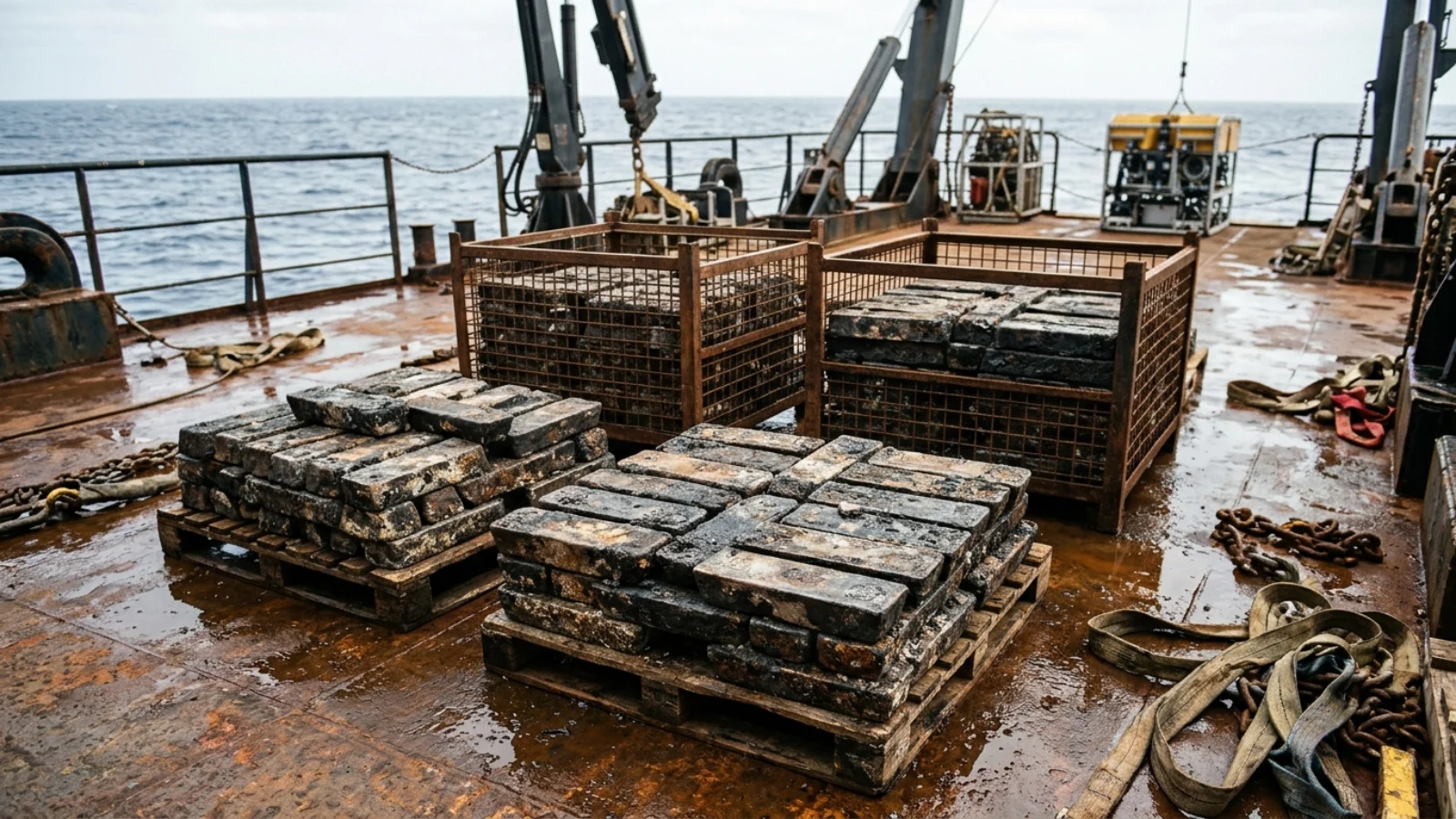
Silver bullion. The British India Steam Navigation cargo ship SS Gairsoppa was torpedoed by the German submarine U-101 on February 16–17, 1941, about 300 nautical miles southwest of Galway, Ireland, while carrying about 200 tons of silver along with tea, pig iron and mail. Early estimates put the silver at about 7 million ounces (200–220 tonnes). Odyssey Marine Exploration found the wreck at nearly 4,700 m in 2011 and in 2012–13 recovered about 2,792 bars, roughly 100 tonnes, said to be 99% of the insured silver, plus 717 letters. Under its contract with the UK government, Odyssey kept 80% of the value.
When Odyssey Marine’s ROV lifted the first silver bars from the Gairsoppa in 2012, they came from deeper than any previous cargo recovery, deeper than the Titanic by more than a kilometre.
The silver was British wartime money. Bought in India and shipped home to pay for the war and to feed the Royal Mint, it went down with a slow tramp steamer that had run short of coal in a winter gale. Seventy years later it became the subject of one of the largest and deepest precious-metal salvages ever attempted, and of a smaller but more moving recovery: hundreds of letters written by people who never knew whether their post would arrive.
What kind of ship was the SS Gairsoppa?
A standard British cargo steamer of 5,237 gross tons, built at the end of the First World War and run by the British India Steam Navigation Company for its whole career.
Palmers Shipbuilding and Iron Company on the Tyne launched her on 12 August 1919 as War Roebuck, one of the wartime “B” type standard ships ordered to replace tonnage lost to U-boats. British India Steam Navigation bought her before completion and renamed her Gairsoppa, after a village in southern India or the nearby Jog Falls, which the British called the Gairsoppa Falls. She was completed on 17 October 1919. Sources disagree on whether the yard was at Jarrow or Hebburn; Palmers worked at both.
She was about 412 ft (126 m) long overall with a beam of 52 ft, driven by a single triple-expansion steam engine that gave around 11.7 knots on trials. That was respectable in 1919 and slow by 1941. For two decades she carried general cargo between India and Britain, with little to record beyond a brief grounding on the Hooghly River below Calcutta in 1930, from which she was refloated undamaged the same day.
What was the Gairsoppa carrying in 1941?
Pig iron, tea, general cargo, mail and about 200 tons of silver ingots and coin, bound for Britain.
The ship left Calcutta late in 1940, called at Durban and Cape Town in early January 1941, and reached Freetown in Sierra Leone on 22 January. Her manifest listed about 2,600 tons of pig iron, 1,765 tons of tea and 2,369 tons of general cargo. Below that ran the item that made her famous: some 200 tons of silver, valued at about £600,000 at the time and destined for the Royal Mint.
Britain needed silver badly. Correspondence later found in Mint files shows officials feared they were within about two months of running out of metal for coinage in early 1941. Silver also served as a reserve that could be sold or pledged to pay for imports. Shipping it from India by sea, through waters patrolled by U-boats and long-range bombers, was a calculated risk.
The total amount aboard is the most confusing number in the story. The UK government’s contract and Odyssey’s early announcements spoke of about 7 million troy ounces, or roughly 200–220 tonnes, which is the figure most news reports repeated. Yet the silver eventually recovered, about 100 tonnes, was said to equal 99 percent of the insured bullion. Either a large uninsured consignment was also aboard and has never been found, or the early estimate was too high. Both figures appear in reliable sources, so we give both.
How did the SS Gairsoppa sink?
Straggling from a convoy in a storm and low on coal, she was torpedoed by U-101 in the Atlantic southwest of Ireland in February 1941.
All but one of about 85 crew died. Second Officer R. H. Ayres survived a long lifeboat voyage, only for the boat to capsize in the surf off Cornwall; he was the only one pulled from the sea alive.
The Gairsoppa sailed from Freetown on 30 January 1941 in convoy SL 64, some 30 merchant ships bound for Liverpool. Heavy weather slowed the convoy, and the old steamer burned more coal than planned. On 15 February Captain Gerald Hyland judged that she could not reach Liverpool with what was left in her bunkers. He left the convoy, cut speed to about 5 knots and turned for Galway Bay in Ireland to take on fuel.
Alone and slow, she was an easy target. A German Focke-Wulf Fw 200 long-range aircraft circled her on the morning of 16 February, and that evening U-101 sighted her. Rough seas delayed the attack until close to midnight. The submarine fired several torpedoes that missed before one struck the starboard side near No. 2 hold shortly after midnight on 17 February. The ship caught fire, settled by the bow and sank within about 20 minutes, roughly 300 nautical miles (560 km) southwest of Galway.
| Date | Event |
|---|---|
| Feb 1941 | Torpedoed by U-101 |
| Sept 2011 | Wreck confirmed at ~4,700 m |
| 2012 | 1,218 silver ingots (~1.4M oz) recovered |
| 2013 | Further ~48–61 tonnes recovered (reports differ) |
| 2014 | Royal Mint issues 50p coins from the silver |
What happened to the Gairsoppa’s crew?
Three lifeboats got away; two vanished, and of the 31 men in the third only Richard Ayres lived.
Most of the crew were lascars, sailors recruited in India and what is now Bangladesh, serving alongside a small group of British officers, naval gunners and a Chinese carpenter. Casualty counts vary between about 85 and the mid-90s depending on how the gunners and passengers are counted, but every account agrees there was one survivor.
The surviving boat, under Second Officer Richard Ayres, held eight Europeans and 23 lascars. It drifted and sailed east for nearly two weeks. The water ran out after eight days, and men died of cold, exposure and from drinking seawater; by the end of the first week only seven were left alive. On 1 March 1941 they sighted the Lizard lighthouse in Cornwall. As they tried to land near Caerthillian Cove, a wave rolled the boat over. Four men drowned in the surf, the radio officer was swept away, and a deckhand who reached a rock with Ayres was washed off and killed. A local farmworker and coastguard volunteer, Brian Richards, pulled Ayres unconscious from the water.
Ayres was appointed MBE in November 1941 and received Lloyd’s War Medal for Bravery at Sea. He went back to sea, retired in 1964 and died in 1992. Four of the men who reached Cornwall are buried at St Wynwallow’s Church, Landewednack. The British dead are named on the Tower Hill Memorial in London, while the lascars and the carpenter appear on rolls of honour in Chittagong and Mumbai.
How was the Gairsoppa wreck found?
Odyssey Marine Exploration, working under a contract with the UK government, located it with sonar and an ROV in 2011 at nearly 4,700 m (about 3 miles) depth.
Because the silver was insured by the British government, which paid out after the sinking, the Crown owned the cargo. The government first invited salvage tenders in 1989 and received a single bid, which came to nothing. In 2011 it signed a contract with Odyssey, a Florida company known for deep-water treasure searches, to locate and salvage the Gairsoppa and a second BI ship, the Mantola, sunk in 1917 with about 600,000 oz of silver aboard.
Odyssey announced on 25 September 2011 that it had found the wreck. The hull lay upright and largely intact on the floor of the North Atlantic, its holds still closed. The company estimated about 220 tonnes of silver aboard and began planning one of the deepest salvages ever attempted.
How much silver was recovered from the Gairsoppa?
About 1.4 million oz in 2012, then tens of tonnes more in 2013: in total roughly 100 tonnes, valued at well over £100 million.
Odyssey kept 80% under its contract and the UK Treasury 20%. The record depth was later beaten by the SS City of Cairo salvage.
The first haul, landed at Bristol in July 2012, was about 1.4 million troy ounces, or 48 tonnes, in roughly 1,200 bars; Odyssey’s own count was 1,218, while the Wikipedia summary gives 1,203. The 2013 season brought up another 1,574 bars, around 1.8 million ounces. Reports of the second season’s weight range from about 48 to 61 tonnes depending on whether they count only that season or include earlier finds. Taken together, the two seasons raised about 2,792 bars and some 100 tonnes, the total Odyssey described as 99 percent of the insured silver.
The value moved with the silver price. At 2012–13 prices the recovered bullion was worth very roughly £100–150 million, of which the British Treasury received a fifth. Odyssey bore all the costs of the search and salvage, the reason the contract gave it the larger share.
How do you salvage silver from 4,700 m?
With remotely operated vehicles working on long cables from a surface ship, cutting into the hull and lifting bars in baskets.
No diver can work at that depth, where the pressure is more than 460 times that at the surface and the water is close to freezing and completely dark. Odyssey’s team used a chartered recovery ship with heavy work-class ROVs, controlled from the deck through an umbilical several kilometres long. The vehicles carried lights, cameras, manipulator arms and cutting tools.
The steel decks above the holds had to be cut open before the silver could be reached, and the bars lay in a jumble mixed with tea chests, pig iron and debris. Each ingot was picked up, placed in a lifting basket and hauled to the surface. Weather on the open Atlantic limited the working season, and every tool and cable had to be designed for the crushing pressure.
Finding the right hold mattered. Wartime manifests and stowage plans showed roughly where the bullion had been loaded, but the ship had broken and settled over seven decades, so the team surveyed the hull in detail before cutting. Working from plans and video, operators could sort silver from pig iron by shape and colour before lifting.
The technique was not new, but the scale was. Earlier deep-sea recoveries had lifted gold coins or small objects; the Gairsoppa job meant moving dozens of tonnes of heavy metal from almost three miles down. Its success helped prove that deep wrecks with valuable cargo are no longer beyond reach, a fact that worries archaeologists as well as interesting investors.
What letters were found on the Gairsoppa?
717 letters, the largest collection of mail ever recovered from a shipwreck.
The mail bags had lain in a hold sealed off from oxygen, so paper that would normally have dissolved survived in fragile form. Conservators at AOC Archaeology in Edinburgh and the Postal Museum in London spent about four years cleaning, drying and separating the sheets. The letters were written by servicemen, families and businesses in India and South Africa, many of them love letters and family news, plus official papers.
The Postal Museum showed a selection in its 2018 exhibition Voices from the Deep. For many visitors they were more affecting than the silver, a reminder that a merchant ship in wartime carried people’s lives as well as cargo.
What happened to the Gairsoppa silver?
Much of it was sold on the bullion market, and some went to the Royal Mint, which struck a commemorative coin.
In 2013 part of the recovered silver was delivered to the Royal Mint at Llantrisant in Wales, completing a journey interrupted 72 years earlier. In April 2014 the Mint announced a limited issue of 20,000 quarter-ounce Britannia coins made from Gairsoppa silver, with a face value of 50 pence, sold to collectors for about £30 each.
Most of the bullion was sold rather than kept as a historical collection. None of the silver is on public display as a museum collection, which marks the Gairsoppa out from wrecks such as the Belitung, where the cargo was kept together for exhibition.
Why does the Gairsoppa matter?
It set a depth record, changed what deep salvage could do and opened debate over how war graves with valuable cargo should be handled.
The ship lies in international waters but is a war grave for scores of sailors. Odyssey worked under government oversight, and the British authorities treated the site as a war grave throughout. Critics still argue that commercial teams should not open such wrecks at all. Supporters reply that the silver belonged to the British public, that the site was handled under government supervision, and that the salvage recovered the letters and told the story of the crew to a new generation.
For families of the crew, the salvage brought renewed attention to men who had been largely forgotten. Most of the dead were lascars, whose service in both world wars was for decades underplayed in British memory. Coverage of the recovery, and of the letters, put the lifeboat story and the scale of the loss back in front of the public.
The depth record did not last long. In 2013 a British team raised silver coins from the SS City of Cairo, another wartime casualty, from about 5,150 m. Together the two salvages show how quickly deep-sea technology has moved in a few decades, and how many lost wartime cargoes may still be waiting on the Atlantic floor.
How much silver was on the SS Gairsoppa?
About 200 tons by the 1941 manifest. Early salvage estimates said about 7 million ounces, but the roughly 100 tonnes recovered was described as 99% of the insured silver.
How deep is the Gairsoppa?
Nearly 4,700 m, close to 3 miles, in the North Atlantic.
Who found the Gairsoppa?
Odyssey Marine Exploration, announced in September 2011.
Who owns the Gairsoppa silver?
Odyssey kept 80% of the value and the UK Treasury 20%.
What sank the Gairsoppa?
A torpedo from the German submarine U-101 in February 1941.
Were there survivors?
One, Second Officer Richard Ayres, rescued off Cornwall after nearly two weeks in a lifeboat.
Was anything besides silver recovered?
Yes, 717 letters, the largest mail haul from any shipwreck.
- Wikipedia. SS Gairsoppa: build, final voyage, cargo manifest, sinking, lifeboat, salvage contract, recoveries, mail and Royal Mint coins.
- Odyssey Marine Exploration (2011–13). Discovery and recovery announcements.
- gCaptain / Irish Times (2012–13). Silver recovery reports.
- The Postal Museum (2018). Voices from the Deep exhibition.
- The Royal Mint (2014). Gairsoppa silver Britannia quarter-ounce coin.
Blane Perun has been exploring Earth’s oceans and marine life for over 25 years. Founder of TheSea.Org in 1999, underwater photographer, coral aquaculture pioneer, and explorer of 80+ countries.
About Blane Perun → More on Shipwreck Treasure →