Treasure Found Near Caesarea — Israel’s Largest Gold Hoard and a Roman Cargo
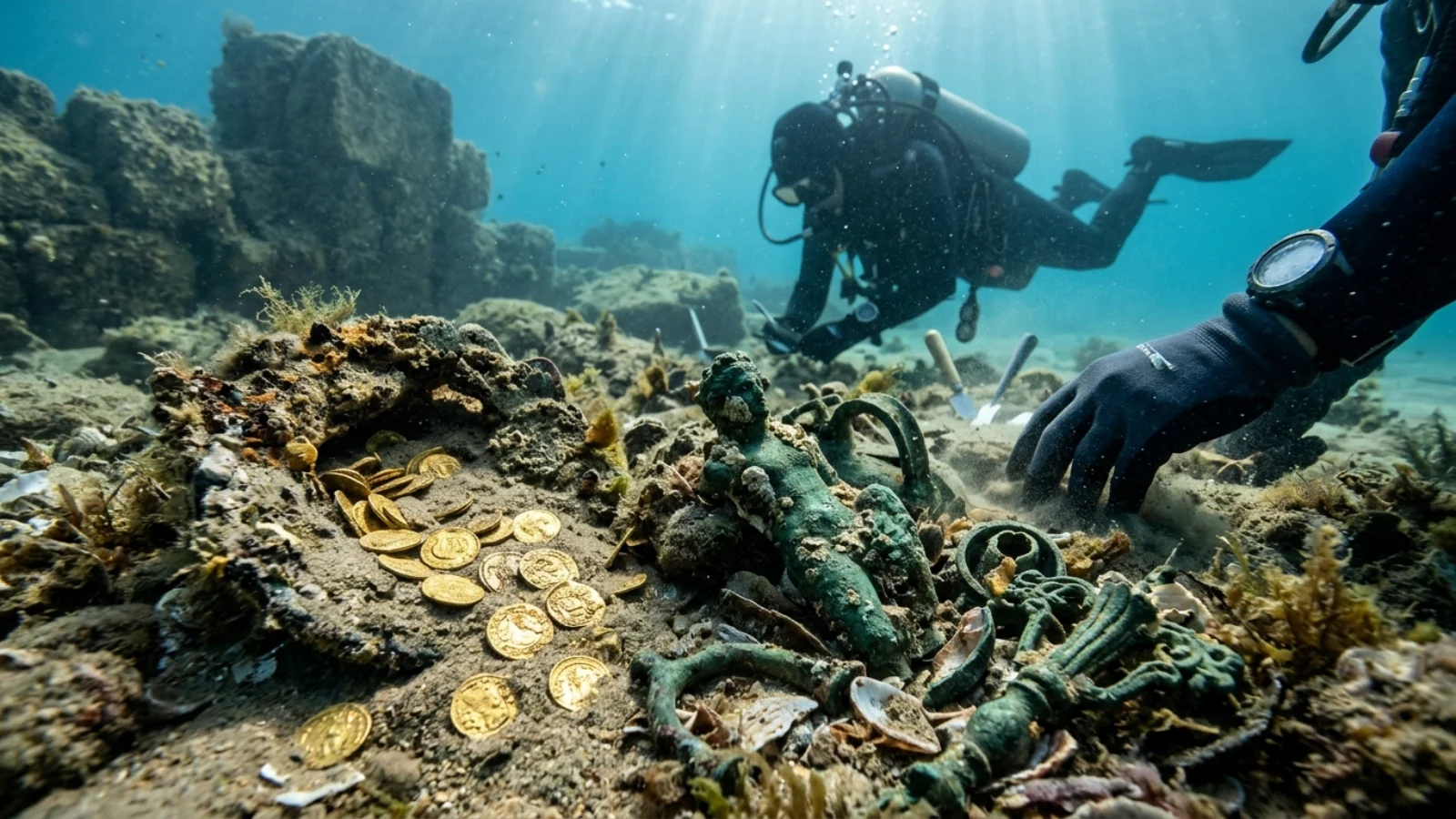
Two major finds by recreational divers in the ancient harbour of Caesarea, Israel. In 2015, winter storms exposed almost 2,000 gold coins of the Fatimid Caliphate, minted from the late 9th to the 11th century, the largest gold hoard ever found in Israel. In 2016, divers found the cargo of a Late Roman ship, about 1,600 years old: bronze statues, a lamp with the sun god Sol, a figurine of the moon goddess Luna and coins, probably being carried for recycling.
Herod the Great built Caesarea’s harbour as one of the engineering wonders of the Roman world. Two thousand years later, its broken breakwaters are still catching ships’ cargoes, and storms keep uncovering them.
Three discoveries in seven years made the site famous well beyond Israel. In 2015 a handful of club divers spotted gold on the sand and led archaeologists to the largest gold hoard ever found in the country. In 2016 two more divers came across the scattered cargo of a Late Roman merchant ship packed with bronze statues and coins. In 2021 an official survey found the remains of two further ships, one Roman and one from the Mamluk period, along with a gold ring engraved with one of the oldest Christian symbols. This page explains what was found each time, who found it, why the harbour keeps producing finds and where the objects can be seen.
What was the 2015 Caesarea gold hoard?
Almost 2,000 gold coins of the Fatimid Caliphate, exposed by winter storms and spotted by divers who reported them to the Israel Antiquities Authority.
The discovery was announced in February 2015. A group of members of the diving club based in the ancient harbour, inside Caesarea National Park, saw something glinting on the seabed. According to the trade journal CoinsWeekly, they first thought it was a toy coin from a game. Once they realised it was real gold, they picked up a few pieces, returned quickly to shore and told the club’s director, who called the Marine Archaeology Unit of the Israel Antiquities Authority (IAA).
IAA divers went back out with the club members and searched the area with a metal detector. They recovered almost 2,000 gold coins of three denominations: the dinar, the half dinar and the quarter dinar, in a range of sizes and weights. Together the coins weighed almost 6 kilograms. Winter storms had shifted the sand that normally covers the harbour floor, and the hoard had simply been lying exposed when the divers swam over it.
Dr. Kobi (Jacob) Sharvit, director of the IAA’s Marine Archaeology Unit, called the find rare historical evidence exposed by the storms. The hoard is still described as the largest trove of gold coins ever discovered in Israel.
Which coins are in the Fatimid hoard?
Mostly gold coins of the caliph al-Hakim (996–1021) and his son al-Zahir (1021–1036), struck in Egypt and North Africa.
The oldest piece is a quarter dinar minted in Palermo, Sicily, in the second half of the 9th century, decades before the Fatimid dynasty itself was founded in 909. Nothing in the assemblage came from the eastern Islamic dynasties that rivalled the Fatimids, so the IAA concluded with confidence that this was a Fatimid treasure rather than a mixed merchant’s purse gathered from across the Islamic world.
The coins were in excellent condition. Dr. Robert Cole, a numismatist at the IAA, explained that they needed no cleaning or conservation from the metallurgy laboratory despite about a thousand years under the sea, because gold is a noble metal that air and water do not attack. Some coins look almost freshly struck, while others are worn and scuffed from years of handling. Several are bent and carry teeth and bite marks, a sign that owners or merchants tested them to be sure they were genuine gold.
The IAA also noted that Fatimid gold stayed in circulation after the Crusaders took the coast, especially in port cities that lived by international trade. A gold dinar was a serious sum of money. The 12th-century traveller Ibn Jubayr recorded that Muslim villagers had to give the Fatimid government half their harvest plus a head tax of one dinar and five carats, a unit based on the fact that 24 carats made one dinar. Letters preserved in the Cairo Geniza describe the Jewish community paying about 500 gold dinars to ransom captives from Ashkelon who had been taken to Egypt.
How did so much Fatimid gold end up on the seabed?
Nobody knows for certain; the IAA has put forward three explanations, all involving a ship lost in or near the harbour.
Sharvit suggested there is probably a wreck of an official treasury vessel nearby, carrying taxes collected in the province back to the central government in Egypt. A second possibility is that the gold was the payroll for the Fatimid garrison stationed in Caesarea to defend the city. The third is that it belonged to a large merchant ship trading between the coastal cities and ports of the Mediterranean that sank at the entrance to the harbour. The Wikipedia summary of the site repeats the merchant-ship and garrison theories.
No hull has been firmly linked to the hoard, and the coins were found loose rather than in a chest. That is typical of Caesarea, where centuries of storms and shifting sand mix material from different periods across the same stretch of seabed.
Who were the Fatimids, and why were they in Caesarea?
An Ismaili Shia dynasty that rose in North Africa in 909, ruled from Cairo from 973 and fought for control of Palestine until the Crusades.
The Fatimids conquered the Aghlabid territory of Ifriqiya, roughly modern Tunisia, between 902 and 909 and proclaimed their own caliphate in opposition to the Abbasids of Baghdad. In 969 their general Jawhar took Egypt and founded a new capital, al-Qahira (Cairo), where the caliph al-Mu’izz arrived in June 973. Palestine and southern Syria changed hands several times over the following decades as the Fatimids fought the Byzantines, the Qarmatians and local Bedouin powers.
Al-Hakim, whose name appears on many of the hoard’s coins, became caliph at the age of eleven in 996. He is remembered for ordering the destruction of the Church of the Holy Sepulchre in Jerusalem in 1009 and for vanishing without trace during a night ride into the hills outside Cairo in February 1021. His son al-Zahir succeeded him. Under Fatimid rule Caesarea was a much smaller place than the Roman and Byzantine city; researchers estimate that its walled area shrank by more than 85 percent between the two periods, and Muslim rulers refortified it in the 11th century.
The Fatimid period at Caesarea ended violently. Baldwin I of Jerusalem captured the city in 1101 after a siege of about 15 days, and his troops killed many of the men and looted the town. In 2018 archaeologists working on land found a separate hoard of 24 gold coins and a gold earring, tentatively dated to 1101, which may have been hidden by a resident during that siege. The Fatimid dynasty itself came to an end in 1171, when Saladin abolished it and founded the Ayyubid dynasty.
What was found in the 2016 Roman shipwreck?
The cargo of a Late Roman merchant ship that sank in a storm about 1,600 years ago, including bronze statues, lamps, figurines and about 20 kilograms of coins.
Shortly before the Passover holiday in 2016, divers Ran Feinstein and Ofer Ra’anan, both from Ra’anana, came across ancient objects on the harbour floor. As soon as they surfaced they contacted the IAA and reported what they had seen and the few items they had brought up. A joint dive with IAA archaeologists showed that a large patch of seabed had been scoured clear of sand, leaving the remains of a ship exposed: iron anchors, remains of wooden anchors and fittings used to build and sail the vessel.
A salvage survey over the following weeks, with IAA divers and volunteers, recovered much of the cargo. The IAA described it as the largest assemblage of marine artifacts recovered in Israel in about thirty years. Many of the bronzes were remarkably well preserved because the sand had protected them. The finds included:
- a bronze lamp decorated with the image of the sun god Sol;
- a figurine of the moon goddess Luna;
- a lamp in the form of the head of an African slave;
- fragments of three life-size cast bronze statues;
- small objects shaped like animals, including a whale;
- a bronze faucet in the form of a wild boar with a swan on its head;
- fragments of large jars used to carry drinking water for the crew.
One of the biggest surprises was two solid lumps of corroded coins, together weighing about 20 kilograms. Thousands of coins had fused into the shape of the pottery vessel in which they were being carried. The legible coins show the emperor Constantine, later called Constantine the Great, and his rival Licinius, who ruled the eastern part of the empire until Constantine defeated him and became sole emperor in 324.
Why were the Roman bronzes on their way to be melted down?
The IAA interprets the cargo as scrap metal being shipped for recycling, which is why statues that would normally have been melted survived.
Jacob Sharvit and his deputy Dror Planer explained that the position and spread of the finds point to a large merchant ship carrying metal for recycling. It apparently ran into a storm at the harbour entrance and drifted until it smashed against the seawall and rocks. The crew seems to have dropped anchors to stop the drift, but the anchors broke, which shows how strong the wind and waves were.
Bronze statues are rare in archaeology because in antiquity almost all of them were eventually melted down and the metal reused. Most surviving ancient bronzes come from the sea, where a wreck took them out of circulation. The same thing happened on a much grander scale at Antikythera in Greece. According to the IAA, earlier excavations at Caesarea had produced only a few bronze statues, so this single cargo added a great deal of material at once, much of it apparently taken from the city itself.
The archaeologists also pointed to the timing. The ship sailed in the decades when Constantine ended the persecution of Christians, and the Edict of Milan in 313 allowed Christians across the empire, including those in Caesarea, to worship openly. Pagan images such as Sol and Luna were still common, but the religious world around them was changing.
What did the 2021 Caesarea shipwrecks reveal?
The remains of two more ships, one Roman of about 1,700 years ago and one Mamluk of about 600 years ago, with hundreds of coins and a gold “Good Shepherd” ring.
In December 2021 the IAA announced the results of an underwater survey carried out over the previous two months. The cargoes and broken hulls of two ships lay scattered on the seafloor in shallow water about 4 metres deep. Sharvit and Planer said the ships were probably anchored nearby when a storm drove them onto the shore, and that they appear to have sunk with all hands.
The Associated Press reported hundreds of Roman silver and bronze coins from the mid-3rd century and more than 500 silver coins from the Mamluk period, along with figurines, bells, pottery and metal fittings from the ships, such as dozens of large bronze nails, lead pipes from a bilge pump and a heavy iron anchor snapped into pieces. Sharvit said the style of some artifacts suggests the Roman ship came from Italy.
The most talked-about find was a thick octagonal gold ring set with a green gemstone. The stone is engraved with a young shepherd in a tunic carrying a ram or sheep on his shoulders. Robert Kool, head of the IAA’s coin department, called it exceptional, because the “Good Shepherd” is one of the earliest Christian symbols, and its owner may have been an early Christian. The survey also produced a red gemstone for a ring, carved with a lyre, the instrument known in Jewish tradition as King David’s harp.
Why does Caesarea’s harbour keep giving up treasure?
It was a huge, busy port built on an exposed coast over a fault line, and storms now strip away the sand that once buried its wrecks.
Herod began building the harbour, called Sebastos, in 22 BCE and dedicated the city and port to the emperor Augustus in 10 or 9 BCE. The coast had no natural harbour, so his engineers created one in the open sea, enclosing roughly 100,000 square metres. When it was built it was the largest artificial harbour constructed in open water. Josephus compared its size to Piraeus, the port of Athens.
The two breakwaters, about 500 metres long on the south side and 275 metres on the north, were made of a hydraulic concrete of lime and pozzolana, a volcanic ash. Herod imported more than 24,000 cubic metres of pozzolana from Puteoli, today Pozzuoli, in Italy. Divers built wooden forms on the seabed and filled them with concrete and rubble of local kurkar sandstone; on the more exposed southern breakwater, the builders sank barges filled with concrete.
The harbour did not last. Cores taken from the breakwaters show that the mortar bonded poorly with the kurkar rubble, and the structure sat on a geological fault. Earthquakes made the moles tilt and settle, and seabed deposits show that a tsunami struck in the 1st or 2nd century. By the 6th century the port could no longer be used, and today the remains of the breakwaters lie more than 5 metres underwater.
Sharvit has linked the recent run of chance finds to two factors: a shortage of sand on the seabed, which leaves ancient objects exposed after storms, and a growing number of divers at the site. Once a find is uncovered, it may be buried again by the next storm, so prompt reporting matters.
What happened to Caesarea after the Fatimids?
It became a Crusader port, was fortified by Louis IX and was destroyed by the Mamluk sultan Baybars in 1265.
Crusaders held the city from 1101 to 1187 and again from 1191 to 1265, with Saladin controlling it in between. During the Seventh Crusade in 1251, Louis IX of France built high walls and a deep moat, parts of which still stand. In 1265 the Mamluk sultan Baybars took Caesarea and razed it so that it could not become a Crusader base again, and the ruins stayed largely empty for centuries. The Mamluk-era silver coins found in 2021 come from that later period, when ships still anchored off a coast with no proper port.
In the late Ottoman period, Bosnian Muslim refugees settled among the ruins and built a small town, some of which survives in the national park. Today Caesarea National Park includes Herod’s theatre, the hippodrome, the Crusader walls and the harbour itself.
Can divers keep what they find at Caesarea?
No. Under Israeli law all antiquities belong to the state, and finders receive no reward.
Israel’s Antiquities Law states that failing to report antiquities, removing them from where they lie, or selling them is a criminal offence that can carry up to five years in prison. The 2015 divers received no finder’s fee. Sharvit praised them as model citizens and warned that when divers take objects home, the archaeological information about where and how they lay is lost for good. The 2016 finders received certificates of appreciation and a tour of the national treasures storerooms.
Recreational diving is allowed in the ancient harbour through the local dive club, and the IAA asks anyone who sees an artifact to leave it in place where possible and report it immediately to its Marine Archaeology Unit. The same law applies along the whole Israeli coast; see our pages on Haifa and Jaffa.
Where can you see the Caesarea treasure?
Part of the 2015 gold hoard was put on show in the harbour itself as part of a visitor presentation called “Time Travel”.
When the 2016 cargo was announced, the IAA said the Fatimid coins were already on display in the Caesarea harbour, while the Roman bronzes were still undergoing conservation and study. The Caesarea Development Corporation said its aim was to present as many of the finds as possible to visitors, including future discoveries. Displays change over time, so check with the national park before travelling if you want to see a particular object.
| Date | Event |
|---|---|
| 22–10/9 BCE | Herod builds the Sebastos harbour |
| 1st–2nd century CE | Tsunami damages the harbour |
| Mid-3rd century | Roman ship found in 2021 is lost |
| Early 4th century (~1,600 years ago) | Merchant ship with bronze scrap sinks |
| 11th century | Fatimid gold lost in the harbour |
| 1101 | Crusaders capture Caesarea |
| 1265 | Baybars destroys the city |
| About 600 years ago | Mamluk-period ship wrecked |
| Feb 2015 | Gold hoard announced |
| May 2016 | Roman bronze cargo announced |
| Dec 2021 | Two more wrecks and the Good Shepherd ring announced |
What gold was found at Caesarea?
Almost 2,000 Fatimid gold dinars, half dinars and quarter dinars, announced in February 2015.
Who found the Caesarea treasure?
Recreational divers from the harbour dive club, who reported it to the Israel Antiquities Authority.
How much does the Caesarea gold hoard weigh?
Almost 6 kilograms.
How old is the Caesarea shipwreck cargo?
About 1,600 years, from the Late Roman period.
What was in the Roman cargo?
Bronze statue fragments, a Sol lamp, a Luna figurine, animal figures and about 20 kg of fused coins.
Is it the largest gold hoard in Israel?
Yes, the 2015 hoard is the largest found in Israel.
What is the Good Shepherd ring?
A Roman gold ring with a green gem showing a shepherd carrying a sheep, found off Caesarea in 2021.
Did the divers get a reward?
No. Israeli law makes all antiquities state property.
- Sci.News (2015). Large hoard of gold coins found in Israel: IAA statements by Kobi Sharvit and Robert Cole.
- CoinsWeekly (March 2015). Israel’s largest gold hoard discovered.
- HeritageDaily / Israel Antiquities Authority (May 16, 2016). Spectacular cargo of ancient shipwreck found in Caesarea.
- Friends of the Israel Antiquities Authority (December 22, 2021). Spectacular ancient treasure discovered at sea.
- Associated Press (December 22, 2021). Israeli archaeologists find treasures in ancient shipwrecks.
- Wikipedia. Caesarea Maritima; Fatimid Caliphate; al-Hakim bi-Amr Allah.
- Archaeology Magazine (2015, 2016). Reports on the gold hoard and the Roman cargo.
Blane Perun has been exploring Earth’s oceans and marine life for over 25 years. Founder of TheSea.Org in 1999, underwater photographer, coral aquaculture pioneer, and explorer of 80+ countries.
About Blane Perun → More on Shipwreck Treasure →