Shicheng — China’s Lion City Beneath Qiandao Lake
Shicheng, the “Lion City”, is the old walled seat of Sui’an County in Zhejiang Province, China, deliberately flooded in 1959 when the Xin’an River hydroelectric dam created Qiandao Lake (Thousand Island Lake). Named after nearby Wushi (Five Lion) Mountain, it was a county seat for more than 1,300 years. Its walls, gates, memorial archways and houses lie roughly 26–40 m deep, depending on lake level, and were brought back to public attention by expeditions in the 2000s.
Unlike most sunken cities, Shicheng did not sink through earthquake, subsidence or rising seas. It was drowned on purpose, together with a second county seat and more than a thousand villages, when China built one of its first large hydroelectric projects in the late 1950s.
The result is one of the most complete drowned towns anywhere: a Ming- and Qing-period county seat with its walls, gates, stone memorial archways, ancestral hall and houses still standing under cold, still fresh water. This page covers why the valley was flooded, how old the city is, what survives, how it was rediscovered, what diving it is like and why it has lasted so well. For an overview of submerged sites worldwide, see how many sunken cities are there.
Why was Shicheng flooded?
To fill the reservoir of the Xin’an River hydroelectric station, a flagship power project for eastern China.
In the 1950s the new People’s Republic needed electricity for industry in Shanghai, Hangzhou and the Yangtze delta. Engineers chose the Xin’an River, a tributary of the Qiantang, in western Zhejiang. The dam they built is 105 m high with a crest length of 466.5 m, and was the first dam in China taller than 100 m; its power plant has an installed capacity of 845 MW. When the final diversion tunnel was closed in September 1959, the river backed up through a populated valley.
The human cost was enormous. Accounts put the number of people relocated at around 290,000, with some sources rounding to 300,000. More than 1,300 villages were lost, along with the seats of two counties: Sui’an, whose county town was Shicheng, and Chun’an, whose seat at He Cheng was also submerged. Sui’an County ceased to exist and was merged into Chun’an. Thousands of hectares of farmland disappeared. Many of the families moved out of the valley had lived there for generations, and their descendants still identify with the drowned towns, which is part of why the city attracted such strong interest once photographs appeared.
The reservoir that formed is Qiandao Lake. It covers about 573 km², holds around 17.8 km³ of water, and is up to about 120 m deep. Former hilltops became 1,078 sizeable islands, plus thousands of smaller ones, which give the lake its name. Wushi Mountain, the “Five Lion” peak that gave the city its name, survives as an island above the drowned town.
How old is Shicheng?
The county dates to AD 208, the county seat moved to the foot of Five Lion Mountain in AD 621, and most of what survives was built or rebuilt under the Ming and Qing dynasties.
| Date | Event |
|---|---|
| AD 208 | County established in the late Eastern Han period |
| AD 621 | County seat moved beneath Five Lion Mountain under the Tang; the walled Lion City grows up here |
| 1513 | Substantial defensive walls built (Ming) |
| 1777 | Date of the latest surviving carved stonework on the archways (Qing) |
| 1868 | Government offices rebuilt after fighting in the Xianfeng era |
| September 1959 | Diversion tunnel closed; valley floods |
| 2001 | Government-organised exploration of the submerged city |
| Jan 2011 | Submerged cities placed under Zhejiang provincial heritage protection |
Sources differ on how to describe the city’s age, and the difference is mostly about what is being dated. The county itself, under an earlier name, goes back to AD 208, at the end of the Eastern Han. According to local histories summarised by diving historians, the county seat moved to its final site below Wushi Mountain in AD 621, early in the Tang dynasty, and the town remained the seat for more than 1,300 years until 1959. Some popular accounts therefore call Shicheng a Han city, others a Tang city. The second submerged county town, He Cheng, is usually described as the older of the two.
The buildings visible today are much younger. The city walls were built in 1513, during the Ming dynasty, probably as defence against raiders and unrest. Many of the stone memorial archways and carved panels date from the Qing dynasty, with the latest dated stonework from 1777. The county offices were destroyed in fighting during the Xianfeng era of the mid-nineteenth century, the period of the Taiping Rebellion, and rebuilt in 1868. By the mid-twentieth century the town had about 5,000 inhabitants. So the underwater city is best understood as a late imperial county town on a very old site.
What did the Lion City look like?
A compact walled town with five gates, stone-paved streets, courtyard houses, an ancestral hall and dozens of carved memorial archways.
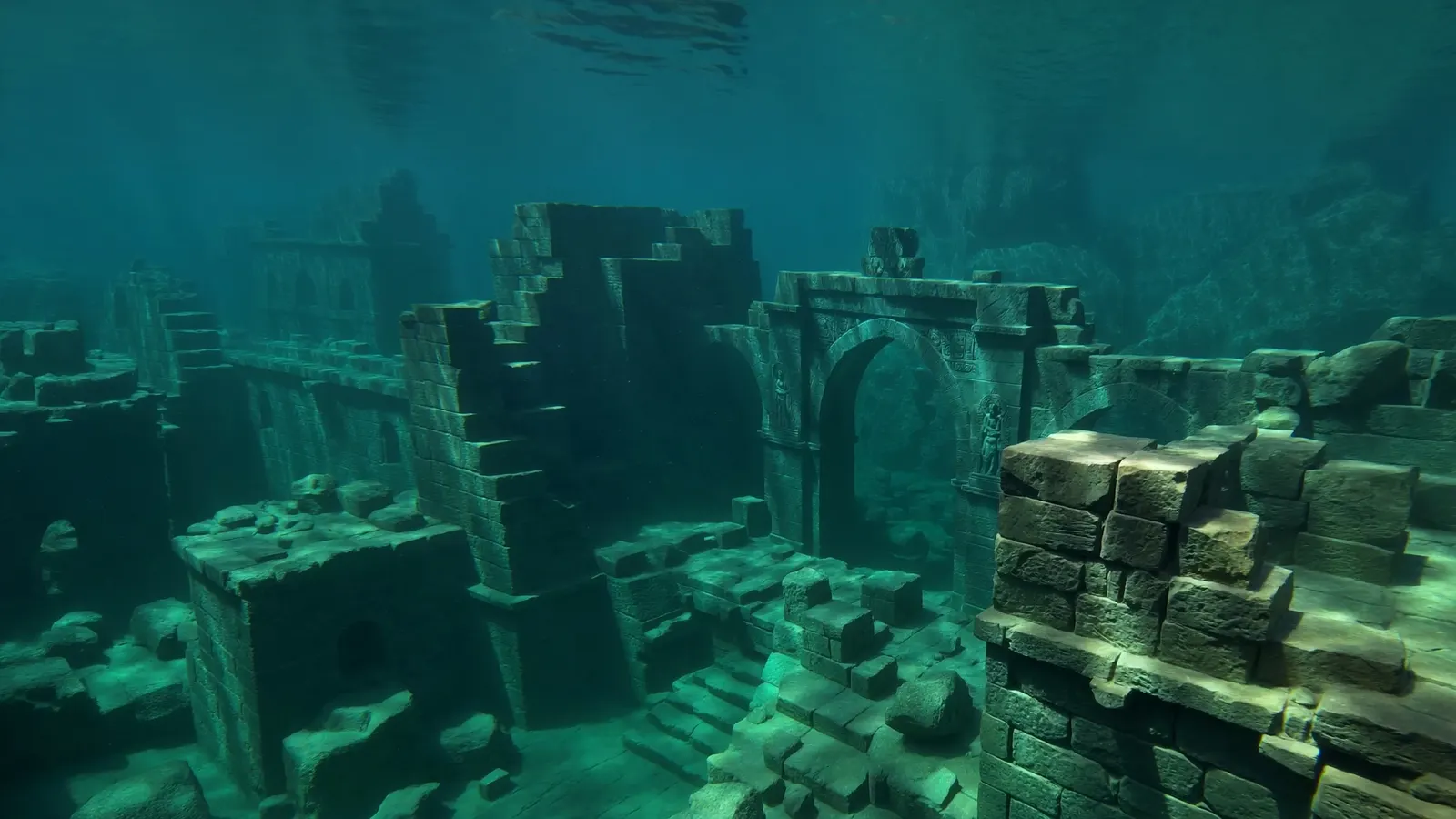
Chinese walled towns usually had four gates, one facing each cardinal direction. Shicheng had five, an unusual layout that has become one of its best-known features. Inside, streets were paved with stone and lined with houses in the regional style, built of brick with timber frames and carved wooden detail. The most striking monuments are the paifang, free-standing memorial archways of stone. Wikipedia’s summary of Chinese reporting counts 265 archways along the streets with surviving stonework, decorated with lions, dragons, phoenixes, flowers, figures and inscriptions.
Paifang were built to honour people and families: officials who passed the imperial examinations, benefactors, or widows praised for not remarrying. Their inscriptions name individuals and give dates, which is why they are so useful for linking the ruins to written records. Chinese descriptions often say the town was “as large as 60 football fields”, a phrase repeated in many English articles, but it is a loose comparison rather than a surveyed figure.
How was Shicheng rediscovered?
Through a government-backed exploration in 2001, recreational technical divers in the mid-2000s, and photographs published in 2011 that went around the world.
For four decades the drowned towns were remembered by the families who had left them but rarely visited. In 2001, Chinese authorities organised an exploration of the submerged city, the first serious look at what had survived. Recreational technical diving came a few years later. According to an account in Advanced Diver magazine, Leigh Chen, owner of the Shanghai dive operator Big Blue, set out to find the city in 2006. After more than ten dives in the area, his team ran a two-week systematic search, swimming straight lines at 5-degree intervals from a reference point, and found the city wall on the fourth day.
Wider fame came in 2011, when Chinese National Geography published underwater photographs and graphics of the Lion City. The images of intact archways emerging from the gloom spread internationally and turned Shicheng into a byword for “China’s Atlantis”. In January 2011 the submerged cities were declared historical relics under the protection of Zhejiang province. Archaeological surveys and exploratory dives have continued since, though detailed scientific publications in English remain scarce.
What do divers see at Shicheng?
Archways, a bridge, an ancestral hall, houses and sections of wall, at depths from the mid-teens to over 30 m.
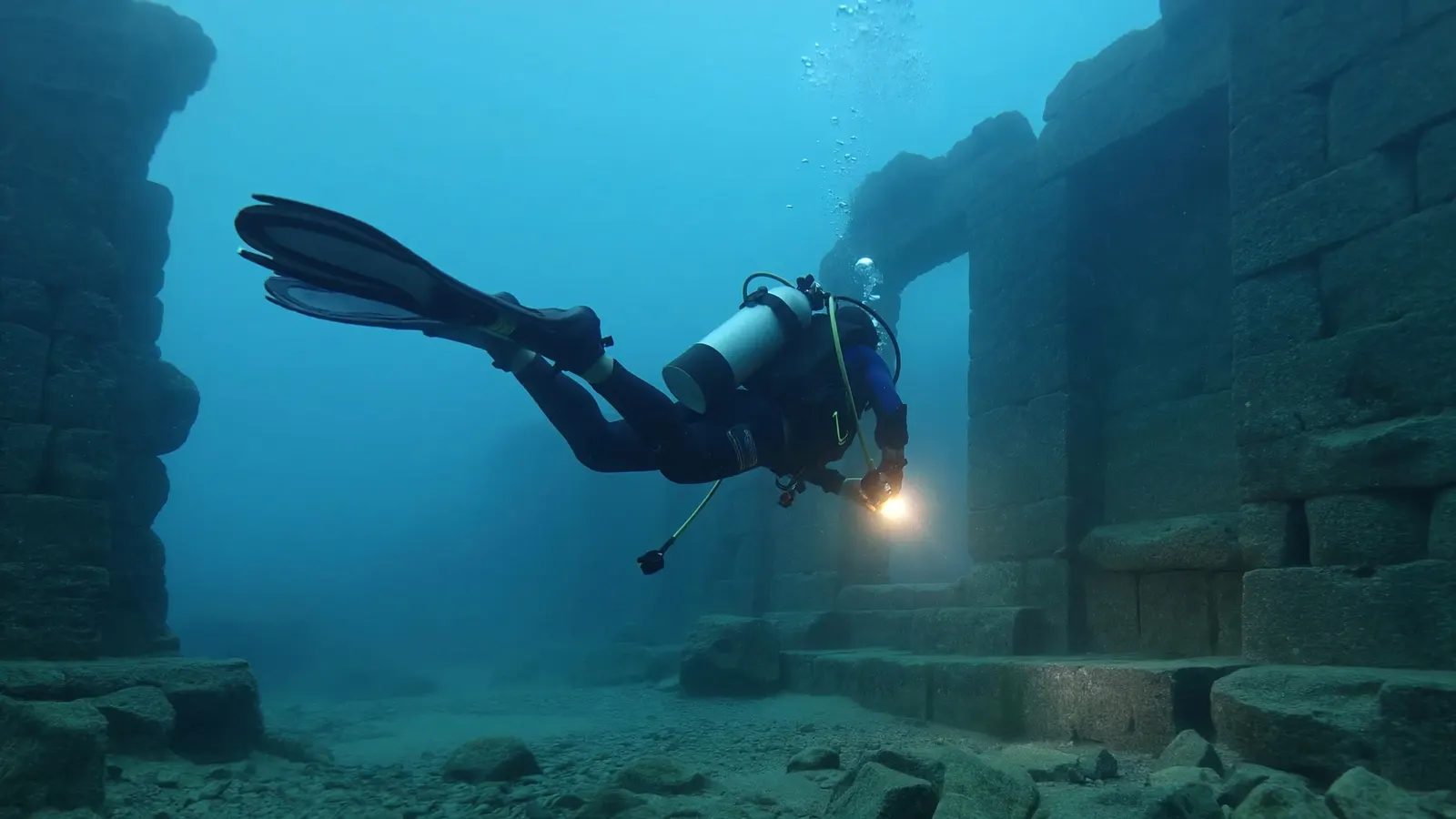
The Advanced Diver account gives a good picture of a typical series of dives. Brick residential buildings lie at about 16 to 23 m. The best-preserved house, referred to by divers as the House of Xin, has four walls and a ceiling, with its entrance at about 22 m. A two-storey wooden ancestral hall, with carved wooden lions on its pillars, sits at about 28 m. A paifang about 6 to 7 m tall and 5 m wide was found on the first descent. The so-called Honor Bridge, around 5 m high and carved with warriors, horses and the names of officials, lies at about 31 to 33 m, and the Chastity Arch, built to honour a widow who did not remarry, at 26 to 28 m. Some carved figures on the Chastity Arch have been damaged by looters, a reminder that the site is vulnerable even underwater.
Visibility is the main limitation. At the deeper monuments divers reported no more than about 2 m, so the city is experienced piece by piece in torchlight rather than as a panorama. The wide photographs that made it famous were composed carefully from many images or taken in rare conditions.
Can you dive Shicheng?
Yes, but only as an experienced diver with a specialist operator, and access has varied over the years.
Diving at Shicheng has been limited to divers experienced in deep and low-light diving. The water is fresh and cold below the surface layer: Advanced Diver recorded about 13 °C on a late-March check dive, and divers wore trilaminate drysuits and breathed nitrox. Depths of 30 m and more in cold, dark water bring noticeable nitrogen narcosis, and silt is easily stirred up, so guidelines are run to the main structures, with a permanent line in the village area. Trips have been run from Shanghai; the lake is roughly four hours from Shanghai Pudong Airport by train, and boat rides on the lake range from a couple of minutes to an hour depending on the site.
Above water, Qiandao Lake is a major tourist area with ferries between islands, scenic viewpoints and lakeside resorts. Its clean water supplies the Nongfu Spring bottled water brand, and sturgeon farmed in pens on the lake produce caviar for international markets. For most visitors, the Lion City is something seen in photographs, models and exhibitions around the lake rather than in person. Proposals to open the site more widely, or to raise or display artefacts, have been discussed in Chinese media but have not produced a public underwater museum.
Why is Shicheng so well preserved?
Fresh water, cold, darkness, stillness and a covering of silt all slow decay.
Most sunken cities lie in the sea, where waves, currents, salt, boring organisms and coral or algae steadily break structures down. Shicheng has none of those. The lake is fresh water, so there is no salt corrosion and no marine shipworms. Below the warm surface layer, the lake has a thermocline at roughly 30 m, and the water around the city stays cold. Little light reaches the bottom, which limits algal growth, and the reservoir is calm enough that the buildings are not pounded by waves. Silt settling over the ruins adds a protective layer. That is why timber beams, stairways and carved wooden lions have survived for more than 60 years, when the same wood exposed to air and rain might have rotted in less time.
The contrast with Mediterranean sites is sharp. At Baiae in the Bay of Naples, Roman villas sank slowly through volcanic ground movement, and their mosaics and walls have been worked over by waves and marine organisms for centuries. Port Royal in Jamaica slid into the sea in an earthquake in 1692 and now lies under sediment in warm salt water. Shicheng’s flooding was sudden and deliberate, and the water that drowned it has also protected it.
What else lies beneath Qiandao Lake?
A second county town, He Cheng, and the remains of hundreds of villages, roads and temples.
Shicheng is the famous one, but it is not alone. He Cheng, the old seat of Chun’an County, was drowned at the same time and is usually described as dating back to the Eastern Han dynasty, making it the older of the two towns. Chinese reports note that many other historic sites have been confirmed beneath the water, which is unsurprising given that more than 1,300 villages were cleared. Ancestral halls, bridges, field walls and old roads were left in place when the water rose, because there was neither time nor money to remove them. For archaeologists, the lake is less a single site than a drowned landscape of rural late-imperial China, frozen at the moment of the 1959 flooding.
The reservoir that hides them is also a working lake. It supports a large fishery: Chinese sources list 83 fish species in 13 families, including bighead, silver and grass carp, mandarin fish and eel, alongside extensive aquaculture. More than 90% of the land on its islands is forested. All of this activity happens directly above the drowned towns, which is part of the challenge of protecting them.
Does Shicheng face any threats?
Looting, careless diving and the slow processes of a reservoir.
The damaged figures on the Chastity Arch show that the site is not immune to theft. Divers can also do harm: fins and hands stir silt, and contact with soft carvings or decayed wood can break them. Reservoir water quality changes too; Chinese research describes Qiandao Lake as shifting towards a more nutrient-rich state, with pressures from cage aquaculture, cruise boats, nitrogen, phosphorus and heavy metals. Provincial protection since 2011, the difficulty of the dives and the limited number of operators all help. Raising the city, which is sometimes suggested in popular articles, would expose wood and stone to air and rapid decay, and is generally seen as impractical. For now, the Lion City remains where the dam left it. For another Asian underwater site, see Yonaguni in Japan.
Where is Shicheng?
Under Qiandao Lake in Chun’an County, Hangzhou, Zhejiang Province, China.
Why is Shicheng underwater?
It was deliberately flooded in 1959 to fill the reservoir of the Xin’an River hydroelectric dam, which created Qiandao Lake.
How deep is Shicheng?
About 26–40 m, depending on the lake level; some buildings lie shallower, at about 16–23 m.
How old is Shicheng?
The county dates to AD 208 and the Lion City became its seat in AD 621; the surviving walls date to 1513 and much of the stonework to the Qing dynasty.
How many people were moved for Qiandao Lake?
Around 290,000 to 300,000 people, from more than 1,300 villages and two county towns.
Can you dive Shicheng?
Yes, with specialist operators, but only for experienced divers: it is deep, cold, dark and often has visibility of 2 m or less.
Why are there five gates?
Shicheng had five gates rather than the usual four of a Chinese walled town; the reason is not well documented in English sources.
- Advanced Diver Magazine. China’s Sunken Lion City: diving the lost world beneath Qiandao Lake (history, depths, conditions, 2006 search).
- Asian Diver (March 2021). History of the ruins: Shi Cheng and He Cheng, relocation and 2011 provincial protection.
- Wikipedia. Shicheng, Zhejiang; Qiandao Lake (dam, lake dimensions, islands, Chinese National Geography 2011 images).
- Chinese National Geography (2011). Underwater photographs of the Lion City.
Blane Perun has been exploring Earth’s oceans and marine life for over 25 years. Founder of TheSea.Org in 1999, underwater photographer, coral aquaculture pioneer, and explorer of 80+ countries.
About Blane Perun →More on Sunken Cities →