Scuba Jokes — Clean Dive Puns, One-Liners and the Science Behind the Punchlines
The most famous scuba joke is: “Why do scuba divers fall backwards off the boat? Because if they fell forwards, they’d still be in the boat.” It works because divers really do enter small boats with a back roll. Below are 30 clean, original scuba jokes, puns, one-liners and captions written for TheSea.Org, followed by the real diving behind the punchlines — so you can laugh and learn at the same time.
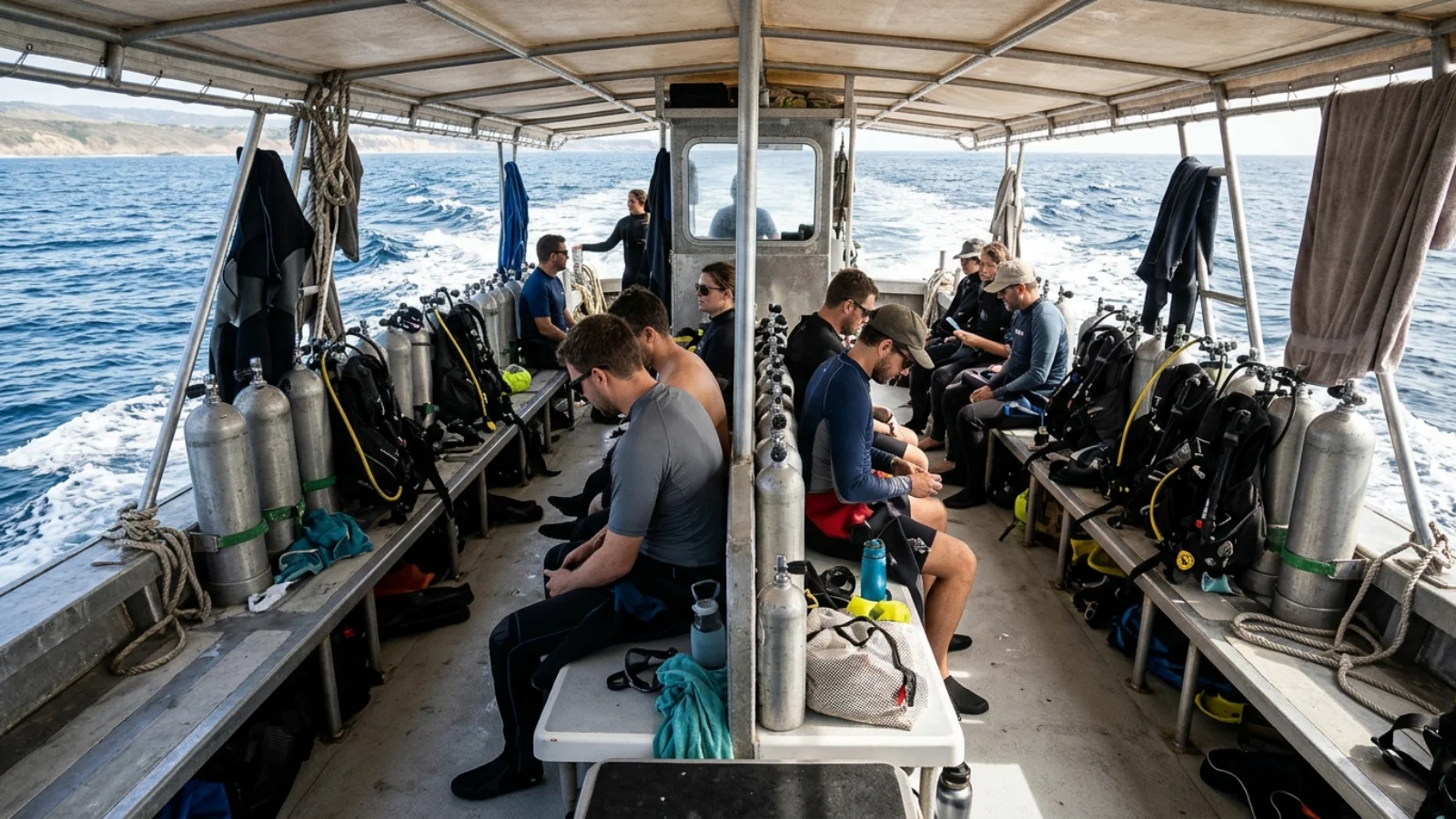
Dive boats involve a lot of waiting: surface intervals, gear checks and rides to the site. Jokes fill the gap, relax nervous students and build the trust a buddy team needs. Good dive-boat humor pokes fun at divers, never at safety.
What is the most famous scuba joke?
Ask any dive boat and someone will tell it: “Why do scuba divers fall backwards off the boat? Because if they fell forwards, they’d still be in the boat.” It is a traditional joke with no known author, and it has survived because it is built on something every diver has actually done.
The backward roll is a real entry technique taught in open-water courses. It is used from small boats, where divers kit up sitting on the side of the boat with their feet on the deck and the water behind them, then tuck the chin, hold the mask and regulator, and roll back. Training material notes that it suits boats where the drop to the water is short, the side is safe to sit on, and the diver will not rotate more than about 120° during the roll. On bigger boats with a high deck, divers use a giant stride instead, stepping forward off a platform, or a controlled seated entry. So the joke is half right: plenty of divers do fall forwards, just from a different boat.
Everything else on this page is original to TheSea.Org: thirty-odd jokes, puns and captions we wrote for dive boats, classrooms and logbooks, followed by the real diving behind them. Because the best dive humour always has a lesson tucked inside, most of the page is about those lessons.
Original dive-boat jokes
- My wetsuit shrank in the closet over the winter. That’s the official story, and my wetsuit and I are sticking to it.
- The three great diver lies: “I’m not cold,” “I’ve got plenty of air,” and “No, really, it was a hammerhead.”
- Dive briefing translation: “a bit of current” means hold onto your mask; “some surge” means say goodbye to breakfast.
- My mask only fogs up when something amazing swims past.
- Every diver carries a camera now, which is why every dive produces 600 photos of the back end of one turtle.
- The giant stride got its name because nobody would sign up for “the awkward hop”.
- Buoyancy control is simple. You just need the lungs of a monk, the patience of a coral and a weight belt that remembers what you had for lunch.
- I don’t need a gauge to know I’m low on air. My buddy keeps staring at mine like it owes him money.
- Our captain says there are no bad dive days. There are good days, and there are stories.
- Night diving: shining a torch into the dark so that four hundred small creatures can stare back at you.
Original scuba puns and one-liners
- My dive computer and I have an agreement: it tells me when to go up, and I don’t argue. (Ask the people who did.)
- I asked a nudibranch for directions. Twenty minutes later it was still pointing.
- Fish ID, lesson one: if it’s yellow, it’s a “yellow one.” Lesson two: there are hundreds of yellow ones.
- That moray isn’t threatening you. It’s breathing. Calm down and do the same.
- Equalise early, equalise often. The reef will wait; it’s been waiting for a few thousand years.
- If your best story starts “So I was at 40 metres and felt amazing,” that wasn’t you. That was nitrogen.
Original scuba jokes for kids
| Question | Answer |
|---|---|
| Why was the octopus so good at the school play? | It put three hearts into it. |
| Why don’t parrotfish ever need to go to the beach? | They make their own sand. |
| Which ocean parent always says “I carried you for weeks”? | A seahorse dad. |
| Why did the pufferfish skip the party? | Whenever it got nervous, it took up the whole room. |
| Why did the cleaner shrimp open a business? | The groupers kept lining up outside. |
| Why is the mantis shrimp always picked first for games? | Nobody wants to be on the other team when it swings. |
| Why does the hermit crab visit every shell on the beach? | It’s house hunting. |
Original instructor one-liners
- Plan the dive and dive the plan. If the plan is “see how it goes,” that’s not a plan, it’s a weather forecast.
- Thumbs up is not a review. Underwater, it means “I’d like to leave now.”
- Never hold your breath: not on the ascent, not while waiting for the manta, and not during my jokes.
- Practise air sharing in the pool until you’re bored, so you can be bored about it in the ocean too.
Original captions for dive photos
- Out of office: 18 metres below the inbox.
- Negatively buoyant, positively happy.
- My happy place has a no-decompression limit.
- Salt in my hair, bubbles in my log, safety stop completed.
Why do divers tell so many jokes?
Diving involves a surprising amount of waiting. There is the boat ride to the site, the briefing, kitting up, the buddy check, and then the surface interval between dives, which is often an hour or more of sitting in the sun with people you met that morning. Jokes fill that time and turn strangers into a team. They also do a quieter job. New divers are often nervous on their first boat dives, and a joke from the crew before the first entry tells them that the people in charge are relaxed and that the experience is supposed to be fun.
The best dive-boat humour has a rule built into it. A joke about thumbs up or ascent rates is easier to remember than a slide in a training manual, which is why instructors reach for them. The flip side is that good dive humour pokes fun at divers, never at safety. Jokes about running out of air, ignoring the computer or skipping a check are funny only because everyone in the boat knows not to do it. The sections below unpack the real diving behind the most common punchlines.
Why does thumbs up mean go up?
On land, thumbs up means “great”. Underwater, it is the standard signal to end the dive and ascend, and new divers often confuse the two, signalling enthusiasm and being led back to the surface. The signal for “I’m fine” is the OK sign, a ring made with the thumb and forefinger, answered by the buddy with the same sign. On the surface or at a distance, divers use a big version, a hand on top of the head or both arms forming a ring overhead.
Signals matter because communication underwater is limited. Almost all recreational diving relies on hand signals, light signals and writing on slates; through-water voice systems exist but are mainly used by military, scientific and commercial divers. Agencies teach a common core of signals, but there are regional and personal variations, which is why a good pre-dive briefing reviews the ones the group will use. See scuba hand signals for the full set.
What is the real lesson behind ‘never hold your breath’?
The two most widely known rules in scuba are “never hold your breath” and “never dive alone”. Both date from the 1950s, when organisations such as the YMCA began training swimmers in the new sport, and both were adopted by the certification agencies that followed, including NAUI, PADI and the British Sub-Aqua Club.
The breath-holding rule comes straight from physics. Water adds about 1 bar of pressure for every 10 m (33 ft) of depth, so the air a diver breathes at depth is compressed. If a diver rises while holding that breath, the air in the lungs expands as the pressure drops. Medical references note that divers breathing compressed air can suffer a collapsed lung from ascending as little as 1 m (3 ft) while holding a full breath. Lung overexpansion can also force air into the bloodstream as an arterial gas embolism, one of the most serious diving injuries. That is why the instructor one-liner above is not really a joke at all: breathing normally and continuously is the most important habit in scuba.
Why are decompression jokes always about going slowly?
Decompression sickness, also called the bends or caisson disease, happens when nitrogen that dissolved into the body’s tissues at depth comes out of solution as bubbles during or after ascent. The nickname comes from the way bubbles often settle in large joints such as the knees and elbows, making people bend over in pain. Treatment is hyperbaric oxygen in a recompression chamber.
The defence is a slow, controlled ascent. Typical maximum ascent rates are about 10 m (33 ft) per minute for dives deeper than 6 m, and some training agencies teach about 9 m (30 ft) per minute. Most recreational divers also make a precautionary safety stop near the end of every dive, even when their computer says no stop is required. Reference sources describe the stop as typically 1 to 5 minutes at 3 to 6 m (10–20 ft); the most commonly taught version is 3 minutes at about 5 m (15 ft). Research using Doppler bubble detection has found that adding a safety stop to a no-stop ascent significantly reduces the bubbles detected afterwards. See the bends for more.
Is narcosis really like having a martini?
Nitrogen narcosis is a reversible change in consciousness caused by breathing nitrogen at high pressure. Divers describe it as feeling tipsy, overconfident or slow-witted, and it is sometimes called the “rapture of the deep” or the “martini effect”. The informal “Martini’s law” holds that every 10 m (33 ft) below 20 m (66 ft) feels like one martini. It is a rule of thumb rather than a measurement, and people vary a great deal, but narcosis does not usually become noticeable shallower than about 30 m (100 ft).
The joke about feeling amazing at 40 metres lands because narcosis impairs judgement precisely when good judgement matters most. The good news is that it reverses within minutes when the diver ascends to shallower water, with no lasting effects. That is why recreational limits are set where they are, and why divers who go deeper train to use helium-based gas mixtures that reduce narcosis.
Why do so many jokes involve peeing in a wetsuit?
Because it happens, and there is a physiological reason. Immersion diuresis is the increase in urine production caused by immersing the body in water. Two things drive it. Cold water draws heat from the skin, causing blood vessels near the surface to constrict, and the hydrostatic pressure of the water pushes blood toward the body’s core. The body reads the result as higher blood pressure and reduces release of antidiuretic hormone, so the kidneys make more urine. The pressure effect is the main one: the rate of diuresis does not change much with water temperature, while sitting up to the neck in a pool for a few hours clearly increases the excretion of water and salts.
There is a bonus myth-buster here. The old sleepover prank of putting a sleeping friend’s hand in warm water to make them wet the bed has no support from this mechanism, because immersing only a limb does not increase urination. The practical lesson for divers is less funny: immersion makes you lose fluid, so drink water between dives, rinse rental wetsuits well and, on drysuit dives, plan accordingly.
Why is the spare regulator called an octopus?
In the early years of scuba, each diver carried a single second stage. If one diver ran out of air, the pair made an emergency ascent while taking turns breathing from the remaining mouthpiece, a skill called buddy breathing. Modern scuba sets carry a backup second stage so a buddy can breathe independently. It is known as the octopus, alternate or secondary, and the name came about because a first stage with several hoses hanging from it looks a bit like an octopus.
That is why air-sharing jokes are so common in classrooms. The buddy system exists mainly so that someone is close enough to help in an out-of-air emergency, and the system most often fails at the moment buddies drift apart. Good gas management, frequent gauge checks and staying close to your buddy prevent most of the situations the jokes describe. The “air hog” label, for a diver who uses gas quickly, is affectionate slang, but it also flags a real planning issue: the dive ends when the first diver reaches the turn pressure, not the last.
Are shark jokes fair?
Sharks are the favourite punchline for non-divers, and the reality is much less dramatic. Around 80 unprovoked shark bites are reported worldwide each year. Between 1958 and 2016, the International Shark Attack File confirmed 2,785 unprovoked attacks worldwide, 439 of them fatal. Of more than 500 shark species, only three, the great white, tiger and bull sharks, account for double-digit numbers of fatal unprovoked attacks. For most divers, seeing a shark is the highlight of a trip rather than a scare.
That is the spirit of good shark humour on a dive boat: it makes fun of our nerves, not the animal. Jokes that cast sharks as villains feed attitudes that make conservation harder, and many shark populations are in steep decline.
What is the real marine life behind the kids’ jokes?
Every kids’ joke above is anchored in a real fact. Octopuses do have three hearts: one main heart pumps blood around the body and two smaller ones pump it through the gills. Parrotfish scrape algae from coral rock with beak-like teeth and excrete the ground-up rock as sand, contributing to sandy beaches and small islands. Male seahorses carry the eggs in a brood pouch on the front of the tail. Mantis shrimp strike by rapidly unfolding their raptorial claws and can seriously injure prey much larger than themselves. Moray eels hold their mouths open because they need to keep water moving over their small gills, which is why a gaping moray is usually just breathing, not threatening. Pufferfish inflate when alarmed, cleaner shrimp run cleaning stations where fish queue to be groomed, and hermit crabs swap into larger shells as they grow.
How old do you have to be to learn scuba?
Plenty of families tell these jokes because diving is something they do together. Some training agencies accept children as young as 8 for supervised scuba experiences and 10 for junior certification, and junior divers are generally restricted to shallower depths, often 12 m (40 ft). See how old do you have to be to scuba dive.
The sport itself is younger than many divers’ grandparents. Jacques-Yves Cousteau and Émile Gagnan designed the Aqua-Lung, the first reliable and commercially successful open-circuit scuba, in 1942 in occupied France. PADI was founded in 1966 by John Cronin and Ralph Erickson and had reportedly issued 29 million certifications by 2022. With that many divers in the water, it is no surprise the dive boat has developed its own jokes, slang and traditions.
When is dive humour not funny?
A joke works on a dive boat when it lowers tension. It stops working when it raises it. Jokes about real accidents, about a diver who panicked, or about equipment failing are best left alone, especially before a dive and especially around beginners. Avoid teasing someone about their air consumption or buoyancy in a way that might make them hide a problem rather than ask for help; the diver who pretends to be fine is the one most likely to get into trouble. And if a buddy signals a problem underwater, it is never the moment for comedy. The rule we use for this page is simple: laugh at divers, laugh at ourselves, never laugh at safety.
If you want to write your own, start with something every diver recognises: the struggle into a wet wetsuit, the fogged mask, the briefing that understates the current, the buddy who photographs everything. Keep it short enough to deliver between kitting up and the entry, and check that the punchline does not accidentally recommend something unsafe. The jokes that last on a dive boat are the ones that new divers retell to their friends, which means they spread the lesson along with the laugh.
For more serious lines, see scuba diving quotes; for true stories stranger than any joke, read scuba diving facts, and if you want to understand every bit of slang on the boat, start with scuba diving terms.
What is the most famous scuba joke?
“Why do scuba divers fall backwards off the boat? Because if they fell forwards, they’d still be in the boat.” It is a traditional joke with no known author.
Do divers really fall backwards off boats?
Yes. The backward roll is a standard entry from small boats; larger boats usually use a giant stride from a platform.
Why does thumbs up mean go up in scuba?
Because it is the signal to end the dive and ascend; the OK ring made with thumb and forefinger means you are fine.
Why do divers say never hold your breath?
Air in the lungs expands as you rise; holding a full breath during an ascent of as little as 1 m can injure the lungs.
Is nitrogen narcosis really like a martini?
Roughly. The informal “Martini’s law” says each 10 m below 20 m feels like one martini, though it is not usually noticeable above about 30 m and reverses on ascent.
Why do divers joke about peeing in wetsuits?
Immersion diuresis: water pressure and cold make the kidneys produce more urine when you are submerged.
What is an air hog?
Friendly slang for a diver who uses air quickly and often ends the dive first.
Are the jokes on this page free to share?
Yes. They were written for TheSea.Org; please share them with a link back.
- Wikipedia contributors (Kiwix mirror, 2023 edition): Scuba skills (backward roll entry); Diver communications; Buddy diving.
- Wikipedia contributors (Kiwix mirror, 2023 edition): Decompression practice (ascent rate, safety stop); Decompression sickness; Nitrogen narcosis.
- Wikipedia contributors (Kiwix mirror, 2023 edition): Pulmonary barotrauma; Diuresis (immersion diuresis).
- Wikipedia contributors (Kiwix mirror, 2023 edition): Shark attack (ISAF statistics 1958–2016).
- Wikipedia contributors (Kiwix mirror, 2023 edition): History of scuba diving; Professional Association of Diving Instructors; Recreational diving.
- Wikipedia contributors (Kiwix mirror, 2023 edition): Octopus; Parrotfish; Seahorse; Mantis shrimp; Moray eel.
Blane Perun has been exploring Earth’s oceans and marine life for over 25 years. Founder of TheSea.Org in 1999, underwater photographer, coral aquaculture pioneer, and explorer of 80+ countries.
About Blane Perun → More on Scuba Diving →