Reef Tank Pests — The Complete Hub & Index
Every reef keeper meets pests sooner or later — it’s part of the craft. This hub organises 43 in-depth articles covering every major reef tank pest, grouped into six categories by organism type and treatment approach. Whether you’re dealing with Aiptasia taking over rockwork, Montipora-eating nudibranchs ravaging corals, hair algae blooms in a new tank, cyano mats in dead zones, or dinoflagellates in an ULNS setup, this is your starting point. Each article covers biology, identification, prevention, and treatment — written from 25+ years of hands-on reef keeping experience. Use the groups below to navigate by pest category, or jump straight to the full index of 43 articles in the cluster at the bottom of the page.
Reef keeping is endlessly rewarding, but every reefer — new or experienced — encounters pests. The good news: almost every pest problem has a solution, and most can be prevented with good husbandry. This hub is designed as both a diagnostic starting point (if you see something in your tank, find it here) and a reference library (each article is a deep-dive into one organism). The six groups below reflect how different pest types respond to different treatment approaches — understanding the category helps orient you to the right strategy before diving into the specific species guide.
Group 1 — Anemones & polyp pests
Nuisance anemones and polyp-like organisms that proliferate on rockwork, stinging corals and consuming tank space. The most common group new reefers encounter.
Key species. Aiptasia is the textbook reef pest — fast-reproducing glass anemones that sting and spread. Majano anemones are similar but stockier. Hydroids form branched colonies that can sting sensitive corals.
Treatment approaches. Biological control works best — Aiptasia-eating filefish and Berghia nudibranchs for aiptasia. Peppermint shrimp for smaller populations. Direct kalk or specialised products like Aiptasia-X for spot treatment.
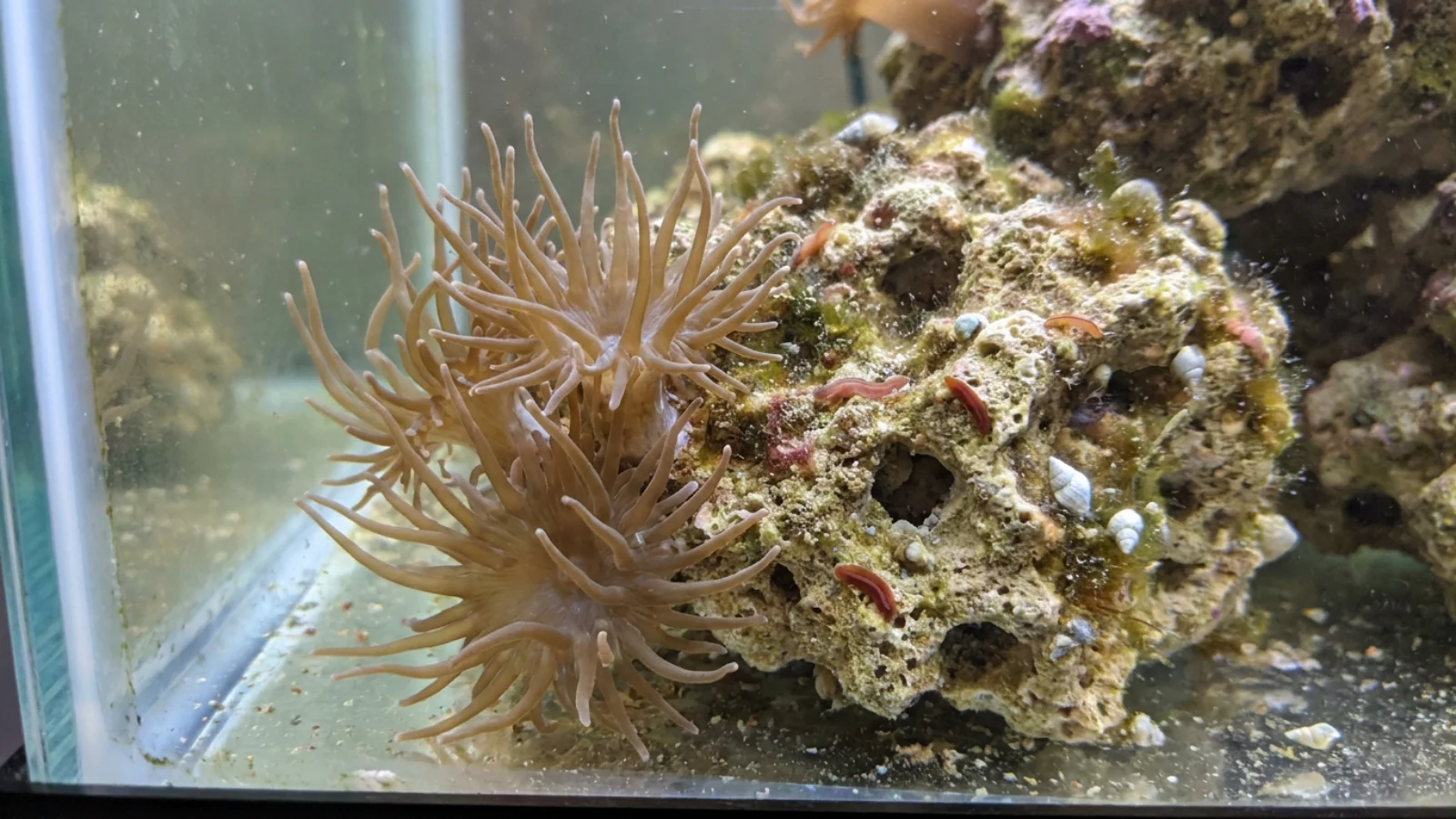
Group 2 — Coral-eating pests
Specialised predators that target specific coral groups — the most dangerous pests for SPS and LPS keepers because they can destroy valuable colonies quickly.
Key species. Coral-eating nudibranchs are genus-specific: Montipora-eating, Zoa-eating, Acro-eating flatworms, and Euphyllia-eating flatworms each target one coral group. Zoanthid-eating spiders, Heliacus snails, and Asterina starfish (sometimes) round out the group.
Treatment approaches. Quarantine is the foundation — every new coral gets dipped and inspected. Once in the tank, treatment usually means coral dips (Coral RX, Revive), manual removal, and sometimes species-specific predators. Speed matters — these pests can destroy colonies in days.
Group 3 — Worms
A diverse group ranging from beneficial detritivores to problematic coral-stressing species. Identification is crucial because the approach depends on friend vs foe.
Friend or foe. Most bristleworms are beneficial cleanup crew (see practical bristleworm guide). The bearded fireworm is dangerous (see bristleworm vs fireworm comparison). Flatworms (both practical and species-ID) can be irritating in large numbers. Spaghetti worms are beneficial filter feeders.
Related guides. What eats bristle worms, peanut worms, reef tank tube worms, and the practical spaghetti worm in reef tank guide cover the rest.
Group 4 — Crustaceans & hitchhikers
Crustaceans that hitchhike on live rock. Includes genuinely dangerous predators, beneficial microfauna, and ambiguous species that require careful assessment.
Key species. Mantis shrimp are incredible predators (23 m/s striking speed) but destroy reef-tank livestock — remove and rehome. Gorilla crabs are Xanthidae pests that need removal. Amphipods and copepods are beneficial microfauna — never a pest. Sponges are filter-feeders, generally beneficial.
Group 5 — Algae pests
Macroalgae and filamentous algae that bloom in nutrient-rich tanks. The most common source of ongoing reef-tank frustration.
Main offenders. Derbesia is the textbook “green hair algae” — see green hair algae reef tank for the practical management guide. Valonia is bubble algae with distinct biology. Brown hair algae involves diatom coating.
Action-focused. How to get rid of hair algae is the 5-phase step-by-step plan. What eats hair algae covers grazer selection. Macroalgae reef tank covers beneficial chaeto refugiums.
Group 6 — Microbial blooms
Single-celled organisms and bacteria that form films and mats. Ranges from the harmless (diatoms) to the genuinely dangerous (dinoflagellates).
By severity. Diatoms are usually a harmless new-tank phase (see how to get rid of diatoms). Cyanobacteria (red slime) are annoying but manageable. Dinoflagellates are genuinely dangerous (see practical dino treatment). Chrysophytes are newly-recognised dino look-alikes.
How to use this hub
Three ways to navigate depending on your situation.
Identify a pest. If you see something in your tank and don’t know what it is, scan the six groups above for visual/behavioural matches, then click through to the specific species article.
Treat a known pest. If you know what you’re dealing with, go directly to the relevant species article for detailed identification, biology, and treatment approaches.
Preventive reading. New reef keepers benefit from reading the foundational articles in each group (Aiptasia, Derbesia, Diatoms, Bristleworms, Mantis Shrimp) to understand what to watch for before problems develop.
What are the most common reef tank pests?
The most common pests in order of frequency: Aiptasia (glass anemones), hair algae (Derbesia), diatoms in new tanks, bristleworms (usually beneficial), cyano red slime, flatworms, and Asterina starfish. Most reef keepers encounter at least 3–4 of these in the first year. All are manageable with appropriate treatment; none need to be catastrophic if caught early.
How do I prevent reef tank pests?
Three foundational practices: (1) quarantine all new additions — fish, corals, inverts — for at least 2–4 weeks before introducing to the display tank; (2) dip corals in a coral dip product (Coral RX, Revive) before adding to the tank, with inspection for hitchhikers; (3) maintain stable water parameters and diverse biology (grazers, pods, microbiome). These three habits prevent the majority of pest problems.
What’s the most dangerous reef tank pest?
For sensitive SPS corals: Acropora-eating flatworms and Montipora-eating nudibranchs can destroy entire colonies in days. For toxin risk: Ostreopsis dinoflagellates (palytoxin-like compounds) threaten both corals and human handlers. For livestock: mantis shrimp hitchhikers destroy fish and shrimp overnight. For ecosystem: Caulerpa sexual events crash entire tanks. The most dangerous pest is the one you don’t know about — which is why QT and identification matter.
Should I try to eliminate all pests?
No — and trying usually makes the tank worse. Many “pests” in this hub are actually beneficial organisms (bristleworms, copepods, amphipods, spaghetti worms, most macroalgae in a refugium). Healthy reef ecosystems have diverse microfauna including some organisms that look like pests but serve important roles. Target actual problems — not every organism that’s new to your eye. The individual species guides help you distinguish friend from foe.
Where should I start if I have multiple pests?
Priority order: (1) address livestock-threatening pests first — coral-eating species, mantis shrimp, dangerous dinos; (2) then aesthetic pests that cause tank damage over weeks/months — hair algae, Aiptasia; (3) then chronic nuisances — cyano, diatoms. Don’t try to treat everything simultaneously — one focused treatment at a time usually produces better results than scattershot effort on many fronts.
Blane Perun has been exploring Earth’s oceans, coral reefs, and marine life for over 25 years. Founder of TheSea.Org in 1999, underwater photographer, coral aquaculture pioneer, and explorer of 80+ countries. He has maintained large reef systems since the late 1990s and has personally dealt with every reef pest documented on this site. This hub and its 43 articles represent the accumulated knowledge from that experience.
About Blane Perun →