Odd-Shaped Swimmers — Triggerfish, Puffers, Boxfish and Trumpetfish: the Reef’s Strangest Body Plans
The order containing triggerfish, filefish, boxfish, pufferfish, porcupinefish and the ocean sunfish, about 430 species. They have small mouths with strong, often fused teeth, reduced or modified scales, and most swim by flapping their dorsal and anal fins (balistiform locomotion) rather than by bending the body. This page also covers trumpetfish, goatfish and remoras, other unusual reef shapes.
Which reef fish have the strangest shapes?

A quick field guide.
| Group | Shape | Defence | Size | Profile |
|---|---|---|---|---|
| Triggerfish | Oval, deep, eyes set high | Locking dorsal spine | 20–75 cm | Triggerfish |
| Filefish | Flattened, file-rough skin | Spine, camouflage | 10–110 cm | Filefish |
| Boxfish & cowfish | Rigid bony box | Armour plus skin toxin | 10–50 cm | Boxfish |
| Pufferfish | Rounded; inflates | Inflation plus tetrodotoxin | 3 cm–1 m | Pufferfish |
| Porcupinefish | Rounded; spines erect when inflated | Spines, inflation, toxin | 20–90 cm | Porcupinefish |
| Trumpetfish | Long, stick-like | Camouflage, shadowing | to ~80 cm | Trumpetfish |
| Goatfish | Elongated, chin barbels | Speed, colour change | 20–50 cm | Goatfish |
| Remora | Sucking disc on head | Rides larger animals | 30–90 cm | Remora |

Why do reef fish evolve such strange shapes?
Most familiar fish, from tuna to trout, swim by bending the body and sweeping the tail from side to side. That is the fastest way to move through open water, but a coral reef is not open water. It is a maze of branches, ledges and holes where the ability to stop, hover, reverse and turn on the spot is worth more than raw speed. Many reef fish therefore swim mainly with their fins rather than their bodies, a style biologists call median and paired fin swimming. Once the body no longer has to flex, it is free to take almost any shape: a disc, a box, a ball or a stick.
Fish biologists name these swimming modes after the groups that use them. Triggerfish practise balistiform swimming, sending waves along their long dorsal and anal fins while the body stays stiff. Pufferfish use a tetraodontiform style, flapping the same two fins from side to side like a pair of oars. Boxfish give their name to ostraciiform swimming, in which the rigid body is driven by the fins and a tail that only oscillates at its base. All three let a fish creep up on prey, hold position in a current at the mouth of its hole and back neatly into shelter. The tail is kept in reserve for short bursts of speed.
A body freed from the demands of speed can be spent on defence instead. The members of the order Tetraodontiformes have each found a different solution. Triggerfish lock themselves into crevices; filefish hide in plain sight; boxfish wear armour; pufferfish swell up and carry poison; porcupinefish add spines. Other odd reef shapes, such as the trumpetfish and the remora, evolved in completely different families for completely different reasons, which shows how strongly the reef environment pushes fish towards unusual designs.
How are these fish related?
Triggerfish, filefish, boxfish, pufferfish, porcupinefish and the ocean sunfish all belong to the order Tetraodontiformes, a group of about 430 species whose fossils go back to the Cretaceous. The name means “four teeth” and refers to the beak of pufferfish, in which the teeth of each jaw are fused into two plates, one on each side, giving four in total. Porcupinefish fuse each jaw into a single plate, so they have two. Triggerfish and filefish keep separate teeth, but they are few, strong and chisel-shaped. Across the order the scales are modified into spines, plates or rough skin, the pelvic fins are reduced or lost, and the gill openings are small slits.
The group is also notable for its unusually small genomes. In 1993 Sydney Brenner and colleagues proposed the Japanese pufferfish, or fugu (Takifugu rubripes), as a compact model vertebrate genome. At roughly 350–400 million base pairs it is about one-eighth the size of the human genome while carrying a broadly similar set of genes, because it contains far less repetitive DNA. An international consortium published a draft of the fugu genome in 2002, and it became one of the main tools for finding genes and their control regions in the human genome by comparison.
How do triggerfish and filefish work?
Locking spines and crunching teeth.
Triggerfish get their name from a three-part dorsal spine: the large first spine locks upright and can only be released by depressing the small second spine, the “trigger”. A triggerfish wedged into a crevice with its spine locked is almost impossible to extract. Powerful jaws and chisel teeth let them eat sea urchins, crabs, molluscs and coral; some blow jets of water to flip urchins over and attack the less spiny underside.
The titan triggerfish (Balistoides viridescens), up to 75 cm, guards a cone-shaped territory above its nest in the breeding season and will charge and bite divers who enter it. The reef triggerfish or humuhumunukunukuāpuaʻa (Rhinecanthus rectangulus) is Hawaii’s state fish. Filefish are close relatives with rough, sandpaper skin; some, like the mimic filefish, copy the colours of toxic puffers, and others eat the pest anemone Aiptasia (see aiptasia-eating filefish).
How do pufferfish and porcupinefish inflate?
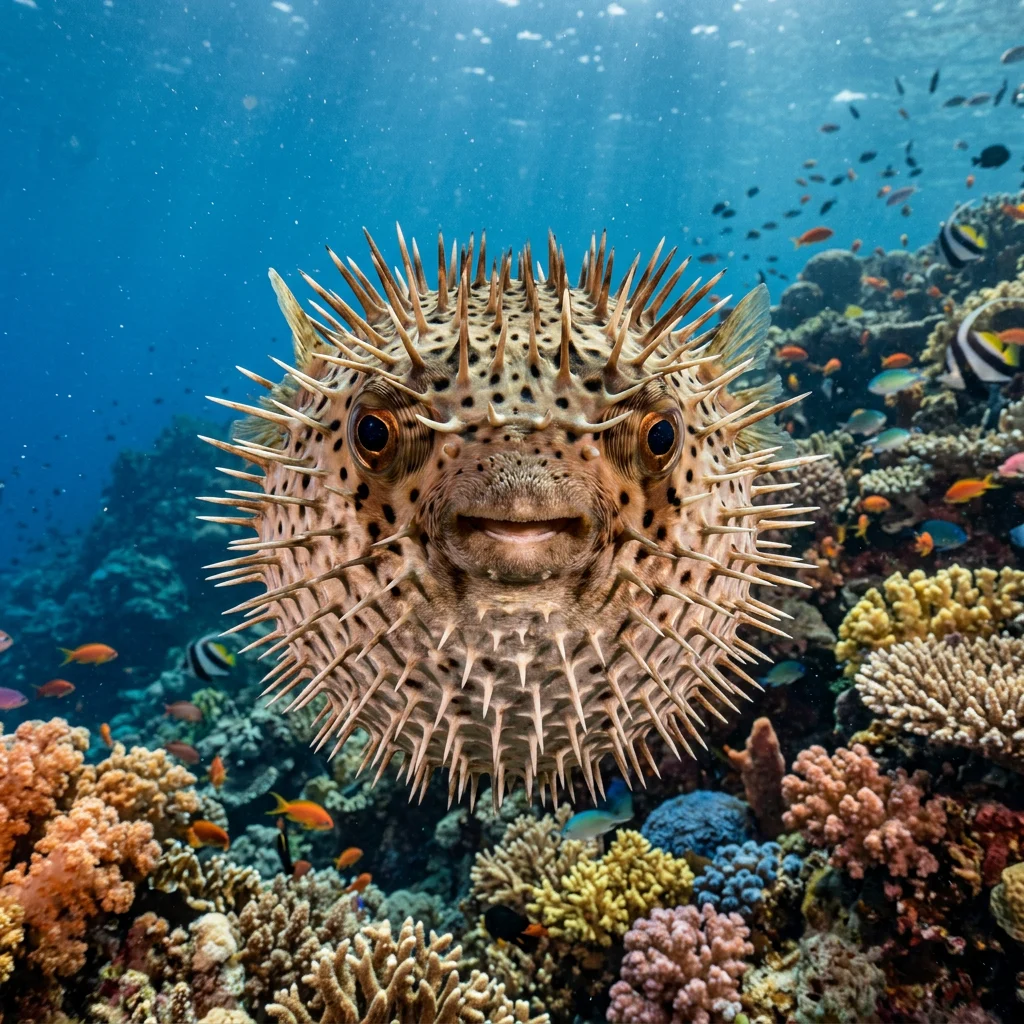
By gulping water into a stretchy stomach.
When threatened, puffers and porcupinefish rapidly pump water (or air at the surface) into an elastic stomach, swelling to two or three times their size. A predator suddenly faces a ball too big to swallow, and in porcupinefish the ball is covered in spines. Inflation is costly and stressful, so divers should never provoke it. Many puffers also contain tetrodotoxin, a nerve poison made by symbiotic bacteria and concentrated in the liver, ovaries and skin; it is roughly a thousand times more toxic than cyanide by weight, and there is no antidote. In Japan, fugu is prepared only by licensed chefs. Male white-spotted pufferfish in Japan build intricate circular sand sculptures to attract mates; see Japanese puffer fish underwater circles.
How does a pufferfish actually inflate?
Inflation is a feat of plumbing. A pufferfish has a hinged joint between its shoulder bones and the back of its skull, so it can rotate its shoulder girdle back and enlarge its mouth cavity with each gulp. The gill slits clamp shut, a valve flips up inside the mouth, and the fish squeezes the water down its gullet into the stomach instead of letting it escape. Elizabeth Brainerd’s research found that the stomach can expand to about 100 times its resting volume. Pufferfish have no ribs to get in the way, and the stomach and body lining fold like the pleats of an accordion.
As the fish fills, wavy fibres in the skin straighten until the body becomes a near-sphere that swallows up the tail and fins, and the taut skin stiffens into a firm shell. In porcupinefish the spines, anchored in those fibres, swing upright. One description of the process counted about 35 gulps in roughly 14 seconds. Peter Wainwright and colleagues argued that inflation evolved from a much older behaviour: the cough that all fish use to clear their gills. Triggerfish, which cannot inflate, use a closely related movement to blow jets of water at the sand to uncover buried prey or to flip sea urchins onto their backs. Inflation, in that view, is a cough that has been redirected into the stomach.
The defence works, but it is costly. A swollen pufferfish cannot swim properly, its breathing is disrupted, and it needs time to recover after expelling the water. Pufferfish taken out of the water sometimes gulp air instead, which can be hard for them to release. That is the main reason divers and snorkellers should never handle a puffer or chase it into inflating for a photograph.
Where does pufferfish poison come from?
The toxin that makes fugu famous, tetrodotoxin, is not made by the fish itself. A 2008 review by Tamao Noguchi and Osamu Arakawa summarised decades of Japanese research showing that the toxin is produced mainly by marine bacteria and passes up the food chain to the puffer through the small invertebrates it eats. Farmed Takifugu rubripes raised on toxin-free feed, in net cages or in tanks on land, stay non-toxic: more than 6,000 cultured fish were tested. When the same non-toxic fish were given food containing tetrodotoxin, they became toxic.
Tetrodotoxin blocks the sodium channels that nerves and muscles use to fire, and in a large enough dose it paralyses the muscles used for breathing. The estimated minimum lethal dose for a person is about 2 mg. Toxic pufferfish survive their own poison because of small changes in their sodium channels that stop the toxin from binding well; toxic species tolerate roughly 300 to 750 times as much as a mouse. Most human poisonings in Japan come from eating the liver, often in home-prepared dishes made from wild fish, and between 1995 and 2007 about 6.4% of reported cases were fatal. The same toxin turns up in an astonishing range of other animals, including blue-ringed octopuses, ribbon worms, some flatworms, certain snails and crabs, and newts on land.
Which pufferfish builds circles in the sand?
Divers off Amami-Ōshima in southern Japan first noticed strange geometric patterns on the sandy seabed in 1995: circles about 2 m across with ridges radiating from a central nest, like a flower or a crop circle. For almost twenty years nobody knew what made them. The builder turned out to be a small pufferfish, about 10 cm long, that was new to science. Keiichi Matsuura of Japan’s National Museum of Nature and Science described it in 2014 as Torquigener albomaculosus, the white-spotted pufferfish.
Males build the circles at 10–30 m depth by swimming in straight lines and ploughing the sand with their fins, working for about a week. Females visit and appear to choose males partly on the quality of the structure and the fine sand gathered at the centre, where the eggs are laid. The male then guards the eggs, and the circle is abandoned after spawning, so a new one is built each time.
Why are boxfish shaped like boxes?

Armour first, speed second.
Boxfish and cowfish are encased in a rigid carapace of fused hexagonal bony plates, with holes for the eyes, mouth, fins and tail. They scull along slowly with their fins. Their bright colours warn predators of ostracitoxin (pahutoxin), a toxin secreted from the skin when stressed that can kill other fish in a closed aquarium. The yellow boxfish’s shape inspired a Mercedes-Benz concept car in 2005, although later studies showed the shape is less stable and less streamlined than first claimed.
Does the boxfish shape really make it stable?
For years the yellow boxfish (Ostracion cubicus) was held up as a model of efficient design. Early flume studies suggested that the keels on its carapace produced small vortices that automatically corrected the fish’s course, and in 2005 Mercedes-Benz unveiled the Bionic concept car based on its shape. A 2015 study by Sam Van Wassenbergh and colleagues tested the idea with models and computer simulations and found the opposite: the carapace tends to destabilise the fish rather than steady it. Instead of being a drawback, that instability helps the boxfish turn sharply in tight spaces, while its fins make constant small corrections to keep it on course.
The box itself is made of hexagonal bony plates that fit together like tiles, leaving the fins, tail, eyes and mouth free. It makes the fish hard to bite and almost impossible to swallow. Boxfish also back up the armour with chemistry. When stressed, they release a skin toxin, pahutoxin or ostracitoxin, that is lethal to other fish in confined water. That is why boxfish are risky choices for home aquariums: a frightened or dying boxfish can poison its tankmates.
Which reef fish pretend to be something else?
The mimic filefish (Paraluteres prionurus) is one of the reef’s best-known copycats. It looks almost identical to Valentin’s sharpnose puffer (Canthigaster valentini), a small, toxic pufferfish with a white body and dark saddles. Predators that have learned to avoid the puffer also leave the harmless filefish alone, a classic example of Batesian mimicry. Divers can tell them apart by the fins: the filefish has a long-based dorsal and anal fin and a small spine on its head, while the puffer has short, rounded fins set far back on the body.
Trumpetfish use a different kind of deception. Hanging vertically among sea rods and gorgonians, a trumpetfish matches the colour and posture of the branches. It also swims tight against the side of a larger, harmless fish such as a parrotfish, using it as a moving screen to get within striking range of small fish. The strike itself is a sudden expansion of the tubular mouth that sucks prey in from a surprising distance.
How do trumpetfish, goatfish and remoras hunt?
Stealth, sniffing and hitchhiking.
Trumpetfish hang head-down among sea rods and gorgonians, mimicking branches, then suck in small fish with a sudden expansion of the tube-like mouth. They also “shadow” larger fish such as parrotfish and groupers, hiding behind them to get close to prey. Goatfish sweep the sand with two chemosensory barbels on the chin, flushing worms and crustaceans, and are often followed by opportunistic wrasses and jacks. Remoras attach to sharks, rays, turtles and even divers with a sucking disc that evolved from the first dorsal fin, feeding on scraps and parasites.
How did the remora get a sucker on its head?
The remora’s sucking disc looks nothing like a fin, but it is one. Studies of how the disc develops in young sharksuckers, published in 2012 by Ralf Britz and G. David Johnson, showed that its ridged plates form from the spines of the first dorsal fin. The fossil record then filled in the transition. In 2013 Matt Friedman of the University of Oxford and colleagues described Opisthomyzon, a remora relative about 30 million years old from the Oligocene of Switzerland, whose disc was smaller and sat on the back, behind the head, rather than on top of it. Over time the disc grew and moved forward.
The disc works by suction and friction. Its plates can be raised to create a low-pressure chamber, and tiny spines on the plates grip the host’s skin so that the remora does not slide backwards when the host swims fast. Remoras save energy by riding along, eat scraps from their host’s meals and pick off some parasites, though they can also irritate the host. They often detach to swim freely and are a regular sight around sharks, manta rays, turtles and even boats.
Are odd-shaped reef fish dangerous?
Mostly only if eaten or provoked.
- Tetrodotoxin: eating improperly prepared puffer can be fatal.
- Boxfish toxin: harmful to other fish, not dangerous to touch for people but best avoided.
- Triggerfish bites: nesting titans and yellowmargin triggerfish can bite hard enough to draw blood.
- Ciguatera: large triggerfish can carry it in some regions.
Where can divers see these odd-shaped fish?
On almost every tropical reef, if you know where to look.
Look for triggerfish over reef tops and rubble, where you will often hear them crunching urchins. Pufferfish and porcupinefish rest under ledges by day and become more active at dusk; the large guineafowl and map puffers of the Indo-Pacific are easy to approach. Boxfish and cowfish potter around coral heads and seagrass in the Caribbean and Indo-Pacific, and juvenile yellow boxfish, bright yellow with black spots and the size of a dice, hide deep in branching coral. Trumpetfish are common on Caribbean reefs among sea rods, while goatfish are easiest to spot on sand patches, often with a following of wrasses. Remoras turn up wherever there are sharks, rays and turtles, and occasionally try to attach to divers.
The family’s giant relative, the ocean sunfish or mola, is a tetraodontiform too, but it lives in the open ocean and visits reefs and kelp edges only to be cleaned by reef fish, notably off Bali’s Nusa Penida and in the Galapagos.
What is the biggest odd-shaped fish?
The heaviest bony fish ever recorded is a tetraodontiform. In December 2021 a bump-head sunfish (Mola alexandrini) was found dead near Faial Island in the Azores. It measured 3.25 m long and 3.59 m from fin tip to fin tip and weighed 2,744 kg, beating a 1996 record of about 2,300 kg from Japan. Ocean sunfish have no true tail; the rear of the body ends in a stiff rudder called the clavus, and they swim by flapping their tall dorsal and anal fins, the same basic technique used by their much smaller reef-dwelling relatives.
What are the weirdest-shaped reef fish?
Boxfish, pufferfish, porcupinefish, triggerfish, filefish, trumpetfish and remoras are among the oddest.
Why is it called a triggerfish?
Its first dorsal spine locks upright and is released only by a smaller “trigger” spine.
Are triggerfish dangerous?
Nesting titan triggerfish can attack divers who enter their territory, and bites can be painful.
Is it bad to make a pufferfish puff up?
Yes. Inflation is stressful and can injure or exhaust the fish.
How poisonous is a pufferfish?
Many contain tetrodotoxin, a nerve toxin roughly 1,000 times more potent than cyanide, with no antidote.
Are boxfish poisonous?
They secrete a skin toxin when stressed that can kill other fish.
What is Hawaii’s state fish?
The reef triggerfish, humuhumunukunukuāpuaʻa.
What does a remora do?
It attaches to larger animals with a head disc and feeds on scraps and parasites.
- Nelson, J. S., Grande, T. C. & Wilson, M. V. H. (2016). Fishes of the World, 5th ed. Wiley.
- Noguchi, T. & Arakawa, O. (2008). Tetrodotoxin: distribution and accumulation in aquatic organisms, and cases of human intoxication. Marine Drugs 6: 220–242.
- Van Wassenbergh, S. et al. (2015). Boxfish swimming paradox resolved: forces by the flow of water around the body promote manoeuvrability. Journal of the Royal Society Interface 12: 20141146.
- Kawase, H., Okata, Y. & Ito, K. (2013). Role of huge geometric circular structures in the reproduction of a marine pufferfish. Scientific Reports 3: 2106.
- Brenner, S. et al. (1993) Characterization of the pufferfish (Fugu) genome as a compact model vertebrate genome. Nature 366: 265–268.
- Matsuura, K. (2015) A new pufferfish of the genus Torquigener that builds “mystery circles” on sandy bottoms in the Ryukyu Islands, Japan. Ichthyological Research 62: 207–212.
- Friedman, M. et al. (2013) An early fossil remora (Echeneoidea) reveals the evolutionary assembly of the adhesion disc. Proceedings of the Royal Society B 280: 20131200.
- Britz, R. & Johnson, G.D. (2012) Ontogeny and homology of the skeletal elements that form the sucking disc of remoras. Journal of Morphology 273: 1353–1366.
- Sawai, E. et al. (2022) Heaviest bony fish: a Mola alexandrini from the Azores. Journal of Fish Biology; reported by Scientific American.
- Zimmer, C. (1997) How the pufferfish got its puff. Discover, September 1997 (work of P. Wainwright and E. Brainerd).
Blane Perun has been exploring Earth’s oceans and marine life for over 25 years. Founder of TheSea.Org in 1999, underwater photographer, coral aquaculture pioneer, and explorer of 80+ countries.
About Blane Perun →