Flapjack Octopus — Opisthoteuthis californiana: The Pancake-Shaped Deep-Sea Cephalopod Behind Pearl in Finding Nemo
The flapjack octopus (Opisthoteuthis californiana) is a small, gelatinous, deep-sea cephalopod whose body is so flattened — pressed front-to-back into a pancake disc — that it has its own descriptive nickname: the “flapjack devilfish.” It is the most compressed body plan of any cephalopod on Earth. Adults reach about 20 cm mantle length, live at depths of ~125 to 1,300 m on the deep seafloor of the North Pacific, and swim by pulsing webbed arms like a jellyfish. Unlike shallow-water octopuses, flapjacks cannot change colour, lack an ink sac, and lack the radula — the tooth-rasp organ. They are best known to the public as the model for Pearl, the pink octopus classmate in Pixar’s Finding Nemo, although the real animal lives far too deep to share a reef with a clownfish. The species was almost named O. adorabilis by Monterey Bay Aquarium researchers in 2015.
Flapjack Octopus
Identification — flattest cephalopod on Earth
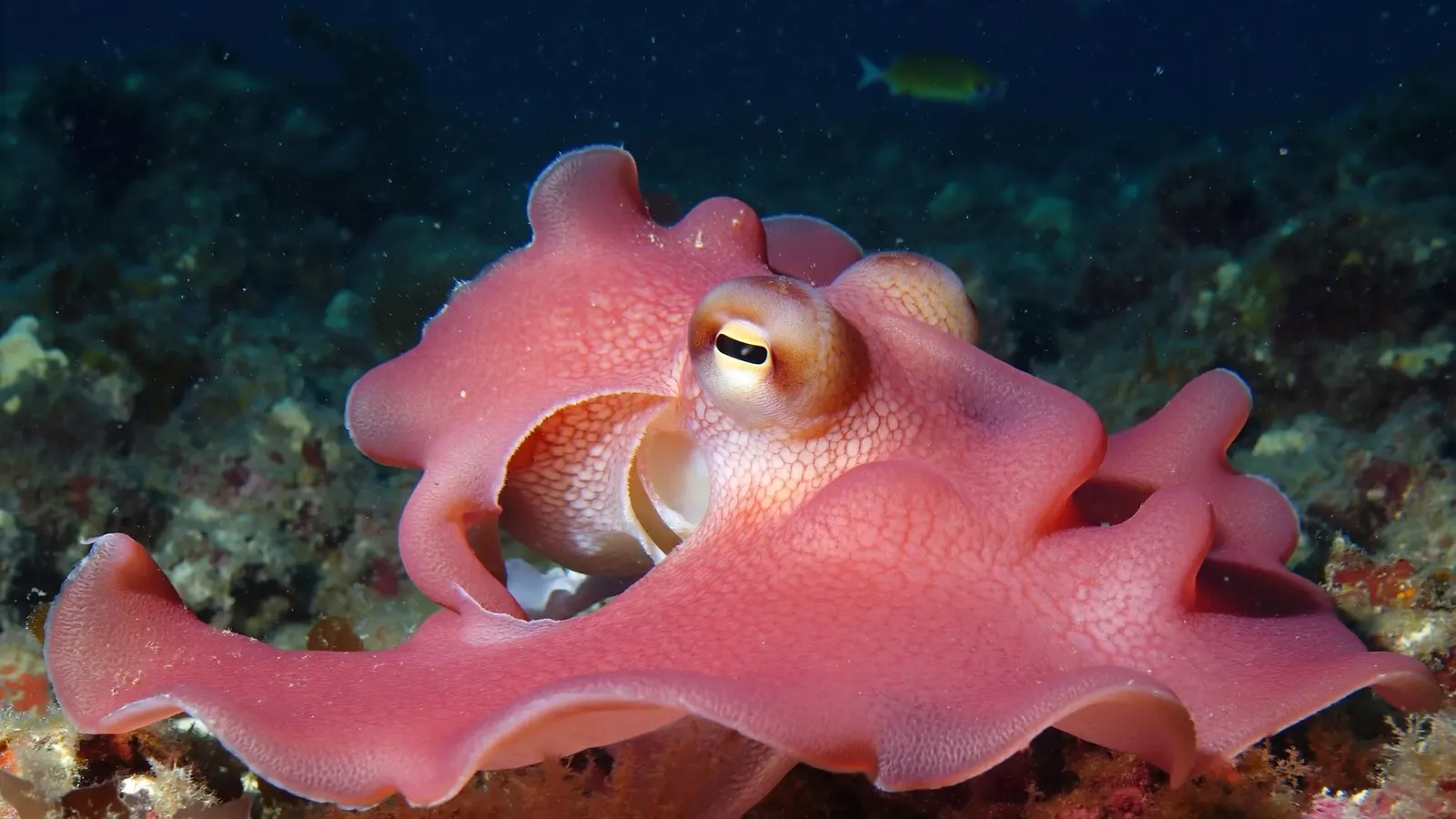
A flapjack octopus does not look like other octopuses. The body is compressed front-to-back into a disc — flatter than any other cephalopod — with eight short, webbed arms spreading from the underside like a flexible parachute. From above it resembles a small, lumpy, orange pancake. From below it resembles an umbrella.
Mantle length tops out at about 20 cm, with the whole animal usually under 25 cm across when fully spread. The body is gelatinous and bright orange to deep pink, sometimes near-transparent, supported internally by a small cartilaginous shell. A pair of paddle-like fins extends above the eyes — the same finned (cirrate) body plan shared with dumbo octopuses, but with the body further flattened. The arms carry the standard sucker arrangement of cirrate octopuses: a single row of suckers flanked by cirri, small hair-like filaments that probe the sediment for prey.
The orange-red coloration is camouflage. Red wavelengths do not penetrate to the species’ habitat (300 m and below) so a red-pigmented animal in deep water is effectively black — invisible to predators that can only see the wavelengths actually present. The flapjack cannot change colour; it does not need to.

Range — deep mud floor of the North Pacific
Flapjack octopuses occupy the deep seafloor of the North Pacific in a horseshoe-shaped distribution from California north to the Bering Sea and back south down the Asian coast to Japan.
Confirmed records span the Bering Sea, Sea of Okhotsk, Aleutian arc, Gulf of Alaska, the deep continental slope off British Columbia, Oregon, and California, the Monterey Canyon and Davidson Seamount systems off central California (where MBARI does most of its observation work), and the deep waters off central Honshu and Kashima-Nada in Japan. Depth records run from about 125 m to nearly 1,300 m, with most observations in the 300–800 m range. Habitat is consistently soft mud, fine sediment, and gravelly seafloor — not rocky reef. The species rests on the substrate as a flattened disc and propels off the bottom only briefly to relocate or evade predators.
Diet — passive sweep with cirri-tipped arms
Flapjack octopuses do not actively hunt the way shallow octopuses do. The deep-sea food supply is too thin to support the energetic cost. Instead, the species sits on the mud and waits, sweeping its webbed arm-curtain through the water and probing the sediment with cirri.
Stomach-content analysis of eight specimens by MBARI found a diet dominated by small benthic and epibenthic crustaceans — copepods, isopods, mysids, and small shrimp (crangonid and hippolytid). Polychaete worms and small soft-bodied invertebrates round out the menu. The hunting method is best described as passive trapping: the arm web spreads across or just above the sediment, the cirri stir the mud and probe for hidden prey, and the suckers carry captured items inward to the small beak. The species has no radula — the tooth-rasp organ used by most molluscs to break shells — because its prey are tiny and soft enough to be processed without one. This is one of the lowest-energy feeding strategies among cephalopods, and it is probably what allows the species to live in such food-poor habitat.

Reproduction — continuous spawning over years
Flapjack octopuses do not follow the standard octopus playbook. Unlike most octopus species, which are semelparous — one big brood, then death — flapjacks spawn continuously over years, laying one or two large eggs at a time.
Females transfer a small number of large, thick-shelled eggs at a time, attaching them to rocks, coral, sponges, or other deep-sea substrate. The eggs are not brooded — the female does not stay to defend them. The hard outer shell of each egg is the protection. Each embryo develops directly inside the egg over many months (in some cases over a year, based on MBARI captive observations), then hatches as a fully-formed miniature flapjack with no planktonic paralarval stage. This is the same reproductive strategy used by dumbo octopuses and other cirrate octopuses, and it is fundamentally different from the high-volume, single-brood approach of shallow-water species. The trade-off is fewer, larger, better-protected offspring, spread over a longer reproductive life — a sensible adaptation to the predictable but food-poor abyssal environment.
“O. adorabilis” — the name that almost happened
In 2015, Monterey Bay Aquarium Research Institute scientists led by Stephanie Bush kept several pink flapjack octopuses from the Monterey Canyon in captivity for study. The animals were so cute that the team publicly floated the proposed name Opisthoteuthis adorabilis.
The name went viral. Articles in Wired, Slate, and major aquariums adopted “adorabilis” as if it were the formal scientific name — which it never was. The proposed name is a nomen nudum (“naked name”) in taxonomic terminology, meaning it was never published with the required formal description, so it has no scientific standing. Recent molecular work suggests the Monterey Canyon specimens are not a distinct species at all but simply members of the long-known Opisthoteuthis californiana, possibly the same as another older species, O. albatrossi. The whole “O. adorabilis” episode is a useful reminder that taxonomy is harder than it looks, and that cute names do not survive contact with the type specimen drawer.
Where the flapjack octopus sits among the major octopus species
| Species | Max size | Habitat | Depth range | Lifespan | Distribution |
|---|---|---|---|---|---|
| Flapjack octopus | ~20 cm | Deep mud | 125–1,300 m | ~1.4–2.6 yrs | N. Pacific |
| Dumbo octopus | 20–31 cm | Abyssal seafloor | 1,000–7,000 m | 3–5 yrs | Worldwide deep |
| Umbrella octopus | 15–25 cm | Deep sea | 500–5,000 m | ~3–5 yrs | Worldwide deep |
| Seven-arm octopus | ~4 m | Mid-water deep | 200–3,000 m | ~3–5 yrs | Worldwide |
| Giant Pacific octopus | ~5 m | Rocky reef | 0–1,500 m | 3–5 yrs | N. Pacific |
| East Pacific Red octopus | ~50 cm | Rocky / soft bottom | 0–300 m | 1–2 yrs | NE Pacific |
| Common octopus | ~1.3 m | Rocky/coastal | 0–200 m | 1–1.5 yrs | Cosmopolitan |
How big is a flapjack octopus?
Small. Mantle length tops out at about 20 cm (8 in), with total span (arms spread) usually under 25 cm. The animal is the size of a side plate. The species is so flat — compressed front-to-back into a disc — that it looks much smaller than its actual surface area.
Where does the flapjack octopus live?
On the deep seafloor of the North Pacific. Confirmed populations span the Bering Sea, Sea of Okhotsk, Aleutian arc, Gulf of Alaska, the deep continental slope from BC south to southern California, the Monterey Canyon and Davidson Seamount, and the deep waters off Honshu, Japan. Depth range is roughly 125 to 1,300 metres, on soft mud bottoms.
Is the flapjack octopus a dumbo octopus?
No, but they are closely related. Both are cirrate (finned) octopuses with the same general body plan — ear-like fins, webbed arms, gelatinous body, deep-sea habitat — but they are in different families. Dumbo octopuses are Grimpoteuthis in the family Grimpoteuthididae; flapjacks are Opisthoteuthis in the family Opisthoteuthidae. The flapjack is more compressed and more flattened than a dumbo, and tends to live shallower — though both are deep-sea animals.
Is Pearl from Finding Nemo a flapjack octopus?
Yes — the design was based on Opisthoteuthis californiana. Pixar artist Andrew Stanton modelled Pearl on the species. The biological problem with the film is that flapjack octopuses live at depths of 125 to 1,300 m, far below the shallow reef Pearl is shown sharing with Nemo. According to one of the film’s scientific consultants, a real Pearl at surface pressure “would be pink mush” — the gelatinous deep-sea body cannot survive at shallow pressure. Pearl is also wrong to say “you guys made me ink!” because flapjacks have no ink sac.
Why was it almost called “Opisthoteuthis adorabilis”?
In 2015, Stephanie Bush and her team at the Monterey Bay Aquarium Research Institute kept several specimens of pink flapjack octopuses from the Monterey Canyon in captivity. The animals were so cute the team floated the proposed name O. adorabilis publicly. The name spread through the media as if it were official, but it was never formally published with a type description, so it remains a nomen nudum — an invalid taxonomic name. The Monterey specimens are now thought to belong to the long-known O. californiana.
Blane Perun has been exploring Earth’s oceans and marine life for over 25 years. Founder of TheSea.Org in 1999, underwater photographer, coral aquaculture pioneer, and explorer of 80+ countries.
About Blane Perun → More on Octopus →