Blanket Octopus — Female 2 Meters, Male 1 Inch: The Most Extreme Sexual Dimorphism in Nature
The blanket octopus (Tremoctopus violaceus) is a pelagic cephalopod that lives in the open ocean rather than on the reef. It is famous for three traits found nowhere else in the octopus world: the iridescent "blanket" of webbing stretched between the long upper arms of mature females (unfurled to make her appear several times larger when threatened), the most extreme sexual size-dimorphism known in any large animal (females reach 2 meters; males are 2.4 centimeters, a weight ratio of at least 10,000:1), and the species' habit of tearing off the venomous tentacles of the Portuguese man o' war and wielding them as weapons. The blanket octopus is immune to that venom. Found worldwide in warm pelagic waters, it is rarely seen alive — the first live male was not photographed until 2002.
Blanket Octopus
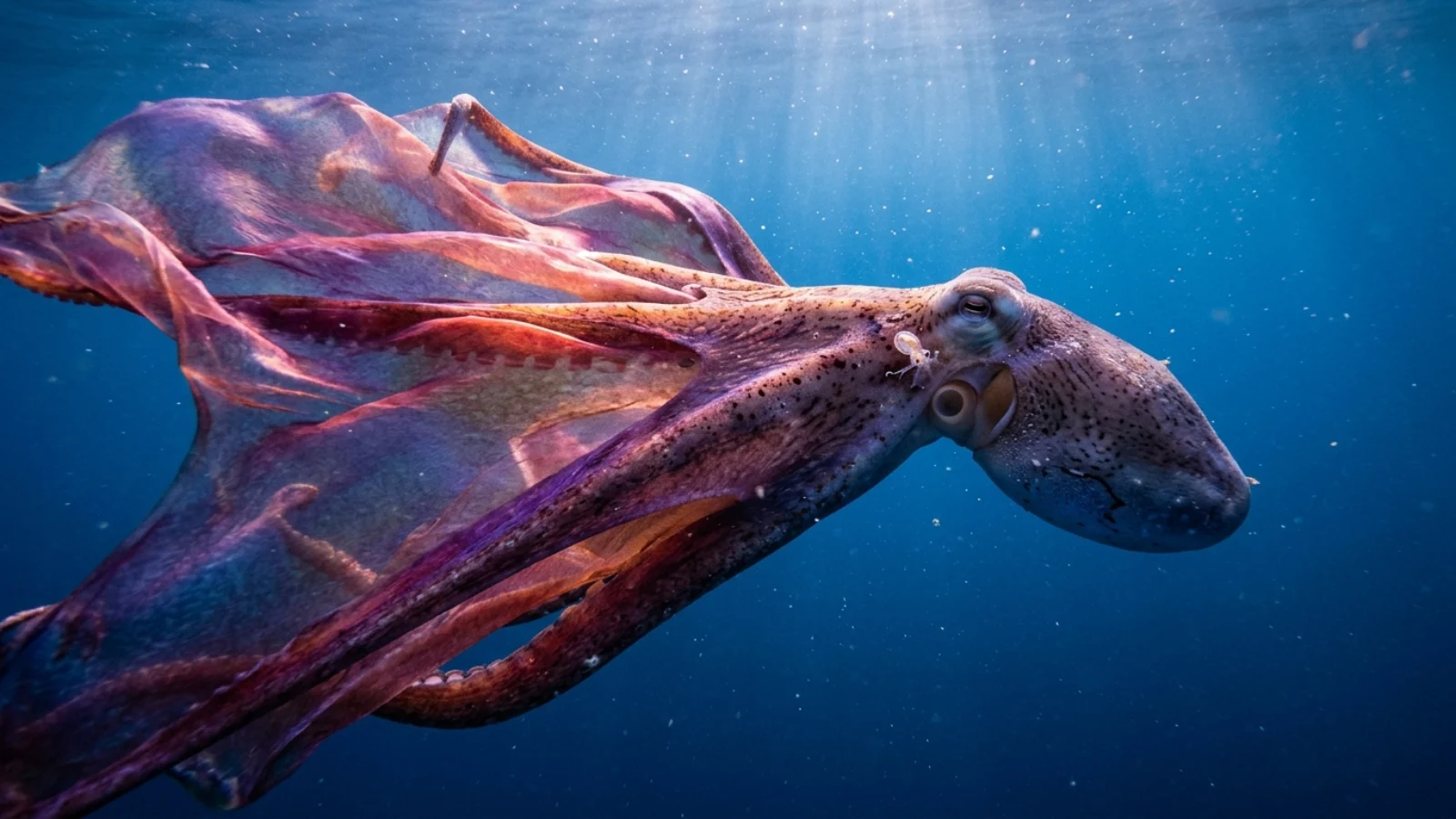
Identification — the iridescent blanket of webbing
A mature female blanket octopus is unmistakable. From a closed swimming posture she looks like an ordinary pelagic octopus, but when she unfurls her long upper arms the "blanket" of webbing between them billows out like an iridescent flag — metres across in large individuals, shimmering through purple, gold, and red as the chromatophores fire.
The blanket is the species' signature. It is a sheet of muscular tissue suspended between the first two arm pairs that can be unfurled at will for display, or wadded against the body when the animal is cruising. The webbing is fully equipped with chromatophores, iridophores, and leucophores — the same colour-producing cell types as the rest of the body — and the female can flash patterns across the blanket in moments. Two functions are documented: it makes the animal appear several times larger when threatened, and parts of it can be deliberately detached if a predator bites in, sacrificing webbing to escape with the body intact.
Mature females reach about 2 m in total length and several kilograms in weight. Males are an entirely different animal: less than 3 cm long, transparent, and so different from the female that for most of biological history nobody knew they were the same species. The first live adult male was not seen until 2002, when M. D. Norman and colleagues found one off the Great Barrier Reef.
Range — pelagic, worldwide, and rarely encountered
The blanket octopus is found in the warm pelagic waters of every ocean. It is one of the few octopus species that does not need the sea floor — it lives, hunts, mates, and reproduces in open water.
Confirmed populations occur throughout the tropical and subtropical Atlantic, Pacific, and Indian Oceans, including the Mediterranean, Gulf of Mexico, Caribbean, eastern Australia, and Hawaii. Genetic work on Mediterranean and Gulf of Mexico specimens has confirmed they belong to the same species (T. violaceus) — not separate populations as some early taxonomists believed. Encounters with live animals are rare because the open ocean is huge and blanket octopuses don't aggregate — most documented sightings come from divers in deep blue-water environments, or from animals brought up incidentally in tuna and swordfish fisheries.
The Portuguese man o' war weapon
No other octopus on Earth uses borrowed weapons. The blanket octopus does. Both juveniles and adult males routinely carry pieces of Portuguese man o' war tentacle (Physalia physalis) in their arms — held aloft, presented to threats, and used both offensively and defensively.
The behaviour was first formally described in 1963 and has been repeatedly observed since. The octopus is immune to the man o' war's venom, an immunity thought to result from specialised skin chemistry that prevents the cnidocytes (stinging cells) from discharging on contact. Young blanket octopuses approach a man o' war from below, tear off pieces of tentacle, and store them — sometimes in specialised dorsal suckers on the first arm pair that appear adapted specifically for this purpose. When threatened or hunting, the octopus wields the tentacle fragments like whips, presenting the still-active stinging cells to an attacker or prey. The cnidocytes remain functional for some time after detachment, so the borrowed weapon retains its sting.
This is the only documented case in cephalopods of kleptoneury — the use of borrowed weapons from another stinging animal. It places the blanket octopus in a small group of animals (including certain nudibranchs that steal anemone nematocysts) that have evolved the trick of stealing other species' chemistry.
The most extreme sexual size-dimorphism on Earth
The size gap between male and female blanket octopuses is so large it broke biology. For more than a century, taxonomists who had measured numerous female specimens and a handful of "tiny pelagic octopus" larvae did not realise the larvae were actually adult males of the same species.
Mature females reach 2 m in total length and weigh several kilograms. Adult males reach 2.4 cm — about the size of a walnut — and weigh roughly a quarter of a gram. The ratio is at least 10,000:1 by weight, and likely closer to 40,000:1 at the extremes. No other animal anywhere near this body size shows anything comparable; the closest large-animal analogues are deep-sea anglerfish, where parasitic males fuse permanently to females.
The biology behind the dimorphism is sexual selection in extreme form. The male's only evolutionary task is to find a female in a vast pelagic environment and successfully transfer sperm. Investment in body size offers no advantage for either task, so males stayed small while females grew large to produce more eggs. The result is the most exaggerated size difference known in any non-microscopic animal.
Reproduction — the detachable arm
Blanket octopus reproduction is as strange as the rest of the species' biology. When a tiny male meets an enormous female in open water, he does not mate in the usual cephalopod way. He tears off his own reproductive arm and hands it over.
Like all male octopuses, the blanket octopus male has a hectocotylus — a specialised arm modified for sperm transfer. Unlike most species, in T. violaceus the hectocotylus is detachable. When the male is ready to mate, the spermatophore pouch inside the arm ruptures and releases sperm into the arm. The male then severs the arm and presents it to the female, who stores it inside her mantle cavity. The male almost certainly dies shortly afterwards. The female may store hectocotyli from several different males simultaneously and uses them later when she is ready to fertilise her eggs.
The arm continues to function autonomously inside the female — an animal organ operating without its original body. When the female releases eggs, the stored hectocotylus releases sperm and fertilisation occurs. Females then carry the developing eggs attached to a calcareous rod inside the arms, brooding hundreds of thousands of tiny eggs in the open ocean until they hatch as planktonic paralarvae.
Conservation — data-deficient pelagic species
The IUCN has not formally assessed Tremoctopus violaceus. The species' pelagic lifestyle and global distribution insulate it from local pressures, but data is so sparse that no population trend can be calculated.
There is no targeted fishery for blanket octopuses, but the species is occasionally caught as bycatch in tuna, swordfish, and other open-ocean longline fisheries. Plastic pollution in the surface waters of the open ocean is a real concern — blanket octopuses feed on small pelagic prey and ingest microplastics, with consequences that are not yet quantified. Climate-driven changes to surface water temperatures and prey distributions are the larger long-term concern.
Where the blanket octopus sits among the major octopus species
The blanket octopus is structurally and ecologically different from almost every other octopus. Comparing it to the more familiar benthic species highlights how unusual it is.
| Species | Max length | Habitat | Lifestyle | Lifespan | Notable trait |
|---|---|---|---|---|---|
| Blanket octopus | 2 m (F) | Open ocean | Pelagic | ~3–5 yrs | Man o' war weapons |
| Giant Pacific octopus | ~5 m | Rocky reef | Benthic | 3–5 yrs | Largest octopus |
| Common octopus | ~1.3 m | Rocky/coastal | Benthic | 1–2 yrs | Tool-use documented |
| Mimic octopus | ~60 cm | Sandy substrate | Benthic | ~9 mo | Mimics other species |
| Blue-ringed octopus | ~20 cm | Tidepools | Benthic | ~2 yrs | Deadly tetrodotoxin |
| Dumbo octopus | ~30 cm | Abyssal | Benthopelagic | 3–5 yrs | Deepest-living octopus |
| Argonaut | ~10 cm | Open ocean | Pelagic | ~1 yr | Calcareous egg case |
How big is a blanket octopus?
It depends entirely on sex. Mature females reach 2 m (6.6 ft) in total length and weigh several kilograms. Adult males are 2.4 cm (1 in) and weigh about a quarter of a gram. The weight ratio is at least 10,000:1 and may reach 40,000:1 — the most extreme sexual size-dimorphism in any animal near or larger than its body size.
Are blanket octopuses dangerous?
Not to humans directly. The blanket octopus itself is not venomous to humans, but small males and juvenile females routinely carry fragments of Portuguese man o' war tentacle as weapons, and those are dangerously venomous. The species lives far from shore and human encounters are rare. There are no documented serious injuries from a blanket octopus.
Why does the male give the female his arm?
It's the species' mating strategy. The male's hectocotylus — the specialised reproductive arm — is filled with sperm. When ready to mate, the male detaches the arm and presents it to the female, who stores it inside her mantle cavity to fertilise her eggs later. The male almost certainly dies shortly afterwards. The female may carry hectocotyli from several different males at once.
Where do blanket octopuses live?
In the open ocean of warm seas worldwide — the epipelagic zone of the tropical and subtropical Atlantic, Pacific, and Indian Oceans, including the Mediterranean, Gulf of Mexico, Caribbean, and waters around Australia and Hawaii. They are pelagic drifters and rarely come near coasts.
Why is the blanket octopus immune to man o' war stings?
Skin chemistry. The blanket octopus's skin contains compounds that prevent the Physalia stinging cells (nematocysts) from discharging on contact. This immunity is what allows the octopus to safely harvest tentacle fragments from the man o' war and wield them as weapons. The exact chemical mechanism is still being investigated.
Blane Perun has been exploring Earth’s oceans and marine life for over 25 years. Founder of TheSea.Org in 1999, underwater photographer, coral aquaculture pioneer, and explorer of 80+ countries.
About Blane Perun → More on Octopus →