Marine Iguana — The Only Lizard That Lives Off the Sea
The marine iguana (Amblyrhynchus cristatus) is the only lizard in the world that forages in the sea. Found only in the Galápagos Islands, it grazes on red and green algae on intertidal rocks and, in larger animals, on the seabed down to about 15 m or more. Males reach about 1.3 m in total length on the biggest islands, and the species is divided into 11 subspecies. It is listed as Vulnerable because of El Niño die-offs, invasive predators and pollution.
Charles Darwin called them “hideous-looking” and “imps of darkness”. Anyone who has snorkelled at Fernandina or Punta Espinoza and watched a marine iguana grazing calmly on algae a few metres down sees something else: an animal doing what no other lizard on Earth does.
Where do marine iguanas live?
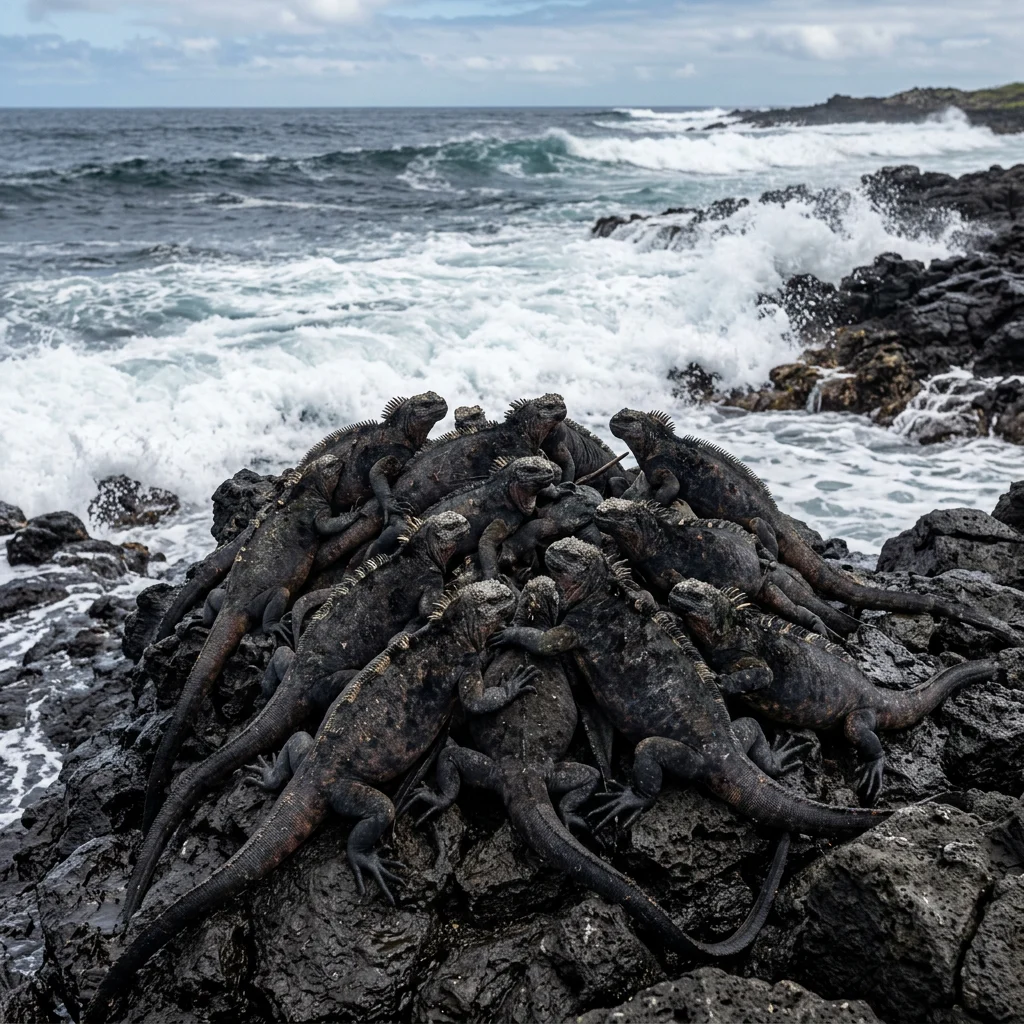
Only on the rocky shores of the Galápagos Islands, Ecuador, where cold, nutrient-rich currents grow dense algal turf.
Each main island has its own population, and a 2017 genetic study led by Aurélien Miralles and Sebastian Steinfartz recognised 11 subspecies, including the large A. c. cristatus of Isabela and Fernandina and A. c. godzilla of northern San Cristóbal. Densities can reach several thousand iguanas per kilometre of coastline on the best islands.

How big do marine iguanas get?
Size varies enormously between islands, depending on how much algae is available. On Isabela and Fernandina, big males reach about 1.3 m total length; on small, food-poor islands like Genovesa, adults are much smaller. Males are larger than females and turn bright red, green or turquoise in the breeding season, especially on Española, where they are nicknamed “Christmas iguanas”.
How do marine iguanas dive and feed?

Only the largest males, about 5% of the population, swim out to graze algae below the tide line, mostly in less than 5 m of water; females and young feed on rocks exposed at low tide.
They swim with side-to-side movements of a flattened tail, with legs held against the body, and grip rocks with long, sharp claws against the surge. Their blunt snout and small, three-pointed teeth scrape algae off the rock. Hatchlings eat adult droppings to acquire the gut bacteria needed to digest algae. See what marine iguanas eat.
Why do marine iguanas sneeze?
Eating seaweed loads them with salt. Special nasal salt glands concentrate it and the iguana expels it in a forceful sneeze, which is why their heads are often crusted white. Read why marine iguanas sneeze.
How do marine iguanas cope with cold water?

Galápagos water can drop below 20 °C. Iguanas bask on black lava to warm up before diving, reduce blood flow to the skin while underwater to slow heat loss, and return to bask after feeding. Their dark colour absorbs sunlight quickly. See how marine iguanas conserve heat.
Do marine iguanas really shrink?
Yes. During El Niño famines, marine iguanas can shrink by up to about 20% of their body length, reabsorbing bone, then regrow when food returns.
Martin Wikelski and Corinna Thom reported this in Nature in 2000. Smaller iguanas need less food and survive El Niño better, so shrinking is a survival strategy. Even so, strong El Niño events have killed up to about 90% of some island populations.
Are marine iguanas endangered?
They are listed as Vulnerable. Threats include El Niño events, introduced cats, dogs, rats and pigs that eat eggs and young, oil spills (the 2001 Jessica tanker spill caused heavy mortality on Santa Fe), plastic pollution and disturbance near towns. See why marine iguanas are threatened.
| Feature | Marine iguana | Galápagos land iguana |
|---|---|---|
| Food | Marine algae | Prickly pear cactus, plants |
| Tail | Flattened for swimming | Round |
| Claws | Long, sharp for gripping rock | Shorter |
| Colour | Dark grey-black; males red/green in breeding season | Yellow-orange |
| Salt glands | Large, sneezes salt | Small |
How was the marine iguana discovered and named?
Sailors thought it ugly, Darwin thought it disgusting, and the scientist who named it thought it came from Mexico.
The first written impressions were not kind. In 1798 the British naval captain James Colnett described the Galápagos iguanas as small and sooty black, so disgusting in appearance that no one on his ship could be persuaded to eat them. When Charles Darwin visited in 1835 aboard HMS Beagle, he called them “most disgusting, clumsy lizards” as black as the lava they crawled over, and repeated someone else’s phrase for them: “imps of darkness”. Darwin nonetheless watched them closely, cut open their stomachs to show they ate seaweed, and tested how long they could stay underwater.
The species had already been formally described ten years earlier, in 1825, by the English zoologist Thomas Bell, who believed his specimen came from Mexico, an error later corrected. Bell named it Amblyrhynchus cristatus. The genus name comes from Greek words meaning “blunt snout”, a good description of the short, flat face, and cristatus is Latin for “crested”, after the row of spines running down the back. It is the only species in its genus.
How did a lizard end up living off the sea?
Its ancestors rafted from the Americas, and the Galápagos offered algae instead of land plants.
The marine iguana and the Galápagos land iguanas (genus Conolophus) share a common ancestor that is thought to have reached the islands from Central or South America, most likely by floating across on rafts of vegetation. Their closest living relatives on the mainland are the spiny-tailed iguanas (Ctenosaura) of Mexico and Central America. Older genetic studies based on mitochondrial DNA put the split between the marine and land iguanas at 8 to 10 million years ago, older than any of the islands now above water, which led to the idea that the lineage first lived on islands that have since sunk. A later study using both mitochondrial and nuclear DNA put the split at about 4.5 million years, close to the age of the oldest existing islands, Española and San Cristóbal.
The two iguanas remain closely enough related to interbreed. On tiny South Plaza, where their breeding seasons and territories overlap, a handful of hybrids have been recorded. They have intermediate features, stay on land and are sterile. Within the marine iguana itself, the populations of different islands are surprisingly young: the deepest splits appear to be less than 230,000 years old, and probably less than 50,000. Occasional iguanas reach other islands and breed there. Only one has ever been confirmed outside the archipelago, an animal that turned up on Isla de la Plata, near mainland Ecuador, in 2014.
Why are some island populations so much bigger than others?
Body size tracks food: the more algae an island grows, the bigger its iguanas.
Measured from snout to vent (the base of the tail), adult marine iguanas range from about 12 to 56 cm, with a tail of 17 to 84 cm on top of that. The differences between islands are dramatic. In one study the average snout-to-vent length on Wolf and Darwin islands was about 19 cm, and Genovesa animals were only slightly bigger, while Santa Cruz iguanas averaged about 35 cm, with those of Isabela and Fernandina close behind. The heaviest males weigh up to about 12 kg on southern Isabela but only about 1 kg on Genovesa. These differences reflect how much algae grows around each island, which in turn depends on water temperature and upwelling.
Males average roughly twice the weight of females and have broader heads, longer spines and larger bony plates on the head. Female choice drives this: females prefer bigger males, and big males win more matings. But size is a double-edged sword. When El Niño cuts off the food supply, the largest males are the first to starve, so the very trait that wins mates in good years becomes a liability in bad ones.
What adaptations let it feed underwater?
Heavy bones for ballast, a paddle tail, grappling-hook claws and teeth built for scraping.
A marine iguana floats if it stops swimming or lets go of the rock, so diving takes effort. One answer is in the skeleton: its limb bones, especially those of the front legs, are unusually dense compared with those of land iguanas, adding ballast. Propulsion comes almost entirely from the flattened tail, swept from side to side, while the legs are held against the body. On the bottom, the iguana pulls itself along with long, curved claws and clings on against the surge. Its feet are often described as webbed, but the webbing is minimal and no greater than in the green iguana. It is not a fast swimmer: average speed is about 0.45 m per second, and it can only roughly double that in short bursts.
The mouth is equally specialised. Each tooth has three points, and in the marine iguana the side points are almost as large as the central one, forming a scraping edge that rasps algae off rock. The teeth also seem to be replaced faster than in other iguanas, which makes sense for an animal grinding against volcanic rock every day. The skull has an unusually large nasal cavity to house the salt glands that let the iguana get rid of the salt it swallows with every mouthful.
What exactly do marine iguanas eat, and how do they find it?
Mostly red and green seaweeds, with a clear menu of favourites and foods to avoid.
Studies of stomach contents and feeding behaviour show that marine iguanas eat at least ten genera of algae, mostly fine red seaweeds such as Gelidium, Hypnea, Polysiphonia and Pterocladiella. On some islands the green sea lettuce Ulva makes up much of the diet. They avoid several algae that contain chemical deterrents, and they generally skip brown algae. Beyond that, choice is driven by energy content and digestibility. On Santa Cruz, a few red algae are preferred, but the iguanas switch to the less favoured Ulva when low tides are not low enough to expose their usual food.
Most iguanas, including all females and young, feed in the intertidal zone at low tide. They dash down to a patch of exposed algae, take a few bites, and scramble back up before the next wave washes over them. Only about 5% of the population, the largest males, swim out to graze below the low-tide line. Most of their dives are short and shallower than 5 m; dives to 7 m or more regularly last 15 to over 30 minutes, the deepest recorded reach about 30 m, and stays of up to an hour have been reported. The minimum size for a diver depends on the island, from about 0.6 kg on Genovesa to about 3 kg on Fernandina. Digesting seaweed requires special gut bacteria, and hatchlings acquire them by eating the droppings of adults during their first months.
How do they manage body heat?
By basking hard, slowing their heart in cold water, and huddling at night.
Sea-surface temperatures around the Galápagos are typically between about 11 and 23°C, but marine iguanas work best at a body temperature of 35 to 39°C, which is also the best temperature for digesting algae. A feeding trip can cool an iguana by as much as 10°C. In the water, the heart slows to about 30 beats a minute, reducing blood flow to the skin and slowing heat loss. Back on land, the heart rate rises to about 100 beats a minute, which helps spread heat absorbed by the dark skin through the body. Cold iguanas are sluggish and vulnerable, and they compensate with bluff and aggression, gaping and biting if approached.
Large males feed mostly around the middle of the day, when the sun is strongest, and their bulk keeps them warm for longer in the water. Smaller animals stick to low tide so they can stay on exposed rock. At night many iguanas sleep in tight groups of up to about 50 to conserve heat. The opposite problem arises at midday: to avoid overheating, iguanas pant, face the sun so that it strikes as little of the body as possible, and raise themselves on straight legs so air can flow underneath.
How do marine iguanas breed?
Males defend tiny territories in leks; females bury a few large eggs in sand or ash.
Breeding takes place at the end of the cool, dry season, with mating from about December to March and nesting from January to April, timed to the algal growth that follows upwelling of the cold Cromwell Current. Females mature at 3 to 5 years, males at 6 to 8. Large males defend territories for up to about three months, often clustered together in a lek. A territory may be as small as 1 square metre and rarely more than about 40. Rivals threaten each other with head-bobbing and open-mouthed displays, and if that fails they lock heads and shove. Females choose mates by size, display rate and territory quality.
About a month after mating, the female lays one to six eggs, usually two or three. They are large for an iguana, about 9 by 4.5 cm and 80 to 120 g each, and a clutch can weigh up to a quarter of the female’s body weight. She digs a nest 30 to 80 cm deep in sand or volcanic ash above the high-tide line, usually near the shore but sometimes up to 2 km inland. Where nest sites are scarce, females fight and guard their burrows for several days. The eggs hatch after about three to four months. Hatchlings weigh 40 to 70 g and immediately run for cover; some travel 3 km in two days. On islands such as Fernandina, newly emerged hatchlings must get past Galápagos racer snakes, which hunt them on the open lava. Most iguanas live 12 years or less, but some reach about 60.
How many marine iguanas are there, and what threatens them?
A few hundred thousand, protected by law but exposed to El Niño, introduced predators and oil.
The whole population is estimated at roughly 200,000 to 300,000 animals, with wide uncertainty because the rocky shores are hard to survey. Fernandina may hold around two-fifths of the total, though estimates for that island alone range from 15,000 to 120,000. On the best shorelines, densities can reach about 8,000 iguanas per kilometre of coast, and their biomass per unit area may exceed that of any other known reptile. The IUCN lists the species as Vulnerable, and the San Cristóbal, Santiago and Genovesa subpopulations as Endangered.
El Niño is the biggest natural threat. Warm water stops the upwelling that feeds the red and green algae, and some island populations have fallen by up to about 90%. Recovery is usually fast, often within four years, but it can be slowed when an introduced brown alga, Giffordia mitchelliae, takes over the rocks, because the iguanas cannot live on it. Climate models suggest strong El Niño events may become more frequent. Introduced dogs, cats, rats and pigs are a major problem on the inhabited islands, where very few hatchlings survive. Removing them is not simple: feral dogs kill adult iguanas but also suppress cats, which eat the young. Oil is another danger. After the tanker Jessica ran aground off San Cristóbal in 2001, the marine iguanas of Santa Fe declined by almost two-thirds, probably because even light oiling killed the gut bacteria they need to digest algae. Introduced diseases are a further concern for an animal that evolved in isolation.
The species is fully protected under Ecuadorian law and listed on CITES Appendix II. Almost its entire range lies within Galápagos National Park and the Galápagos Marine Reserve. Some coastal roads have lowered speed limits to protect young iguanas, and black rats were eradicated from Pinzón Island in 2012.
How to watch marine iguanas responsibly
They are easy to see, almost impossible to frighten, and that is exactly why visitors need to be careful.
Marine iguanas are famously tame. They rarely try to escape, and even animals that have been caught before show only slightly more wariness. That makes them easy to photograph at sites like Tortuga Bay on Santa Cruz, Punta Espinoza on Fernandina, and Española, but also easy to disturb without noticing. Park rules require visitors to stay at least 2 m from wildlife, and signs remind people not to step on basking animals, which are often the same colour as the lava. Never touch or feed them. Research on tourism has found that stress hormone levels can predict which iguanas survive El Niño famines, so avoiding unnecessary disturbance matters. Snorkellers at the western islands may see large males grazing on the bottom: watch from the surface and give them space to come up for air and return to the rocks to warm up.
On South Plaza, marine iguanas occasionally mate with land iguanas, producing rare hybrid iguanas. Their beach neighbours include the Galápagos sea lion.
Where do marine iguanas live?
Only in the Galápagos Islands, on rocky coastlines.
What do marine iguanas eat?
Mostly red and green algae grazed from intertidal rocks or the seabed.
How deep can marine iguanas dive?
Most dives are shallower than 5 m, but large males can reach about 30 m. Dives below 7 m often last 15–30+ minutes, and stays of up to an hour have been reported.
Why do marine iguanas sneeze?
To expel excess salt concentrated by special nasal glands.
Are marine iguanas dangerous?
No. They are herbivores and harmless to people.
Do marine iguanas shrink?
Yes. During El Niño they can shrink by up to about 20% in length to survive food shortages.
How long do marine iguanas live?
Most live 12 years or less, but some reach about 60 years.
Are marine iguanas endangered?
They are listed as Vulnerable by the IUCN.
- Miralles, A. et al. (2017). Shedding light on the Imps of Darkness: an integrative taxonomic revision of the Galápagos marine iguanas. Zoological Journal of the Linnean Society 181: 678–710.
- Wikelski, M. & Thom, C. (2000). Marine iguanas shrink to survive El Niño. Nature 403: 37–38.
- Charles Darwin Foundation. Marine iguana research.
- Reptiles of Ecuador. Amblyrhynchus cristatus account.
- Wikipedia. “Marine iguana” (body size by island, diving, thermoregulation, breeding, population 200,000–300,000, threats and protection).
- Darwin, C. (1839). Journal of Researches (The Voyage of the Beagle), Galápagos chapter.
- IUCN Red List. Amblyrhynchus cristatus: Vulnerable.
Blane Perun has been exploring Earth’s oceans and marine life for over 25 years. Founder of TheSea.Org in 1999, underwater photographer, coral aquaculture pioneer, and explorer of 80+ countries.
About Blane Perun →More on Marine Reptiles →