How Many Sea Lions Are There? — Six Species, One Extinct, Several in Trouble
There are six living species of sea lion, and very roughly 700,000–900,000 individual sea lions in the world, a figure you get by adding up stock estimates made in different years. The most numerous are the California sea lion (about 258,000 in the US stock alone, NOAA’s 2014 estimate, plus roughly 105,000plus perhaps 100,000 more in Mexicondash;115,000 more in Mexico) and the South American sea lion (an older estimate of about 265,000, before H5N1 bird flu killed at least 24,000 in 2023). The New Zealand (about 12,000), Australian (only about 2,700 pups per breeding cycle) and Galapagos (17,000–24,000) sea lions are each listed as Endangered, and the Japanese sea lion is extinct.
How many of each sea lion species are there?
| Species | Approx. population | IUCN status | Where |
|---|---|---|---|
| California (Zalophus californianus) | ~258,000 (US, 2014) + ~75,000–85,000 Pacific Baja + ~31,000 Gulf of California | Least Concern | Vancouver Island to Mexico |
| South American (Otaria flavescens) | ~265,000 (pre-2023 estimate); at least 24,000 died of H5N1 in 2023 | Least Concern | Peru & Brazil to Cape Horn, Falklands |
| Steller (Eumetopias jubatus) | ~53,000 western stock in Alaska (2024 model) + roughly 60,000–80,000 eastern stock (2009–11 counts) | Near Threatened | North Pacific, California to Japan |
| Galapagos (Z. wollebaeki) | 17,000–24,000 (2018); ~16,000 in 2001, ~40,000 in 1978 | Endangered | Galapagos Islands |
| New Zealand (Phocarctos hookeri) | ~12,000; 1,425 pups at the Auckland Islands in 2025/26 | Endangered | Auckland & Campbell Is., Otago |
| Australian (Neophoca cinerea) | ~2,700 pups per breeding cycle (2021 assessment) | Endangered | South & Western Australia |
| Japanese (Z. japonicus) | 0 | Extinct | Formerly Sea of Japan; last confirmed record 1974 |
Figures come from NOAA stock assessments, peer-reviewed censuses, the IUCN Red List and national agencies, and are rounded. They come from different years, so the global total is only a rough sum. Sea lions are counted mostly through pup counts at rookeries, then multiplied up using life tables, so estimates carry wide margins.
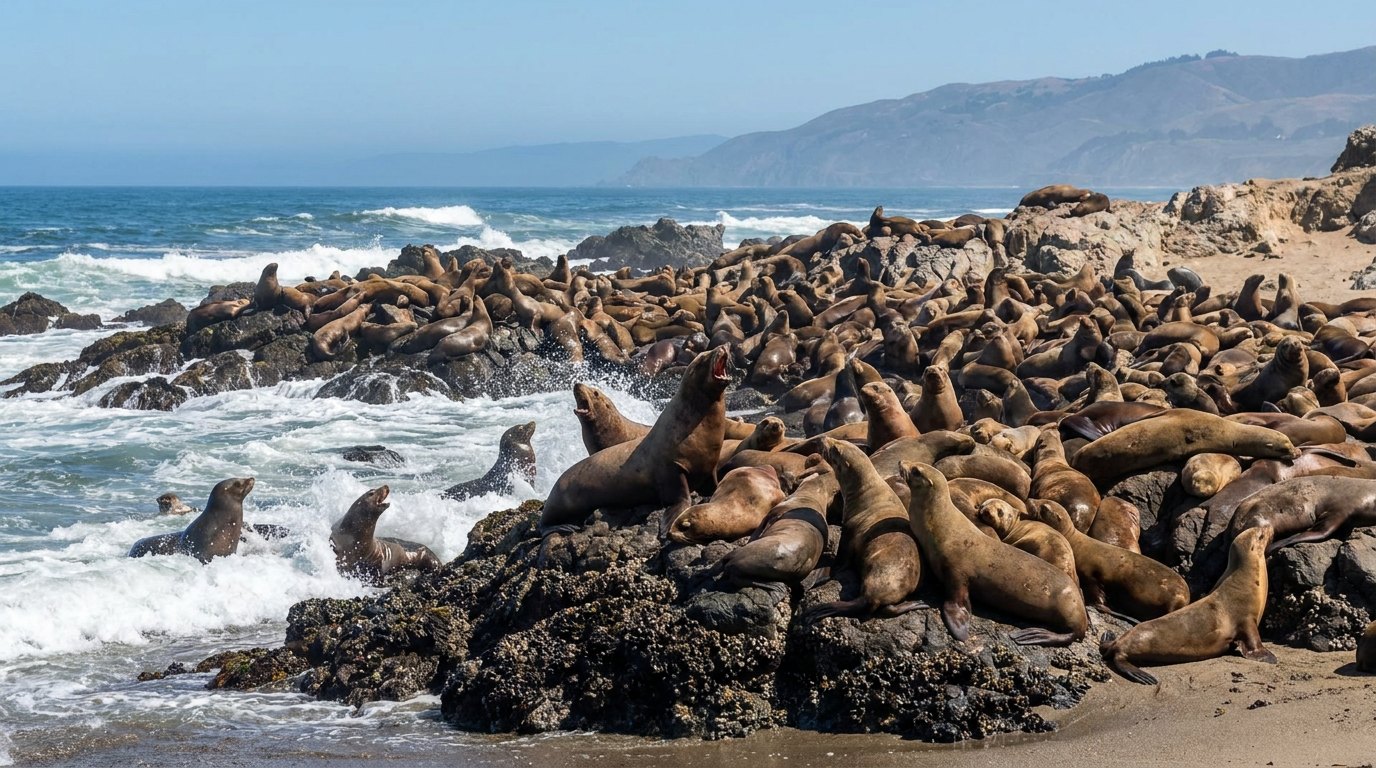
Are sea lion numbers going up or down?
California sea lions are a conservation success: NOAA estimated net growth of about 7% a year from 1975 to 2014, and the stock is now near its estimated carrying capacity of about 275,000, though El Niño years cause sharp drops. Steller sea lions split into two stories: the western stock fell by an estimated 70–80% from the 1970s, mostly in Alaska and the Aleutians, and is still listed as Endangered under the US Endangered Species Act, while the eastern stock grew enough to be removed from the ESA list in 2013. New Zealand sea lion numbers at the Auckland Islands, the main breeding area, fell by about half between 2000 and 2015, with fishing bycatch and pup disease both implicated. Australian sea lions are still declining, by an average of about 2% a year at monitored colonies.
What happened to the Japanese sea lion?
The Japanese sea lion once lived around Japan and Korea. Commercial hunting in the early 1900s, including live capture for circuses, wiped it out. The last confirmed record is a juvenile caught off Rebun Island, Hokkaido, in 1974, and the species is listed as Extinct.
How do scientists count sea lions?
Nobody counts every sea lion. Adults spend days at sea between visits to land, so a beach count on any given day misses many of them. Researchers instead count pups, which stay ashore for weeks after birth, and then multiply. In NOAA’s 2013 assessment of the eastern Steller sea lion stock, for example, a total of 15,038 pups was multiplied by factors of 4.2 or 5.2 to give a population range of 63,160 to 78,198. That spread shows how much the final number depends on assumptions about birth rates and survival. Official minimum estimates are lower and more cautious than these multiplied totals.
The counting itself has changed. In Alaska in 2024, NOAA photographed rookeries in the Gulf of Alaska from a Twin Otter aircraft with a vertically mounted camera. A research vessel, the RV Tiĝlâx, worked the western and central Aleutian Islands with visual counts and drone imagery. The Aleut Community of St. Paul flew its own drones over Walrus and Otter islands. Off southern California, drones flying at 46 m replaced most ground counts of California sea lion pups at San Miguel Island in 2023, which cut disturbance to the colony.
Raw counts can mislead even when they are done carefully. A 13-year study of individually marked Galapagos sea lions on the islet of Caamaño found that the chance of seeing any given adult in the colony on a count day was only about 16% in the breeding season and 23% outside it. Raw counts suggested the colony was declining. Mark-resight estimates did not support that, and the two measures were not even significantly correlated. The authors, Trillmich and colleagues, concluded that attendance patterns can swamp real population change. That is why trends are best judged from long series of pup counts, not single surveys.
California sea lions: the numbers behind the recovery
The most recent full NOAA stock assessment for the US population of California sea lions, published in 2018, is built on a 2014 west-coast pup count of 47,691. From that, NOAA gives a best estimate of 257,606 animals and a minimum of 233,515. The model puts carrying capacity, the number the ecosystem can support, at 275,298. The stock was about 40% above its maximum net productivity level, which means it is classed as being at its optimum sustainable population and is not considered depleted or strategic under US law.
The same report sets the potential biological removal at 14,011 animals a year. That is the number that could be lost to human causes each year without stopping the stock from reaching or staying at its optimum. Known human-caused deaths and serious injuries were at least 321 a year: a minimum of 197 in commercial fisheries, about 29 in hook-and-line fisheries, and about 24 a year removed at the Columbia River under Section 120 of the Marine Mammal Protection Act, which allows the removal of sea lions that prey on salmon. Another 155 shootings were documented between 2012 and 2016. These are minimums, because most deaths at sea are never found.
The US animals are only part of the species. Mitochondrial DNA separates five genetically distinct populations: a Pacific temperate group (the US stock), a Pacific subtropical group along Baja California, and three groups in the Gulf of California. Commonly cited estimates for the Mexican groups are 75,000–85,000 for western Baja California and about 31,393 for the Gulf of California. The Coronado Islands just south of the border produce only between 12 and 82 pups a year.
Ocean warmth drives the year-to-year swings. The NOAA assessment estimates that for each 1°C rise in sea surface temperature, the odds of pup and yearling survival fall by about half. Indicators from the California Current integrated ecosystem assessment suggest that a 1°C rise cut the population growth rate by about 7%, with no matching boost when the water cooled. Why those warm years also bring mass strandings is covered on our page about sea lions dying in California.
Steller sea lions: two stocks, two different stories
For management, Steller sea lions have long been split at 144°W, roughly the middle of the Gulf of Alaska. Animals to the west form the western stock and those to the east the eastern stock. Recent genetic work suggests the animals in the Sea of Okhotsk and the Kuril Islands form a third, Asian stock, while those off eastern Kamchatka and the Commander Islands belong with the western group. In 1997 the western stock was listed as endangered and the eastern stock as threatened under the US Endangered Species Act.
The eastern stock recovered. NOAA’s 2013 assessment gave counts of 24,447 in Southeast Alaska (2009), 23,481 in British Columbia (2010), 2,781 in California (2011) and about 5,500 in Oregon (2008–09). It put the minimum estimate for the whole stock at 57,966. Pup counts grew by about 4.2% a year from 1979 to 2010. California is the weak end of that range: non-pup counts there were 4,000 to 6,000 between 1927 and 1947 but only 1,500 to 2,000 from 1980 to 2011. At Año Nuevo Island the breeding population had fallen by 85% by 1987. The eastern stock was removed from the endangered species list in October 2013.
The western stock tells a harder story. NOAA’s provisional 2024 survey counted 22,082 non-pups at 102 sites and 7,017 pups at 54 sites. Modelled to include sites not visited that year, the Alaskan part of the stock was estimated at 39,774 non-pups and 12,953 pups. Across the whole western stock in Alaska, numbers rose by just under 1% a year from 2009 to 2024, but the report says the rate of increase has been slowing since around 2016. The regions differ sharply. In the western Aleutians, non-pups fell by about 5.7% a year, leaving only 337 counted in 2024. Meanwhile the central Gulf of Alaska grew by about 2.5% a year, and the eastern Gulf declined by about 1.9% a year. Overfishing of pollock and herring, and nutritional stress have both been proposed to explain the earlier crash, but no single cause has been proven.
South American sea lions and the 2023 bird-flu die-off
The South American sea lion ranges from Peru around Cape Horn to southern Brazil and the Falkland Islands. For years its population was given as about 265,000 and described as stable overall, with declines in the Falklands and Argentine Patagonia offset by increases in Chile and Uruguay. Genetic work shows that the Pacific and Atlantic populations form two clades whose females have barely mixed for more than a million years. Some authors use the name Otaria byronia rather than O. flavescens for the species.
That 265,000 figure predates a mass die-off. Highly pathogenic avian influenza H5N1 spread through South American seabirds from late 2022, and sea lions probably caught it by living alongside and feeding on infected birds. In Peru, Gamarra-Toledo and colleagues reported 5,224 dead sea lions in early 2023. In Chile, strandings surged from January 2023 and peaked in June, with 4,545 stranded and dead animals recorded. Of 168 sea lions tested, 34 were positive for influenza A and 21 were confirmed as H5N1. Sick animals showed tremors, disorientation, paralysis and severe breathing problems. By October 2023 the virus had reached the Atlantic coast, killing sea lions in Uruguay, Argentina and Santa Catarina in Brazil. A 2024 review by Plaza and colleagues put the total at at least 24,000 sea lions dead between January and October 2023 across Peru, Chile, Argentina, Uruguay and Brazil.
Genetic studies of the marine-mammal viruses found the same set of mammal-adapting mutations in sea lions, elephant seals and terns from several countries. The authors of a 2024 Nature Communications study argued this supports mammal-to-mammal transmission, not just repeated spillover from birds. Until fresh colony counts are published, any total for South American sea lions should be treated as out of date.
Galapagos sea lions: counted island by island
The Galapagos sea lion lives almost entirely in the archipelago, with a small population on Isla de la Plata off mainland Ecuador. A census of every rookery from 2014 to 2018 by Páez-Rosas and colleagues estimated 17,000 to 24,000 animals in 2018, growing by about 1% a year after correcting the counts. Older estimates were mixed: the first archipelago-wide census in 1978 counted about 8,000 animals and extrapolated a population of about 40,000, while a 2001 census counted 4,937 and estimated about 16,000. The 2018 counts were close to the 2001 level, so the authors suggest the population may have been fairly stable over the past two decades after the earlier halving, although some colonies are still falling: a 21-year study of the Caamaño colony found steady decline since monitoring began in 2003 (Childs et al. 2026). The highest count was in 2014. It was followed by a 23.8% drop in 2015 linked to that year’s El Niño, when warm water drove prey deeper and pup production fell. The Galapagos fur seal, counted in the same surveys, numbered only 3,093 in 2018.
Local trends can differ from the archipelago-wide one. An earlier study of the southeastern islands of San Cristóbal, Española, Floreana and Santa Fe estimated only 2,300 to 4,100 sea lions there, declining by about 8.7% a year between 2011 and 2015. Over a longer period, 2005–2015, the El Malecón rookery on San Cristóbal, the largest in the region, grew by about 2% a year. Living alongside people brings new risks, including diseases linked to free-roaming dogs: canine heartworm has now been confirmed in Galapagos sea lions on San Cristóbal.
New Zealand sea lions: pup counts at the Auckland Islands
Roughly 99% of New Zealand sea lion pups are born in the subantarctic Auckland and Campbell islands, so pup counts there track the species. Estimates for the whole species fell from about 15,000 in the mid-1990s to about 9,000 in 2008, based on pup production. In the 2025/26 season, the Department of Conservation estimated 1,425 ± 30 pups at the Auckland Islands, up from 1,375 the previous year but below the 1,457 of 2023/24. DOC said the drop in pup production over the past four years suggests falling survival or breeding rates among adult females.
Fishing has been the main suspected cause. Squid trawlers around the Auckland Islands drowned sea lions as bycatch from the 1990s, which led to sea lion exclusion devices with a 23 cm grid that lets squid through but stops adults. Disease is the other big factor. Between late 2006 and early 2010, a hypervirulent strain of Klebsiella pneumoniae killed 123 pups on Enderby Island, 58% of observed pup deaths there. Female pups at Enderby Island are now treated with ivermectin, a deworming drug that trials linked to lower Klebsiella deaths. Sea lions began breeding again on the Otago Peninsula in 1993, more than 150 years after hunting wiped them out on the mainland. Stewart Island was recognised as a breeding colony in 2018.
Australian sea lions: smaller than anyone thought
The Australian sea lion breeds only in South and Western Australia, over a range of about 3,000 km. Its breeding cycle lasts about 17–18 months and is not synchronised between colonies, which makes counting unusually hard. A 2021 assessment in Endangered Species Research by Goldsworthy, Shaughnessy and Mackay used data from 80 breeding sites to estimate total pup abundance at 2,739: 82% in South Australia and 18% in Western Australia. From 1,776 site surveys made between 1970 and 2019, the authors found usable time series at 30 sites. These showed pup numbers falling by an average of 2.0% a year, a 64% decline over three generations (42.3 years). They concluded that the population is much smaller than previously estimated and is still shrinking.
Hookworm infects every newborn pup, and pup mortality at Seal Bay on Kangaroo Island ran at 19.2% and 28.9% in consecutive seasons studied in 2019–21. In the past, sea lions on Dangerous Reef were shot for shark bait in the 1960s and 1970s, and animals caught in gillnets in the 1980s were also shot. At the northwest edge of the range, a 2026 genetic study found that the Houtman Abrolhos colonies form a single, highly isolated population with extremely low genetic diversity, and warned they could disappear.
The Japanese sea lion: how a species was counted down to zero
The Japanese sea lion’s numbers can be read from harvest records. Japanese fishermen took as many as 3,200 in harvests around the turn of the 20th century. The catch fell to about 300 by 1915 and to a few dozen by the 1930s, and commercial harvesting ended in the 1940s because almost none were left. In total, as many as 16,500 may have been killed. The last credible colony report came from the Liancourt Rocks in 1951, with 50 to 60 animals. Claimed sightings since then, in Tottori in 2003 and the Koshiki Islands in 2016, involved animals of unclear identity and are unconfirmed. Reported sightings in Korea are probably misidentified Steller sea lions.
What threatens sea lions today?
- Bycatch in trawl, gillnet and squid fisheries (a major issue for New Zealand and Australian sea lions).
- Prey shortages linked to warm-water events such as El Niño and marine heatwaves.
- Toxic algae producing domoic acid, especially in California.
- Disease, including leptospirosis and Klebsiella outbreaks in New Zealand pups.
- Entanglement in plastic and fishing debris, and illegal shooting by fishers.
How many sea lions are left in the world?
Very roughly 700,000–900,000, most of them California and South American sea lions. It is a sum of estimates from different years, not a single count.
Are sea lions endangered?
Three species are: the New Zealand, Australian and Galapagos sea lions. The Japanese sea lion is extinct.
How many California sea lions are there?
About 258,000 in the US stock (NOAA, 2014), plus roughly 75,000–85,000 on the Pacific coast of Baja California and about 31,000 in the Gulf of California.
What is the rarest sea lion?
Probably the Australian sea lion: a 2021 assessment counted only about 2,700 pups across 80 breeding sites. The New Zealand sea lion, at around 12,000 animals, is also among the rarest.
When did the Japanese sea lion go extinct?
The last confirmed record is a juvenile caught off Rebun Island, Hokkaido, in 1974. Later sightings have not been confirmed.
How many species of sea lion are there?
Six living species, plus the extinct Japanese sea lion.
- NOAA Fisheries (2018). California sea lion (Zalophus californianus): U.S. Stock Assessment Report.
- Pinniped Specialist Group / pinnipeds.org. Species information pages: California and Steller sea lions.
- Pinnipeds.org. South American sea lion species page.
- RNZ (2016). Rarest sea lions in the world and the threats they face.
- IUCN Red List. Otariidae assessments.
- NOAA Fisheries (2025). Results of the 2024 Steller sea lion surveys in Alaska (provisional).
- NOAA Fisheries (2013). Steller sea lion, eastern U.S. stock: Stock Assessment Report.
- Gamarra-Toledo V. et al. (2023). Mass mortality of sea lions caused by highly pathogenic avian influenza A(H5N1) virus. Emerging Infectious Diseases 29(12).
- Ulloa M. et al. (2023). Mass mortality event in South American sea lions correlated to HPAI H5N1 outbreak in Chile. Veterinary Quarterly.
- Plaza P.I. et al. (2024). Pacific and Atlantic sea lion mortality caused by HPAI A(H5N1) in South America. Travel Medicine and Infectious Disease.
- Uhart M.M. et al. (2024). Epidemiological data of an influenza A/H5N1 outbreak in elephant seals in Argentina indicates mammal-to-mammal transmission. Nature Communications.
- Páez-Rosas D. et al. (2021). Declines and recovery in endangered Galapagos pinnipeds during the El Niño event. Scientific Reports 11. doi:10.1038/s41598-021-88350-0
- Childs A.K. et al. (2026). Maternal flexibility in Galápagos sea lions mitigates climate impacts but not population decline. Behavioral Ecology. doi:10.1093/beheco/arag107
- Riofrío-Lazo M., Arreguín-Sánchez F. & Páez-Rosas D. (2017). Population abundance of the endangered Galapagos sea lion in the southeastern Galapagos archipelago. PLoS ONE.
- Trillmich F. et al. (2016). On the challenge of interpreting census data: insights from a study of an endangered pinniped. PLoS ONE.
- Department of Conservation (2026). NZ sea lion monitoring at the Auckland Islands 2025/26.
- Roe W.D. et al. (2015). Septicaemia and meningitis caused by infection of New Zealand sea lion pups with a hypermucoviscous strain of Klebsiella pneumoniae. Veterinary Microbiology.
- Goldsworthy S.D., Shaughnessy P.D. & Mackay A.I. (2021). Assessment of the status and trends in abundance of a coastal pinniped, the Australian sea lion. Endangered Species Research 44.
- Morris V. et al. (2026). Population structure and genetic diversity analyses reveal isolation that may imperil the northernmost colony of the endangered Australian sea lion. Ecology and Evolution.
- California Current IEA (2025). Sea lion productivity indicator, technical documentation.
Blane Perun has been exploring Earth’s oceans and marine life for over 25 years. Founder of TheSea.Org in 1999, underwater photographer, coral aquaculture pioneer, and explorer of 80+ countries.
About Blane Perun →More on Sea Lion →