Do Sea Lions Bite? — Yes, and the Infection Can Be Worse Than the Wound
Yes, sea lions bite. They have strong jaws and long, conical canine teeth designed to grip fish, and they bite when handled, cornered, fed, defending pups or territory, or sick. Most bites are to the hands and legs of people at docks, beaches and in the water. The bigger danger is infection: sea lion mouths carry bacteria including Mycoplasma, which causes ‘seal finger’, a painful joint infection that needs specific antibiotics. Clean any bite thoroughly and see a doctor, telling them it was a marine mammal.
Why do sea lions bite?
| Reason | Typical situation |
|---|---|
| Defence | A person walks up to a resting sea lion or blocks its way to the water |
| Territory | Breeding bulls in summer charge swimmers, kayakers or rivals |
| Pup protection | Mothers bite people approaching pups |
| Food conditioning | Sea lions fed at docks grab at hands, fish and clothing |
| Illness | Domoic acid poisoning makes sea lions erratic and aggressive |
| Handling | Rescuers, researchers and fishers releasing hooked animals |
Sea lions are not predators of people; bites are defensive, territorial or food-related. See why do sea lions attack humans for each trigger.
People who work with sea lions every day learn to read these warning signs; see marine mammal trainer for how that job works.
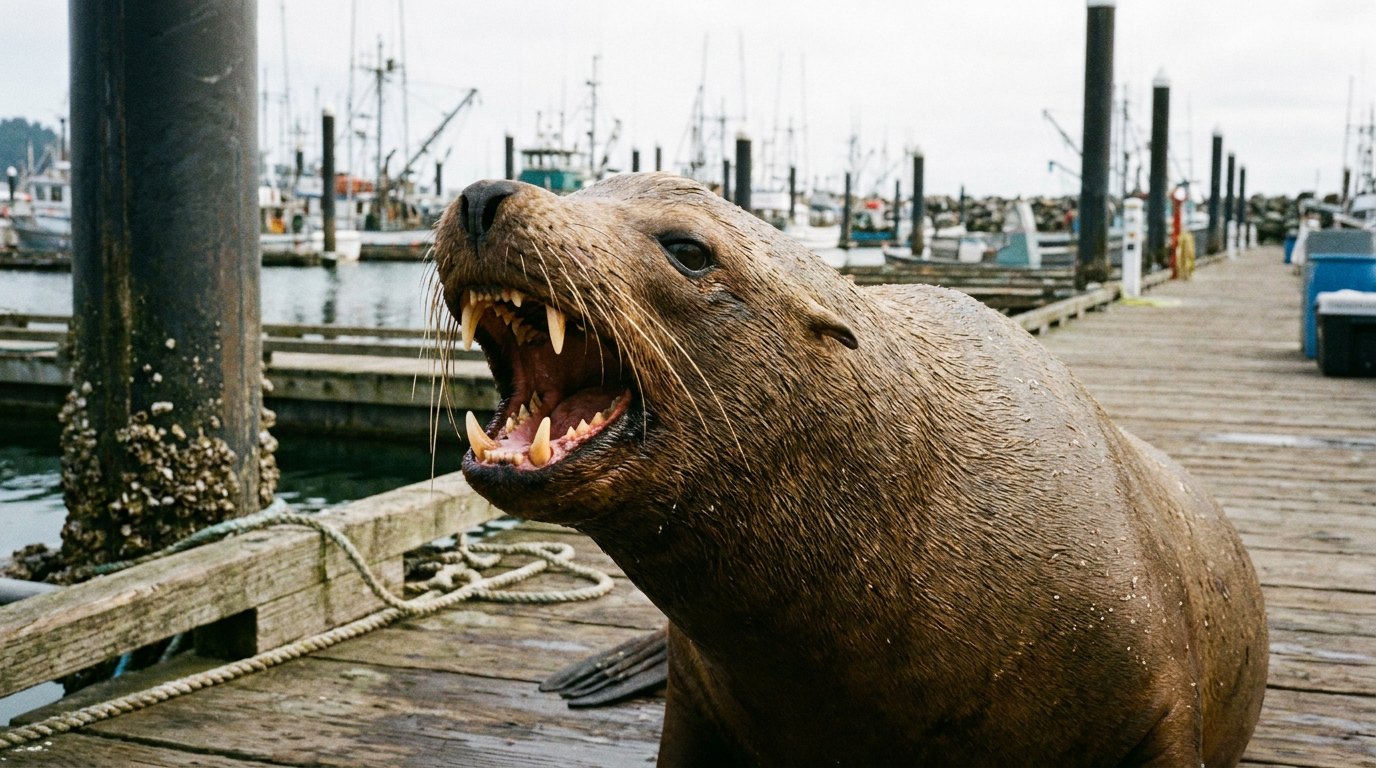
How strong is a sea lion bite?
Strong enough to cause deep punctures, tearing and, from large males, serious injury. A sea lion’s teeth are simple and conical, built to seize and hold slippery fish and squid, which are swallowed whole. They don’t chew, so a bite tends to grip and shake rather than slice. A Steller sea lion bull can weigh up to about 1,120 kg, so even a defensive nip can knock a person over or pull them into the water.
What is seal finger?
An infection caused mainly by Mycoplasma bacteria from seal and sea lion mouths, usually after a bite or handling.
Seal finger (historically ‘spekk-finger’ among Norwegian sealers) causes intense pain, swelling and stiffness in a finger or hand days after contact, and can spread to joints and cause permanent damage. Standard first-line antibiotics for animal bites often don’t work; doctors typically use tetracycline-class drugs. Marine mammal bites can also carry other bacteria, and handling sick sea lions can expose people to leptospirosis.
How do you avoid being bitten?
- Stay at least 50 yards (about 45 m) away from sea lions on land, as NOAA recommends.
- Never feed sea lions or leave fish scraps on docks; it’s illegal and creates bold animals.
- Don’t sit on dock edges with legs dangling where sea lions are begging.
- Swim and kayak away from rookeries and haul-outs, especially in summer.
- Keep dogs leashed and away.
- If you hook a sea lion, cut the line as close as you safely can and report it; never try to grab it.
Do sea lions bite divers?
Rarely. Diving and snorkelling with sea lions at places like Los Islotes in Mexico’s Sea of Cortez, the Galapagos and Hornby Island in British Columbia is popular precisely because young sea lions are playful and curious. Juveniles may mouth fins or hoods. Territorial bulls are another matter: they patrol near rookeries and may bluff-charge. Follow guides’ briefings, don’t touch the animals, and give bulls room.
For overall risk see are sea lions dangerous? and compare leopard seals.
How big are the animals doing the biting?
Size explains why even a defensive sea lion bite is serious. Steller sea lions are the largest of the family: adult males weigh 450 to 1,120 kg, about 544 kg on average, while adult females are 2.3 to 2.9 m long and weigh 240 to 350 kg. California sea lions, the species most people meet on US docks and beaches, are smaller; NOAA gives adult lengths of about 6 feet for females and 7.5 feet for males, with males much heavier and darker than the slender, tan females. Pups are small, about 16 pounds at birth for a California sea lion and around 23 kg for a Steller, but they are rarely alone for long, and their mothers are not.
A sea lion’s teeth are made to catch and hold fish and squid that are swallowed whole, so the bite tends to grip, puncture and tear rather than slice cleanly. Add a strong neck that can twist and shake, and an animal that can weigh several times as much as the person it bites, and it is easy to see how a “nip” from a frightened or frustrated sea lion can leave deep puncture wounds, crush injuries or a person pulled off a dock into the water.
Who actually gets bitten?
The people most often bitten are not tourists but the people who work with marine mammals. In 2008, Hunt and colleagues, including the veterinarian Frances Gulland, published the first attempt to measure the risks of marine mammal work, in Diseases of Aquatic Organisms. Of 483 people who answered their survey, 88% were researchers or rehabilitators. Half of all respondents, 243 people, reported having been injured by a marine mammal, and 23% reported a skin rash or reaction. The illnesses they described included seal finger, conjunctivitis, viral and bacterial skin infections and contact dermatitis, and a few reported serious diseases such as tuberculosis, leptospirosis and brucellosis, although the survey could not confirm the diagnoses. Prolonged and frequent exposure, direct contact with live animals and contact with tissue, blood and excretions all raised the odds of injury and illness.
Rehabilitation centres see other infections too. A survey of 11 North American marine mammal centres between 2007 and 2009 found sealpox, a poxvirus of seals and sea lions, in 23 of 1,423 pinnipeds, mostly animals under a year old, and workers had also caught it at two facilities. The lesson for the public is simple: if trained staff with gloves, boards and nets get bitten and infected, an unprotected person trying to pet or rescue a sea lion is taking a much bigger risk.
Where does seal finger come from?
Seal finger has a long history among people who hunt and handle seals. It was first described scientifically in 1907. Norwegian sealers called it spekkfinger, from their word for blubber, and in the Gulf of Finland it was known as salrota. For centuries the usual treatment once a finger became useless was amputation. Today it is more often an occupational hazard of biologists, veterinarians, aquarium staff and divers, and it can follow a bite, a scratch, or contact with seal bones, blubber or untreated pelts.
For most of that time nobody knew what caused it, because the organism is hard to grow in the laboratory and most patients are treated with antibiotics before samples are taken. The first link to Mycoplasma, a group of tiny bacteria without cell walls, came in 1991, after a trainer at the New England Aquarium was bitten by a seal. In 1998 Baker, Ruoff and Madoff reported in Clinical Infectious Diseases that the organism was most likely Mycoplasma phocacerebrale, a species previously isolated during an epidemic disease among Baltic seals.
The picture has since become more complicated. In 2023, researchers at Statens Serum Institut in Denmark described a new species, Mycoplasma phocimorsus, from six strains isolated between 2000 and 2014 from Scandinavian patients with seal finger or septic arthritis, all of whom had contact with seals. The strains were susceptible to doxycycline and moxifloxacin but resistant to azithromycin and erythromycin, antibiotics sometimes chosen for other infections. Erysipelothrix rhusiopathiae, a bacterium better known from pigs and fish, has also been implicated in some cases.
A 2025 literature review in the International Journal of Circumpolar Health noted that seal finger usually looks like an ordinary infection around the nail or finger, with swelling, redness and pain, so it is easily missed. Left untreated or treated with the wrong antibiotic, it can spread into joints, which a course of tetracycline could usually have prevented. The authors called for more awareness among doctors working in coastal, Arctic and aquarium settings, which is why anyone bitten by a sea lion should tell the clinician exactly what bit them.
What else can people catch from sea lions?
A 2012 review of marine mammal zoonoses in Zoonoses and Public Health found that most infections people pick up from marine mammals are localised skin infections that clear on their own or with treatment, but that some can cause serious systemic illness if they are not recognised. Three are worth knowing about for sea lions.
Leptospirosis is endemic in California sea lions and flares into epidemics every few years. The bacteria are shed in urine, which is one reason rescuers wear gloves and avoid contact with wet sand and fluids around sick animals. Sealpox causes raised nodules on the skin of pinnipeds and occasionally on the hands of the people who handle them.
Tuberculosis is the most unexpected. In 2003 Debra Cousins and colleagues named Mycobacterium pinnipedii, a member of the tuberculosis complex, after comparing isolates from 30 cases in six pinniped species from Australia, Argentina, Uruguay, Great Britain and New Zealand. Seals and sea lions appear to be its natural hosts, but it can also cause disease in humans and other mammals, and it is most likely spread by aerosols. A 2014 genetic study even found a form of tuberculosis most closely related to M. pinnipedii in a Peruvian human skeleton dated to about 1000 CE, suggesting seals once carried the disease across the ocean to people in the Americas.
When is the risk of a bite highest?
For California sea lions, the calendar matters. According to NOAA Fisheries, most pups are born from May through June, and the breeding season runs from late June to early August. Males are polygamous and set up breeding territories that may include up to 14 females, defending them with aggressive displays and loud vocalising. Females are ready to mate again three to four weeks after giving birth. Males reach sexual maturity at four to five years but do not usually hold territories until they are about nine to twelve years old, which means the biggest, most experienced bulls are the ones guarding beaches in summer.
That combination puts the highest bite risk around rookeries and haul-outs in early summer, when territorial bulls are on edge, mothers are nursing small pups, and beaches are busiest with people. A mother may leave her pup on shore for days while she feeds at sea, and a lone pup is not an abandoned one; walking up to it is one of the surest ways to meet an angry female. Outside the breeding season, the main risks shift to habituated animals around docks and fishing piers, and to sick animals stranded on beaches during toxic algae blooms.
What happens after a bite?
Most people bitten by a sea lion recover fully, but the wound needs more care than a cut from a rock or a fishhook. Puncture wounds from conical teeth push bacteria deep into tissue, where they are hard to wash out, and swelling and pain from seal finger can appear only days later, after the original wound seemed to be healing. Because the organisms involved may not respond to some antibiotics commonly used for bites, including azithromycin and erythromycin in the case of Mycoplasma phocimorsus, telling the doctor that the injury came from a sea lion matters as much as the first aid itself.
For workers, the 2008 survey authors added a practical point: diagnosis of marine mammal infections was often helped by veterinarians, so people at risk were encouraged to consult a marine mammal veterinarian as well as a physician when a diagnosis proved difficult. For everyone else, the simplest protection is distance. NOAA advises staying at least 50 yards from seals and sea lions and never feeding them, and keeping dogs on a lead.
What do the rules say about getting close?
In the United States, sea lions are protected under the Marine Mammal Protection Act, which bans harassing them. NOAA Fisheries goes further than a simple distance rule: it says it does not support or approve any activity that involves closely approaching or trying to interact with wild seals and sea lions, including attempts to swim with, pet, touch or provoke a reaction from them. The agency’s rule of thumb is to stay at least 50 yards away, about half a football field, and to take particular care around pups, because a curious pup may come close on its own while its mother is nearby and may treat a person as a threat.
Signs that you are too close include an animal that starts to stare at you, fidget or flee into the water, and NOAA notes that repeated disturbance can even cause mothers to abandon pups. Dogs are a common trigger. NOAA asks owners to keep dogs on a leash around seals and sea lions, both to prevent bites to the dog and to protect the animals. Feeding is treated as harmful and illegal, because it is the quickest way to turn a wary wild animal into one that approaches people expecting food and bites when none appears.
Outside the United States the details differ, but the principle is the same in most places where sea lions haul out near towns: keep back, keep dogs restrained, do not feed, and call the local wildlife or stranding service if an animal looks sick or injured rather than trying to handle it. Trained responders have the equipment, training and permits to do it safely.
Do sea lions bite humans?
Yes, when cornered, handled, fed, defending pups or territory, or when sick.
Is a sea lion bite dangerous?
It can cause deep wounds, and infection, including seal finger, is a serious risk.
What is seal finger?
A Mycoplasma infection from seal or sea lion contact that causes severe hand and joint pain; it needs specific antibiotics.
What should I do if a sea lion bites me?
Wash the wound thoroughly, see a doctor promptly, and mention it was a marine mammal bite.
Are sea lions friendly to divers?
Young sea lions are often playful, but they are wild animals; avoid touching them and keep away from bulls.
Do sea lions have sharp teeth?
Yes: long conical canines and pointed cheek teeth for gripping fish.
- NOAA Fisheries. Marine mammal viewing guidelines and the Marine Mammal Protection Act.
- Pinniped Specialist Group / pinnipeds.org. Species information pages: California and Steller sea lions.
- Hartley, J.W. & Pitcher, D. (2002). Seal finger: tetracycline is first line. Journal of Infection 45: 71–75.
- The Marine Mammal Center, Sausalito. Domoic acid toxicity and sea lion strandings.
- Hunt, T. D. et al. (2008). Health risks for marine mammal workers. Diseases of Aquatic Organisms 81.
- Roess, A. A. et al. (2011). Sealpox virus in marine mammal rehabilitation facilities, North America, 2007–2009. Emerging Infectious Diseases.
- Baker, A. S., Ruoff, K. L. & Madoff, S. (1998). Isolation of Mycoplasma species from a patient with seal finger. Clinical Infectious Diseases.
- Skafte-Holm, A. et al. (2023). Mycoplasma phocimorsus sp. nov., isolated from Scandinavian patients with seal finger or septic arthritis after contact with seals. International Journal of Systematic and Evolutionary Microbiology.
- Reddy, S. G. et al. (2025). Seal finger: a literature review. International Journal of Circumpolar Health.
- Waltzek, T. B. et al. (2012). Marine mammal zoonoses: a review of disease manifestations. Zoonoses and Public Health.
- Cousins, D. V. et al. (2003). Tuberculosis in seals caused by a novel member of the Mycobacterium tuberculosis complex: Mycobacterium pinnipedii sp. nov. International Journal of Systematic and Evolutionary Microbiology 53.
- NOAA Fisheries: California sea lion species page; Marine Life Viewing Guidelines (accessed November 2026).
- Wikipedia: Seal finger; Mycobacterium pinnipedii; Steller sea lion (accessed November 2026).
Blane Perun has been exploring Earth’s oceans and marine life for over 25 years. Founder of TheSea.Org in 1999, underwater photographer, coral aquaculture pioneer, and explorer of 80+ countries.
About Blane Perun →More on Sea Lion →