Dusky Dolphin — The Acrobat of Kaikōura and Patagonia
The dusky dolphin is a medium-sized, highly acrobatic dolphin of cool Southern Hemisphere coasts, around 1.7–2 m long and 70–85 kg, found off New Zealand, Argentina, Chile, Peru and southern Africa. It is famous for leaps, flips and somersaults, and off Kaikōura, New Zealand, it gathers in groups of up to about 1,000. Long known as Lagenorhynchus obscurus, it has recently been moved to its own genus. The IUCN lists it as Least Concern.
If you have ever seen a dolphin throw itself into a full somersault for no obvious reason, there is a good chance it was a dusky. Off Kaikōura on New Zealand’s South Island, hundreds of them leap, spin and belly-flop around the boats, and it is one of the most spectacular marine wildlife sights in the Southern Hemisphere.
How do you recognise a dusky dolphin?
A short beak, a dark back and tail, pale grey flank blazes sweeping toward the tail, a white belly and a fairly tall, two-toned dorsal fin.
New Zealand females measure about 1.67–1.78 m and 69–78 kg; males about 1.65–1.75 m and 70–85 kg. Peruvian animals may be larger, around 2 m. The pale face and throat distinguish it from the dark-faced Peale’s dolphin, which overlaps with it off Argentina.
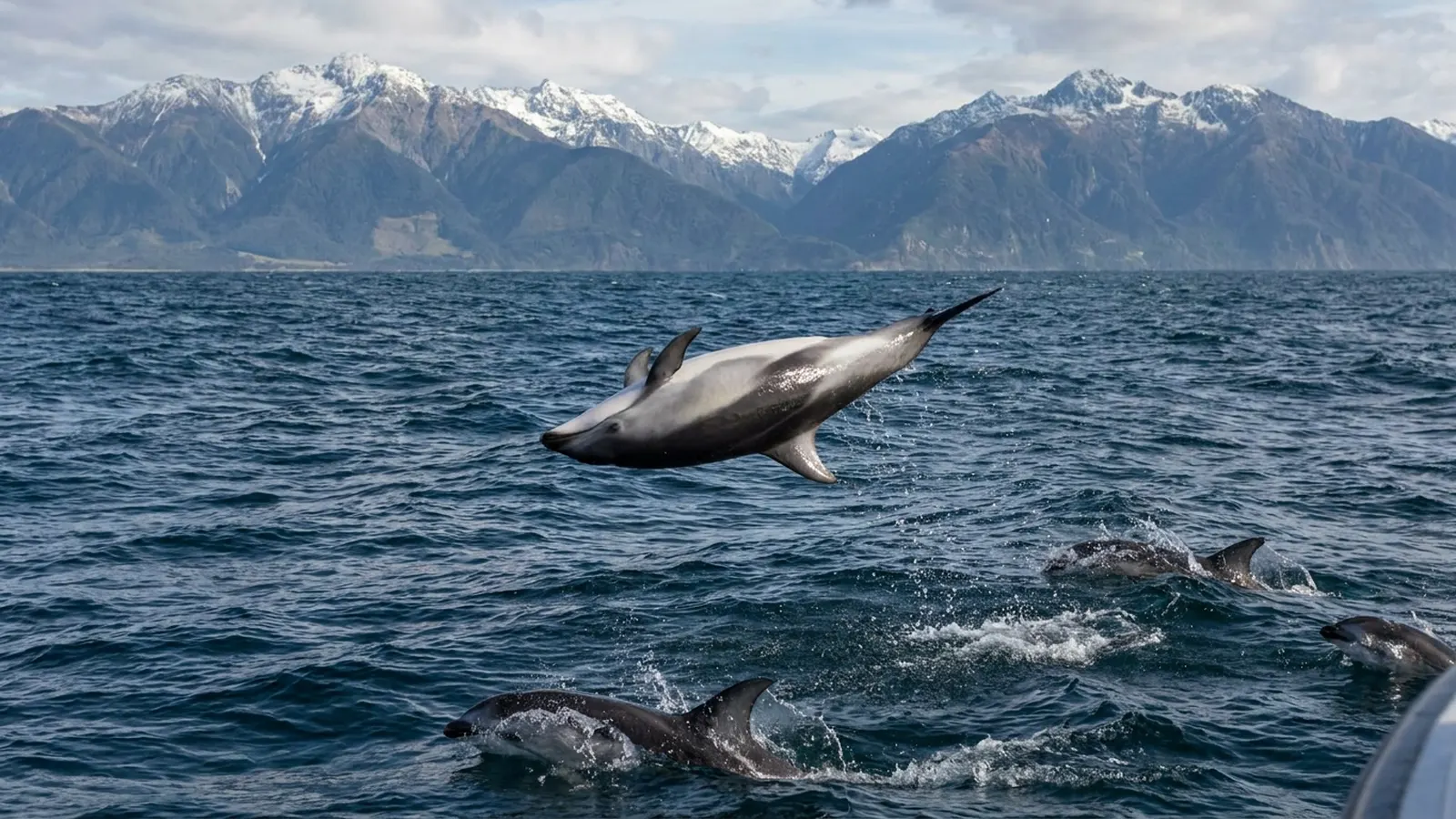
Why do dusky dolphins jump so much?
Leaping seems to serve several purposes: herding fish, signalling to other dolphins, courtship and play.
Researchers classify dusky leaps into four types, and calves learn them in a predictable order.
| Leap type | What it looks like | Likely role |
|---|---|---|
| Noisy | Splashing slaps and belly flops | Signalling, herding fish |
| Clean | Head-first re-entry with little splash | Travel, fast movement |
| Coordinated | Two or more dolphins leaping in sync | Social bonding, courtship |
| Acrobatic | Flips, somersaults and spins | Social display and play |
Calves typically master noisy leaps first, then clean, then coordinated, and acrobatic leaps last. For more on why dolphins leave the water, see why do dolphins jump.
Where do dusky dolphins live?
In cool, coastal waters of the Southern Hemisphere: New Zealand, South America from southern Peru to Argentina, and southwest Africa.
In New Zealand they are most common on the east coast of the South Island, from Kaikōura to Timaru, and in the Marlborough Sounds. In South America they range from southern Peru around Cape Horn and north to about 36°S off Argentina, where over 6,500 have been counted between Península Valdés and Puerto Deseado. In Africa they occur from Lobito Bay, Angola, to False Bay, South Africa.
How did the dusky dolphin get its names?
The species was first described by John Edward Gray at the British Museum in 1828, from a stuffed skin and a single skull sent from the Cape of Good Hope. Gray called it Delphinus obscurus; the specimen had reportedly been obtained by a Captain Haviside and reached the museum through the Royal College of Surgeons in 1827. The Latin obscurus means dark or dim, a reference to the sooty grey back.
For most of the twentieth century the dusky dolphin sat in Lagenorhynchus, a catch-all genus for short-beaked dolphins in both hemispheres. Genetic studies repeatedly showed that grouping was artificial. In 2025 Anders Galatius and colleagues added phylogenomic data from more than 3,000 nuclear genes and found that the dusky dolphin and the Pacific white-sided dolphin of the North Pacific form their own branch, separate from Peale’s and hourglass dolphins, which group with Hector’s and Commerson’s dolphins. They proposed a new genus for the dusky and Pacific white-sided pair, Aethalodelphis, meaning “sooty dolphin” or “dusky dolphin”.
Within the species, three subspecies are generally recognised: the African dusky dolphin (obscurus), Fitzroy’s dolphin off Argentina (fitzroyi) and the Peruvian or Chilean dusky dolphin (posidonia). A New Zealand subspecies has been proposed but is not widely accepted. Genetic work suggests the Argentine and southern African populations split from a shared Atlantic ancestor around 2,000 generations ago and have exchanged few genes since. Most populations have low genetic diversity, the Peruvian population being the exception, and possible hybrids with long-beaked common dolphins and with southern right whale dolphins have been described.
What sounds do dusky dolphins make?
Surprisingly few whistles. When Rachel Vaughn-Hirshorn, Bernd Würsig and colleagues analysed recordings from Argentina and New Zealand, published in 2012, they documented no whistles at either site. The dolphins communicated mainly with clicks and burst pulses, rapid trains of clicks that sound like buzzes to human ears. Some burst-pulse sounds occurred in structured sequences of between two and fourteen closely matched pulses, suggesting they carry meaning.
Whistles have been recorded in other studies, particularly when dusky dolphins mix with common dolphins, which whistle freely. Dusky echolocation clicks are short and broadband, with energy peaking at around 40–50 kHz and again at 80–110 kHz, and they are about 9–12 dB quieter than those of the larger white-beaked dolphin. The relative silence of dusky dolphins compared with whistling species may also be a defence: killer whales hunt them, and a quiet group is harder to find.
How do dusky dolphins court and mate?
Dusky dolphins live in a fission-fusion society. Off Kaikōura, large groups split into smaller subgroups made up of mating adults, nursery groups of mothers and calves, and non-breeding adults, and the pattern changes through the day. In Argentina’s Golfo San José, dolphins switch between small travelling groups and large social and sexual gatherings.
Mating groups usually consist of a single female pursued by around ten males in high-speed chases. Observations from New Zealand suggest females prefer males that are fast and agile rather than large or aggressive, and females may prolong a chase until only the most persistent males remain. Unlike male bottlenose dolphins, male duskies cannot monopolise a female. Both sexes mate with several partners, males have large testes for sperm competition, and much sexual behaviour appears to be social rather than reproductive (see how dolphins mate).
Reproduction is slow. New Zealand females first give birth at around seven years of age, perhaps slightly earlier in Argentina. A study of dusky dolphins off Peru found a reproductive cycle lasting about 28.6 months: roughly 12.9 months of pregnancy, 12 months of lactation and 3.7 months of rest before the next conception.
Why do mothers and calves stay in shallow water?
Females with calves gather in nursery groups in shallow, sheltered water, where they spend most of their time resting. Shallow water seems to offer two kinds of protection. Killer whales are major predators of dusky dolphins (a reminder of the dolphins’ place in the ocean food web), and the dolphins respond to them by moving into shallow water close to shore; a 1998 paper by Rochelle Constantine and colleagues documented killer whale predation on dusky dolphins at Kaikōura. Night-time feeding in the deep scattering layer over the canyon is probably too dangerous and too demanding for young calves.
The second threat comes from their own species. Nursery groups tend to avoid mating groups, because adult males chasing females can separate calves from their mothers. A calf exhausted and disoriented after being separated is more exposed to predators. Mothers have been seen looking after calves that are not their own, and both adults and calves in nursery groups chase small fish, which may give calves their first hunting practice.
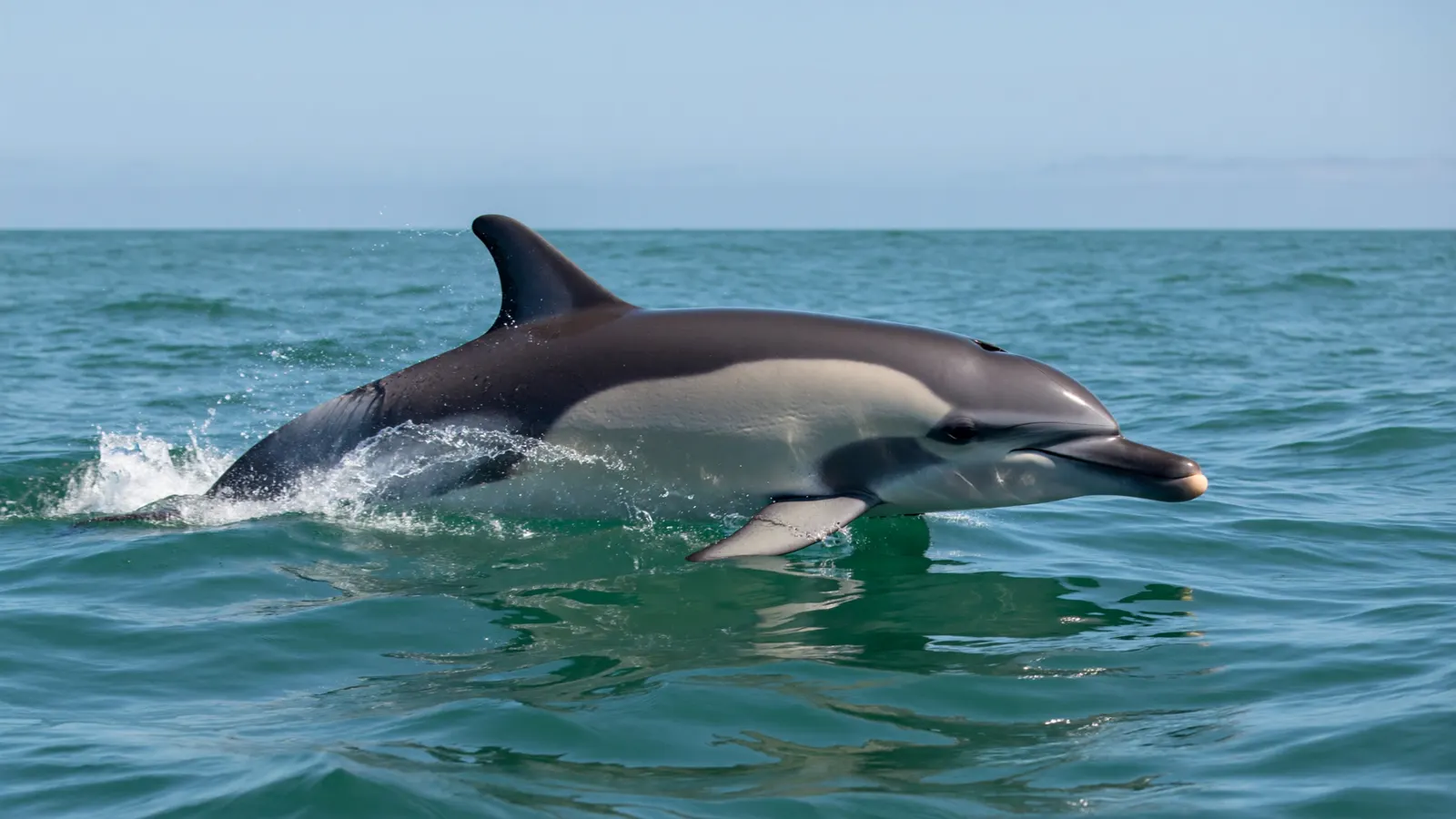
How do dusky dolphins swim so fast?
In 1936 the zoologist James Gray calculated that a dolphin could not possibly have enough muscle power to swim as fast as dolphins were reported to swim, a puzzle known as Gray’s paradox (more in how dolphins swim). In 2024 Randall Davis, Lorenzo Fiori, Bernd Würsig and Dara Orbach used a drone to film free-ranging dusky dolphins off Kaikōura at speeds from 0.9 to 6.9 m per second and calculated the drag on their bodies. Drag fell sharply with speed, by up to 89% above 2 m per second, with a further 17% saving when the dolphins porpoised above 4 m per second. At 6.9 m per second the power required was about 15.8 W per kg, close to the maximum aerobic capacity of other mammals of their size, so the paradox disappears once real drag is measured.
The same team tested why dolphins ride bow waves. Using respiration rate as a measure of effort, they found that dusky dolphins riding the bow of a research vessel breathed about 45% less often than free-swimming dolphins at speeds above 4 m per second, while free-swimming dolphins’ breathing rose steeply with speed. Bow-riding may well be fun, but it also saves a great deal of energy.
How do dusky dolphins hunt?
By day they herd schooling fish into tight bait balls; at night off Kaikōura they feed on the deep scattering layer that rises from the Kaikōura Canyon.
In Argentina and the Marlborough Sounds, small groups cooperate to herd anchovies or pilchards against the surface, attracting seabirds and sometimes sea lions. Off Kaikōura, where the deep canyon comes close to shore, dusky dolphins rest during the day in big groups and hunt lanternfish and squid at night as the scattering layer rises. Prey includes anchovies, pilchards, hake, hoki and squid of several genera.
Do dusky dolphins migrate?
Not in the regular way that many whales do. Individual dusky dolphins can travel long distances, with movements of around 780 km recorded, but there are no well-defined seasonal migrations. Instead, populations off Argentina and New Zealand shift inshore and offshore with the seasons and with the time of day, following prey. Off Argentina they keep close company with southern right whales, South American sea lions and flocks of gulls, cormorants, terns, shearwaters and albatrosses. When they herd anchovies into a tight ball against the surface, the shore or even the hull of a boat, they may use flashes of their white bellies to keep the school together, and the feast they create draws in sea lions, sharks and seabirds that profit from the dolphins’ work.
How does tourism affect dusky dolphins?
Dolphin watching off Kaikōura began in the late 1980s as a side attraction to sperm whale watching, and New Zealand now has around 75 permitted dolphin tour operators. Tours operate under permits with limits on numbers and rules for approach and swimming. A 2012 study by Dave Lundquist, Neil Gemmell and Bernd Würsig modelled how dusky dolphin groups switched between behaviours. When tour vessels were within 300 m, dolphins spent less time resting in spring and summer and more time milling in most seasons. Spring and summer, when conception and births happen, are exactly when lost rest is likely to cost the most.
Argentina’s dusky dolphin tourism grew from a base of southern right whale watching off Península Valdés. The number of tourists going to see dusky dolphins rose from 1,393 in 1997 to 1,840 in 2000, and the share of trips that encountered dolphins climbed from 25% in 1999 to 90% in 2001. Without the permit system used in New Zealand, dolphin activities there are more often disrupted by tour boats. Golfo Nuevo off Península Valdés also produced a curiosity: an almost all-white, probably leucistic, adult dusky dolphin photographed three times between 2016 and 2018.
Aquaculture is a local issue in New Zealand. In Admiralty Bay in the Marlborough Sounds, an important winter area for dusky dolphins and the site of proposed mussel-farm expansion, observers found that dolphins rarely entered existing farms and, when they did, swam quickly along the lanes between rows of lines and floats, suggesting the farms remove usable habitat rather than attract the animals.
Are dusky dolphins still killed off Peru?
Peru banned the capture of small cetaceans and the trade in their meat in the mid-1990s, but monitoring shows the killing has not stopped. Observers working with Jeffrey Mangel and colleagues accompanied 66 fishing trips from the northern port of Salaverry between March 2005 and July 2007. They recorded 253 small cetaceans caught, of which dusky dolphins made up 29%, second only to common dolphins. Gillnet vessels from that single port were estimated to take about 2,412 small cetaceans a year between 2002 and 2007, and some animals were harpooned rather than netted. Meat and blubber are used as shark bait and, illegally, for human consumption.
There is a practical way to reduce the toll. In a follow-up experiment from Salaverry between 2009 and 2011, the same research group fitted acoustic pingers to driftnets on 156 sets and compared them with 195 sets without pingers. Bycatch of small cetaceans fell by 37%, and catches of the target sharks and rays were unchanged, which matters greatly for fishers’ willingness to use the devices.
Is the dusky dolphin endangered?
Not overall, but the Peruvian population was heavily hunted and is listed as Vulnerable.
After the Peruvian anchoveta fishery collapsed in 1972, small cetaceans became targets for food and shark bait off Peru and Chile. Thousands of dusky dolphins were killed each year at the peak; estimates have run as high as 10,000–15,000 annually, despite Peru banning the hunt in 1996. Elsewhere, bycatch in trawls and gillnets, mussel farming in New Zealand bays and tourism pressure are monitored. New Zealand regulates swim-with-dolphin operations to limit disturbance.
More: which dolphins are endangered.

Where can you see dusky dolphins?
Kaikōura in New Zealand is the best-known place; they are also seen off Península Valdés in Argentina and in the Marlborough Sounds.
Why do dusky dolphins jump?
To herd fish, signal to other dolphins, court and play. Researchers recognise noisy, clean, coordinated and acrobatic leaps.
How big is a dusky dolphin?
About 1.65–1.8 m and 70–85 kg in New Zealand; Peruvian animals may reach about 2 m.
Is the dusky dolphin endangered?
No, it is Least Concern overall, but the Peruvian subspecies is Vulnerable because of past and illegal hunting.
What do dusky dolphins eat?
Anchovies, pilchards, hake, hoki and squid; off Kaikōura they also feed on the deep scattering layer at night.
How long do dusky dolphins live?
About 26–30 years.
What genus is the dusky dolphin?
It was long Lagenorhynchus; revisions in 2019 and 2025 moved it first to Sagmatias and then to Aethalodelphis.
- Würsig, B. & Würsig, M. (eds) (2010). The Dusky Dolphin: Master Acrobat Off Different Shores. Academic Press.
- IUCN Red List: Lagenorhynchus obscurus.
- Vollmer, N. L. et al. (2019). Taxonomic revision of the dolphin genus Lagenorhynchus. Marine Mammal Science.
- Galatius, A. et al. (2025). Phylogenomic, morphological and acoustic data support a revised taxonomy of the lissodelphinine dolphin subfamily. Molecular Phylogenetics and Evolution 108299.
- Vaughn-Hirshorn, R. L. et al. (2012). Characterizing dusky dolphin sounds from Argentina and New Zealand. Journal of the Acoustical Society of America 132: 498–506.
- Constantine, R., Visser, I. & Buurman, D. (1998). Killer whale predation on dusky dolphins in Kaikoura, New Zealand. Marine Mammal Science 14(2).
- Davis, R. W., Fiori, L., Würsig, B. & Orbach, D. N. (2024). Drag reduction and locomotory power in dolphins: Gray’s paradox revealed. Journal of the Royal Society Interface 21: 20240227.
- Fiori, L., Davis, R. W., Würsig, B. & Orbach, D. N. (2024). Energetic savings of bow-riding dolphins. Scientific Reports 14.
- Lundquist, D., Gemmell, N. J. & Würsig, B. (2012). Behavioural responses of dusky dolphin groups to tour vessels off Kaikoura, New Zealand. PLoS ONE 7(7): e41969.
- Mangel, J. C. et al. (2010). Small cetacean captures in Peruvian artisanal fisheries: high despite protective legislation. Biological Conservation 143: 136–143.
- Mangel, J. C. et al. (2013). Using pingers to reduce bycatch of small cetaceans in Peru’s small-scale driftnet fishery. Oryx 47(4).
Blane Perun has been exploring Earth’s oceans and marine life for over 25 years. Founder of TheSea.Org in 1999, underwater photographer, coral aquaculture pioneer, and explorer of 80+ countries.
