Bubble Tip Anemone Placement — Give It Choices, Then Let It Pick
The best bubble tip anemone placement is the one it chooses, so your job is to offer good options. Provide holes and crevices in stable rock in the middle to upper part of the tank, under moderate-to-strong light with gentle, random flow, and well away from pump intakes and prized corals. Set the anemone near those crevices and let it walk. Most bubble tips anchor their foot deep in a hole with the disc in the light within a few days to a couple of weeks; if it keeps moving, the light, flow or footing is wrong.
Good bubble tip placement starts before the anemone arrives: a few solid crevices in the right part of the tank, gentle and varied flow, every intake covered, and a buffer of space between the anemone and the corals you care about most. Then you let the anemone choose.
Unlike corals, anemones are not glued where you put them. A bubble tip anemone, Entacmaea quadricolor, can release its foot (the pedal disc) and glide slowly across rock, glass and sand until it finds a spot it likes, and it will keep moving if it never does. Most placement problems in home aquariums come from fighting that behaviour, by repeatedly moving the anemone, instead of setting up the tank so that the anemone’s preferred spot is also a safe one. This page explains how. For feeding, water quality and general husbandry, see bubble tip anemone care.
Where do bubble tip anemones live in the wild?
Wild behaviour is the best guide to placement. The bubble tip anemone is widespread across the tropical Indo-Pacific, including the Red Sea, and is the most common clownfish host anemone in the region. It grows up to about 30 cm across and gets most of its energy from photosynthetic zooxanthellae living in its tissues, so light is essential. It also catches food with its tentacles and takes in waste and scraps cleaned from the clownfish that live in it.
In the wild it grows in two distinct ways, and both have placement lessons. Large adults with long, stringy tentacles are often found alone in deeper, more dimly lit water. Smaller, younger individuals often live in groups or colonies near the surface in bright sunlight, and these are the ones that most often show the bulbous tentacle tips that give the species its common name. Whether the tips swell into bubbles depends on several factors, including flow, light, colour form, whether the anemone is hosting a fish, and possibly its bacterial community. In aquariums, a bubble tip that loses its bubbles is not necessarily unhealthy; it may simply be responding to conditions.
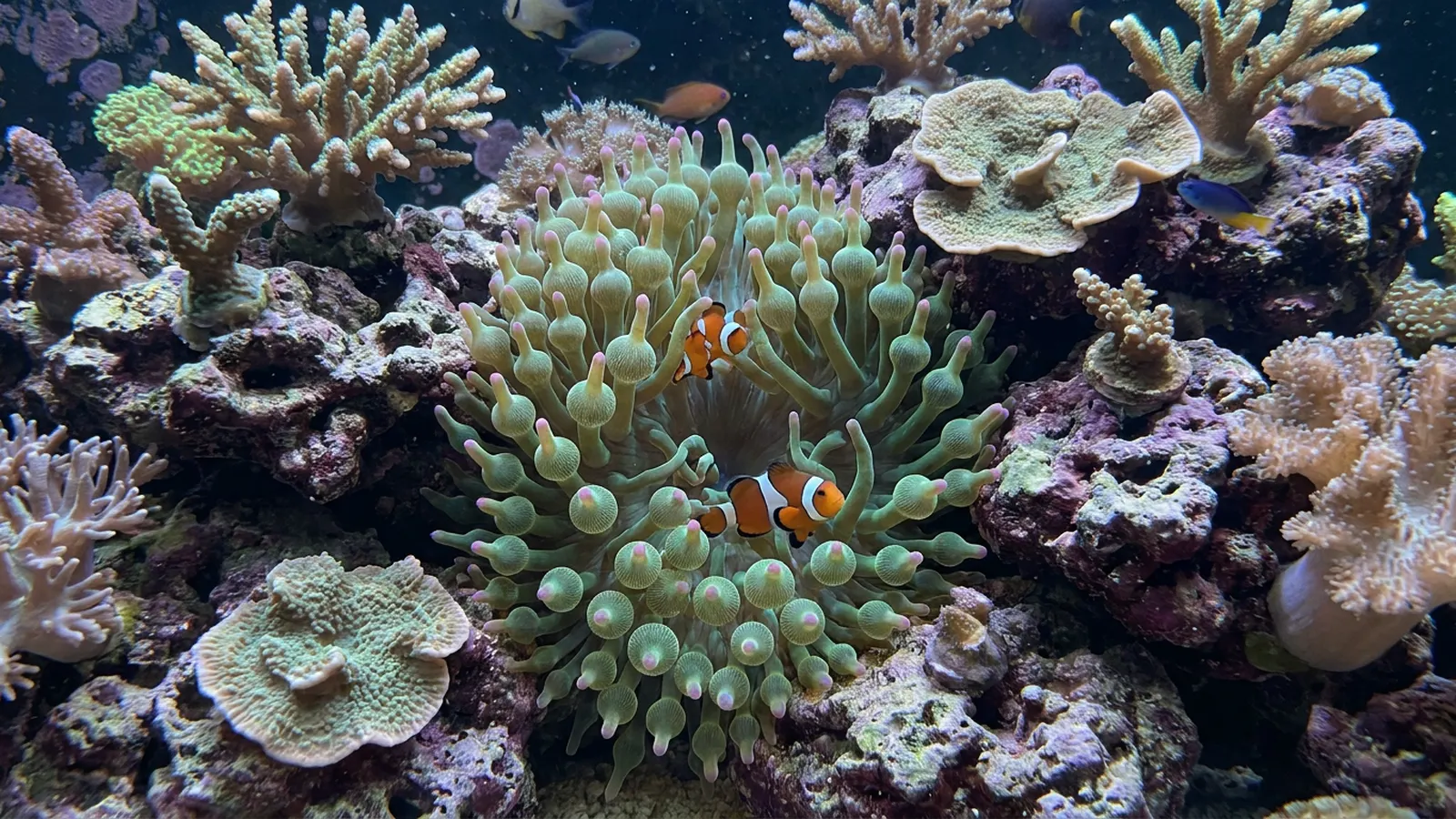
In both forms, the anemone typically wedges its foot deep into a hole or crevice in the reef and spreads its oral disc and tentacles out into the light. When threatened, it can withdraw into that crevice. That is the arrangement to recreate: a secure, sheltered foot and an exposed, well-lit disc.
Where should I place a bubble tip anemone?
In a tank, mimic the wild arrangement: deep holes in stable rock where the foot can grip, in the middle to upper part of the aquascape, with a disc position that catches good light without being blasted by flow. Offer two or three such sites so the anemone has a choice. If none of them suits it, you want it to settle on another rock, not wander into a pump.
The crevices matter more than their exact position. A good hole is deep enough for the anemone to tuck its whole foot and lower column inside, about as wide as the foot, and in rock that is glued, pinned or otherwise stable. An anemone that settles in a loose rock can topple the stack as it expands and contracts. Smooth, shallow depressions are poor sites, because the anemone cannot anchor securely and will keep looking for something better.
When you introduce the anemone, set it on the rock beside one of the prepared holes, with its foot against the rock, and turn the pumps down for an hour or so while it attaches. Some keepers place it inside an upturned cup or a ring of rock for a few hours so it cannot be blown away before it grips. Then leave it alone. It is normal for a new bubble tip to move several times over the first few days and to take up to about two weeks to settle. Each time it is pulled off the rock or moved by hand, the process starts again.
How much light does a bubble tip anemone need?
Moderate to strong reef lighting, introduced gradually. Because the anemone depends on its zooxanthellae, light is the single most important placement factor. Too little light and it will slowly starve, stretch its column and disc toward the surface, and keep wandering upward. Without adequate lighting it can expel its zooxanthellae, a process called bleaching, which leaves it white or translucent and, if not corrected, eventually kills it. White or very translucent anemones in shops are likely to be bleaching and should not be bought.
Too much light too suddenly causes a different reaction: the anemone shrinks, hides under ledges or turns its disc away from the light. This is common after a lighting upgrade or when an anemone moves from a dim shop tank into a strongly lit display. The answer is to start with reduced intensity and raise it over several weeks, rather than to move the anemone into shade permanently. The two wild growth forms suggest that the species tolerates a wide light range, from bright shallows to dimmer deeper water, so most reef lighting setups can work if changes are gradual.
| What you see | What it means | Change |
|---|---|---|
| Disc stretched up toward lights | Too little light | Raise intensity slowly |
| Hidden under ledge, small | Too much light or stress | Lower briefly, then reacclimate |
| Tentacles whipping, foot moving | Flow too strong | Redirect pumps |
| Limp, not expanding | Flow too weak or water issue | Add random flow, test water |
| Pale, white or see-through | Bleaching | Check light and temperature, feed lightly |
| Settled, full, sticky | Spot is right | Leave it alone |
How much flow does a bubble tip anemone need?
Moderate, varied flow is ideal: enough to make the tentacles sway gently and carry away waste, not so much that they whip, fold over or expose the column. An anemone in water that is too still tends to look limp, collects detritus and may move in search of better flow. One in a strong, steady jet will keep its tentacles pulled in or will move away. Random or alternating flow from more than one pump is better than a single laminar stream.
Flow also determines where an anemone goes when it does move. Anemones often travel with or across the current and end up in corners, behind rocks or against the glass where flow is weakest. That is why intakes matter so much. Pump intakes, overflow teeth and return nozzles should be covered with foam, mesh or guards before the anemone goes in. An anemone pulled into a powerhead is usually shredded and can release enough toxins and decaying tissue to harm the rest of the tank. Treat covered intakes as a requirement, not an option.
Should a bubble tip anemone be on the rock or the sand?
Rock. Bubble tips are crevice dwellers and prefer hard footing. They may sit at the base of rock where it meets sand, with the foot tucked under a ledge, but a foot on open sand is usually a sign it has not yet found a home. This is one of the main differences from sand-dwelling anemones such as carpet anemones and rock flower anemones, which bury their foot in sediment or attach to buried rubble and need a deep, stable sand bed instead of rockwork.

How do I keep a bubble tip away from my corals?
Use separation and planning. Bubble tips sting, and corals that end up under or beside their tentacles can be damaged. Many reefers give the anemone its own island of rock, separated from the main coral rockwork by a strip of sand, so that the easiest places to settle are on the anemone’s island. Anemones can and do cross sand, so the strip reduces wandering rather than preventing it. Keep corals that are sensitive to stings, such as small-polyp stony corals, out of tentacle reach and preferably not directly downstream, where the tentacles will drift in the current. Remember that the anemone can grow to about 30 cm across and may divide, so leave room for it to expand.
The sting itself is a cocktail of toxins delivered by the anemone’s stinging cells. A 2024 study in Toxins by Hoepner and colleagues, which described the bubble tip as the most popular host sea anemone, compared the genes expressed in its tentacles with the proteins actually present in its venom and found that not all of the toxin genes switched on in the tentacles end up in the venom. For the aquarist the practical point is simpler: the tentacles that clownfish shelter in are armed, the reach of those tentacles grows as the anemone grows, and the safest coral is one placed beyond the anemone’s fully expanded spread, with a margin for the current to push the tentacles further.
Splitting deserves planning too. Wild bubble tips reproduce mainly by broadcast spawning, releasing gametes into the water. In eastern Australian waters this happens between January and April, and the resulting larvae can survive up to 59 days in the plankton, with settlement peaking at about 10 days. Wild anemones only occasionally split by longitudinal fission, but in aquariums splitting is the usual way they multiply, and a well-placed anemone can become two or more over time. Each clone will look for its own crevice. See bubble tip anemone splitting.
How does clownfish hosting affect placement?
Bubble tips are hosts for clownfish, and that changes how they behave in a tank. The species is a generalist host, recorded with 14 species of anemonefish, around half of all species, including the tomato, Clark’s, maroon and cinnamon (red and black) clownfishes. In the wild the maroon clownfish has been recorded only in the large solitary form, while the cinnamon clownfish lives mainly in the clustered form. The ocellaris clownfish, the most popular aquarium species, is not among the species recorded with bubble tips in the wild, so in aquariums that pairing is less predictable.
A hosted anemone gets food scraps and cleaning from its fish and may expand more fully, but a large or vigorous clownfish can also push and pull the anemone, sometimes driving it to move. Place the anemone where the clownfish can reach it without being forced through strong flow, and do not expect the fish to settle the anemone in place. Recent genetic work suggests that what aquarists call a single species may be several. A 2026 study in Systematic Biology by Chiodo and colleagues identified six cryptic species within E. quadricolor, some of which host the generalist Clark’s clownfish and others the more specialist tomato clownfish. That may help explain why some pairings of anemone and fish work better than others.
When is a tank ready for a bubble tip anemone?
Placement is not just about where in the tank; it is also about which tank. Wikipedia’s summary of keeping this species advises that the aquarium should be at least six months old and stable before an anemone is added, and that larger tanks make it easier to keep one healthy. A mature system has more stable water chemistry, a well-established biological filter and fewer swings in temperature and salinity, all of which reduce the stress that sends anemones wandering. Larger tanks also provide more rockwork, more choice of sites and more distance between the anemone and the corals.
Aquacultured anemones are a good choice where they are available. A 2022 study in Aquaculture Research by Watson and Younger examined bubble tips grown from whole and cut halves under different feeding regimes. Cutting did not affect the anemones’ zooxanthellae, and direct feeding reduced weight loss more than dissolved nutrients alone. They also observed that all the anemones were highly mobile, a reminder that moving around is normal behaviour for this species and not, on its own, a sign of illness.
What if my bubble tip anemone won’t stay put?
Read do anemones move? for a checklist. Most persistent wandering comes from unsuitable light, flow, footing or unstable water, and fixing the cause works better than repositioning the anemone. Check, in order: whether any parameter has changed recently, especially temperature or salinity; whether the light is too strong or too weak at the spots it rejects; whether the flow at the crevices is too strong or too still; whether the rockwork offers holes it can actually use; and whether a fish, crab or other animal is bothering it. Climate research adds one more reason to watch temperature closely: studies have found that higher water temperatures cause bleaching in this species, whereas raised carbon dioxide alone had no significant effect. If the anemone is pale and roaming, temperature and light are the first things to rule out.
Where is the best place for a bubble tip anemone?
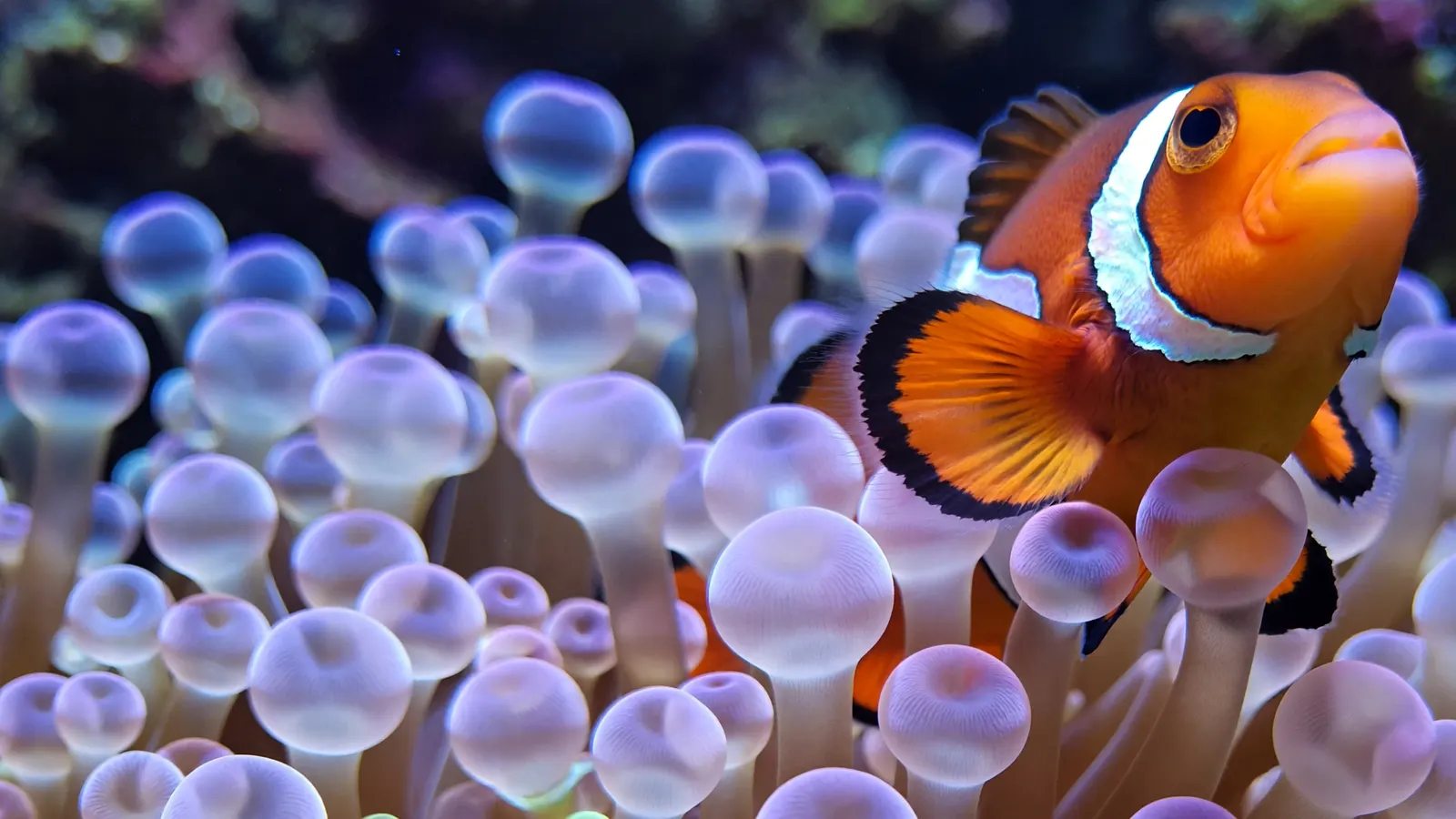
In a deep, stable rock crevice in the middle to upper part of the tank, under moderate to strong light with gentle, varied flow, away from intakes and sensitive corals.
Should I glue a bubble tip anemone in place?
No. Anemones are not corals. Offer good crevices and let it attach and choose its own spot.
How long does it take a bubble tip to settle?
Usually a few days; up to about two weeks is normal. Repeated moving resets the process.
Can a bubble tip anemone live in the sand?
It prefers rock. A foot on open sand usually means it has not found a home yet.
Why does my bubble tip keep moving?
Usually the light, flow or footing is wrong, or the water is unstable. Fix the cause rather than moving it.
Will a bubble tip anemone sting my corals?
Yes, corals within reach of its tentacles can be stung. Give it its own rock with space around it.
How do I stop it going into a pump?
Cover every pump intake, overflow and return with foam, mesh or guards before adding the anemone.
How old should my tank be for a bubble tip?
Commonly at least six months old and stable, with mature filtration.
- Wikipedia. Bubble-tip anemone, Entacmaea quadricolor: size, growth forms, hosted anemonefish, reproduction, aquarium notes and climate effects.
- Chiodo T. et al. (2026). Clownfishes differentiate cryptic host species and reveal a diverse species complex in the clownfish-hosting sea anemones. Systematic Biology. doi:10.1093/sysbio/syag033
- Watson G.J., Younger J. (2022). Developing anemone aquaculture for the marine aquarium trade: a case study using the bubble-tip anemone Entacmaea quadricolor. Aquaculture Research.
- Hoepner C.M. et al. (2024). Proteotranscriptomics of the host sea anemone Entacmaea quadricolor. Toxins 16: 85. doi:10.3390/toxins16020085
Blane Perun has been exploring Earth’s oceans and marine life for over 25 years. Founder of TheSea.Org in 1999, underwater photographer, coral aquaculture pioneer, and explorer of 80+ countries.
About Blane Perun →