Bubble Tip Anemone Care — The Easiest Host Anemone, Done Right
The bubble tip anemone (Entacmaea quadricolor) is the easiest host anemone for a reef tank, but it still needs a mature, stable system. Add it only to a tank that has been running for several months, give it moderate-to-strong reef lighting, gentle random flow and a rock crevice to anchor its foot, and cover every pump intake. Keep water at standard reef values (about 24–27 °C, salinity 1.025–1.026, alkalinity 8–11 dKH) and feed a small piece of shrimp or mysis about once or twice a week. Healthy bubble tips grow to about 30 cm and host 14 clownfish species.
Most bubble tip losses trace back to one cause: the anemone went into a tank that was not ready. Stability beats everything else on this list.
The bubble tip anemone, Entacmaea quadricolor, is the most widely kept host anemone in the reef hobby, and for good reason. It tolerates a wider range of conditions than the carpet and magnificent anemones, it is now propagated in large numbers in home aquariums, and it hosts more clownfish species than almost any other anemone. None of that makes it a beginner animal in a brand-new tank. This guide covers what the species needs in the wild, how to translate that into an aquarium, and how to read the signs that something is going wrong.
What do bubble tip anemones need?
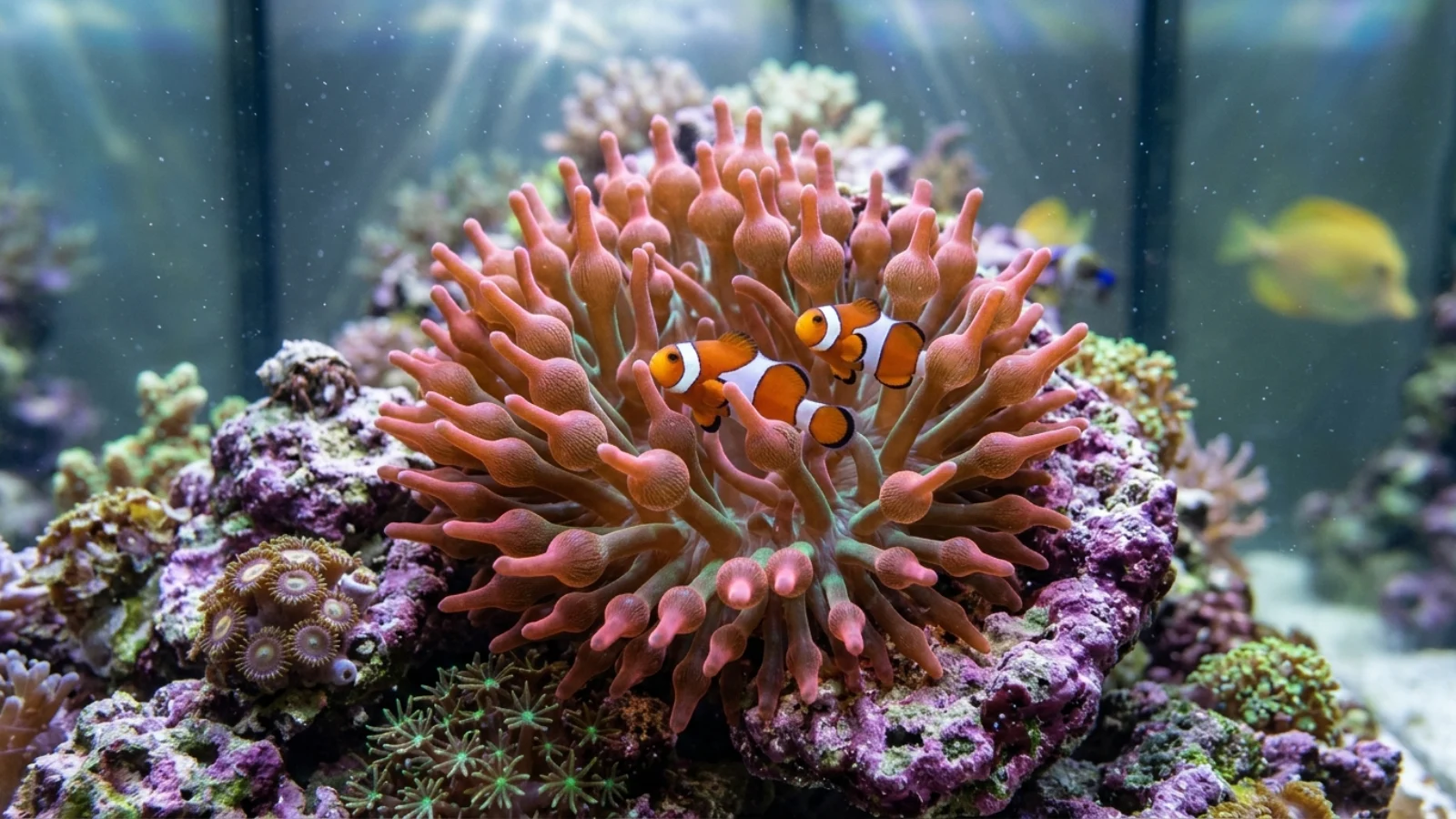
In the wild, bubble tips live on Indo-Pacific reefs including the Red Sea, with their foot wedged in a crevice and the disc exposed to light. Their zooxanthellae algae supply most of their energy, so light is food. The swollen “bubble” tips that give them their name are not always present and can come and go with conditions; they are not, on their own, a health indicator.
The species ranges across the tropical Indo-Pacific, from the Red Sea east through the western Pacific, and it comes in several colour morphs, most familiarly green and rose, with orange and red forms also common in the trade. Wild populations show two growth forms. Large, solitary adults with long, stringy tentacles tend to live in deeper, dimmer water, while smaller anemones cluster in groups nearer the surface in bright sun, and those shallow clusters are the ones most likely to show swollen tentacle tips. Young anemones start with about 20 tentacles and add more as they grow. The tips can change with flow, light, colour form and whether a clownfish is present, which is why captive specimens often show few or no bubbles even when perfectly healthy.
Like reef-building corals, the bubble tip carries zooxanthellae, single-celled algae living inside its tissues. These photosynthesise and pass most of the anemone’s energy to it as sugars. The anemone tops up that income by catching food with its stinging tentacles and by taking scraps and waste from its resident clownfish. In practical terms, this means lighting is not decoration in a bubble tip tank. An anemone kept under weak light gradually expels its algae, turns white and starves, no matter how often it is fed.
| Parameter | Target | Notes |
|---|---|---|
| Temperature | 24–27 °C (75–80 °F) | Avoid swings |
| Salinity | 1.025–1.026 SG | Stable |
| pH | 8.0–8.4 | Normal reef range |
| Alkalinity | 8–11 dKH | Stable more than exact |
| Nitrate | Low but detectable | Ultra-low nutrients can starve algae |
| Phosphate | Low | Avoid spikes |
| Tank maturity | Several months+ | Not for new tanks |
The table gives standard reef values rather than special anemone numbers. Several experienced keepers simply aim to match natural seawater for temperature, salinity, alkalinity, calcium and magnesium, and note that captive bubble tips seem less sensitive to nitrate than many corals. What hurts anemones most is change: a heater sticking on, a salinity drift during evaporation, or a big swing in alkalinity after a missed dose. Consistency within a reasonable range matters more than chasing an exact figure.
Tank age is the other half of stability. The usual advice is that the system should be at least six months old and stable before an anemone goes in, and that larger tanks are easier, because a bigger water volume buffers mistakes. A mature tank has settled bacterial populations, stable nutrient levels and established rockwork that will not shift and crush an anemone wedged into it.
How do you set up a tank for a bubble tip anemone?
Lighting needs are usually described as moderate to high. Reef Builders writer Jeremy Gay suggests that any reef-grade LED fixture of more than about 40 watts is adequate for a bubble tip and gives a target of roughly 150–200 PAR where the anemone sits, with flow of about 20 times the tank volume per hour. Royal blue LEDs bring out the fluorescent colours of red and rainbow morphs. If a new anemone comes from a dimmer shop tank, raise the light over a couple of weeks rather than all at once, or it may bleach.
Placement decides whether the anemone stays put. Bubble tips anchor their foot deep in a crevice or hole and extend the disc toward the light, and most settle in the middle of the rockwork rather than at the very top or on the sand. One practical approach is to place the anemone before most corals go in, hold it gently over the chosen hole for about ten minutes so the foot can grip, and keep corals at least a few centimetres beyond the reach of the fully extended tentacles. An anemone with a secure spot for its foot rarely wanders; one that keeps moving is usually unhappy with light, flow or the rock itself.
How do you feed a bubble tip anemone?
Feed a piece of mysis, chopped shrimp, clam or silverside smaller than the mouth about once or twice a week, by placing it on the tentacles with tongs. Healthy anemones grab food and close around it within minutes. Spitting out food hours later as a slimy ball is normal waste; rejecting food immediately suggests stress. More in what do anemones eat?
How much to feed is debated. Because the zooxanthellae supply most of the energy, some long-term keepers report never deliberately feeding their bubble tips, relying on light, plankton and whatever the clownfish brings. Research supports a middle path. In a 2014 study published in PLoS One, Anna Scott, Jannah Hardefeldt and Karina Hall of Southern Cross University found that feeding newly cut bubble tips increased growth of the oral disc and reduced weight loss compared with unfed anemones. Small, regular meals help a stressed, recovering or freshly split anemone; large whole fish are unnecessary and can foul the water.
Whatever you feed, keep pieces smaller than the mouth, turn off strong pumps for a few minutes so the food is not blown away, and watch for clownfish stealing the meal. Remove any food the anemone ignores so it does not rot in the rockwork.
Which clownfish go with a bubble tip anemone?
Many. In the wild it hosts 14 anemonefish species, including tomato, clarkii, maroon, cinnamon and others. Captive-bred ocellaris and percula clownfish often accept it too, though there is no guarantee. Pairing details are in do clownfish need anemones?
The fourteen wild partners are the Barrier Reef, Allard’s, Barber’s, two-band, orange-fin, Clark’s, red saddleback, tomato, whitesnout, red-and-black, Oman, Australian and three-band anemonefishes, plus the maroon clownfish. That is around half of all anemonefish species, which makes the bubble tip one of the great generalists among host anemones. Researchers think competition, rather than chemistry, is the main reason it does not host the rest. Some pairings show a preference for one growth form: the red-and-black anemonefish is found mainly in the clustered shallow form, and the maroon clownfish only in the large solitary form.
Ocellaris and percula clownfish do not use this anemone in the wild, which is why tank-raised fish of those species may ignore it for weeks or never move in. Several of the bubble tip’s natural partners, including the tomato, maroon and Clark’s clownfish, are large and territorial and will bite hands that come near their anemone. Juvenile three-spot damselfish and small shrimps such as Periclimenes brevicarpalis also shelter among its tentacles in the wild.
What are signs of a healthy or sick bubble tip?
A bubble tip that shrinks to a tight ball for a few hours and then reopens is usually expelling waste or adjusting. One that stays shrunken for days, wanders constantly or has a gaping mouth needs attention: test water, check for heater or salinity problems, and see why anemones wander.
Bleaching deserves special attention because it is common and often slow. A bleached bubble tip has lost its zooxanthellae and looks white or glassy. Specimens that are already pale or translucent in the shop should not be bought. When choosing an anemone, look instead for rich colour, a closed mouth, tentacles that feel sticky to a fingertip or a piece of food, and a foot that is firmly attached to rock or glass rather than lying loose in the bag or tank. Ask whether it was tank-propagated; captive clones have already proved they can live under aquarium lights. Recovery is possible when the cause, usually poor light, a sudden light increase or a heat spike, is fixed early and the anemone is given small, regular meals while its algae regrow. In the wild, rising sea temperatures are expected to cause more bleaching in this species, while experiments found that higher carbon dioxide levels on their own had no significant effect.
Can bubble tip anemones live with corals?
Yes, with planning. Give the anemone room and keep sensitive corals out of its reach; it will sting what it touches if it moves. Placement strategies are in bubble tip anemone placement. Healthy bubble tips may also clone themselves; see bubble tip splitting.
How does the bubble tip compare with other host anemones?
Among the anemones that host clownfish, the bubble tip is the one most hobbyists should start with. The same 2021 trade survey found that the three most sought-after species were the bubble tip, the mini carpet anemone Stichodactyla tapetum and the magnificent anemone Heteractis magnifica, and that buyers usually wanted specimens with a tentacle crown of 100–200 mm, well below the maximum size of these animals. Experienced keepers regard the Heteractis and Stichodactyla anemones as much harder to keep alive, and many advise beginners to avoid them altogether. See carpet anemone care for the contrast.
The bubble tip’s adaptability shows even in its naming history. It was first described in 1828 by Friedrich Leuckart from material collected on Eduard Rüppell’s Red Sea expedition, as Actinia quadricolor. Over the following century, naturalists working in different parts of its huge range described it again and again under new names, and more than fifty synonyms are now listed, from Gyrostoma helianthus to Physobrachia douglasi. Much of that confusion came from the same flexibility that makes it a good aquarium animal: one species, many shapes and colours.
Should you buy a captive-bred bubble tip anemone?
Yes, whenever you can. Tank-propagated bubble tips are hardier and take pressure off wild reefs.
In the wild, bubble tips reproduce mainly by broadcast spawning. In eastern Australia this happens between January and April, and the planula larvae can survive up to 59 days in the plankton, with settlement peaking at about ten days. Wild anemones split by longitudinal fission only rarely. In aquariums the pattern flips: well-fed bubble tips under good light often divide, sometimes completing a split within about a day, and some tanks end up with a dozen or more clones. One shop reportedly rehomed around 100 from a single reef tank.
That captive supply matters. Sea anemones are heavily collected for the aquarium trade, and harvesting has reduced densities and caused local losses in some places. In a 2018 survey of 445 aquarists and businesses in 39 countries, published in 2021 by Nicola Fraser and colleagues, E. quadricolor was the most wanted anemone of all. Respondents overwhelmingly preferred captive-bred animals, 95% of aquarists and 94% of businesses, and most said they would pay more for them. The same survey found that anemones commonly lived 12 months or more in captivity, and 20% lived longer than ten years.
The Southern Cross University team also showed that bubble tips can be propagated deliberately. Anemones cut in half survived at 89–94% across two experiments, and quarters at 62–80%. Halves healed and grew faster, while quarters produced more anemones overall, and the cut pieces took up to 56 days to form a new, off-centre mouth. The authors suggested this simple method could supply the trade year-round and even restock depleted reefs. Home aquarists should leave cutting to experienced hands and let healthy anemones split on their own.
Are bubble tip anemones hard to keep?
They are the easiest host anemone but still need a mature, stable reef tank, ideally six months old or more.
How big do bubble tip anemones get?
Up to about 30 cm across, though most aquarium specimens stay smaller.
How often should I feed a bubble tip anemone?
About once or twice a week with small meaty pieces; light supplies most of its energy.
What lighting does a bubble tip anemone need?
Moderate to high reef lighting, roughly 150–200 PAR at the anemone, increased gradually.
Why has my bubble tip lost its bubbles?
Bubble tips come and go with light, flow, colour form and hosting, and are not a reliable health sign alone.
Can I keep a bubble tip in a nano tank?
Possible in an established nano with strong light, but stability is harder in small volumes.
Will a bubble tip sting my corals?
Yes, if it touches them. Give it space.
Will ocellaris clownfish host a bubble tip?
Often, but not reliably. Ocellaris do not use this anemone in the wild, so some never move in.
- Wikipedia: Bubble-tip anemone (Entacmaea quadricolor): range, growth forms, 14 hosted anemonefishes, reproduction, aquarium notes, climate effects.
- Scott, A., Hardefeldt, J.M. & Hall, K.C. (2014). Asexual propagation of sea anemones that host anemonefishes. PLoS One 9(10): e109566.
- Fraser, N., Mangubhai, S., Hall, K. & Scott, A. (2021). Sea anemones in the marine aquarium trade: market preferences indicate opportunities for mariculture and conservation. Aquatic Conservation 31(12): 3594–3606.
- Gay, J. (2023). The indomitable red bubble tip anemone. Reef Builders.
Blane Perun has been exploring Earth’s oceans and marine life for over 25 years. Founder of TheSea.Org in 1999, underwater photographer, coral aquaculture pioneer, and explorer of 80+ countries.
About Blane Perun →