Blackbeard’s Mightiest Pirate Ship: The Story of La Concorde
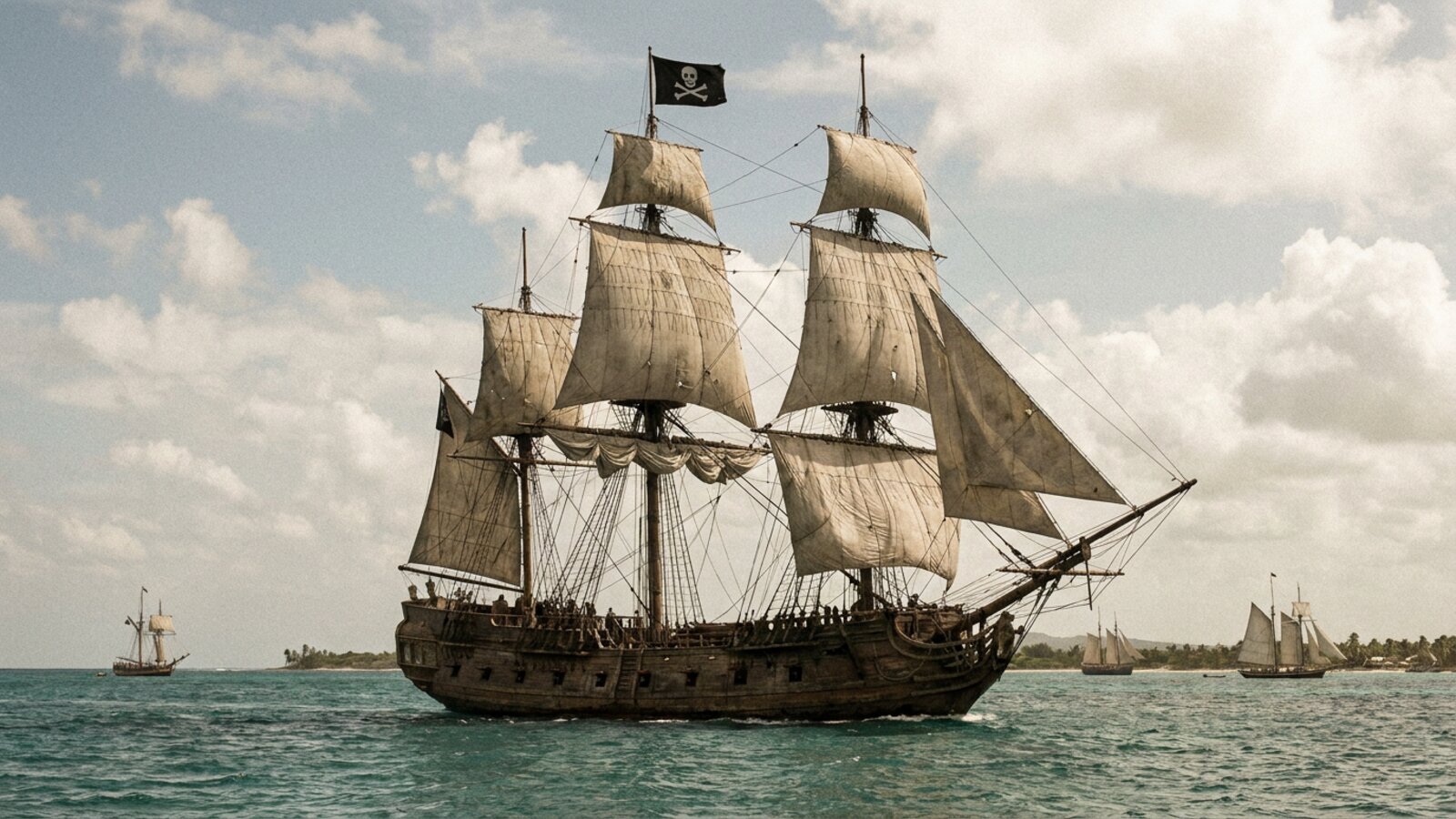
Queen Anne’s Revenge was Blackbeard’s most powerful ship, originally the French slave vessel La Concorde, captured near Martinique in November 1717. Blackbeard armed it to approximately 40 cannons — equivalent to a Royal Navy frigate — making it the most powerful privately operated vessel in the Western Atlantic at the time. Its mightiness came not just from its armament but from what that armament represented: a force that no merchant ship could rationally resist and few colonial naval assets could challenge. It was deliberately grounded at Beaufort Inlet in June 1718, ending its eight months as Blackbeard’s flagship.
Among the various vessels Blackbeard operated during his piracy career, Queen Anne’s Revenge stands entirely apart. It was not the ship he started with, not the ship he died on, and not the ship he was commanding at the end. But it was the ship that defined the peak of his power, and it is the ship whose physical remains have given us the most detailed evidence about what Golden Age piracy actually looked like from the inside. Understanding what made it his mightiest ship requires understanding both what the vessel was and what Blackbeard did with it.
What La Concorde was before Blackbeard took it
La Concorde was not an ordinary merchant vessel. It was a Guineaman — a ship designed and built specifically for the transatlantic slave trade — and its construction reflected the specific demands of that trade in ways that also made it exceptionally valuable as a pirate flagship.
Built in 1710 and operated by the French Compagnie des Indes, La Concorde was large, heavily constructed, and built for speed. The slave trade required vessels that could cover the Atlantic efficiently while carrying significant weight: the human cargo of enslaved Africans, the provisions required to keep them alive during the Middle Passage, and the armed crew needed to control the vessel against the constant threat of revolt. Large, heavy, and fast — these were exactly the qualities that made a vessel effective as a warship.
Guineamen also incorporated specific structural features that had military applications. The partition in the middle of the vessel — designed to separate crew quarters from the enslaved cargo hold — provided a defensive barrier that could protect crew in the event of revolt. On a warship, the same structure provided protected firing positions and defensive depth. The structural logic of the slave ship mapped onto the tactical requirements of a fighting vessel more directly than most merchant ship types.
The capture and conversion
Blackbeard captured La Concorde in late November 1717, operating with a smaller sloop near the island of Martinique. The French crew had been severely weakened by disease during the voyage — dysentery and other illnesses had incapacitated a significant portion of the men. After a brief engagement, the captain surrendered.
The transformation from slave ship to warship was systematic. La Concorde carried 14 cannons at the time of capture. Blackbeard added guns until the total reached approximately 40. This was a substantial armament project requiring both the physical guns — obtained from other prizes or through Nassau’s pirate economy — and the structural reinforcement to mount and operate them safely. The result was a vessel carrying firepower equivalent to a Royal Navy frigate of the period.
The renaming was deliberate and meaningful. Queen Anne’s Revenge referenced the War of the Spanish Succession (Queen Anne’s War), which had ended in 1714. Many of Blackbeard’s crew and potential recruits were former privateers who had fought in that war and now found themselves without employment. The name was a message of recognition to those men and a signal about the kind of captain Blackbeard intended to be.
Why 40 guns changed everything
The significance of Queen Anne’s Revenge’s 40-cannon armament cannot be overstated. It fundamentally changed what Blackbeard could do and who he could threaten.
Before Queen Anne’s Revenge, Blackbeard was a capable sloop captain in the Nassau pirate community — dangerous and effective, but operating within the constraints that all sloop-based pirates faced. A sloop captain could take merchant prizes, evade naval pursuit, and operate along coastlines where larger vessels could not follow. What he could not do was challenge naval vessels, blockade ports, or present a force that colonial governments had to treat as a military problem rather than a policing problem.
After Queen Anne’s Revenge, all of those constraints changed. A 40-gun warship with a crew of 300 to 400 men was not a policing problem. It was a military problem. No merchant vessel in the Atlantic trade could fight it. Most colonial port defences were not equipped to resist it. The only force capable of challenging it was a comparable Royal Navy vessel — and there was none stationed in the Caribbean and American colonial waters that could match it when Blackbeard was at peak strength. The Charleston blockade of May 1718 demonstrated this directly: a pirate fleet centred on Queen Anne’s Revenge held an American colonial capital hostage for a week because the British state had nothing in the area capable of stopping it.
The end: Beaufort Inlet and the deliberate grounding
Queen Anne’s Revenge’s career as Blackbeard’s flagship ended abruptly in June 1718 when it ran aground in Beaufort Inlet, North Carolina. The circumstances of the grounding have been debated by historians, but the consensus has shifted decisively toward the view that it was deliberate.
Blackbeard was simultaneously negotiating a pardon with Governor Charles Eden of North Carolina. A man seeking to present himself as ready to settle down as a reformed character faced a fundamental credibility problem: he commanded a 40-gun warship and hundreds of armed men. The pardon negotiation required him to appear less threatening. By losing his flagship and dispersing his crew — some accounts say he deliberately left a portion of them marooned on a sandbar — Blackbeard reduced his apparent military capacity to a single sloop with a small crew, making the pardon both more negotiable and more credible.
Stede Bonnet, Blackbeard’s former partner who was present at Beaufort Inlet, later made explicit accusations that Blackbeard had deliberately run the ship aground and cheated his crew of their shares in the process. Whatever Blackbeard’s specific intentions, the effect was that Queen Anne’s Revenge ceased to exist as an operational vessel, the fleet dispersed, and Blackbeard emerged from the process as a much smaller and less threatening figure — which was, arguably, exactly what he needed to be to secure his pardon.
What was Blackbeard’s most powerful ship?
Queen Anne’s Revenge, the former French slave ship La Concorde, which he armed to approximately 40 cannons — equivalent to a Royal Navy frigate. It was the most powerful privately operated vessel in the Western Atlantic during its eight months as his flagship, from late 1717 to June 1718.
Why was La Concorde such a good pirate ship?
Slave ships were large, fast, and heavily built — qualities that translated directly into effectiveness as warships. La Concorde was designed to carry significant cargo weight at speed while providing security against revolt, which gave it structural features useful for combat. Blackbeard added guns to create a vessel that could challenge any merchant ship and most naval assets in the region.
How many guns did Queen Anne’s Revenge have?
Approximately 40 cannons, up from 14 on La Concorde at time of capture. This was equivalent to the armament of a Royal Navy frigate of the period, making it the most heavily armed private vessel operating in the Western Atlantic during Blackbeard’s peak career.
Why did Blackbeard get rid of Queen Anne’s Revenge?
Most historians believe he deliberately grounded it at Beaufort Inlet in June 1718 while negotiating a pardon with North Carolina’s governor. A 40-gun warship and hundreds of armed men made the pardon negotiation difficult. By losing the ship and dispersing the crew, he reduced his apparent threat level, making accommodation with colonial authority more feasible.
What happened to the wreck of Queen Anne’s Revenge?
It was discovered in Beaufort Inlet in 1996 by Intersal Inc. at approximately six metres depth. North Carolina archaeologists confirmed the identification. Over 400,000 artifacts have been recovered in an ongoing excavation managed by the North Carolina Department of Natural and Cultural Resources. Artifacts are displayed at the North Carolina Maritime Museum in Beaufort.
Blane Perun has been exploring Earth’s oceans and marine life for over 25 years. Founder of TheSea.Org in 1999, underwater photographer, coral aquaculture pioneer, and explorer of 80+ countries.
About Blane Perun →