Blackbeard History: The Full Documented Story of Edward Teach
The history of Blackbeard that can be stated with reasonable confidence covers approximately two years: from his emergence as an independent pirate operator around late 1716 to his death at Ocracoke Inlet on November 22, 1718. His early life before piracy is almost entirely undocumented. His documented career includes command of Benjamin Hornigold’s fleet, capture of La Concorde and its transformation into Queen Anne’s Revenge, operations across the Caribbean and American colonial coast, the blockade of Charleston in May 1718, a pardon negotiated and abandoned, and a final battle that produced one of the most dramatic deaths in pirate history.
Blackbeard history is both better documented and less well understood than popular accounts suggest. Better documented because the two years of his active career generated substantial colonial records, naval correspondence, court documents, and newspaper accounts that have survived and been studied by historians. Less well understood because the primary popular source — Captain Charles Johnson’s A General History of the Pyrates, published in 1724 — is a brilliant but unreliable text that blends documented fact with vivid invention, and separating the two requires careful historical work that popular treatments rarely undertake.
Before piracy: what the record does and doesn’t show
Almost nothing is documented about Edward Teach’s life before his appearance in the Nassau pirate community around 1716. The name itself appears in multiple variant spellings in the historical record, which was normal for the period but has created confusion about whether different records refer to the same person.
What historical scholarship generally accepts: he was English, probably born around 1680, probably from Bristol or somewhere in southwestern England, and almost certainly served as a sailor or privateer during the War of the Spanish Succession (1701–1714) before transitioning to piracy. The privateer background is strongly suggested by his seamanship competence — he was clearly an experienced and capable mariner before he appears in the historical record — and by the fact that the War of the Spanish Succession created exactly the pool of unemployed maritime workers from which Nassau’s pirate community was built after 1714.
What is not documented: his specific birthplace, his family, his early employment, the name of any vessel he served on before Nassau, or any detail of his personal life before approximately 1716. Claims in popular sources about his childhood, his parents, or his early career are largely invented to fill an evidential gap that the actual historical record cannot fill.
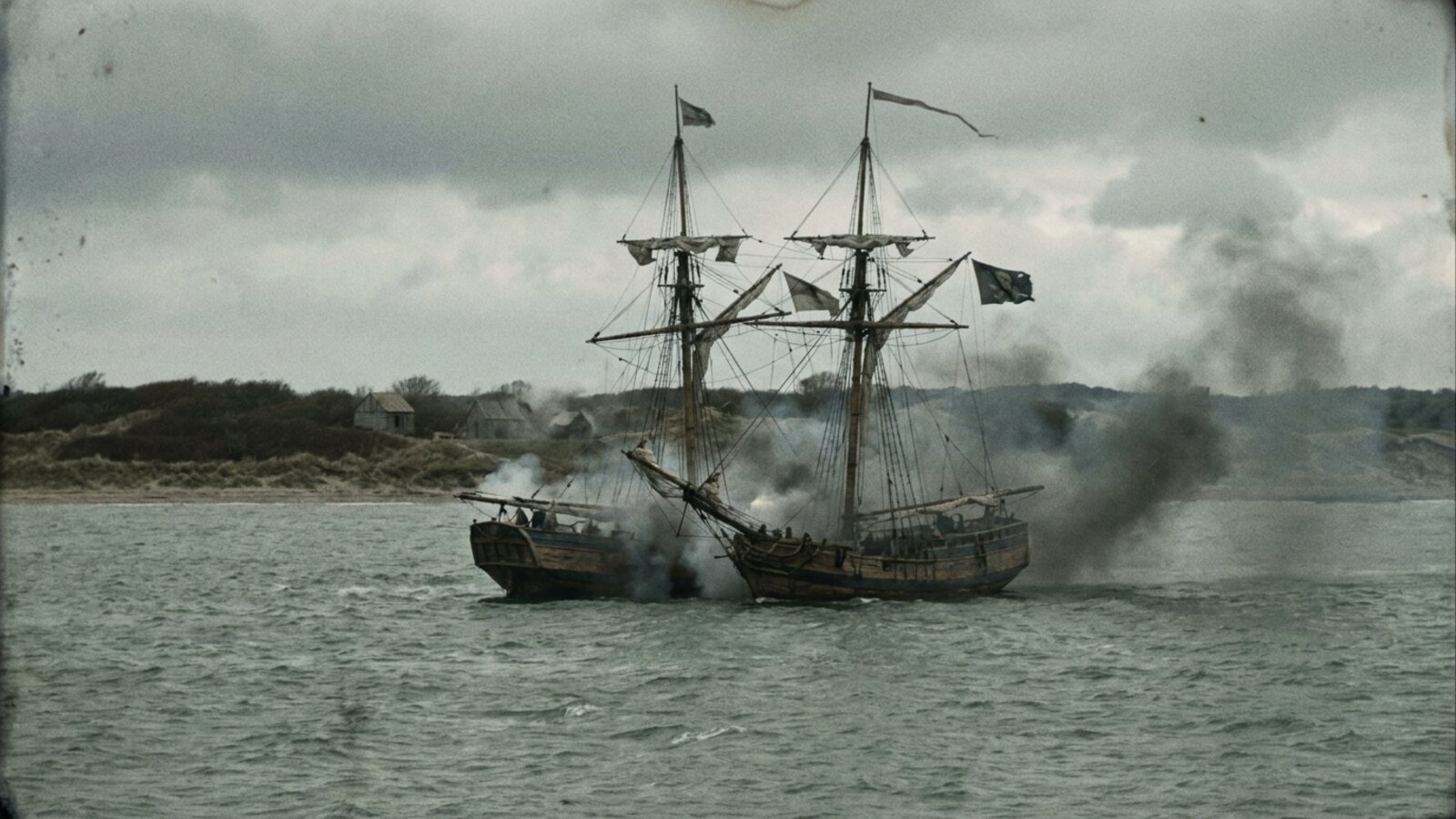
Nassau and the Hornigold years: 1716–1717
Blackbeard’s documented career begins in Nassau, where he was part of Benjamin Hornigold’s fleet. Hornigold was one of the most senior figures of the Nassau pirate republic and had built a significant force of vessels operating primarily against Spanish and French shipping.
Hornigold gave Teach command of a sloop within his fleet, which is the first specific documentation of Teach as a captain. The arrangement was productive: Hornigold’s fleet operated effectively across the Caribbean and the Bahamas channel during 1716 and into 1717. The relationship ended when Hornigold’s crew, tired of his policy of not attacking British ships, deposed him by democratic crew vote. Teach, who apparently had no such restriction, emerged as an independent operator with his own vessel and crew.
The first documented description of Teach’s appearance comes from late 1717, recorded by Henry Bostock, the captain of a vessel Teach captured. Bostock described a tall man with a long thick black beard, worn braided or tied, who was physically imposing and deliberately cultivated a threatening presence. This is the earliest eyewitness account and it establishes the visual template that all subsequent descriptions elaborate.
Queen Anne’s Revenge and peak operations: 1717–1718
In November 1717, Teach captured the French slave ship La Concorde near Martinique. This single acquisition transformed his operational capacity and marked the beginning of the most powerful phase of his career.
La Concorde was a large, fast, heavily armed vessel designed to carry significant weight at speed — qualities that made it ideal as a flagship. Teach renamed it Queen Anne’s Revenge, added guns to bring the total armament to approximately 40 cannons, and made it the centre of a fleet of smaller supporting sloops. With this force he became the dominant pirate presence in the Caribbean and along the American colonial coast.
Between late 1717 and May 1718, Teach’s fleet operated across a vast geographic range — from Belize and Honduras through the Caribbean islands to the Bahamas and up the American colonial coast to the Carolinas and Virginia. The approximately 40 vessels he captured during his career were taken across this range. He operated in consort with Stede Bonnet, the gentleman pirate, for part of this period. He appears in colonial correspondence from multiple jurisdictions during these months as a known threat to Atlantic trade.
The pardon and return to piracy
After the Charleston blockade and the apparent deliberate grounding of Queen Anne’s Revenge at Beaufort Inlet in June 1718, Teach negotiated a pardon with Governor Charles Eden of North Carolina and settled briefly in Bath Town. The settlement was genuine enough that he reportedly received a commission as a privateer and may have married.
The pardon did not hold. By late 1718, Teach had resumed raiding vessels in the waters off North Carolina. His resumption of piracy, combined with the proximity of his activities to Virginia shipping, alarmed Governor Alexander Spotswood of Virginia sufficiently to organise a naval response even though North Carolina was outside his jurisdiction. Spotswood commissioned Lieutenant Robert Maynard with two small sloops and dispatched him to find and engage Blackbeard without informing the North Carolina governor — an act of questionable legal authority that succeeded operationally.
The final battle at Ocracoke Inlet
The battle of Ocracoke Inlet on November 22, 1718, is the most specifically documented event of Blackbeard’s career and one of the most detailed accounts of a Golden Age pirate engagement in the historical record.
Blackbeard’s sloop Adventure was at anchor in the inlet when Maynard’s vessels arrived in the morning. The battle unfolded over several hours. Jane ran aground early and was effectively out of the engagement. Ranger was damaged and withdrew. Maynard’s crew sustained significant losses from Blackbeard’s initial broadside. Maynard ordered his surviving crew below decks, leaving the deck apparently clear. Blackbeard brought his crew aboard what he believed was a largely unmanned vessel — and Maynard’s men came up from below to engage in close-quarters combat.
Blackbeard was shot five times and cut approximately twenty times before he died. Contemporary accounts describe him continuing to fight through these wounds until he finally collapsed from blood loss. Maynard decapitated the body and hung the head from his bowsprit — both as proof for the reward Spotswood had offered and as a public demonstration of what the Virginia governor’s campaign had achieved. The head was subsequently displayed at the entrance to the Hampton River. Blackbeard’s surviving crew were tried and most were executed.
What is the primary historical source for Blackbeard’s history?
Captain Charles Johnson’s A General History of the Pyrates (1724) is the most detailed account, supplemented by colonial correspondence, court records, naval dispatches, and newspaper accounts from the period. Johnson’s account is vivid but unreliable in places; colonial records provide corroboration and correction.
When did Blackbeard’s piracy career begin?
His documented career as an independent pirate captain begins around late 1717, after the crew of Benjamin Hornigold’s fleet deposed Hornigold. His involvement with Hornigold’s fleet from around 1716 is the beginning of his documented piracy, though he had prior maritime experience of unknown duration.
Did Blackbeard actually have 14 wives?
This claim comes from Johnson’s General History and is not corroborated by independent documentation. It is generally treated by historians as Johnson’s embellishment rather than documented fact. A marriage in Bath Town after the pardon is the one documented or plausible instance.
Why did Blackbeard accept a pardon if he resumed piracy?
The pardon offered legal safety and the ability to operate as a privateer rather than a pirate. Whether Teach accepted in good faith or as a tactical pause is debated. The fact that he resumed raiding relatively quickly suggests the pardon was either never seriously intended as permanent or that circumstances changed his calculation.
How long was Blackbeard’s active piracy career?
Approximately two years — from late 1717 to November 1718. His involvement with Hornigold’s fleet from around 1716 extends this to roughly two and a half years, but his independent command began in late 1717. It is one of the shortest careers of any major Golden Age pirate.
Blane Perun has been exploring Earth’s oceans and marine life for over 25 years. Founder of TheSea.Org in 1999, underwater photographer, coral aquaculture pioneer, and explorer of 80+ countries.
About Blane Perun →