The Squid Beak — One of the Hardest Biological Materials on Earth
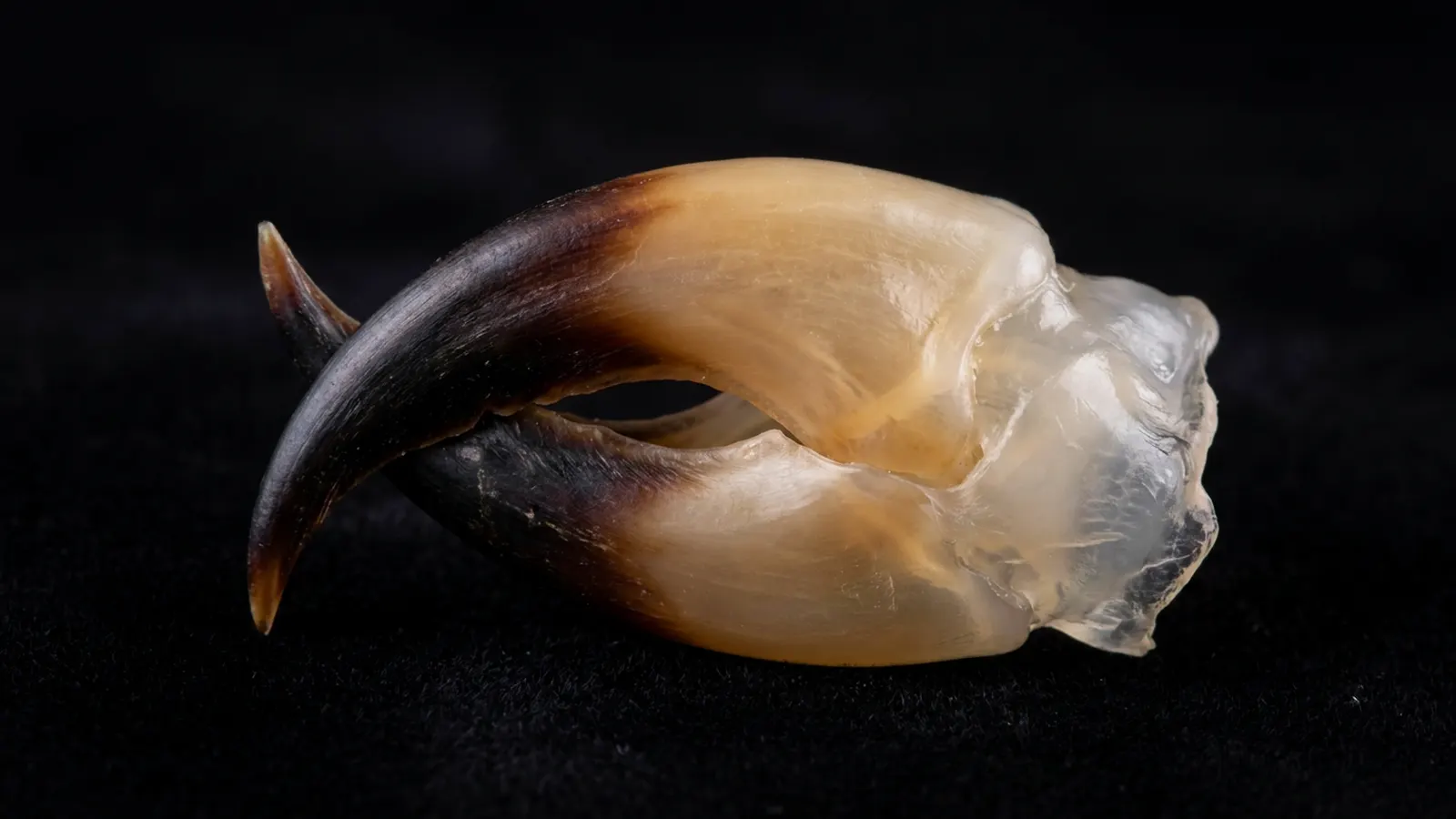
A squid beak is a paired, chitinous mandible at the centre of the arm crown — an upper and a lower jaw made of pure chitin reinforced with cross-linked protein. Shaped somewhat like a parrot’s beak, it is used to cut, tear, and shred captured prey before the food is passed to the radula and swallowed. The beak is one of the hardest, most abrasion-resistant biological materials known, approaching the hardness of some metals, and it has become a celebrated subject in biomimetic materials research. Colossal squid beaks can exceed 4.2 cm in length.
The squid beak is the hardest single part of a squid. It is harder than any other structure in the animal, harder than most invertebrate materials, and — at its tip — approaches the hardness of certain industrial metals. Even more remarkably, it is not uniformly hard. The beak is built with a sophisticated hardness gradient, transitioning smoothly from a soft, flexible base to an extremely hard cutting edge. That gradient solves an engineering problem humans have struggled to replicate: how do you attach a hard cutting tool to a soft body without the attachment point failing from stress? The squid figured it out 200 million years ago.
The paired mandibles — how the beak actually works
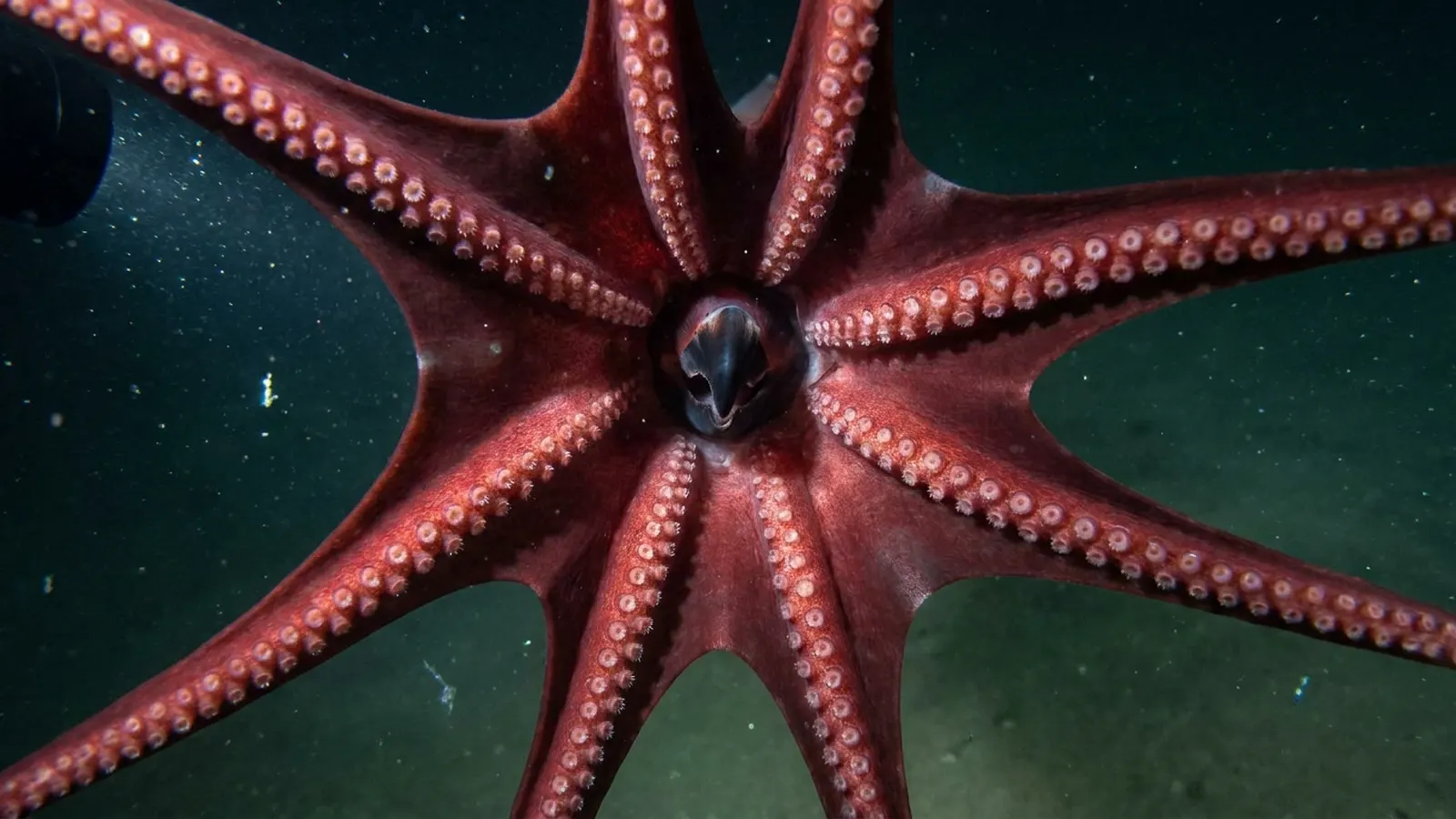
A squid beak has two parts: an upper mandible and a lower mandible, facing each other and articulating around a central opening. When the beak closes, the two edges meet in a shearing cut that works much like a pair of scissors.
Each mandible is a curved, pointed piece of chitin resembling a parrot’s beak turned upside-down — that is, pointing downward. The upper mandible sits above, the lower mandible below, and muscles in the surrounding buccal mass drive the mandibles against each other to cut, tear, or crush prey. The cutting edge is extremely sharp and extremely hard, and the action is precise: a squid can cleanly sever a fish’s spine with a single closure. In the colossal squid, the beak is large enough to bite through the cartilage of a Patagonian toothfish — one of its primary prey species — in pieces small enough to pass through the squid’s doughnut-shaped brain into the narrow esophagus beyond. The beak is the first stage in the squid’s digestive system, and without it, the squid could not eat large prey at all.
What makes the beak remarkable is the material. It is not bone. It is not calcified in any way. It contains no calcium, no phosphate, no minerals typical of vertebrate skeletons. Instead, it is made of chitin — the same structural polysaccharide found in insect exoskeletons, crustacean shells, and fungal cell walls — reinforced with a specialised protein matrix called sclerotised protein that cross-links to produce extreme hardness. Chitin by itself is not that hard; it is the cross-linked protein scaffolding that makes the squid beak one of the hardest non-mineralised biological materials known to science.
The hardness gradient — the engineering puzzle of attaching hard to soft
The squid beak is hard at the tip and progressively softer as you move toward the base, where it connects to the soft muscle of the buccal mass. This gradient is the feature that has made the beak a celebrity in materials science.
Here is the engineering problem: when you attach a rigid cutting tool to a soft substrate, the junction between them experiences enormous stress every time the tool is used. In a man-made system, that junction is almost always the failure point — the knife handle breaks before the blade does, the saw teeth crack free of the metal body, the tool eventually fails because of concentrated stress at the interface. Biological systems face the same problem, and most of them solve it imperfectly; teeth crack, claws break, jaws wear. The squid beak solves the problem by eliminating the interface altogether. Instead of a hard material bolted to a soft one, the squid beak is a continuous gradient in which the hardness and composition change smoothly over a distance of several millimetres. The tip is fully sclerotised chitin, hard enough to cut bone; the base is gently hydrated and soft enough to be indistinguishable from the surrounding muscle. There is no junction to fail. This principle — called functionally graded materials — is the holy grail of modern engineering, and the squid beak is one of the best natural examples of how to do it right.

The beak as a research tool — what beaks tell biologists
Beyond their role in the squid’s body, squid beaks have become one of the most valuable tools for studying cephalopods. They survive where nothing else does.
Most of what is inside a squid — the muscle, the organs, the skin — breaks down quickly after the animal dies. But the beak is almost indestructible. It resists decomposition, it resists digestion, and it does not dissolve in stomach acid. When a sperm whale eats thousands of squid over its lifetime — as sperm whales do — the only parts of those squid that persist are the beaks, which accumulate by the thousands in the whale’s stomach. Biologists who examine the stomachs of stranded sperm whales (and the beaks they contain) can identify squid species, estimate their sizes, and reconstruct the whale’s diet with remarkable precision. A large sperm whale stomach may contain more than 10,000 squid beaks, each identifiable to species. Some species — including the colossal squid — were known almost entirely from beak evidence for decades before any complete specimen was recovered. The beak is, in a very real sense, the permanent record of the squid that used to exist around it.
What is a squid beak made of?
Chitin reinforced with cross-linked protein — the same structural polysaccharide that makes up insect exoskeletons and crustacean shells, but toughened by a specialised protein matrix. The beak contains no calcium and is not a bone. Its hardness comes from the cross-linking of the protein, not from mineralisation.
How hard is a squid beak?
Extremely hard at the tip — approaching the hardness of some industrial metals — and progressively softer toward the base, where it is indistinguishable from the surrounding muscle. This hardness gradient is one of the most studied examples in materials science and is a key inspiration for biomimetic research into functionally graded materials.
Why does a squid need a beak?
Because a squid’s esophagus passes through the centre of its ring-shaped brain, and nothing larger than the hole in the brain can be swallowed whole. The beak solves this problem by shredding captured prey into pieces small enough to fit. Without the beak, a squid couldn’t eat large prey at all.
How big can a squid beak get?
The largest documented squid beak belongs to the colossal squid (Mesonychoteuthis hamiltoni) and measures over 4.2 cm. Giant squid beaks are slightly smaller at around 4 cm. Sperm whales regularly accumulate thousands of these beaks in their stomachs, and colossal squid specimens were known mostly from beaks recovered from whale stomachs long before any complete specimen was obtained.
Why are squid beaks used in biomimetics?
Because the squid beak solves a classic engineering problem: how to attach a hard cutting surface to a soft body without creating a weak point at the junction. It does this through a smooth hardness gradient with no abrupt interface. Engineers are trying to replicate this in artificial materials for applications from prosthetics to aerospace components.
Blane Perun has been exploring Earth’s oceans and marine life for over 25 years. Founder of TheSea.Org in 1999, underwater photographer, coral aquaculture pioneer, and explorer of 80+ countries.
About Blane Perun → More Squid Q&A →