Gorgonia mariae — The Small, Open-Net Sea Fan
Gorgonia mariae, the wide-mesh sea fan, is the smallest sea fan in the Caribbean, growing to about 30 cm tall. Its branches are only partly joined, so the net looks open and loose rather than tightly meshed. It lives in the tropical western Atlantic and Caribbean on reef slopes and hard bottom at roughly 5–47 m, deeper on average than the common and Venus sea fans.
Most divers swim past Gorgonia mariae because it does not look like a “proper” sea fan. It looks like a sea fan someone started knitting and gave up on.
What is Gorgonia mariae?
It is a gorgonian octocoral in the family Gorgoniidae, the same genus as the common sea fan and the Venus sea fan. It was described by Frederick Bayer, the great twentieth-century octocoral specialist. The supporting axial rod in the main stem and branches is gorgonin, calcified to some extent, which makes it flexible and almost unbreakable.
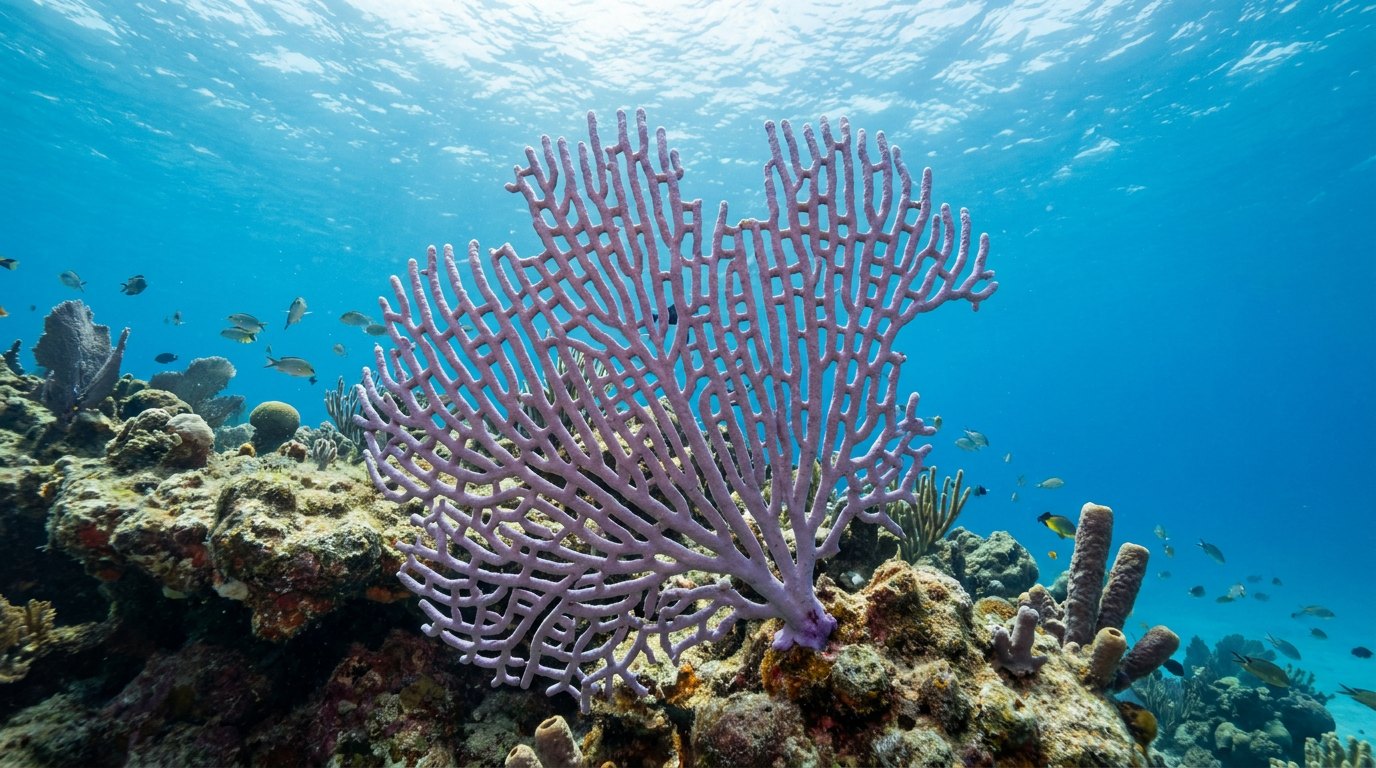
How do you identify the wide-mesh sea fan?
- Size: small, around 30 cm tall, about a quarter the height of a big common sea fan.
- Mesh: wide and open; many branchlets do not join their neighbors.
- Branches: only slightly compressed; side branches pinnately divided, like a feather.
- Shape: still roughly fan-shaped and in one plane, but with gaps and loose ends.
If a fan has a tight, even net it is probably G. ventalina or G. flabellum. If it looks half-finished and feathery, think G. mariae.
Where does Gorgonia mariae live?
It occurs in the tropical western Atlantic Ocean and the Caribbean Sea. It anchors to the seabed in moderately deep water, from about 5 to 47 m, and has been reported to about 50 m. That deeper habitat, with gentler water movement than the surf zone, suits its looser structure; the shallow-water Gorgonia species need tight nets to withstand surge.
How does it feed?
Like its relatives, it carries symbiotic dinoflagellates in its tissue and also captures plankton with its polyps. At depth there is less light, so plankton capture likely matters more than for shallow fans.
Was Gorgonia mariae affected by sea fan disease?
The 1990s aspergillosis outbreak affected Caribbean gorgonians widely, with G. flabellum and G. ventalina the most heavily affected. Symptoms included tissue dieback, abnormal tufts of growth and purpling. The wide-mesh sea fan’s deeper habitat may have offered some protection, though data are limited.
How can divers help wide-mesh sea fans?
Sea fans grow slowly and break easily. Keep good buoyancy near walls and ledges, keep gauges and octopus regulators clipped so they do not drag, and never hold onto a fan to steady yourself or for a photo. Report fans with unusual purple lesions or large patches of bare skeleton to local marine park staff, since disease tracking depends on sightings from divers.
- Hover, do not hold.
- Clip hoses and gauges.
- Approach fans from the side, not from above where fins hit them.
- Report diseased colonies to the local park.
Why does sea fan shape change with depth?
Shallow fans live in oscillating surge that pushes water back and forth through the net; a dense, flat fan held across the surge strains the most plankton. Deeper down, flow is slower and more steady, and colonies can afford an open, lighter structure. The gorgonian family shows this pattern repeatedly: fans shallow, taller and bushier forms deeper. See the gorgonian hub.
Comparing the three Caribbean Gorgonia
Size, mesh and branch shape are the quickest ways to separate the Caribbean’s three main sea fans.
| Feature | G. mariae | G. ventalina | G. flabellum |
|---|---|---|---|
| Size | About 30 cm | Up to about 1.5 m | Up to about 1–1.5 m |
| Mesh | Open, many branchlets unjoined | Tight, even net | Tight net, often with side outgrowths |
| Small branches | Slightly compressed, feathery | Round or flattened in plane of fan | Flattened across plane of fan |
| Typical setting | Deeper slopes, walls and hard bottom | Shallow surge zones and outer reefs | Shallow reefs, especially the Bahamas |
Juvenile common and Venus sea fans can be small too, so size alone can mislead. A young G. ventalina already has a tight, fully joined net; a wide-mesh sea fan keeps its loose, unfinished look even when fully grown.
Who was Frederick Bayer?
Frederick M. Bayer was a curator at the Smithsonian Institution’s National Museum of Natural History and one of the most important octocoral specialists of the twentieth century. His 1961 monograph, The Shallow-Water Octocorallia of the West Indian Region, in which Gorgonia mariae was described, remains a standard reference for identifying Caribbean sea fans, sea rods and sea plumes. Over his long career he described many species from shallow reefs to the deep sea, and much of the vocabulary divers and scientists use for gorgonian anatomy traces back to his work.
What lives on the wide-mesh sea fan?
Small fans attract fewer residents than big ones, but they are still used. The flamingo tongue snail and its relative the fingerprint cyphoma graze Caribbean gorgonians, including Gorgonia, and can sometimes be seen on wide-mesh fans. Brittle stars wrap around the branches, small gobies and blennies perch on them, and arrow crabs often sit at the base. Because the mesh is open, residents are easier to spot than on a dense common sea fan, which makes these colonies worth a slow look with a light.
How does it reproduce and grow?
Like other Gorgonia, it reproduces sexually, releasing eggs and sperm from separate male and female colonies, with larvae settling on hard ground to start new fans. Growth is slow, and the small adult size means the colonies are never as conspicuous as their shallow cousins. Detailed growth and spawning data for this species are scarce, largely because it lives deeper and has attracted less research than the common sea fan.
Where to look for it
Wall and slope dives across the Caribbean are the best bet. Look on ledges, overhang lips and hard-bottom patches between about 15 and 30 m, especially where there is some current. Popular wall-diving areas such as Bonaire, the Cayman Islands, Cozumel and Belize all have suitable habitat. Because it is small, pale and feathery, it is easiest to find by looking for “scruffy” fans silhouetted against the blue as you drift along the wall.
What is Gorgonia mariae?
The wide-mesh sea fan, a small Caribbean gorgonian with a loose, open net.
How big does the wide-mesh sea fan grow?
About 30 cm tall, making it the smallest Caribbean sea fan.
How deep does Gorgonia mariae live?
About 5 to 47 m, occasionally to about 50 m.
How do you tell Gorgonia mariae from other sea fans?
Many of its branchlets do not interconnect, so the mesh is open and feathery.
Is Gorgonia mariae photosynthetic?
Yes, it hosts symbiotic algae, and it also catches plankton.
Who described Gorgonia mariae?
Octocoral expert Frederick M. Bayer, in 1961.
Where can divers see Gorgonia mariae?
On Caribbean walls, ledges and deeper reef slopes, mostly around 15 to 30 m. Look for small, loose, feathery fans growing out from the reef.
Is the wide-mesh sea fan rare?
It is not known to be rare, but it is easily overlooked because it is small, lives deeper than other sea fans and does not look like a classic fan. It has been studied far less than its shallow relatives.
- Wikipedia contributors. Gorgonia mariae and Gorgonia flabellum (size, depth, disease).
- Bayer, F.M. (1961). The Shallow-Water Octocorallia of the West Indian Region.
- WoRMS. Gorgonia mariae Bayer, 1961.
Blane Perun has been exploring Earth’s oceans and marine life for over 25 years. Founder of TheSea.Org in 1999, underwater photographer, coral aquaculture pioneer, and explorer of 80+ countries.
About Blane Perun →