Gorgonia flabellum — The Venus Sea Fan
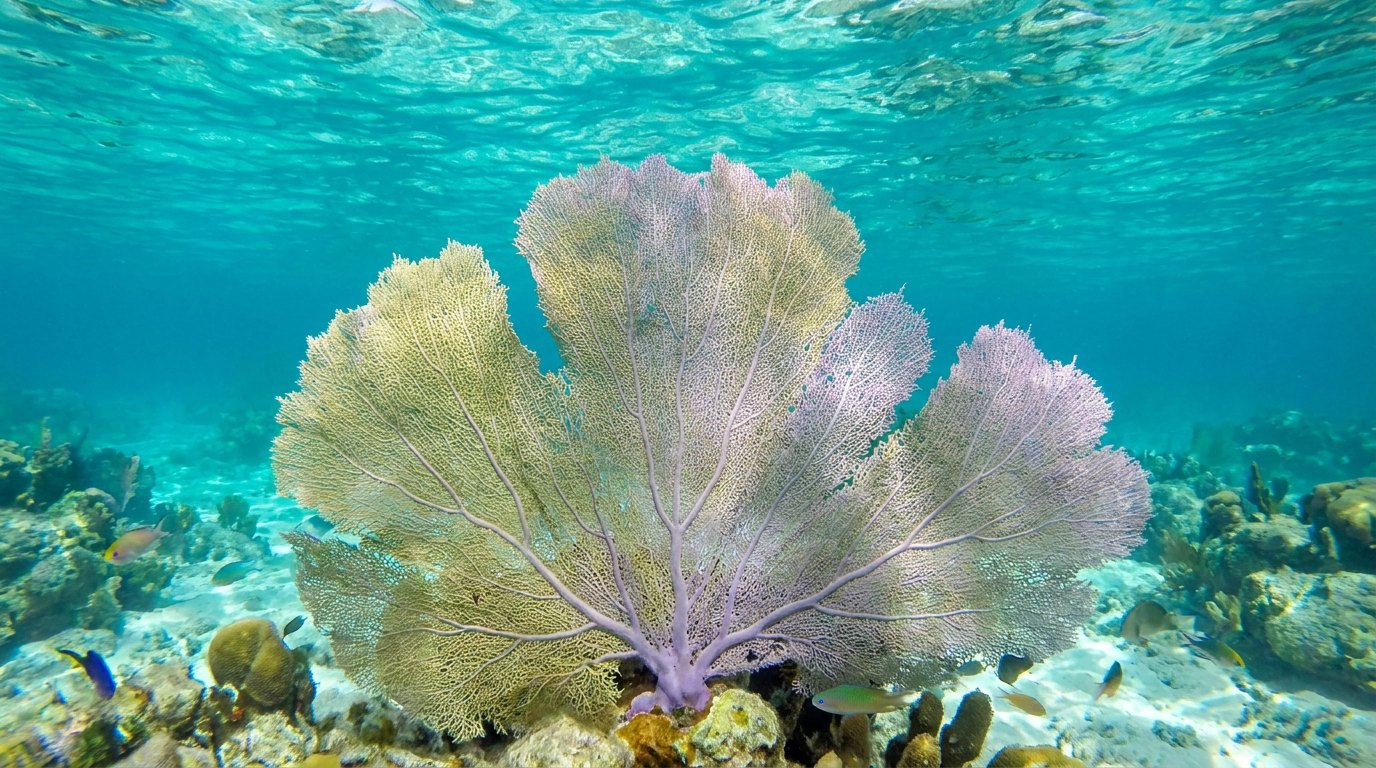
Gorgonia flabellum, the Venus or Bahamian sea fan, is a Caribbean gorgonian that grows as a flat, slightly untidy lattice up to roughly 1–1.5 m tall. It is a shallow-water species, most often within about 10 m of the surface where wave action is strong, and is especially common in the Bahamas. Its branches are flattened at right angles to the fan, the key difference from the common sea fan.
Snorkel the shallow reefs of the Exumas and you will see fans everywhere, many of them a little ragged at the edges with extra mini-fans sprouting from the main blade. Those are Venus sea fans.
What is Gorgonia flabellum?
Gorgonia flabellum is a colonial octocoral in the family Gorgoniidae and one of the two big sea fans of the Caribbean, the other being its close relative the common sea fan. Its common names include Venus fan, Venus sea fan, West Indian sea fan and purple gorgonian seafan, and divers in the Bahamas often simply call it the Bahamian sea fan. Carl Linnaeus named both it and G. ventalina in 1758, and the species name is simply the Latin word for a small fan.
A colony is not one animal but thousands of tiny polyps sharing a single body. Each polyp has eight feathery tentacles, the mark of the octocorals, and all of them are linked by a thin living rind called the coenenchyme. That tissue sits over an internal axis made of gorgonin, a horny protein, mixed with calcite. The axis makes the fan tough and flexible at once: it can bend with a passing wave and spring back instead of snapping. The living layer is white, yellowish or pale lavender, and the Coralpedia guide to Caribbean corals, compiled at the University of Warwick, notes that yellow is the most common colour.
The World Register of Marine Species lists nine accepted species in the genus Gorgonia, but only three are familiar to Caribbean divers: the Venus fan, the common sea fan and the much smaller wide-mesh sea fan. All three are filter-feeding, sun-loving animals that build flat nets of branches, and all three were hit by the same disease outbreaks in the late twentieth century.
How do you identify the Venus sea fan?
The most reliable clue is the shape of the small branches in cross-section. In G. flabellum they are compressed at right angles to the plane of the fan, so if you look at the colony edge-on, each twig appears as a flat blade standing across the net rather than lying in it. Coralpedia adds that the compression is usually strong and is most obvious on the inner edges of the branches. In G. ventalina the branchlets are either round or flattened in the same plane as the fan, which gives the common sea fan a smoother, more lace-like look.
The second clue is the outline. A Venus fan tends to look untidy. Short, stubby side growths stick out of the main blade, and these often grow into small secondary fans set at an angle to the first, so that one base can carry several overlapping fans. Field guides describe the overall effect as slightly ragged, and Coralpedia rates the side growths as the most consistent sign a diver can use without a hand lens.
- Branches flattened across the fan, not along it.
- Outline irregular, with small extra fans or outgrowths.
- Color pale: white, yellow or light lavender.
- Setting very shallow, surge-swept reefs.
Both large species can exceed 1.5 m in height and width, so size does not separate them. The wide-mesh sea fan, Gorgonia mariae, is easier: it is the smallest sea fan in the Caribbean, reaching only about 30 cm, and many of its branchlets end freely instead of joining into a closed mesh. In the Bahamas, where Venus fans dominate the shallows, the two big species are easy to tell apart. In Florida and the Lesser Antilles they overlap more and are more easily confused, and a close look at the branch edges is the only dependable test.
Where does Gorgonia flabellum live?
The Venus fan is a western Atlantic species. It is very common in the Bahamas and also occurs in Florida, the Lesser Antilles and other parts of the Caribbean. It is a shallow-water animal that seldom grows deeper than about 10 m, and it favours the shallow, wave-washed parts of the reef where the swell breaks and drains back. Dive guides record it from about 1 m to around 30 m, but the bulk of the population lives in the top few metres.
Published surveys give a picture of how patchy it can be. On the Caribbean coast of Costa Rica in the late 1970s and early 1980s it was common enough to form stands of roughly two to three colonies per square metre on reefs such as Cahuita, Isla Uvita and Portete. In a survey of the reefs off Flamenco Beach on Culebra, Puerto Rico, published in PeerJ in 2020, the differences between offshore survey sites were explained mostly by a brain coral, crustose coralline algae and G. flabellum, a sign of how prominent the fan is there. Yet on the reefs of La Parguera in south-western Puerto Rico, a study of flamingo tongue snails counted more than a thousand common sea fans but only a single Venus fan inside its transects. Local wave exposure, depth and history all seem to shape where each species wins.
Why do sea fans face the waves?
A Venus fan is usually oriented perpendicular to the incoming waves, with its flat face square to the surge. This is not chance. A sea fan is essentially a sieve, and a sieve works best when water passes through it rather than along it. In a study of nine Caribbean octocorals published in Scientific Reports in 2018, Rossi and colleagues described sea fans as having a net-like planar shape with a high surface area, positioned perpendicular to water flow. With the fan set this way, every polyp on both faces gets a share of the plankton carried back and forth by the swell.
The orientation also has a mechanical cost. Broadside to the waves, a large fan takes the full drag of each surge, and that is why a flexible gorgonin skeleton matters so much. The axis bends, the fan leans, and the load is spread to the holdfast cemented onto the reef rock. Storms still tear some fans loose, especially where bioeroding organisms have weakened the rock beneath them, but on a normal day the fan survives conditions that would snap a rigid coral of the same size.
How does the Venus sea fan feed?
Like the common sea fan, it is mixotrophic. Microscopic dinoflagellate algae of the genus Symbiodinium live inside its tissues. They photosynthesise and pass part of the sugars they make to the host. At the same time the polyps open their tentacles to catch zooplankton and organic particles drifting past. Shallow, bright, well-flushed water suits both methods, which is one reason the fan is so tied to the surge zone. You can read more about this partnership in our guide to why zooxanthellae matter to corals.
Research on its sister species shows how much sea fans lean on their algae. In the Rossi study the common sea fan had the highest photosynthetic capacity and efficiency of all nine species measured, but also the highest respiration, so its daily surplus was not larger than that of other octocorals. The authors linked these differences to colony shape: fans and plumes, with thin branches and small polyps, run at higher metabolic rates than thick-branched sea rods. In their histology the algal cells were far more abundant in the polyps than in the connecting tissue. A 2015 study in The ISME Journal by Baker and colleagues, which measured 11 gorgonian species in Bocas del Toro, Panama, found that sea fans and sea plumes were net autotrophs, producing more oxygen than they consumed, while most sea rods were net heterotrophs. The productive species also kept specialised, obligate partnerships with their algae and were more resistant to bleaching. These findings come from other members of the family, but the Venus fan shares the same body plan and habitat.
How do Gorgonia sea fans reproduce?
The reproductive cycle of G. flabellum itself has received little study. What is known for the genus comes mainly from its relatives. In the wide-mesh sea fan, gametes are shed into the body cavity of each polyp and leave through the mouth, and fertilisation happens in open water. The fertilised egg becomes a planktonic planula larva, which develops tentacles, internal partitions and a throat before settling on its aboral end and turning into a tiny new fan. Once settled, a colony grows by budding new polyps along its branches, and the branches fuse where they touch to form the mesh.
Recruitment can be strong. The ecologist P. J. Edmunds followed common sea fans at two sites off St. John in the US Virgin Islands from 2013 to 2019, a period that included two Category 5 hurricanes in 2017. Neither the density of colonies nor the density of young recruits collapsed, and he described the species as highly resilient. A decade-long study of Florida’s Coral Reef published in 2025 found the same pattern across arborescent octocorals as a whole: cover fell slightly between 2013 and 2023, by 1.67%, but colony density rose by 33.7% as waves of recruits replaced losses after disturbances such as Hurricane Irma. Sea fans are part of a wider shift in which octocoral forests are filling space left by declining reef-building corals.
What happened to the Venus fans of Costa Rica?
The best-documented event in the species’ history is a local catastrophe. In 1984 Héctor Guzmán and Jorge Cortés of the University of Costa Rica reported in the Revista de Biología Tropical that Venus fans on the Caribbean coast of their country had begun to die gradually in early 1982 in Cahuita National Park. By early 1983 more than 90% of the colonies there were dead, and only their skeletons remained, still standing in place and coated with algae. The same die-off was seen on reefs along the whole coast, from Moín and Limón south to Puerto Viejo, Punta Uva, Manzanillo and Punta Mona. Photographs from 1977 and 1984 of a patch reef at Cahuita show a dense stand of fans replaced by bare stalks.
What made the event striking was its precision. No other octocoral on those reefs was affected, even though more than 23 species lived alongside the fans. The authors worked through seven possible causes in turn. Water temperature had spiked above 35 °C in some months of 1983, during a strong El Niño, but the deaths had started a year earlier, and the plexaurid gorgonians nearby, which are less heat-tolerant than members of the Gorgoniidae, survived untouched. Sediment was ruled out because the encrusting octocoral Erythropodium caribaeorum, which should be more sensitive to smothering, stayed healthy. Hydrocarbon pollution was present only at low levels. Wave damage could not explain colonies that died upright on their holdfasts, and predators such as the flamingo tongue snail and the bearded fireworm usually move on before killing a whole colony.
That left disease. Guzmán and Cortés concluded that the pattern matched black band disease, a mat of cyanobacteria and sulphur bacteria that advances across coral tissue and leaves bare skeleton behind, which by then had been recorded in octocorals as well as stony corals. They suggested that Gorgonia might be vulnerable because it produces relatively little protective mucus compared with other gorgonians. They could not detect the start of the infection, so the diagnosis stayed tentative, but the paper was the first report of a mass mortality of G. flabellum anywhere.
What diseases affect Venus sea fans today?
A decade later a much larger outbreak swept the region. In 1995 a disease killed and injured sea fans across the Caribbean, and G. flabellum and G. ventalina were the species most affected; the wide-mesh fan was also susceptible. The cause turned out to be Aspergillus sydowii, a fungus normally found in soil and not previously known to attack marine invertebrates. Infected fans showed tissue dieback, abnormal tufts of growth and purpling around the affected areas. Some recovered completely, others died. In common sea fans, larger colonies suffered more than small ones and reproduction fell in infected colonies.
How a soil fungus reached the sea is still debated. One early idea was dust blown across the Atlantic from Africa, but samples of African dust did not contain this species, so that route now seems unlikely. Run-off of soil from land is one possibility. Another is the flamingo tongue snail, a specialist predator of sea fans in whose faeces the fungus has been found, which could carry it from colony to colony.
Other threats have appeared since. In August 2008 divers in south-east Florida noticed sea fans, including G. flabellum, G. ventalina and the deep-water fan Iciligorgia schrammi, being smothered by filamentous cyanobacteria. A team led by Y. Kiryu sampled affected and healthy common sea fans over several months and published the results in the Journal of Invertebrate Pathology in 2015. Under the microscope, covered tissue showed swarms of immune cells, dying sclerite-forming cells and dying algae, and fungal threads were more prominent in the skeletons of overgrown fans than in clean ones. Heat stress on the same reefs also drives coral bleaching, which weakens corals and octocorals alike.
Which animals eat or damage Venus fans?
The best-known predator is the flamingo tongue snail, Cyphoma gibbosum, a small ovulid whose orange-yellow mantle with black markings covers a plain shell that averages 25–35 mm long. It crawls over gorgonians grazing living tissue, and Gorgonia species are among its common prey. Females glue their eggs to colonies they have recently fed on, and the larvae hatch after roughly ten days. A survey off La Parguera, Puerto Rico, published in 2014 by Lucas and colleagues found the snail feeding on at least 16 octocoral species. Bare patches left by grazing can be colonised by algae, sponges or branching fire coral, which can turn a small wound into permanent loss.
The bearded fireworm, Hermodice carunculata, also browses on octocorals. Both predators tend to take part of a colony and move on rather than eat it all, so their main effect is to remove tissue and open the way for infection. Octocoral tissue is stiffened by tiny calcite sclerites that give it a grainy, spiky texture and help deter predators. The sclerites also carry chemistry: a 2017 study in PeerJ identified 70 compounds associated with the sclerites of common sea fans, many with antimicrobial or antioxidant roles, which may help colonies resist infection.
Is Gorgonia flabellum endangered?
NatureServe rates the Venus sea fan as Vulnerable. The main pressures are the ones described above: disease outbreaks that can wipe out a local population within a year or two, hurricanes that strip fans from the shallows, warming water that stresses their algal partners, and nutrient-rich run-off that favours cyanobacterial mats. Because the Venus fan lives in such shallow water, it is also exposed to anchors, fins and souvenir collecting in the most heavily used parts of the reef.
Dried sea fans sold as decoration were historically taken from the Caribbean, including both large Gorgonia species. Many countries now restrict collection, and dried fans are dead colonies. Admire living ones in the water instead.
Where can you see Venus sea fans?
The Bahamas are the stronghold, and the shallow reefs of islands such as the Exumas are some of the easiest places to find them from the surface. Our guide to the best snorkeling in the Bahamas covers sites where fans grow within reach of a snorkeler. They also appear on shallow reefs in Florida, in Puerto Rico and its offshore islands of Culebra and Vieques, and on parts of the Mexican Caribbean coast, including Cozumel.
For a good look, float over the fan rather than beside it, and check the edge of the blade for the cross-wise flattened branchlets that confirm the species. Look too for passengers. Flamingo tongue snails are easy to spot against the pale tissue, and a fresh grazing scar nearby often gives one away. Never stand on the reef to steady yourself, and keep a little distance in surge, when it is easy to be pushed into a fan. Photographers get the best results with the light behind the fan, which shows off the lattice and makes the faint lavender or yellow tint glow.
What is Gorgonia flabellum?
The Venus or Bahamian sea fan, a shallow-water Caribbean gorgonian in the family Gorgoniidae.
How is G. flabellum different from G. ventalina?
Its branchlets are flattened at right angles to the fan, and its outline is untidier, with side growths and small extra fans.
Where is the Venus sea fan found?
Most commonly in the Bahamas, and also in Florida, the Lesser Antilles, Puerto Rico, Costa Rica and other parts of the Caribbean.
How big does the Venus sea fan get?
Large fans reach about 1.5 m tall and wide.
How deep does Gorgonia flabellum grow?
Mostly shallower than about 10 m, though it has been recorded to around 30 m.
Does the Venus sea fan need sunlight?
Yes. It hosts photosynthetic algae, though it also catches plankton.
What killed Venus sea fans in Costa Rica?
Over 90% died at Cahuita in 1982–83; researchers suspected black band disease.
Is Gorgonia flabellum endangered?
NatureServe rates it Vulnerable; disease, storms and warming have caused local losses.
- Wikipedia contributors. Gorgonia flabellum; Gorgonia; Gorgonia mariae; Aspergillus sydowii; Cyphoma gibbosum; Hermodice carunculata; Gorgonin.
- Coralpedia, University of Warwick. Gorgonia flabellum species account.
- Guzmán, H. M. & Cortés, J. (1984). Mortandad de Gorgonia flabellum Linnaeus (Octocorallia: Gorgoniidae) en la costa Caribe de Costa Rica. Revista de Biología Tropical 32(2).
- Kiryu, Y. et al. (2015). Pathological effects of cyanobacteria on sea fans in southeast Florida. Journal of Invertebrate Pathology 129: 13–27.
- Rossi, S. et al. (2018). Linking host morphology and symbiont performance in octocorals. Scientific Reports 8: 12823.
- Baker, D. M. et al. (2015). Productivity links morphology, symbiont specificity and bleaching in the evolution of Caribbean octocoral symbioses. The ISME Journal 9: 2620–2629.
- Edmunds, P. J. (2020). High ecological resilience of the sea fan Gorgonia ventalina during two severe hurricanes. PeerJ 8: e10315.
- Liberman, R. et al. (2025). Octocoral dynamics over a decade on Florida’s coral reef. Scientific Reports 15: 37635.
- Lucas, M. Q. et al. (2014). Natural prey preferences and spatial variability of predation pressure by Cyphoma gibbosum on octocoral communities off La Parguera, Puerto Rico. International Scholarly Research Notices 2014: 742387.
- Toledo-Hernández, C. et al. (2017). Comparison of chemical compounds associated with sclerites from healthy and diseased sea fan corals (Gorgonia ventalina). PeerJ 5: e3677.
- Gómez-Andújar, N. X. & Hernández-Delgado, E. A. (2020). Spatial benthic community analysis of shallow coral reefs to support coastal management in Culebra Island, Puerto Rico. PeerJ 8: e10080.
Blane Perun has been exploring Earth’s oceans and marine life for over 25 years. Founder of TheSea.Org in 1999, underwater photographer, coral aquaculture pioneer, and explorer of 80+ countries.
About Blane Perun →