Underwater Photography — How Water Changes Light, Colour and Technique
Underwater photography is photography in a medium that fights the camera at every step. Water absorbs colour, starting with red, scatters light off every suspended particle, cuts contrast with every metre between lens and subject, and bends light as it passes through the housing port. Good underwater photos come from understanding those effects and working around them: getting close, bringing your own light, and keeping the marine life you photograph unharmed.
This section collects TheSea.Org’s guides to photographing the ocean and the reef aquarium, from colour correction of blue dive photos to galleries of our own reef tanks and coral farm. Below is an overview of the principles that apply whether you are shooting a whale shark in open water or a coral polyp through aquarium glass.
Why do underwater photos turn blue?
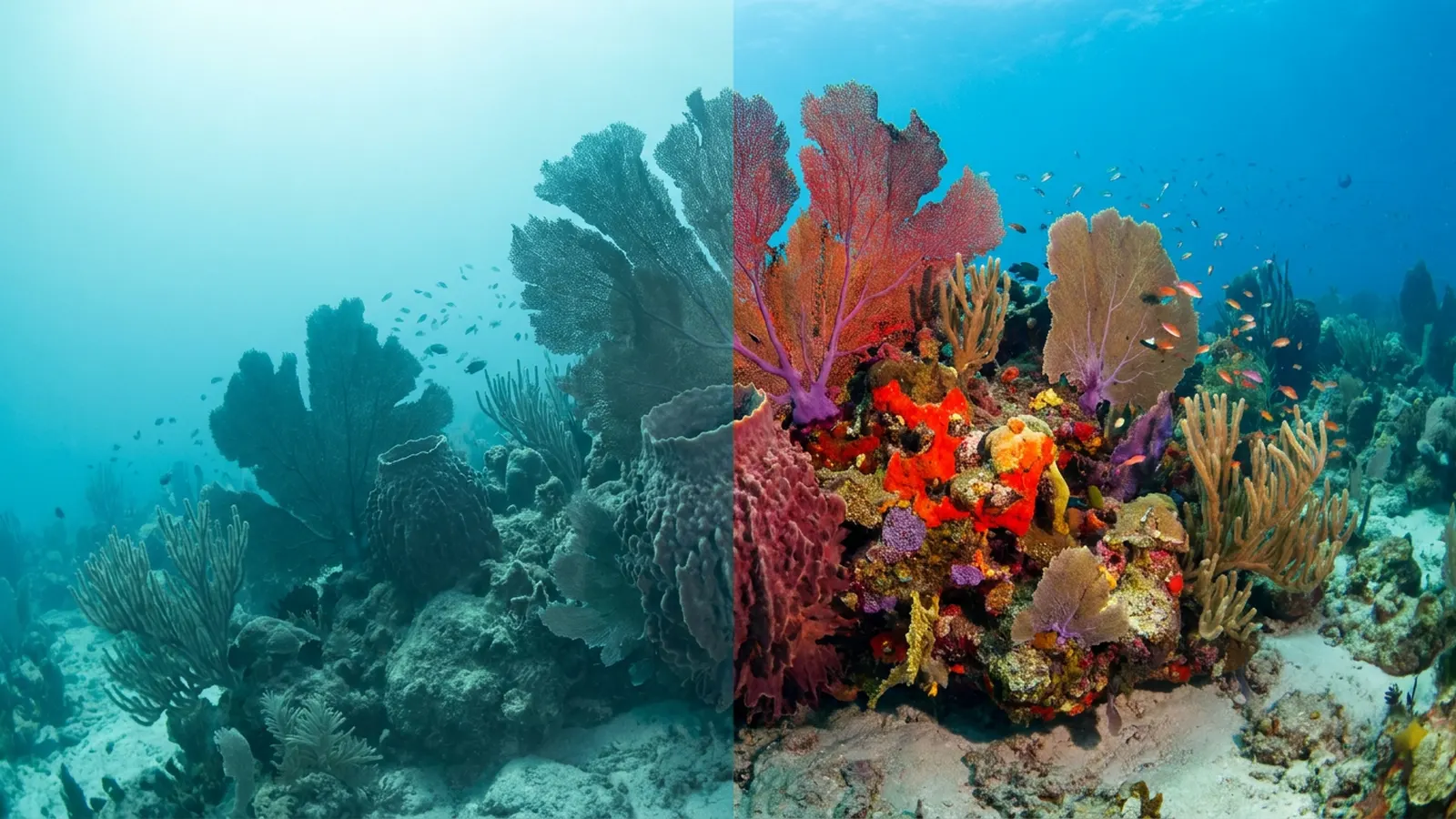
Because water absorbs light selectively. Sunlight contains all the colours of the spectrum, but water molecules absorb the longer, red wavelengths much more strongly than the shorter blue ones. Red begins to fade within the first few metres of descent, orange and yellow follow as you go deeper, and green and blue penetrate furthest. NOAA notes that by around 100 metres red light no longer penetrates at all, which is why so many deep-sea animals are red: in the dark, red looks black.
The distance that matters is not just depth but the total path the light travels: from the surface down to the subject and then sideways from the subject to the camera. A red sponge two metres away at 15 metres depth has lost its colour twice over. That is why photos of distant reef scenes look washed-out blue even in shallow water, and why getting close helps so much.
What does a strobe actually fix?
A strobe, or underwater flash, carries a full spectrum of light down with you. Fired from close range, it puts back the reds, oranges and yellows that the water has absorbed on the way down, so the subject shows its true colours. The catch is that the strobe’s own light is absorbed by water too, on its way to the subject and back. Strobes are effective over a metre or two at most, and the closer you are, the more vivid the result.
In very shallow, bright water there are alternatives. A red filter on the lens in blue tropical water, or a magenta filter in green water, removes some of the excess blue or green and lets the camera balance the colour, as long as there is enough sunlight. Shooting in RAW and setting a custom white balance on a neutral patch of sand works in the same range. Neither can restore colour that was never recorded; for that, see our guide to colour correction in Photoshop and Lightroom.
What is backscatter and how do you avoid it?
Backscatter is the snowstorm of bright specks that appears when a strobe lights up particles floating between the lens and the subject: plankton, sediment and organic debris. It is the most common reason good underwater photos are spoiled. The cure is geometry. Position strobes out to the sides and slightly back, angled so that the centre of their beam misses the water directly in front of the lens and only the edge of the beam lights the subject.
Everything else helps too. The closer you are to the subject, the less water and therefore fewer particles sit between lens and subject. Good buoyancy keeps you off the bottom so you do not kick up silt. And in poor visibility, macro subjects are always easier than wide-angle scenes, simply because there is so little water in the picture.
Why does everything look bigger underwater?
Through a diving mask or a flat camera port, light bends as it passes from water into air. The effect, set by the refractive index of water, makes subjects look roughly a third larger and about a quarter closer than they really are. Divers learn to correct for it when judging distances; photographers have to deal with what it does to lenses.
Behind a flat port, a lens loses part of its field of view and edges of the frame can soften. That suits macro lenses, which are used behind flat ports to gain magnification. Wide-angle and fisheye lenses are instead used behind dome ports, curved windows that largely cancel the refraction and restore the lens’s wide view, at the cost of needing careful focus on a virtual image that sits just in front of the dome.
Macro or wide angle?
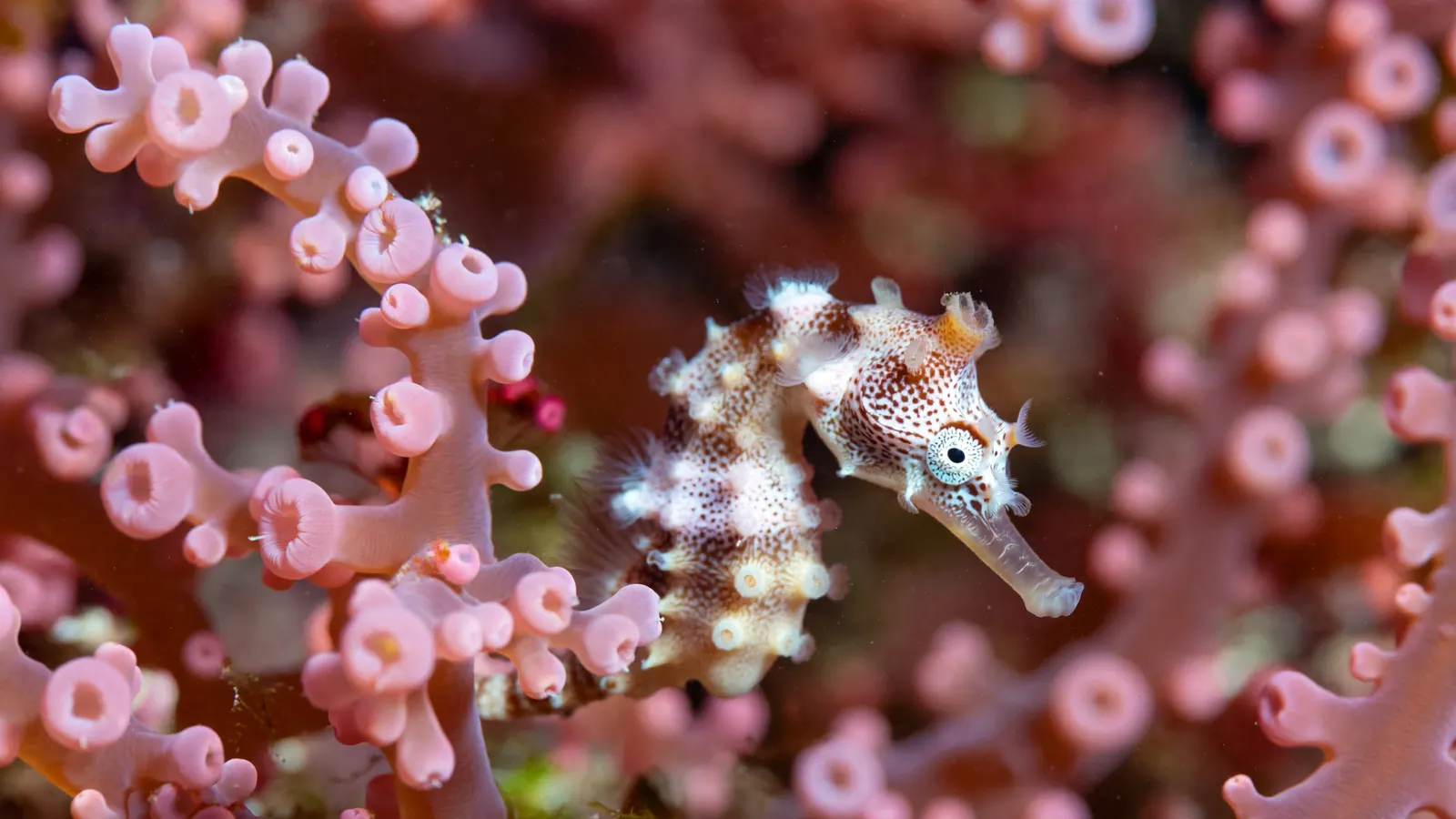
Underwater photography splits into two disciplines that need different lenses, ports and habits. Macro is close-up work on small subjects: nudibranchs, shrimps, gobies, blennies, coral polyps. It works in almost any visibility, needs precise buoyancy and patience, and is the natural place for beginners to start. Wide angle covers reef scenes, wrecks, large animals and divers. It needs clear water, careful strobe placement or good natural light, and the confidence to get very close to big subjects so they fill the frame.
Most experienced photographers pick one set-up per dive, because changing lenses underwater is impossible with most housings. Wet lenses, which clip onto the outside of the port, offer some flexibility, but the rule still applies: decide what you are going to photograph before you get wet.
How is photographing a reef tank different?
In some ways it is easier: no buoyancy, no air limit and subjects that cannot swim away very far. But the aquarium brings its own problems. Reef lighting is usually heavily blue, so photos come out looking violet unless you correct the white balance or use a filter matched to the lights. The front glass reflects the room behind you, so photographers shoot with the room lights off, the lens close to or touching the glass and a dark cloth if needed. And tiny scratches, algae film and bubbles on the glass show up instantly at macro distances.
Shooting straight through the glass, rather than at an angle, avoids distortion and colour fringing. A macro lens shows coral polyps and small fish in detail that the eye easily misses, and some of the most striking photos in our galleries are of coral tissue and polyps that are only a few millimetres across.
How do you photograph marine life responsibly?
By putting the animal and the reef ahead of the picture. Master buoyancy before carrying a camera, because a diver focused on a viewfinder who kicks or kneels on coral does more damage than any photograph is worth. Do not move or handle animals to get a better background, chase animals that are trying to leave, or bait fish to draw them in. Limit the number of flashes on sensitive subjects, such as seahorses and small, light-sensitive animals, and respect local rules on photography in marine parks.
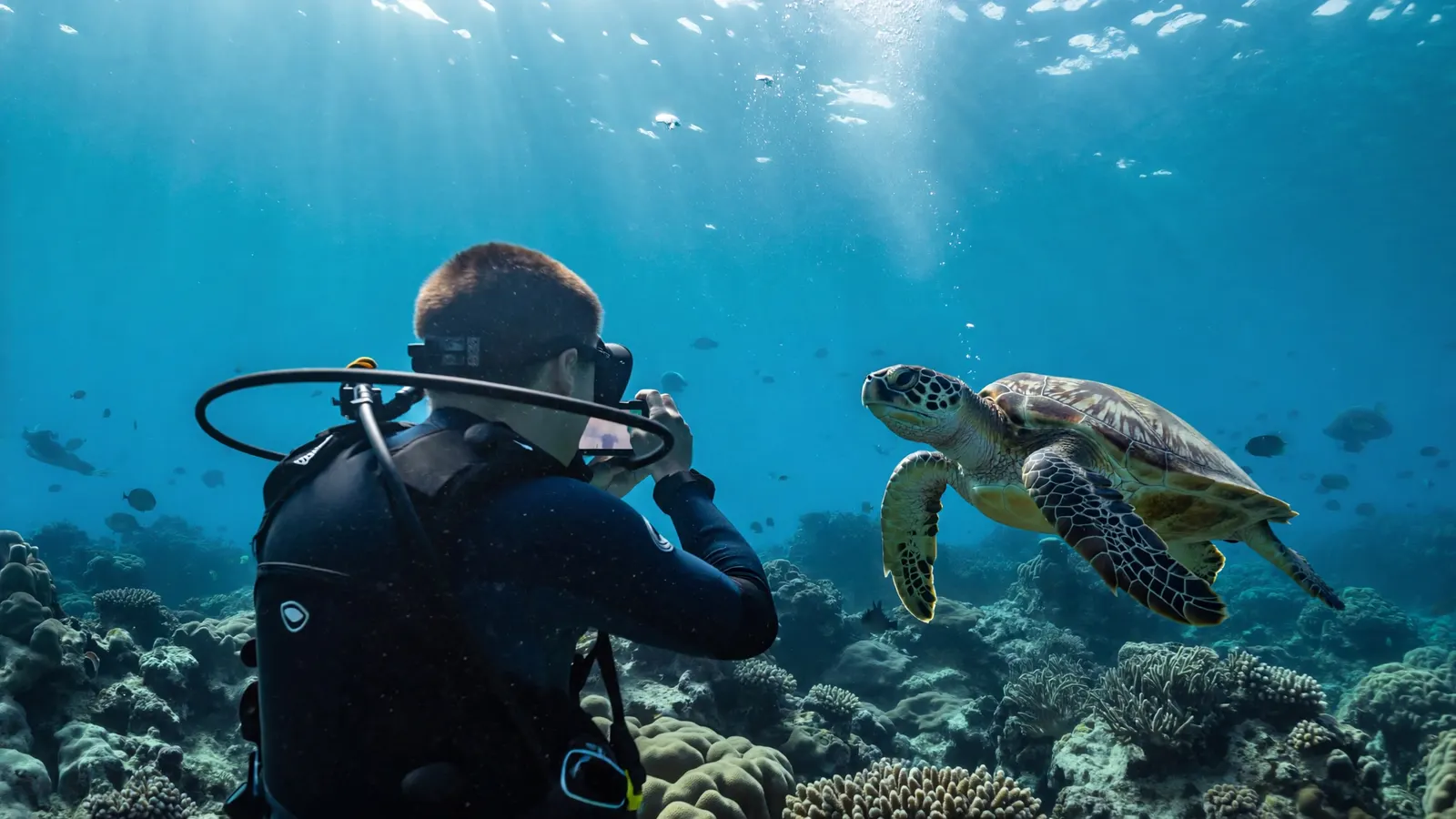
Patience is both the ethical choice and the better technique. Animals that are not being pursued behave naturally, come closer and give you the moments that make memorable photographs: a goby peering out of its burrow, a cleaner shrimp at work, a turtle that has decided you are no threat.
Why do underwater photos look blue?
Water absorbs red, orange and yellow light first, leaving mostly blue and green at depth.
Do I need a strobe for underwater photography?
Not in very shallow, bright water, but below a few metres a strobe is the only way to restore full colour.
What is backscatter?
Bright specks caused by a strobe lighting particles in the water between lens and subject.
Why do things look bigger underwater?
Refraction at a flat mask or port makes subjects look about a third larger and closer.
Should beginners start with macro or wide angle?
Macro is usually easier: it works in poorer visibility and with simpler gear.
How do you photograph a reef tank?
Turn off room lights, shoot straight through clean glass, and correct for blue lighting with white balance or a filter.
- NOAA Ocean Explorer, “Why are so many deep-sea animals red?” (light absorption with depth)
- Underwater optics: refraction at flat and dome ports (refractive index of water about 1.33)
Blane Perun has been exploring Earth’s oceans and marine life for over 25 years. Founder of TheSea.Org in 1999, underwater photographer, coral aquaculture pioneer, and explorer of 80+ countries.
About Blane Perun →