Scuba Diving Equipment — The Complete Gear List, What It Costs and What to Buy First
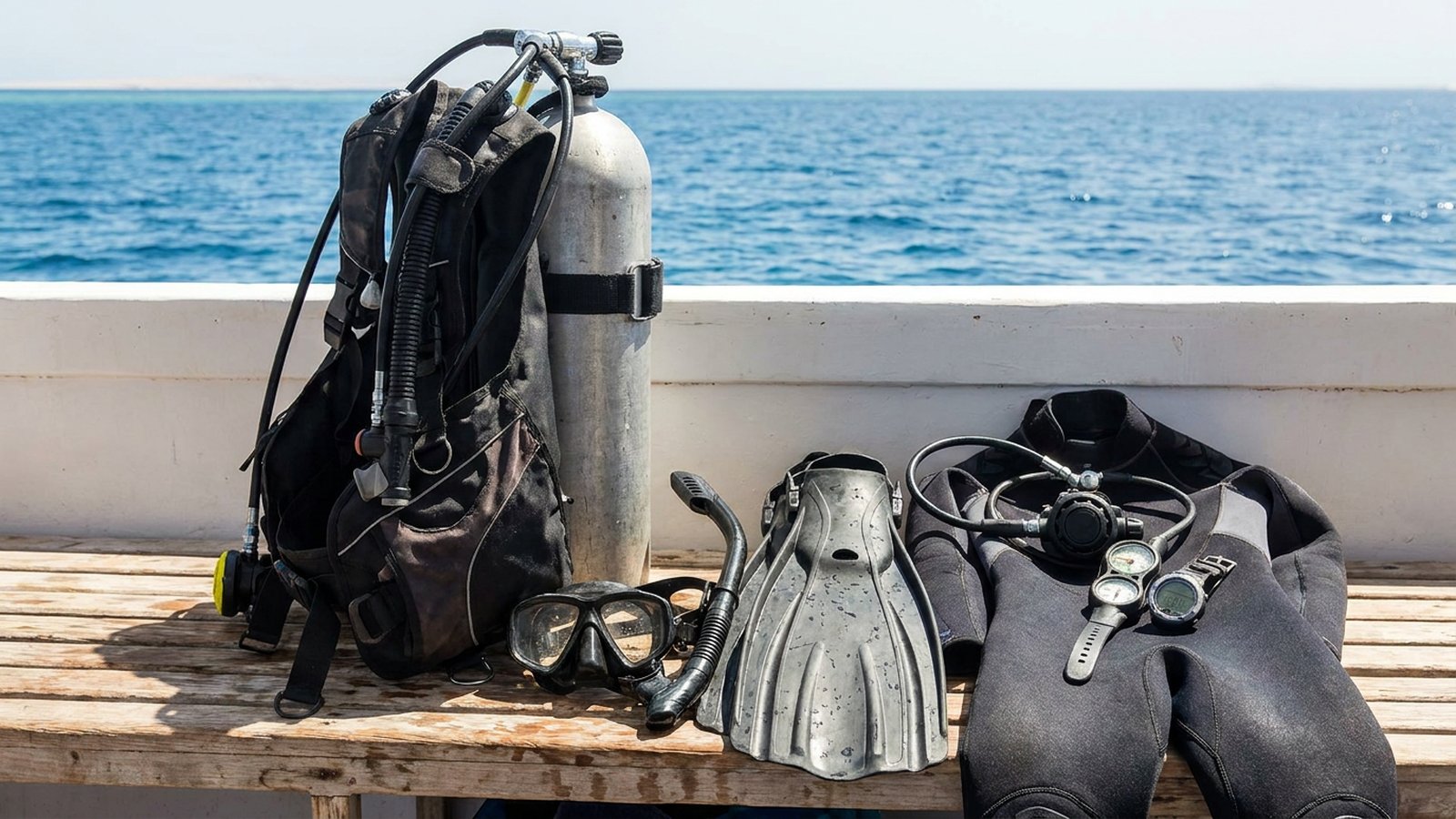
Scuba diving equipment falls into three groups: life support (tank, regulator, BCD, dive computer), personal gear (mask, fins, boots, exposure suit) and accessories (weights, light, cutting tool, camera). PADI’s 2026 guide puts a basic complete set at about $1,700 and a mid-range set at $2,700–$3,100, while renting a full set costs about $60 a day. Most new divers buy a mask, fins and a computer first and rent the rest. Every item has its own guide below.
What equipment do you need to scuba dive?
At minimum: a mask, fins, an exposure suit, a buoyancy compensator (BCD), a regulator with an alternate air source and a pressure gauge, a cylinder, weights and a dive computer. Boots, a cutting tool, a light and a surface marker buoy are standard additions depending on where you dive.
“Scuba” stands for self-contained underwater breathing apparatus, and the core of the equipment is exactly that: a cylinder of compressed gas, a regulator that delivers it at the pressure you need to breathe, and a buoyancy compensator that holds the cylinder on your back and lets you float, sink or hover. Everything else either keeps you comfortable (mask, fins, suit, boots, gloves), keeps you informed (computer, gauge, compass) or keeps you safe in unusual situations (alternate air source, cutting tool, surface marker buoy, light). It helps to think of the kit in three groups. Life-support equipment is the cylinder, regulator, BCD and computer. Personal gear is the mask, fins, boots and exposure suit. Accessories include weights, a light, a cutting tool, a marker buoy and a camera. The groups differ not just in what they do but in how you should acquire them, which is the main decision a new diver faces.
| Item | What it does | PADI price guide (USD, March 2026) | Buy or rent first? |
|---|---|---|---|
| Mask, fins and snorkel | Vision, equalising, propulsion | $150–$250 together | Buy |
| Booties or boots | Warmth and protection; fit open-heel fins | $45–$50 booties; $50–$90 soft-sole; $120–$150 hard-sole | Buy |
| Dive computer | Depth, time, no-stop limits, ascent rate, log | $250–$400 basic; $400–$600 with console | Buy early |
| Wetsuit | Thermal insulation | about $300 (3 mm); $350–$650 (5 mm); $400–$650 (7 mm) | Buy once diving regularly |
| Drysuit | Warmth in cold water | $1,800–$4,000 off the rack, plus $180–$400 undergarment | Rent or take a course first |
| Regulator | Delivers breathing gas from the cylinder | $650–$800 | Rent from reputable shops, then buy |
| BCD | Buoyancy control; carries the cylinder | $310–$550 basic; $800–$1,000 backplate and wing; $1,000+ top models | Rent, then buy |
| Gloves and hood | Warmth and protection | $25–$60 gloves; about $30 hood | Buy for cold water |
| Cylinder and weights | Gas supply; ballast | not priced (most divers rent) | Usually rent |
| Dive bag | Transport | $50–$100 mesh or duffle; $150–$230 roller | Optional |
The prices in the table come from PADI’s gear-cost guide by Megan Denny, published on 7 March 2026. They are typical US retail prices for name-brand equipment and will vary by region, season and brand. PADI’s basic full set, about $1,700, includes a mask, fins, snorkel, wetsuit and booties but not a drysuit, cylinder, weights or dive bag. The mid-range set, $2,700 to $3,100, assumes no drysuit and no bag. Cylinders and weights are not priced, because most divers rent them wherever they dive. For a fuller cost breakdown, see how much scuba gear costs.
How does the life-support equipment work?
The cylinder stores gas at high pressure, the regulator reduces it in two stages to the pressure around you, and the BCD and computer let you control your depth and stay within safe limits.
Cylinder. The workhorse of tropical dive resorts is the aluminium “80”, an aluminium cylinder with an internal volume of about 11 litres. At its rated working pressure of 3,000 psi (207 bar), it holds a nominal 80 cubic feet, or about 2,300 litres, of gas measured at surface pressure. In the United States, scuba cylinders fall into three working-pressure classes: low pressure (2,400 to 2,640 psi, 165 to 182 bar), standard (3,000 psi, 207 bar) and high pressure (3,300 to 3,500 psi, 227 to 241 bar). Elsewhere, 232 bar is a very popular rating for both steel and aluminium cylinders. Steel cylinders are often lighter than aluminium ones of the same gas capacity because steel is stronger, so they also need less ballast. Aluminium cylinders are more buoyant, which suits warm-water diving where the suit adds little buoyancy. Every cylinder must be periodically requalified. In the United States the Department of Transportation requires a hydrostatic test every five years but does not require an annual visual inspection, and other countries set their own intervals.
Regulator. A scuba regulator works in two stages. The first stage, mounted on the cylinder valve, reduces the cylinder pressure to an intermediate pressure, typically about 8 to 10 bar above ambient. The second stage, the demand valve in your mouth, drops that to ambient pressure and delivers gas only when you inhale. The single-hose design used today was invented in the early 1950s by the Australian Ted Eldred. Secondary demand valves, pressure gauges and low-pressure inflator hoses were later added to the first stage. The first stage connects to the cylinder by one of two fittings. The yoke (A-clamp or CGA 850) is rated to a maximum of 240 bar, while the DIN fitting screws into the valve and can withstand up to 300 bar, allowing high-pressure steel cylinders. The DIN system is less common worldwide, and plug adaptors rated to 232 or 240 bar can be screwed into suitable DIN valves so that they accept a yoke regulator. Our regulator guide covers models and servicing.
Alternate air source and gauge. Every recreational diver carries a second demand valve, usually called an octopus, so that a buddy who runs out of air can breathe from it. It is not truly redundant for the diver carrying it, because it shares the same cylinder and first stage. Only an independent supply such as a pony or bailout cylinder offers full redundancy. The submersible pressure gauge, or a wireless transmitter linked to a dive computer, shows how much gas remains in the cylinder and is the instrument you check most often during a dive.
BCD. A buoyancy compensator is an inflatable bladder that lets a diver be neutrally buoyant underwater and positively buoyant at the surface. Because the gas inside obeys Boyle’s law, its volume, and so the lift it provides, changes with depth. That is why you add small amounts of air as you descend and vent it as you ascend. Early designs were horse-collar life jackets worn around the neck, developed in the 1960s from wartime life vests. They have largely been replaced by jacket-style BCDs and back-mounted wings, which keep the diver level in the water. PADI prices a basic BCD with integrated weight pockets at $310 to $550, top models at over $1,000 and a backplate, harness and wing at $800 to $1,000. See our BCD guide for the trade-offs.
Dive computer. A dive computer measures depth and elapsed time and runs a decompression algorithm to show how long you can stay at your current depth before you would need decompression stops, the no-stop limit. Unlike printed dive tables, it calculates continuously from your actual profile rather than assuming the whole dive was spent at the deepest point. It warns of excessive ascent rates and missed stops, and many models also log the dive, track water temperature, monitor oxygen exposure on nitrox and read cylinder pressure from a transmitter. Because it tracks every dive, continuity matters: a rented computer knows nothing about the dive you did yesterday, which is why many divers buy one early. PADI prices basic computers at $250 to $400 and models with a two-gauge console at $400 to $600. See our dive computer guide.
What personal gear do you need?
A mask that fits your face, fins and boots you can kick in for an hour, and an exposure suit matched to the water temperature.
Mask. A diving mask must enclose the nose as well as the eyes. As you descend, the air in the mask is compressed and has to be topped up by breathing out through the nose to avoid mask squeeze, a form of barotrauma around the eyes. That is why swimming goggles cannot be used for scuba. Scuba masks use tempered glass lenses, either one faceplate or two lenses, with a soft silicone skirt that seals against the face. Fit is personal. Faces differ enough that the right mask is simply the one that seals on yours, which is why the mask is almost everyone’s first purchase. Our mask guide explains how to test the fit in a shop.
Fins and boots. Fins exist because human feet are too small and the wrong shape to push a diver loaded with equipment efficiently through the water. They come in two styles. Full-foot fins slip on like a shoe and are worn barefoot or with thin socks, and the first, the Cressi Rondine, was designed in 1948. Open-heel fins have an adjustable strap and are worn over neoprene boots, which add warmth and protect your feet on rocky shore entries and boat decks. PADI prices booties at $45 to $50, soft-sole boots at $50 to $90 and hard-sole boots at $120 to $150. Thicker suits and boots compress with depth, which changes how a fin strap fits, so buy fins and boots together. See fins and boots.
Exposure suit. Wetsuits are made of foamed neoprene, whose insulation comes from tiny gas bubbles trapped in the rubber. The same bubbles make the suit buoyant, and they compress as you go deeper, so a wetsuit loses some warmth and buoyancy with depth. Suits range from thin shorties covering only the torso to 8 mm semi-dry suits worn with hood, boots and gloves. PADI prices a name-brand 3 mm wetsuit at about $300, a 5 mm at $350 to $650 and a 7 mm at $400 to $650. In cold water, a drysuit keeps the diver dry and relies on undergarments for warmth. It is fitted with an inflation valve and a dump valve, because the air inside must be adjusted with depth just like a BCD, so drysuit diving takes practice beyond basic training. Membrane drysuits are made of trilaminate or rubberised fabric and depend entirely on the undergarments for insulation. See our wetsuits and drysuits guide, and gloves for hands.
What accessories do divers carry?
Weights to sink, a cutting tool for entanglement, a light for colour and night dives, and a surface marker buoy so the boat can find you.
Weights. Divers carry ballast to offset the buoyancy of their body, suit and equipment. Weights are almost always lead, chosen for its high density, low cost, ease of casting and resistance to corrosion. They come as blocks threaded on a belt, cast shapes, or pellets of lead shot in pouches, and many BCDs have integrated weight pockets. Whatever the system, the weights must be releasable quickly in an emergency. Most divers rent weights with the cylinder, so the main skill is working out how much you need, which changes with the suit, the cylinder and salt or fresh water.
Surface marker buoy. Two kinds are used. A surface marker buoy (SMB) is towed throughout the dive to show the group’s position. A delayed surface marker buoy (DSMB) is inflated and sent up on a line towards the end of the dive to show the boat that the divers are ascending and where they will surface. Recreational divers and dive operators widely consider a DSMB important safety equipment, yet deploying one is not part of entry-level training with every agency, and incompetent use carries significant hazards. Practise in shallow water before relying on it.
Cutting tool, light and other extras. A dive knife or line cutter is an entanglement tool, not a weapon,. A light restores colours that the water absorbs, so reds and oranges reappear on the reef, and it is essential at night. A dive watch makes a useful backup to a computer but not a replacement. Ordinary ear plugs are dangerous underwater because they trap an air space that cannot be equalised. Only vented plugs designed for diving should be used. Hard-hat diving helmets are surface-supplied professional equipment, not part of a recreational scuba set.
What should I buy first?
The gear that touches your face and feet, then a computer. Rent the heavy life-support items until you know what you like and how often you will dive.
PADI’s advice follows a simple logic. Renting is useful for trying different equipment and for finding out whether diving will be a long-term interest. But rental costs add up. The guide’s author found that three BCD rentals cost almost half the price of a new BCD, and for committed divers owning is much cheaper. Wetsuits should be tried on before buying, ideally at a local dive shop. Renting a regulator is reasonable only if you dive rarely, and only from a reputable operation, since a poorly serviced regulator is dangerous. Drysuit divers should know that rental drysuits are often unavailable and should contact the shop in advance. The guide also advises women divers to rent BCDs before buying.
Is it cheaper to buy or rent scuba gear?
For frequent divers, buying. At about $60 a day, renting a full set overtakes PADI’s $1,700 basic set after roughly 28 diving days, before you count servicing.
The break-even arithmetic is straightforward: $1,700 divided by $60 is just over 28 days. A diver who does one week-long trip a year might take three or four years to reach that point. Someone who dives most weekends would get there within a season. The calculation is not quite that simple, because owned regulators and BCDs need periodic servicing, cylinders need requalification, and travelling with a full set adds baggage fees. Rental prices also vary widely by destination, and PADI’s $60 a day or $100 a weekend is a typical US figure, not a universal one.
That is why the common pattern is a hybrid. Most divers own the mask, fins, boots and computer from the start, add a suit once they know the water temperatures they dive in, and buy the regulator and BCD once they are diving several times a year. Cylinders and weights stay rented almost everywhere. Whatever you buy, buy life-support equipment from a shop that can service it, and have any second-hand regulator, BCD or computer inspected before you dive it. A bargain regulator with an unknown history is not a bargain. For first steps in the sport, see scuba diving for beginners.
What equipment do you need for scuba diving?
A mask, fins, exposure suit, BCD, regulator with an alternate air source and pressure gauge, cylinder, weights and a dive computer, plus boots, a cutting tool and a surface marker buoy for many dives.
How much does a full set of scuba gear cost?
About $1,700 for a basic set and $2,700 to $3,100 for a mid-range set, according to PADI’s March 2026 guide. Neither figure includes a drysuit, cylinder, weights or bag.
What scuba gear should I buy first?
A mask, fins and boots, and a dive computer. Add an exposure suit next, then a BCD and regulator once you dive regularly.
How much does it cost to rent scuba gear?
PADI gives about $60 a day or $100 a weekend for a complete set with wetsuit in the US. Prices vary by destination.
Can I use swimming goggles for scuba?
No. A diving mask must cover the nose so you can equalise the air space as you descend. Goggles cannot be equalised and cause mask squeeze.
What is the difference between DIN and yoke regulators?
Both connect the regulator to the cylinder. Yoke (A-clamp) fittings are rated to 240 bar; DIN fittings screw into the valve and are rated to 300 bar, so they suit high-pressure steel cylinders.
How often does a scuba tank need testing?
In the United States, the DOT requires a hydrostatic test every five years. Annual visual inspections are not federally required there. Other countries set different intervals.
Do I need my own dive computer?
It is the most useful early purchase after a mask and fins, because it keeps a continuous record of your dives and no-stop calculations from one day to the next.
- Denny, M. (7 March 2026). How much does dive gear cost? PADI Blog.
- Wikipedia (Kiwix snapshot, 2023): Diving cylinder; Diving regulator; Buoyancy compensator (diving); Dive computer; Alternative air source
- Wikipedia (Kiwix snapshot, 2023): Diving mask; Swimfin; Wetsuit; Dry suit; Diving weighting system; Surface marker buoy
Blane Perun has been exploring Earth’s oceans and marine life for over 25 years. Founder of TheSea.Org in 1999, underwater photographer, coral aquaculture pioneer, and explorer of 80+ countries.
About Blane Perun →