The Five Oceans of the World — One Connected Ocean, Five Great Basins
Five: the Pacific, Atlantic, Indian, Southern and Arctic. Strictly, there is one global ocean, since all five are connected; the divisions follow continents, ridges and currents. The ocean covers about 71% of Earth’s surface. A 2010 study by Woods Hole and NOAA scientists put its total volume at about 1.332 billion km³ and its average depth at 3,682 m.
How many oceans are there?
Earth has one continuous body of salt water, the world ocean, which wraps around the continents and covers about 71% of the planet’s surface. For convenience, geographers divide it into five named oceans: the Pacific, Atlantic, Indian, Southern and Arctic. The boundaries between them follow continents, undersea ridges, narrow straits and, in the case of the Southern Ocean, a great current, but water moves freely across all of them. A drop of water off California may, over centuries, travel through every ocean basin on Earth.
The world ocean is enormous. In 2010, Matthew Charette of the Woods Hole Oceanographic Institution and Walter Smith of NOAA used satellite-derived measurements of seafloor depth to recalculate its size, arriving at a volume of about 1.332 billion cubic kilometres and an average depth of about 3,682 m. That volume holds roughly 97% of all the water on Earth. Spread evenly over a smooth planet, it would form a layer more than two and a half kilometres deep.
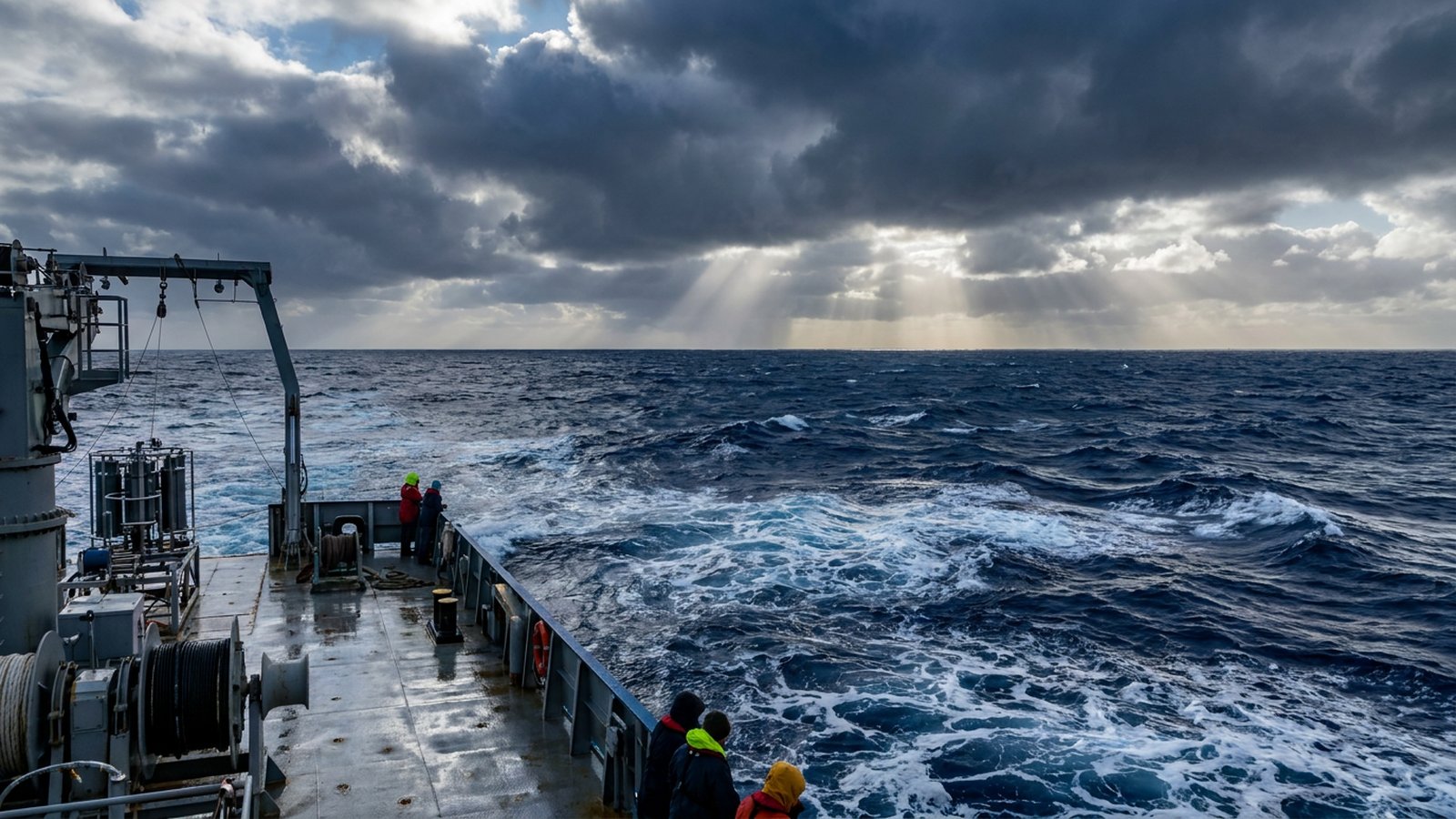
How do the five oceans compare?
The Pacific is by far the largest and deepest; the Arctic is the smallest and shallowest.
| Ocean | Approx. area (million km²) | Deepest point | Depth |
|---|---|---|---|
| Pacific | ~155–168 | Challenger Deep, Mariana Trench | ~10,924 m |
| Atlantic | ~77–106 | Brownson Deep, Puerto Rico Trench | ~8,378 m |
| Indian | ~68–75 | Java (Sunda) Trench | ~7,187 m |
| Southern | ~20–22 | South Sandwich Trench | ~7,432 m |
| Arctic | ~14–15.5 | Molloy Deep, Fram Strait | ~5,551 m |
Published figures for ocean areas vary because sources draw boundaries differently, especially for marginal seas such as the Mediterranean, Caribbean, Gulf of Mexico and South China Sea, and because some older sources include the Southern Ocean’s waters within the Pacific, Atlantic and Indian oceans. Using one widely cited set of figures, the Pacific covers about 168.7 million km², nearly half of the world ocean and around a third of Earth’s entire surface; the Atlantic about 85 million km²; the Indian about 70.6 million km²; the Southern about 22 million km²; and the Arctic about 15.6 million km². Average depths follow a similar pattern: close to 4,000 m in the Pacific, roughly 3,600–3,750 m in the Atlantic and Indian oceans, about 3,300 m in the Southern Ocean and only about 1,200 m in the Arctic, much of which sits on broad, shallow continental shelves.
The deepest point in each ocean was surveyed with a single full-ocean-depth sonar system during the Five Deeps Expedition of 2018–2019, led by explorer Victor Vescovo. Analysing that data, scientists put the Challenger Deep in the Mariana Trench at about 10,924 m (±15 m), Brownson Deep in the Puerto Rico Trench at about 8,378 m, the deepest point of the South Sandwich Trench within the Southern Ocean at about 7,432 m, a deep in the Java Trench at about 7,187 m, and the Molloy Hole in the Fram Strait of the Arctic at about 5,551 m. The same survey mapped some 550,000 km² of seafloor, much of it never surveyed before.
The Pacific Ocean
The Pacific stretches from the Arctic to Antarctica and from Asia and Australia to the Americas. It is larger than all of Earth’s land area combined and holds about half of the world ocean’s water. The Spanish explorer Vasco Núñez de Balboa, crossing the Isthmus of Panama in 1513, called it the Mar del Sur, the “South Sea”. Its modern name comes from Ferdinand Magellan’s expedition, which crossed it in 1520–1521 and, after the storms off the tip of South America, found its waters calm enough to call them pacífico, “peaceful”. The name is misleading: the Pacific is ringed by subduction zones, trenches and volcanoes known as the Ring of Fire, and it generates more great earthquakes and tsunamis than any other ocean. It also contains the largest coral reef system, the Great Barrier Reef.
The Atlantic Ocean
The Atlantic separates the Americas from Europe and Africa. Its name goes back to ancient Greek writers, including Herodotus around 450 BC, who referred to the “Sea of Atlas” beyond the Pillars of Heracles at the Strait of Gibraltar. Down its middle runs the Mid-Atlantic Ridge, a volcanic mountain chain where new seafloor forms as the American plates move away from the Eurasian and African plates, so the Atlantic is still slowly widening. It is one of the younger ocean basins, having opened as the supercontinent Pangaea broke apart. The Atlantic is also the engine of the global overturning circulation: in the far north, near Greenland and in the Labrador and Nordic seas, cold, salty surface water sinks to form North Atlantic Deep Water, which then spreads south through the deep ocean. The Gulf Stream carries warm water from the tropics towards Europe, one reason north-western Europe is milder than other regions at the same latitude.
The Indian Ocean
The Indian Ocean is the third largest and the warmest of the major oceans. Unlike the Pacific and Atlantic, it is closed to the north by the land mass of Asia, which gives it its most distinctive feature: the monsoon. Seasonal heating and cooling of the Asian continent reverses the winds over the northern Indian Ocean twice a year, and the surface currents reverse with them. For thousands of years these predictable winds carried traders between East Africa, Arabia, India and South-East Asia. The Indian Ocean’s deepest known point lies in the Java Trench south of Indonesia, where the Indo-Australian Plate slides beneath the Eurasian Plate, the same subduction zone that produced the 2004 Indian Ocean earthquake and tsunami.
The Southern Ocean
The waters encircling Antarctica, recognised as a separate ocean because the Antarctic Circumpolar Current gives them distinct properties and ecology.
The Southern Ocean surrounds Antarctica and is usually defined as the water south of 60° S. The International Hydrographic Organization included it, with that boundary, in a 2000 revision of its guidelines on the limits of oceans and seas; the revision has never been formally adopted because of unrelated disputes, but the definition is widely used. National Geographic recognised the Southern Ocean as the fifth ocean in June 2021, and most atlases now count five oceans rather than four. What makes the Southern Ocean distinct is the Antarctic Circumpolar Current, which flows eastward around the continent without interruption by land. It is the largest ocean current on Earth by volume, and it isolates Antarctica’s cold waters from the warmer oceans to the north. The Southern Ocean is also where Antarctic Bottom Water, the densest water in the ocean, forms beneath sea ice before spreading along the seafloor into all the major basins.
The Arctic Ocean
The Arctic Ocean is the smallest and shallowest of the five, almost enclosed by North America, Greenland and Eurasia, and connected to the Atlantic mainly through the Fram Strait and the Barents Sea and to the Pacific through the narrow Bering Strait. Some oceanographers treat it as a marginal sea of the Atlantic. Much of it is covered by sea ice, almost completely in winter, but its summer ice cover has declined sharply since satellite records began in 1979, and the Arctic is warming faster than the global average. The first surface crossing of the frozen ocean was led by Wally Herbert in 1969, by dog sled from Alaska to Svalbard. Today, the shrinking ice is opening new shipping routes and new questions about how the ecosystem will cope.
How is the ocean divided by depth?
Oceanographers also divide the ocean vertically, into layers defined by light and depth. The sunlight (epipelagic) zone, from the surface to about 200 m, receives enough light for photosynthesis and holds most familiar marine life. Below it, the twilight (mesopelagic) zone extends to about 1,000 m; a little light filters down, but not enough for plants, and many animals there make their own light. The midnight (bathypelagic) zone runs from about 1,000 to 4,000 m in permanent darkness, followed by the abyssal zone from about 4,000 to 6,000 m, which covers the vast, sediment-blanketed abyssal plains. The deepest layer, the hadal zone, lies below about 6,000 m and is found almost entirely in ocean trenches. Because the average ocean depth is close to 3,700 m, most of the ocean’s volume lies in the dark, cold zones below 1,000 m, where pressure rises by roughly one atmosphere for every 10 m of depth.
What is the difference between an ocean and a sea?
Oceans are the five great divisions of the world ocean. Seas are smaller bodies of salt water, usually partly enclosed by land, that form parts of an ocean: the Caribbean and the Mediterranean belong to the Atlantic, the South China Sea to the Pacific, and the Arabian Sea to the Indian Ocean. The word “sea” is also used loosely, both for the ocean in general and for some landlocked salt lakes such as the Caspian and Dead seas, which are not part of the world ocean at all. The International Hydrographic Organization publishes the standard reference boundaries for named oceans and seas, used for navigation and charting.
What connects the oceans?
Currents. Wind-driven gyres move surface water around each basin, and a slow global overturning circulation links them all.
At the surface, the trade winds and westerlies drive great rotating current systems, called gyres, in each ocean basin, clockwise in the Northern Hemisphere and anticlockwise in the Southern. Western boundary currents such as the Gulf Stream and the Kuroshio carry heat from the tropics towards the poles. Below the surface, a much slower circulation is driven by differences in temperature and salinity. Cold, salty water sinks near Greenland and around Antarctica, spreads through the deep ocean and gradually rises again, mainly in the Indian, Pacific and Southern oceans. A parcel of water may take on the order of a thousand years to complete the circuit. Because this deep water is so cold, the average temperature of the whole world ocean is only about 4 °C, even though tropical surface waters can be close to 30 °C. See how ocean currents form.
Why do the oceans matter?
The ocean regulates Earth’s climate. Water stores far more heat than air, and according to the Intergovernmental Panel on Climate Change the ocean has absorbed more than 90% of the extra heat trapped by greenhouse gases in recent decades, as well as a large share of the carbon dioxide released by burning fossil fuels. That uptake slows warming on land, but it comes at a cost: the ocean is warming, its surface waters are becoming more acidic, and marine heatwaves are becoming more frequent. Through evaporation, the ocean also drives the water cycle that brings rain to the continents.
Ocean life is just as important. Marine phytoplankton carry out roughly half of the photosynthesis on Earth and produce about half of the oxygen in the atmosphere. Fisheries feed billions of people, and coral reefs, mangroves and seagrass meadows protect coastlines from storms. The ocean floor carries the global mid-ocean ridge system, the longest mountain range on Earth at about 65,000 km, as well as the deepest trenches, the largest volcanoes and ecosystems, such as hydrothermal vent communities, that run on chemical energy instead of sunlight.
How much of the ocean has been explored?
Surprisingly little. Satellites can estimate seafloor depth everywhere, but only at coarse resolution; detailed mapping requires ships with sonar. The international Seabed 2030 project, which aims to map the entire ocean floor in high resolution by 2030, reported in the mid-2020s that only about a quarter of the seafloor had been mapped to modern standards. The deep sea remains the least explored habitat on the planet, and scientists estimate that most marine species have not yet been formally described. Every major deep-sea expedition still turns up animals new to science.
Who explored the oceans?
The history of ocean exploration runs from Polynesian navigators who settled the Pacific by reading stars, swells and birds, through the European voyages of the 15th to 18th centuries, to the scientific expeditions that founded modern oceanography. James Cook’s Pacific voyages in the 18th century charted coasts and islands with unprecedented accuracy, and the British HMS Challenger expedition of 1872–1876 sampled the deep sea in every ocean except the Arctic, discovering thousands of new species. In 1960, Jacques Piccard and Don Walsh reached the bottom of the Challenger Deep in the bathyscaphe Trieste. Meet the people behind these discoveries in our oceanographers series.
How many oceans are there?
Five: the Pacific, Atlantic, Indian, Southern and Arctic, all connected as one world ocean.
Which is the largest ocean?
The Pacific, covering about a third of Earth’s surface and holding about half of the ocean’s water.
Which is the smallest ocean?
The Arctic, about 14–15.6 million km², which is also the shallowest.
How much of Earth is covered by ocean?
About 71% of the surface.
What is the average depth of the ocean?
About 3,682 m, according to a 2010 Woods Hole/NOAA study.
What is the deepest point in the ocean?
The Challenger Deep in the Mariana Trench, Pacific Ocean, about 10,924 m (±15 m).
When did the Southern Ocean become the fifth ocean?
The IHO defined it in a 2000 revision of its guidelines, and National Geographic recognised it in June 2021.
What is the difference between a sea and an ocean?
Seas are smaller, usually partly enclosed by land, and are parts of oceans; for example, the Caribbean is part of the Atlantic.
- Charette, M.A. & Smith, W.H.F. (2010). The volume of Earth’s ocean. Oceanography 23(2).
- Bongiovanni, C., Stewart, H.A. & Jamieson, A.J. (2021). High-resolution multibeam sonar bathymetry of the deepest place in each ocean. Geoscience Data Journal. doi:10.1002/gdj3.122
- Stewart, H.A. & Jamieson, A.J. (2019). The five deeps: the location and depth of the deepest place in each of the world’s oceans. Earth-Science Reviews 197.
- NOAA Ocean Service. How many oceans are there?
- IPCC (2019, 2021). Special Report on the Ocean and Cryosphere; AR6 Working Group I (ocean heat uptake).
- Wikipedia: Ocean; Pacific, Atlantic, Indian, Southern and Arctic Ocean articles (areas, average depths, naming history).
Blane Perun has been exploring Earth’s oceans and marine life for over 25 years. Founder of TheSea.Org in 1999, underwater photographer, coral aquaculture pioneer, and explorer of 80+ countries.
About Blane Perun →