Bottom-Dwelling Reef Fish — Stonefish, Frogfish, Scorpionfish and the Masters of Camouflage on the Seafloor
Fish that spend most of their time resting on, or buried in, the reef floor rather than swimming above it. Many lack a swim bladder or have a reduced one, and rely on camouflage and ambush. This page covers scorpionfish, stonefish and lionfish (Scorpaenidae and relatives), frogfish (Antennariidae), flatfish, stargazers, jawfish, hawkfish, dragonets and flying gurnards.
What makes a fish a bottom dweller?
Biologists divide fish by where they live in the water column. Pelagic fish, such as jacks and tuna, swim in open water. Demersal fish live near the bottom and feed there but still swim above it. Benthic fish, the true bottom dwellers on this page, spend most of their time resting directly on the seabed, wedged into the reef or buried in sand. The distinction matters because life on the bottom shapes almost every part of a fish’s body and behaviour.
Buoyancy is the first change. Open-water fish use a gas-filled swim bladder to hover without effort, but a fish that rests on the bottom gains little from one, and many benthic species have a reduced swim bladder or none at all. Flatfish lose theirs during metamorphosis, and hawkfishes lack one. Without that float, a fish sinks when it stops swimming, which suits an animal that wants to sit still.
Body shape follows. Some bottom dwellers are flattened from top to bottom, with wide heads and eyes on top, like stargazers and crocodilefish. Flatfish are flattened from side to side but lie on one side, so in practice they become low, thin discs. Others, such as stonefish and frogfish, are lumpy and irregular, built to resemble rocks or sponges rather than fish. Eyes and mouths often point upward, because prey arrives from above. Many species have thick, scaleless or warty skin, fleshy flaps and tassels that break up their outline, and the ability to change colour over seconds, hours or days.
Finally, there is a characteristic way of feeding. Most benthic reef fish are sit-and-wait predators. Instead of chasing prey, they rely on camouflage to let prey come close, then strike with explosive suction, expanding the mouth and throat so fast that water and prey rush in together. A low-energy lifestyle with brief bursts of extreme speed is the common thread linking fish as different as a stonefish, a frogfish and a flounder.

Which fish live on the bottom of coral reefs?
The ambushers, the burrowers and the perchers.
| Fish | Strategy | Danger to people | Profile |
|---|---|---|---|
| Stonefish | Looks exactly like a rock; ambush | Extremely venomous spines | Stonefish |
| Scorpionfish | Mottled camouflage with skin flaps | Venomous spines | Scorpionfish |
| Lionfish | Herds prey with fan-like fins | Venomous spines | Lionfish |
| Frogfish | Lures prey with a fishing rod | None | Frogfish |
| Flounder & flatfish | Lie flat, buried, colour-matching | None | Flounder |
| Stargazers | Buried with only eyes and mouth showing | Venomous spines; some give electric shocks | Stargazer |
| Jawfish | Live in self-built burrows | None | Jawfish |
| Hawkfish | Perch on coral tips, pounce | None | Hawkfish |
| Dragonets | Slow pickers on rubble; toxic mucus | None | Dragonet |
| Flying gurnard | Creeps over sand, flashes “wings” | None | Flying gurnard |
How dangerous is a stonefish?
The most venomous fish known, but only if you touch it.
The reef stonefish usually carries 13 dorsal spines, each with venom sacs, that it raises when pressed. Stepping on one injects a mix of proteins (verrucotoxin and related toxins) that causes excruciating pain, swelling and tissue death, and in rare cases heart failure. An antivenom exists, developed in Australia in the late 1950s. Fatalities are rare with treatment. Scorpionfish and lionfish venom is similar but weaker. First aid for all three: immerse the wound in hot water (as hot as tolerable, below about 45°C) for 30–90 minutes and get medical help.
The reef stonefish, Synanceia verrucosa, is the most widespread of the stonefishes, found in shallow water from the Red Sea and East Africa across the Indian Ocean and western Pacific to French Polynesia and southern Japan. It was first described in 1801 by the German naturalists Marcus Bloch and Johann Schneider, and its species name means “covered in warts”. Its skin is scaleless and lumpy, often overgrown with algae, and its small, upward-facing eyes sit in pits on a wide, flat head. The dorsal fin carries 12–14 spines, most often 13, each sheathed in thick skin with paired venom glands at the base. The spines are stiff enough to pierce thin-soled shoes.
The venom is a defensive weapon, not a hunting one. Stonefish catch small fish and crustaceans by suction, swallowing them whole in a fraction of a second, and raise the spines only when pressed from above. That is why nearly all human injuries happen to people wading on reef flats at low tide or placing hands on the bottom. The Australian antivenom produced by the Commonwealth Serum Laboratories since 1959 has made deaths very rare, but a sting is still a medical emergency.
How do scorpionfish and lionfish differ?
Stonefish, scorpionfish and lionfish all belong to the broad scorpionfish group, and all carry venomous fin spines, but they use them and their bodies very differently. Classic scorpionfish, such as the tassled and devil scorpionfish, sit motionless on rock or rubble, coloured and textured to match it, and ambush passing prey much like stonefish. Some, such as the leaf scorpionfish, rock gently from side to side like a drifting leaf. Their venom is generally weaker than a stonefish’s but still very painful.
Lionfish are more active. They hover just above the bottom or under ledges, often at dusk and through the night, and herd small fish and shrimp into corners with their wide, fan-like pectoral fins before swallowing them. The red lionfish, Pterois volitans, reaches up to about 47 cm and lives around 10 years in the wild. Its long, banded spines advertise its venom rather than hiding it, which is the opposite strategy to the stonefish’s camouflage.
How do frogfish fish?
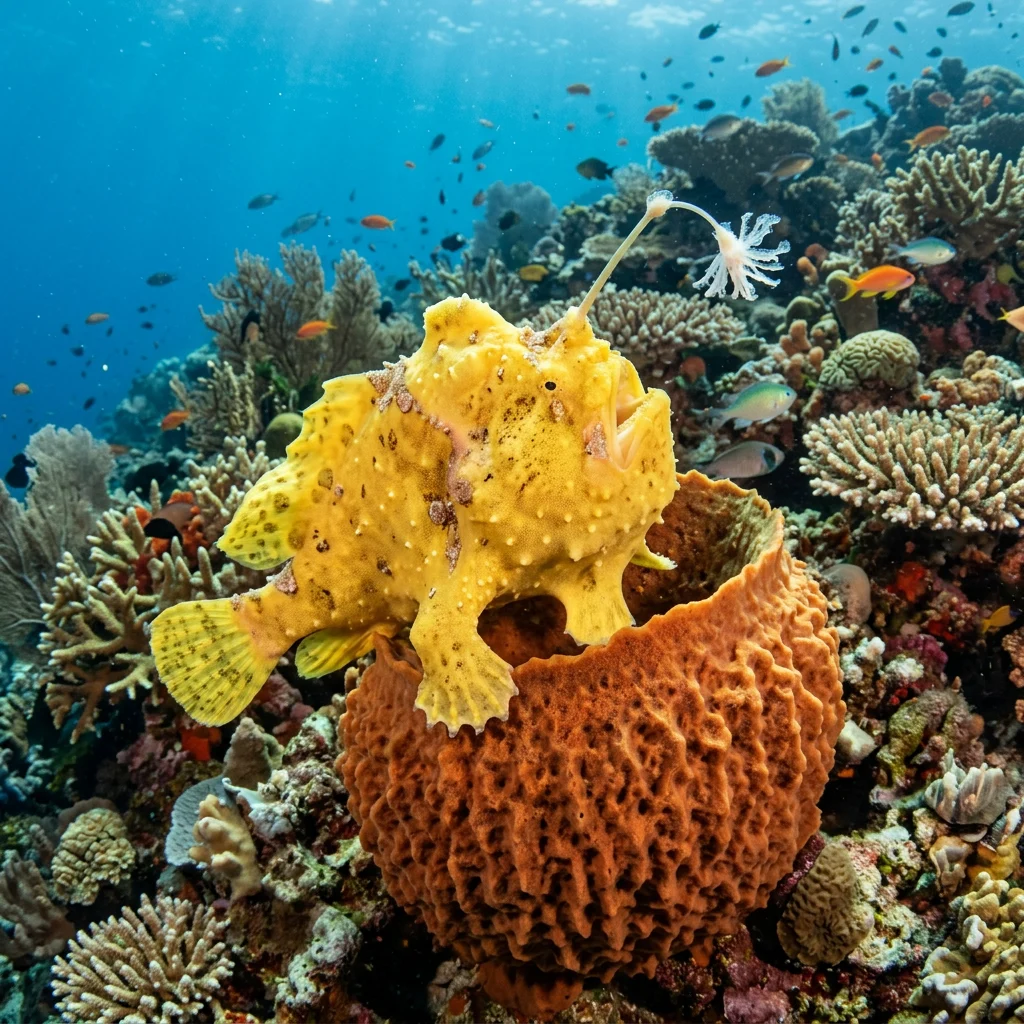
With a rod, a lure and the fastest gulp in the sea.
Frogfish have a modified first dorsal spine (the illicium) tipped with a lure (the esca) that looks like a worm, shrimp or small fish depending on species. The frogfish wiggles the lure, and when prey comes within range it opens its mouth so fast, in about 6 milliseconds, that the prey is sucked in before it can react. Frogfish can swallow prey as long as themselves. They “walk” on their pectoral and pelvic fins and change colour over days to match sponges. The deep-sea anglerfish are close relatives; see deep-sea anglerfish.
The family Antennariidae contains around 50 species, ranging from about 2.5 cm to 38 cm long. They live mainly in tropical and subtropical seas where surface water is above about 20 °C, from the Red Sea and Indian Ocean across the Pacific to the Atlantic. Their camouflage is extraordinarily varied: individuals mimic sponges, sea squirts, coralline algae and, in the case of the striated frogfish discovered in 2005 behaving like a sea urchin, even other animals. The sargassum fish breaks the bottom-dwelling rule entirely, living in drifting mats of sargassum weed and sometimes carried as far as Norway.
Frogfish reproduction is as odd as their hunting. In most species, the female’s belly swells over hours to days as up to 180,000 eggs absorb water. The pair then swims up from the bottom and releases eggs and sperm at the top of the ascent. The eggs are laid in a gelatinous ribbon or raft that can be up to a metre long and drifts at the surface until the larvae hatch two to five days later. A few genera instead lay their eggs on rocks or plants and guard them, and some carry them on their bodies. The partners part quickly after spawning, since the larger female might otherwise eat the smaller male.
Why are lionfish a problem in the Atlantic?
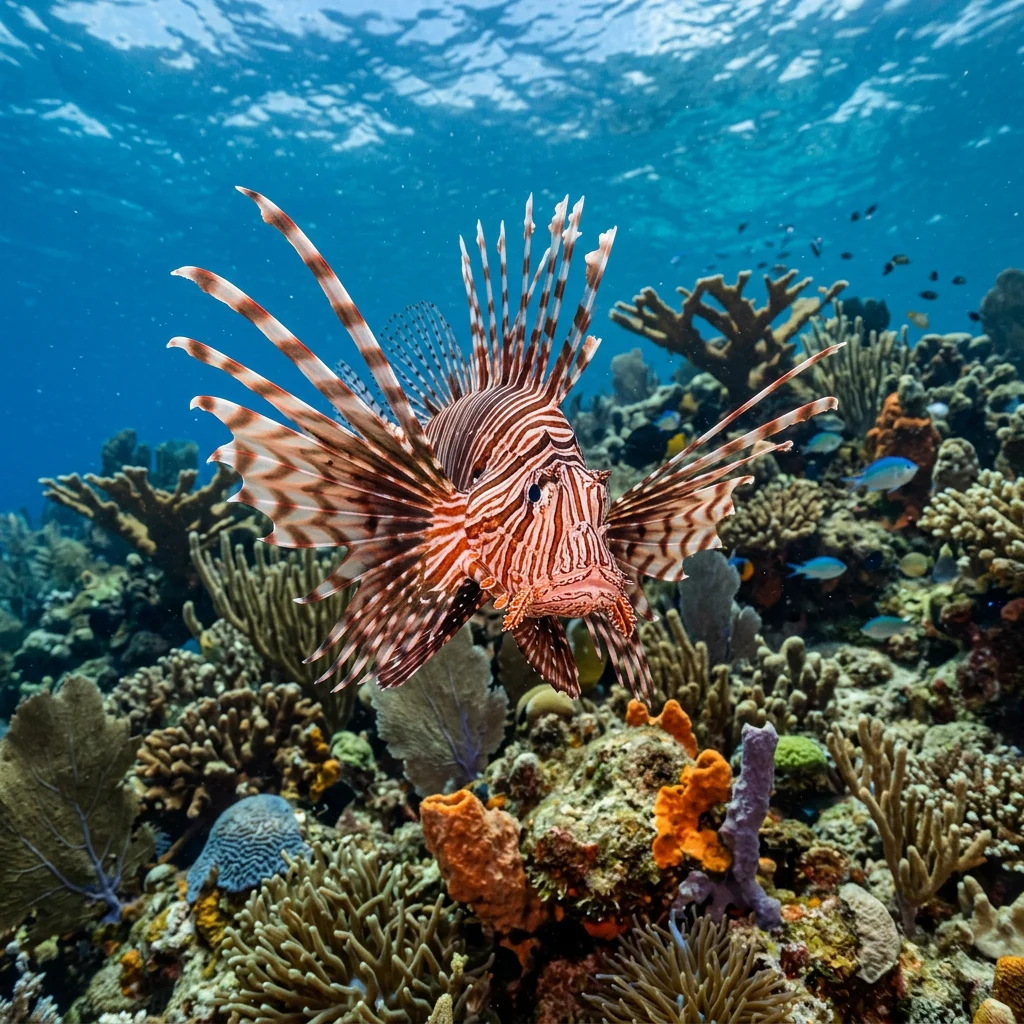
A Pacific predator loose in a new ocean.
Red lionfish and devil firefish, native to the Indo-Pacific, were first recorded off Florida in the mid-1980s, probably from aquarium releases. With no natural predators, high reproduction (a female can release tens of thousands of eggs every few days) and a broad diet, they spread through the Caribbean, Gulf of Mexico and up to North Carolina, and later into the Mediterranean via the Suez Canal. Studies in the Bahamas found a single lionfish could cut recruitment of native reef fish on a small reef by about 80% in five weeks. Culling and lionfish fishing derbies help locally.
In its native Indo-Pacific range, lionfish are held in check by predators, parasites and competitors that have evolved alongside them. In the western Atlantic, most large fish and sharks have not learned to recognise lionfish as food, although lionfish have been found in the stomachs of Nassau and tiger groupers in the Bahamas. Lionfish eat mostly crustaceans and small fish, including juveniles of commercially and ecologically important reef species, and have partly filled the role of overfished snappers and groupers. Because they court and spawn year-round in warm water, releasing floating egg masses, a few founders can produce a large population within years. Removal by divers can keep numbers down on individual reefs, and promoting lionfish as a food fish, which is safe to eat once the spines are removed, has become part of the management effort in Florida and the Caribbean.
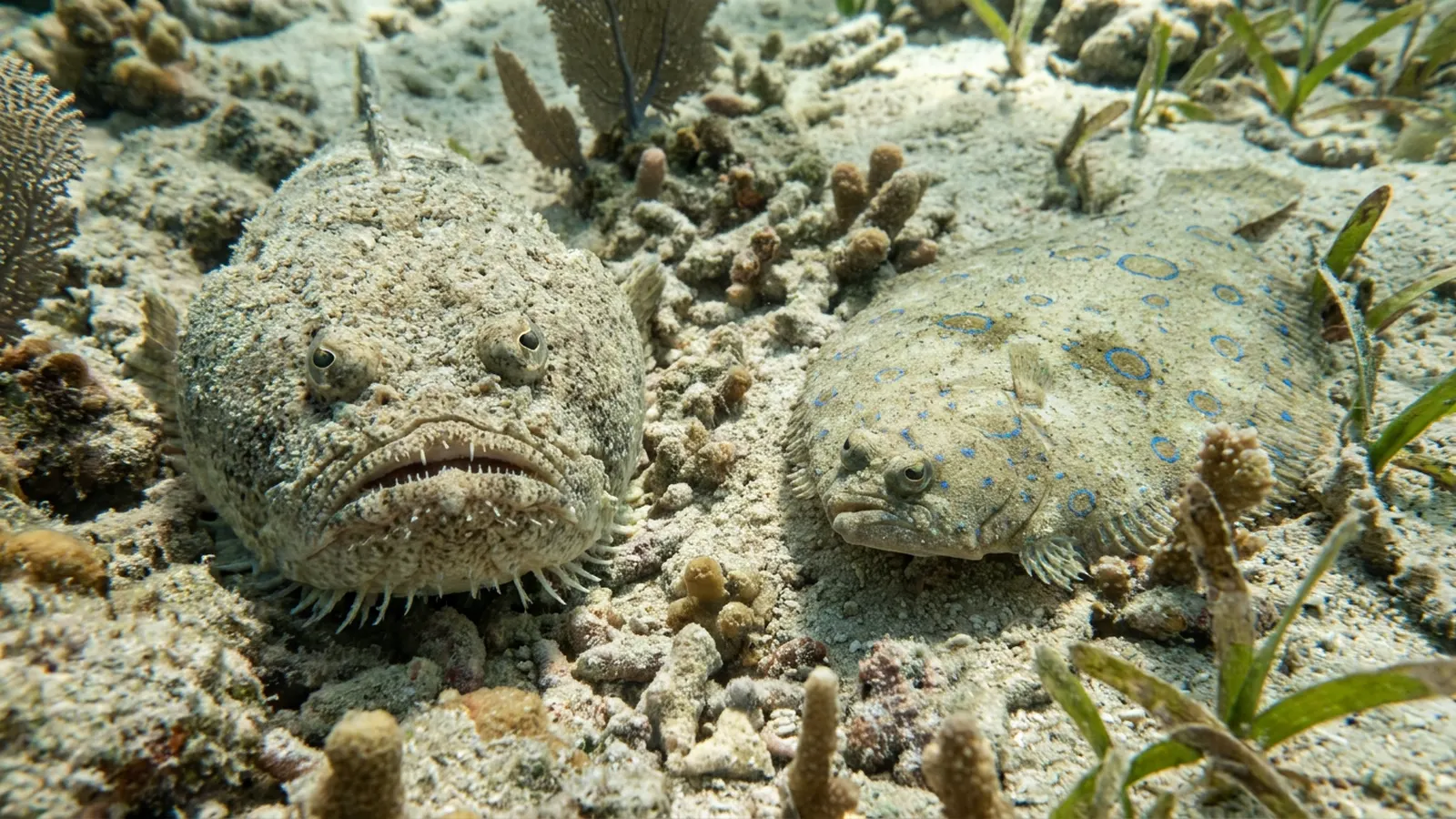
How do flatfish and stargazers hide?
By disappearing into the sand.
Flounder and other flatfish begin life as normal, upright larvae. As they grow, one eye migrates across the top of the head to join the other, and the fish lies on its side. Specialised skin cells let peacock flounders match the sand within seconds. Stargazers bury themselves completely, with only their upward-facing eyes and mouth showing, and some have a worm-like lure on the lower lip. Atlantic stargazers have electric organs that can deliver shocks of up to about 50 volts. See whitemargin stargazer.
Flatfish are a large group, with more than 800 described species in 16 families. The eye migration is driven by hormones during metamorphosis, and depending on the family the eyes end up on the right side, the left side or either. Righteye flounders such as plaice and halibut lie on their left side; lefteye flounders such as the peacock flounder of the Caribbean lie on their right. Soles defend themselves chemically as well as with camouflage. The Red Sea Moses sole, Pardachirus marmoratus, releases a milky secretion from glands at the base of its fins that contains pardaxin, a peptide that disrupts cell membranes and irritates the gills of predatory fish. The marine biologist Eugenie Clark showed that it deterred sharks, prompting decades of research into pardaxin as a shark repellent and, more recently, as an antimicrobial.
Stargazers form the family Uranoscopidae, with about 50 living species found in shallow and deep seas worldwide. They range from about 18 to 90 cm long. All have two large venomous spines behind the gill covers, above the pectoral fins. Electric organs have evolved in two genera: in Astroscopus they are built from modified eye muscles, and in Uranoscopus from muscles associated with sound production. Unlike electric rays or electric eels, stargazers do not use electricity to sense their surroundings; the shocks are used only for hunting or defence. The ichthyologist William Leo Smith once called them “the meanest things in creation.”
Which bottom dwellers are harmless and charming?
The ones photographers queue for.
Yellowhead and other jawfish hover above their burrows, which they line with pebbles and shell, and males incubate eggs in their mouths. Hawkfish perch on coral heads like birds on branches. Mandarinfish (a dragonet) perform dusk mating dances in Philippine and Palauan rubble. Flying gurnards walk along the sand and flash huge blue-edged pectoral fins when startled. See odd-shaped swimmers for more unusual reef shapes.
The yellowhead jawfish, Opistognathus aurifrons, is a good example of how much behaviour can be packed into a small bottom fish. It reaches about 10 cm, lives on Caribbean sand and rubble from about 3 to 40 m deep, and spends most of its life within a metre or so of its burrow, which it builds and maintains by carrying sand, shell fragments and small stones in its mouth. When threatened it either retreats into the burrow, pulling a stone over the entrance, or spits sand at the intruder. Hawkfishes, by contrast, use thickened lower pectoral-fin rays to wedge themselves onto coral heads in surge and pounce on small crustaceans below them; the family contains about 33 species.
Which other bottom dwellers should divers look for?
The groups in the table are only a sample. Lizardfish rest propped on their pelvic fins on sand and coral, then dart up to seize passing fish with needle-toothed jaws. Crocodilefish, or flatheads, lie flat on the sand with ornate lacy flaps over their eyes. Batfish of the family Ogcocephalidae, relatives of frogfish, walk over the bottom on limb-like fins and carry a tiny lure tucked in a pocket under the snout. Gobies are one of the most species-rich reef fish families, and many live on the bottom, including the shrimp gobies that share burrows with blind snapping shrimp, the fish acting as lookout while the shrimp keeps the burrow clear.
Rays and sharks have bottom dwellers too. Stingrays bury themselves in sand with only eyes and spiracles showing, and wobbegongs and epaulette sharks rest on reefs by day. These animals belong to different branches of the fish family tree from the bony fishes above, yet they have arrived at the same solutions: flattened bodies, camouflage, upward-facing eyes and a patient, ambush-based way of feeding.
Where is the best place to see bottom-dwelling fish?
Muck diving is made for them.
The richest places for bottom dwellers are not pristine coral gardens but the black volcanic sand and rubble slopes known as “muck” sites. Lembeh Strait in North Sulawesi, Anilao in the Philippines, Ambon and Alor in Indonesia, and Milne Bay in Papua New Guinea are famous for frogfish, stonefish, scorpionfish, flamboyant cuttlefish and dozens of other cryptic species. In the Caribbean, Bonaire’s shore dives and Florida’s Blue Heron Bridge produce frogfish, flying gurnards, jawfish and batfish. Red Sea reef flats are reliable for stonefish and lionfish.
Slow down to a crawl, scan every rock and sponge, and use a dive guide’s pointer rather than your fingers. A good tip is to look for symmetrical shapes, an eye or a mouth line, among the irregular texture of the reef: camouflage breaks down when you spot the one feature that cannot be hidden.
Why do bottom dwellers matter on a reef?
Benthic ambush predators are an important link in reef food webs. They eat large numbers of small fish, shrimp and crabs, and are themselves eaten by groupers, moray eels, sharks and octopuses. Because they rarely move far, their numbers respond quickly to local conditions such as habitat damage or overfishing of their predators. The lionfish invasion shows what happens when a predator arrives without the checks it evolved with: native prey fish are not wary of it, and few local predators take it.
Many bottom dwellers are also popular in the aquarium trade, especially colourful dragonets, jawfish, hawkfish and small scorpionfish. Mandarinfish, which feed almost continuously on tiny crustaceans, often starve in tanks without a mature population of live food. Responsible collection, captive breeding where possible and protection of muck-diving sites, which are often unprotected coastal sand and rubble, help keep these species available for divers and photographers in the wild.

What fish live on the bottom of coral reefs?
Stonefish, scorpionfish, lionfish, frogfish, flounder, stargazers, jawfish, hawkfish, dragonets and gurnards.
What is the most venomous fish?
The reef stonefish, Synanceia verrucosa.
How do you treat a stonefish sting?
Hot-water immersion for pain, then urgent medical care; antivenom is available.
Are lionfish dangerous?
Their spines are venomous and painful but rarely life-threatening to healthy adults.
Why are lionfish invasive?
They have few predators in the Atlantic, breed rapidly and eat many native fish.
How do frogfish catch prey?
They wave a lure on a modified spine and gulp prey in about 6 milliseconds.
Can stargazers shock you?
Some can. Stargazers in the genera Astroscopus and Uranoscopus have electric organs, and all stargazers have venomous spines.
Why do flounders have both eyes on one side?
One eye migrates across the head as the larva develops into a bottom-dwelling adult.
- Pietsch, T. W. & Grobecker, D. B. (1987). Frogfishes of the World. Stanford University Press.
- Albins, M. A. & Hixon, M. A. (2008). Invasive Indo-Pacific lionfish reduce recruitment of Atlantic coral-reef fishes. Marine Ecology Progress Series 367: 233–238.
- Schofield, P. J. (2009). Geographic extent and chronology of the invasion of non-native lionfish into the Western North Atlantic and Caribbean Sea. Aquatic Invasions 4: 473–479.
- Froese, R. & Pauly, D. (eds.). FishBase. www.fishbase.org.
- Grobecker, D.B. & Pietsch, T.W. (1979). High-speed cinematographic evidence for ultrafast feeding in antennariid anglerfishes. Science 205: 1161–1162.
- Ramachandran, V.S. et al. (1996). Rapid adaptive camouflage in tropical flounders. Nature 379: 815–818.
- Clark, E. (1974). The Red Sea’s sharkproof fish. National Geographic 146: 718–727.
Blane Perun has been exploring Earth’s oceans and marine life for over 25 years. Founder of TheSea.Org in 1999, underwater photographer, coral aquaculture pioneer, and explorer of 80+ countries.
About Blane Perun →