Natural Threats to Coral Reefs — Storms, Predators and Disease
The main natural threats to coral reefs are tropical storms and cyclones, which smash reef structure; coral-eating predators such as the crown-of-thorns sea star; coral disease; and natural extremes of temperature, low tides and fresh water from heavy rain. Reefs evolved with these shocks and healthy reefs usually recover within years to decades. Today, however, warming, pollution and overfishing are making several natural threats more frequent and severe while weakening reefs’ ability to bounce back.
Coral reefs have always lived dangerously. Long before people fished them or warmed the ocean, reefs were battered by cyclones, grazed by predators, swept by disease and occasionally baked or freshened by extreme weather. Reefs are, in effect, adapted to periodic catastrophe: they are knocked back, then regrow from surviving colonies and new coral larvae. This page explains the main natural threats to coral reefs, how much damage each does, and why the line between “natural” and “human-caused” threats has become blurred.
What counts as a natural threat?
Disturbances that do not originate with people, and that reefs have faced for millions of years.
Natural threats include tropical storms, coral-eating predators, disease, and natural extremes of temperature, tide and salinity. A cyclone may flatten a section of reef, an outbreak of sea stars may strip it of living coral, or an unusually low tide may expose corals to lethal sun and air. Historically, healthy reefs absorbed these blows and regrew over the following years.
The crucial difference from many human pressures is that natural disturbances are usually episodic. They strike, do their damage and pass, leaving the reef to rebuild. Some even play a useful role: storms clear space for new coral settlement and spread broken fragments that can regrow into new colonies, and predators that target fast-growing corals stop them from crowding out slower species, helping to maintain diversity. The danger arises when disturbances come too often, or hit reefs that are already weakened. For the full picture, see natural threats to the coral reef and global threats to coral reefs.
Storms and cyclones
The most dramatic natural threat: a single cyclone can turn living reef into rubble in hours.
A powerful tropical cyclone, hurricane or typhoon generates waves strong enough to snap branching corals, overturn massive colonies and scour whole sections of reef. Shallow, exposed reefs on the path of the storm take the worst damage, while sheltered or deeper reefs may escape. Storm surge and heavy rain can add sediment and fresh water from land. On Australia’s Great Barrier Reef, a widely cited study of monitoring data from 1985 to 2012 (De’ath and colleagues, 2012) attributed nearly half of the coral cover lost over that period to cyclones.
Recovery depends on what is left. If live coral fragments and nearby healthy reefs remain, and if the water is clean and grazing fish keep seaweed in check, coral cover can regrow substantially within a decade or so. If the reef is reduced to loose rubble that keeps shifting, new corals struggle to settle and recovery can stall. Warmer seas are expected to make the strongest storms more intense, which means storm damage is likely to become a larger share of the threat.
Crown-of-thorns sea stars and other predators
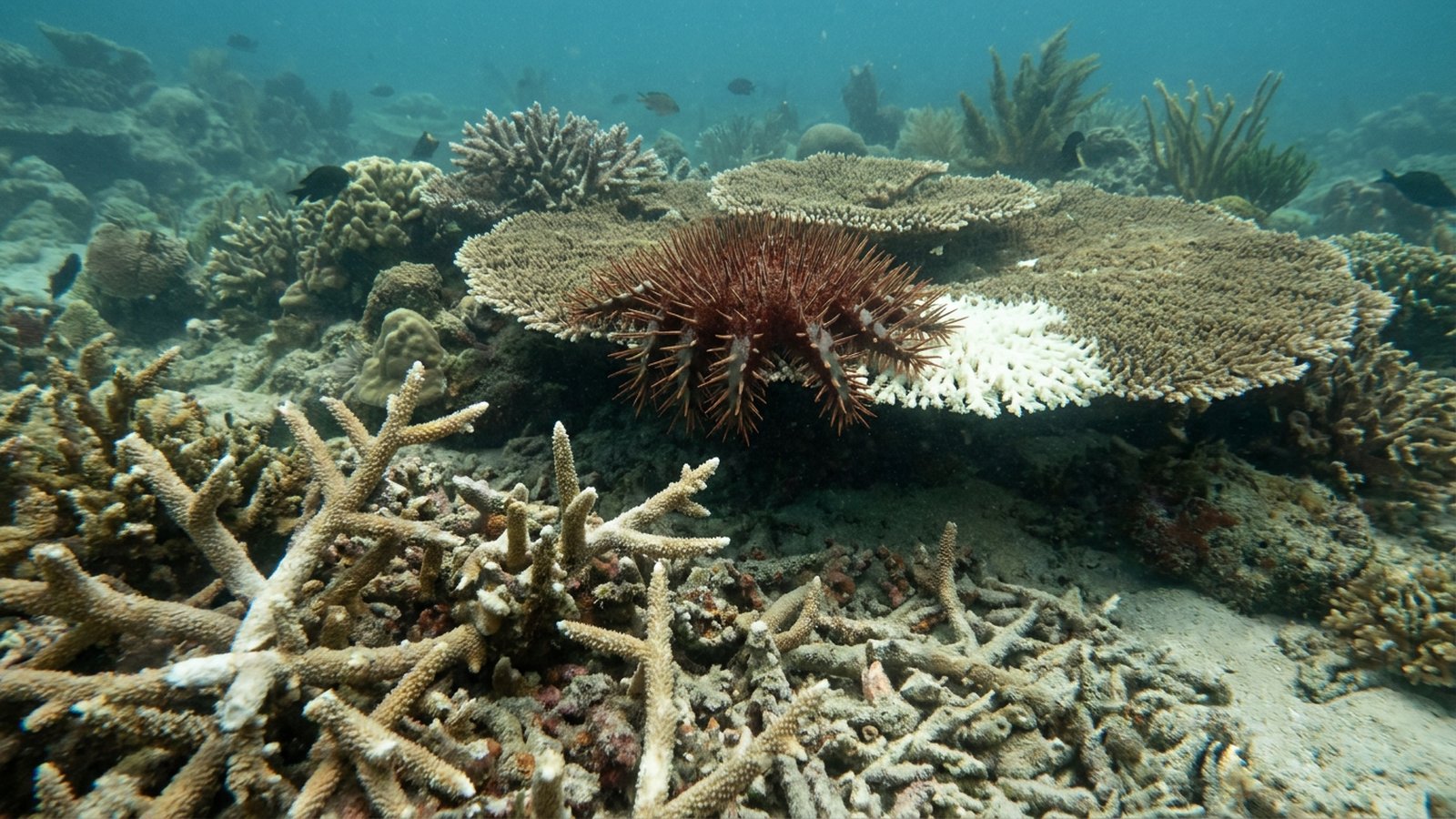
A native sea star that eats living coral, and that periodically explodes in number.
The crown-of-thorns sea star (Acanthaster species) is a large, venomous-spined sea star that feeds on living coral. It climbs onto a colony, turns its stomach out over the coral and digests the tissue, leaving a white skeleton behind. A single adult can kill several square metres of coral a year. In normal numbers it is a natural part of Indo-Pacific reef life, but periodic population explosions — outbreaks — can involve thousands of sea stars and strip vast areas of reef. The same 2012 study attributed roughly 42% of Great Barrier Reef coral loss between 1985 and 2012 to crown-of-thorns outbreaks.
Why outbreaks happen is still debated, but evidence suggests that nutrient runoff from farms and rivers boosts the plankton that the sea star’s larvae eat, so more of them survive. Removal of their natural predators may also play a part; the giant triton snail is a famous predator of crown-of-thorns, and some fish eat juveniles. Control programs on the Great Barrier Reef now cull sea stars by injection at high-value sites. Other coral predators include the coral-eating snail Drupella, some parrotfish and butterflyfish, and fireworms, but these rarely cause reef-wide damage on their own.
| Natural threat | What it does | Natural role | How humans amplify it |
|---|---|---|---|
| Storms & cyclones | Break and scatter coral | Clears space, spreads fragments | Warmer seas fuel stronger storms |
| Crown-of-thorns | Eats living coral tissue | Natural part of reef life | Nutrient runoff linked to outbreaks |
| Coral disease | Kills tissue across colonies | Background mortality | Warming and pollution spread it faster |
| Temperature extremes | Heat or cold stress, bleaching | Seasonal variation | Climate change pushes past limits |
| Low tides & heavy rain | Expose or freshen shallow coral | Brief, localised | Runoff and weather shifts |
| Grazing & bioerosion | Fish, urchins and sponges wear down reef | Normal, balanced | Overfishing unbalances numbers |
Coral disease
Pathogens that kill coral tissue, often visible as an advancing band of dead skeleton.
Coral diseases carry descriptive names: white band, black band, white plague, yellow band and, most recently, stony coral tissue loss disease. Many are linked to bacteria or other microbes, although the exact cause of several remains unclear. Disease has reshaped whole regions. In the Caribbean, white band disease in the 1980s killed much of the once-dominant elkhorn and staghorn coral, the main builders of shallow Caribbean reefs. Stony coral tissue loss disease, first reported off Florida in 2014, has since spread through much of the Caribbean and affects many species of reef-building coral.
Disease is a classic example of a natural threat that people make worse. Outbreaks tend to follow marine heatwaves, when corals are stressed and their defences are weak, and nutrient and sewage pollution can increase disease risk. Physical damage from anchors or divers can open wounds for infection. The Caribbean’s experience shows how a disease that targets just a few key species can transform a region with relatively few coral species; see threats to coral reefs in the Caribbean.
Temperature, tides and fresh water
Quieter natural extremes that can still kill coral over large areas.
Corals live close to their upper temperature limit, so an unusually warm summer can trigger bleaching, in which corals expel their symbiotic algae. Natural climate swings such as El Niño have always caused occasional heat stress, but warming has turned these events into frequent mass bleaching episodes, which is why bleaching is now treated mainly as a climate-change threat rather than a natural one. Cold snaps can also kill corals at the edges of their range, as happened in parts of the Florida Keys during severe winters.
Very low tides can expose reef flats and crests to air and strong sun for hours, killing the tops of colonies. Heavy rain and river floods lower salinity and deliver sediment, which can bleach or smother shallow corals near river mouths. Earthquakes and volcanic eruptions occasionally uplift, bury or crack reefs. These events are usually local, but on a reef already stressed by other factors they add up.
When natural threats stop being natural
Human pressures amplify natural threats and strip away the resilience reefs need to recover.
Human activity has changed the character of natural threats. Warmer seas intensify the strongest cyclones and push corals toward bleaching and disease. Nutrient runoff appears to fuel crown-of-thorns outbreaks. Warm, polluted water spreads disease further and faster. In each case, a natural threat has been amplified by people. At the same time, overfishing, pollution and repeated heatwaves leave reefs with fewer surviving corals, fewer grazing fish and dirtier water — exactly the ingredients needed for recovery. A storm that a healthy reef would shrug off can tip a stressed reef into long-term decline. See human-caused threats to coral reefs and local threats to coral reefs.
The practical implication is encouraging. Because human pressures both amplify natural threats and undermine recovery, reducing them helps on both fronts. Cleaner river water means fewer crown-of-thorns outbreaks; protecting grazing fish helps reefs regrow after storms; limiting anchor damage reduces disease risk. Protecting a reef’s natural defences, from triton snails to parrotfish, is part of the same effort described under coral reef conservation. Regional examples include Belize and the Philippines.
How scientists track natural threats
Long-term monitoring separates natural ups and downs from lasting decline.
Because reefs naturally rise and fall with storms and outbreaks, a single survey says little about whether a reef is in trouble. Agencies such as the Australian Institute of Marine Science have surveyed the same reefs year after year for decades, recording coral cover, crown-of-thorns numbers, disease and storm damage. Those long records are what allowed researchers to attribute Great Barrier Reef coral loss to cyclones, crown-of-thorns and bleaching, and to measure how quickly reefs recover between disturbances. Satellites add sea-temperature data that flag heat stress, while divers and citizen-science programs report outbreaks and disease early, so managers can cull sea stars or close sites before damage spreads.
The clearest lesson from this monitoring is about timing. A reef that is hit by one major disturbance a decade usually recovers. A reef hit by a cyclone, then an outbreak, then a heatwave within a few years often does not. Keeping the gaps between disturbances long enough — mostly by reducing the human-driven ones — is the key to reef survival.
What are the natural threats to coral reefs?
Tropical storms and cyclones, coral-eating predators such as the crown-of-thorns sea star, coral disease, and natural extremes such as very low tides, heavy rain and unusual heat or cold. Reefs evolved with these disturbances and normally recover, but human pressures now make several of them worse.
How do storms damage coral reefs?
Cyclone waves snap branching corals, overturn large colonies and break the reef into rubble. Storms can also add sediment and fresh water from land. Healthy reefs can regrow within years to a decade or more, but repeated storms or weak reefs slow recovery.
What eats coral reefs?
The most damaging coral predator is the crown-of-thorns sea star, which digests living coral tissue. Others include Drupella snails, some butterflyfish and parrotfish, and fireworms. Only crown-of-thorns outbreaks regularly cause reef-wide damage.
Why do crown-of-thorns outbreaks happen?
The causes are debated, but nutrient runoff from land is thought to boost the plankton their larvae eat, increasing survival. Loss of natural predators may also contribute. Outbreaks have been one of the biggest causes of coral loss on the Great Barrier Reef.
Is coral bleaching a natural threat?
Occasional bleaching from natural heat swings has always happened, but today’s frequent mass bleaching events are driven by human-caused ocean warming. Bleaching is therefore usually classed as a climate-change threat rather than a natural one.
Can coral reefs recover from natural disasters?
Yes, if they are healthy and given time. Surviving colonies regrow and new larvae settle, often over years to decades. Recovery is faster where water is clean, grazing fish are abundant and disturbances are not repeated too often.
Blane Perun has been exploring Earth’s oceans and marine life for over 25 years. Founder of TheSea.Org in 1999, underwater photographer, coral aquaculture pioneer, and explorer of 80+ countries.
About Blane Perun → More on Coral Reefs →