Bivalves — Two Shells, Countless Ways to Live
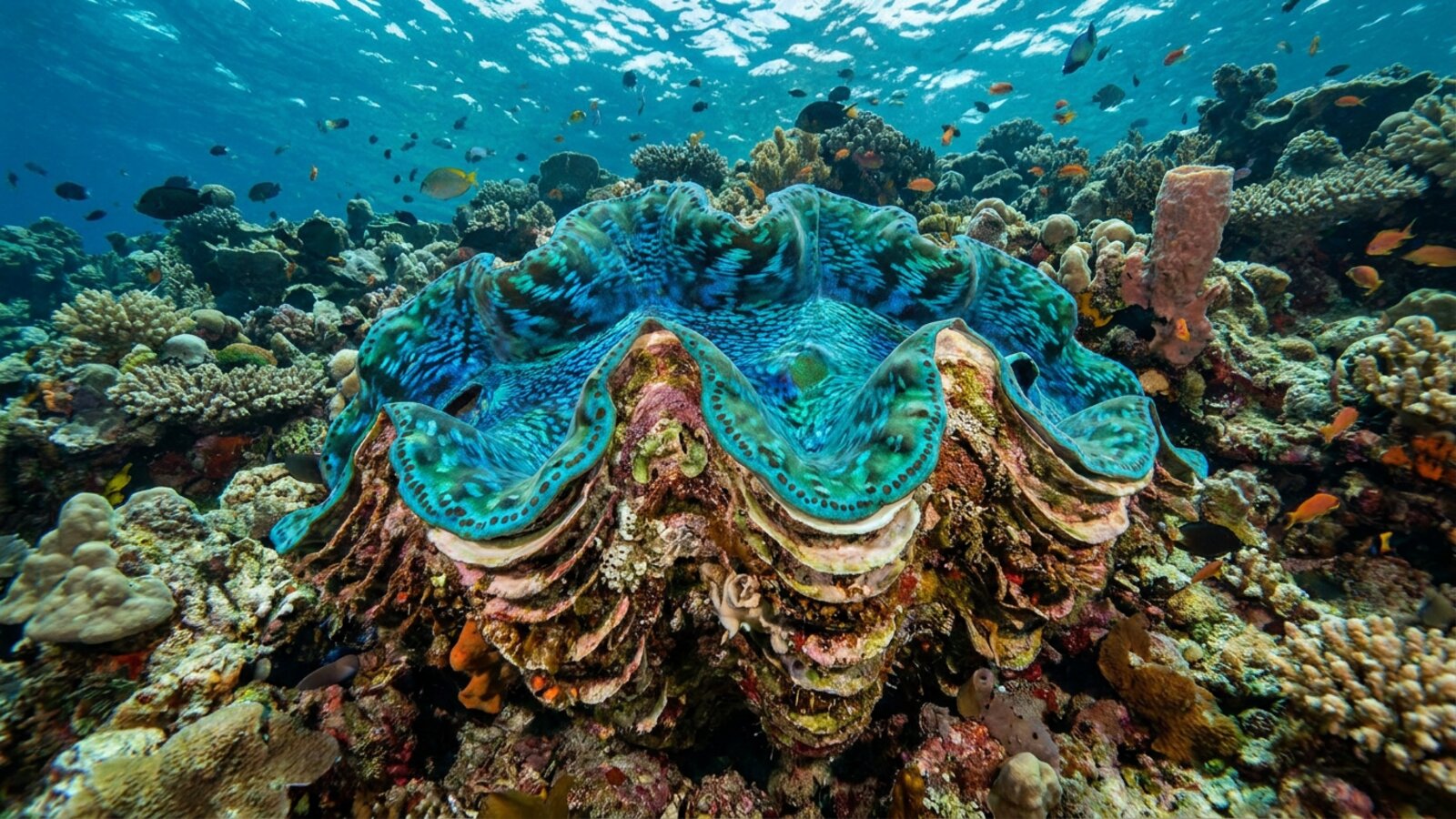
Bivalves are molluscs of the class Bivalvia whose soft bodies are enclosed by a shell of two hinged valves. The class includes clams, cockles, mussels, oysters, scallops and many others, about 9,200 living species, roughly 8,000 of them marine. Bivalves have no head and no radula; most are filter feeders that strain food with enlarged gills. They range from less than a millimetre to over a metre long, and have been around for more than 500 million years. On coral reefs, the giant clams farm algae in their mantles, while file clams and thorny oysters show how varied the group can be.
What is a bivalve?
A bivalve is a mollusc whose body is laterally flattened and enclosed in a shell made of two parts, called valves, joined along one edge by a hinge. The name comes from the Latin bis, two, and valvae, the leaves of a folding door. Bivalves make up the class Bivalvia, a name first used by Carl Linnaeus in 1758. In earlier centuries the group was also called Lamellibranchiata, after its plate-like gills, or Pelecypoda, meaning “axe-foot”, after the shape of the muscular foot many species use for digging.
The class includes many familiar animals: clams, cockles, mussels, oysters, scallops, razor shells and shipworms, as well as more exotic forms such as the giant clams of coral reefs. There are about 9,200 known living species in about 1,260 genera and 106 families. Around 8,000 of them live in the sea or in brackish estuaries; the rest live in fresh water, where the largest family, the Unionidae or freshwater mussels, has about 700 species. The largest marine families are the venus clams, Veneridae, with more than 680 species, followed by the tellins and the lucinid clams, each with over 500.
How is a bivalve built?
Bivalves have abandoned many features of other molluscs. They have no distinct head and no radula, the rasping tongue that snails use to feed. Instead, their body is enclosed by the mantle, a sheet of tissue that lines the shell and secretes it. The two valves are made of calcium carbonate, in the form of calcite, aragonite or both, often with an inner layer of iridescent nacre, and they are covered on the outside by a thin organic skin, the periostracum. A flexible ligament along the hinge, often helped by interlocking teeth, holds the valves together and springs them open when the muscles relax. One or two strong adductor muscles close the shell.
Inside, the gills, called ctenidia, are greatly enlarged. In most bivalves they serve not only for breathing but also as the main feeding organ, trapping particles from the water. Many species have siphons, tubes formed from the mantle edge, through which water is drawn in and expelled. The foot is used for burrowing, crawling or anchoring, and in many species a gland at its base produces byssal threads, the tough fibres that mussels and giant clams use to attach to rock.
How do bivalves live and feed?
Most bivalves are filter feeders. They pump water through the shell and over the gills, where tiny hairs called cilia trap phytoplankton, bacteria and organic particles in mucus and carry them to the mouth. A large bed of mussels or oysters can filter enormous volumes of water, which is why bivalves play an important role in keeping coastal waters clear and in cycling nutrients. Some bivalves feed on deposits on the sea floor, and a few deep-sea species are carnivores that catch small animals.
Bivalves live in an astonishing range of ways. Many burrow into sand or mud, where they are relatively safe from predators. Others, like mussels, attach to rocks with byssal threads; oysters and thorny oysters cement one valve permanently to a hard surface; scallops and file clams can swim by clapping their valves; and shipworms bore into wood. On coral reefs, giant clams have taken a different path entirely, farming symbiotic algae called zooxanthellae in their mantles so that they can grow large in nutrient-poor tropical water. Our guides to the maxima, crocea, squamosa and derasa clams describe how this partnership works and how each species has adapted to a different part of the reef.
How do bivalves reproduce?
Most bivalves reproduce by broadcast spawning, releasing eggs and sperm into the water, where fertilisation takes place. The fertilised egg develops into a swimming trochophore larva and then into a veliger larva with a tiny shell, which feeds on plankton before settling to the bottom and transforming into a juvenile. Some bivalves brood their young, and freshwater mussels have a remarkable larval stage that lives as a temporary parasite on the gills or fins of fish. Many bivalves change sex during their lives; giant clams, for example, mature first as males and later become hermaphrodites.
Some bivalves are extraordinarily long-lived. The ocean quahog, Arctica islandica, a clam of the North Atlantic, is among the longest-lived animals known: one individual collected off Iceland in 2006 was found to be about 507 years old, determined by counting the annual growth lines in its shell.
Why do bivalves matter?
Bivalves have been part of human diets for as long as people have lived on coasts, and shell middens, ancient heaps of discarded shells, are among the oldest traces of coastal settlement. The Romans cultivated oysters in ponds, and today mussels, oysters, clams and scallops are among the most important farmed seafoods in the world. Pearl oysters provide most natural and cultured pearls, and shells have been used for tools, buttons, jewellery and currency. Our guide to the thorny oyster explains how Spondylus shells were traded across Neolithic Europe and the ancient Andes.
Bivalves also matter ecologically. They filter water, stabilise sediments, provide habitat for other species and feed fish, birds, sea stars, crabs and people. On coral reefs, giant clams add to primary production and reef building, while the electric flame scallop shows that bivalves can still surprise scientists, with its mirror-like flashing display built from silica nanospheres.
Many bivalves face threats from overharvesting, pollution, habitat loss, disease and ocean acidification, which makes it harder for shell-building animals to lay down calcium carbonate. Giant clams have been hit particularly hard by overfishing, and all species are now protected under CITES. The guides below cover the reef bivalves on TheSea.Org.
On the beach, bivalves leave some of the most familiar shells; see our guides to the scallop shell and the tiny, colourful coquina clam.
What is a bivalve?
A mollusc with a body enclosed in a shell of two hinged valves.
How many species of bivalves are there?
About 9,200 living species, roughly 8,000 of them marine.
Do bivalves have a head?
No. Bivalves have no head and no radula.
How do bivalves eat?
Most filter plankton and particles from water using their gills.
What is the largest bivalve?
The giant clam Tridacna gigas, which can exceed 1 m and 200 kg.
How long do bivalves live?
Most live a few years, but the ocean quahog can live over 500 years.
Are scallops bivalves?
Yes. Scallops, clams, oysters and mussels are all bivalves.
Are giant clams endangered?
Several species are; all giant clams are protected under CITES.
- Wikipedia: Bivalvia; Giant clam; Ocean quahog.
- Huber, M. (2010). Compendium of Bivalves. ConchBooks.
- Butler, P.G. et al. (2013). Variability of marine climate on the North Icelandic Shelf in a 1357-year proxy archive based on growth increments in the bivalve Arctica islandica. Palaeogeography, Palaeoclimatology, Palaeoecology 373: 141–151.
- CITES Appendix II listing of Tridacninae.
Blane Perun has been exploring Earth’s oceans and marine life for over 25 years. Founder of TheSea.Org in 1999, underwater photographer, coral aquaculture pioneer, and explorer of 80+ countries.
About Blane Perun →