What Animals Eat Sea Urchins? — Otters, Sea Stars, Lobsters, Snails and Birds
Apart from fish, the animals that eat sea urchins are mammals (sea otters and humans), sea stars (above all the sunflower sea star), crustaceans (spiny lobsters, American lobsters and crabs), snails (Caribbean helmet shells) and birds (gulls, common eiders and oystercatchers). Small and juvenile urchins have the most enemies; big adults are eaten mainly by otters, large lobsters and big sea stars.
This page covers the non-fish predators. For sheephead, triggerfish, wolffish and the rest, see what fish eat sea urchins? and for the overview, what eats sea urchins?
Why do young urchins have so many more enemies?
The list of animals that eat sea urchins depends heavily on the size of the urchin. A newly settled urchin is less than a millimetre across, with spines too short and fine to deter anything, and for its first months it can be eaten by crabs, small fish, shrimps, wrasses, sea stars, snails and even other grazers that scrape the rock where it sits. As it grows, its spines lengthen and its test thickens, and one predator after another drops off the list because the urchin no longer fits in its mouth or claws. By the time a red sea urchin reaches about 4 cm across, it no longer needs to shelter beneath the spine canopy of adults, according to Animal Diversity Web, and the biggest adults, which can approach 19 cm, are tackled only by sea otters, sunflower sea stars and the largest lobsters and fish.
This size refuge shapes urchin populations everywhere. In most places the number of urchins that reach adulthood is set less by how many larvae settle than by how many juveniles survive the gauntlet of small predators in their first year or two. Habitat matters too: juveniles hidden in crevices, under boulders or among the spines of adults survive far better than those on open rock. When predators of juveniles become abundant, as happened with crabs in the Gulf of Maine, urchin populations can be held down for decades even when adults face few threats.
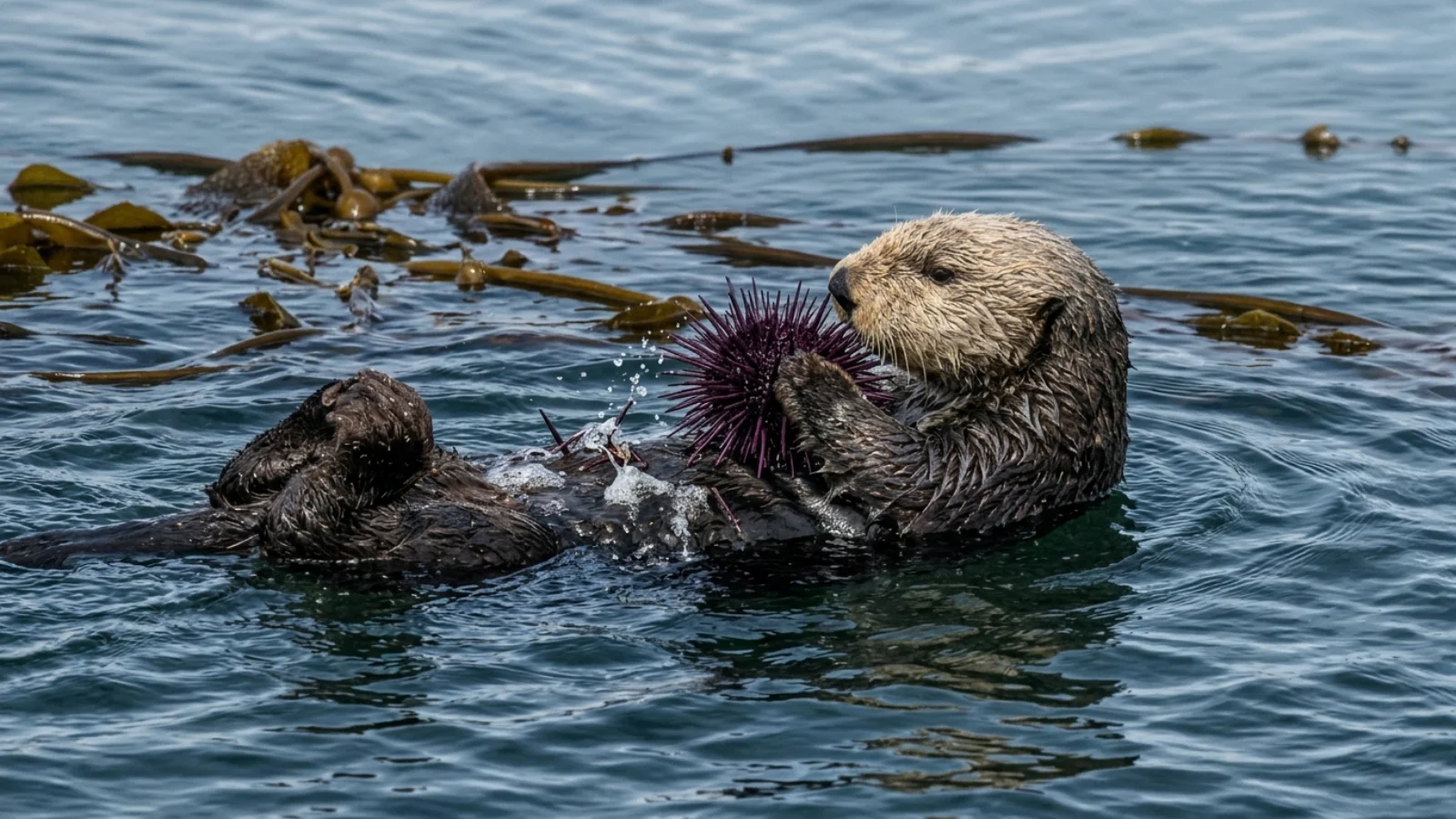
Which mammals eat sea urchins?
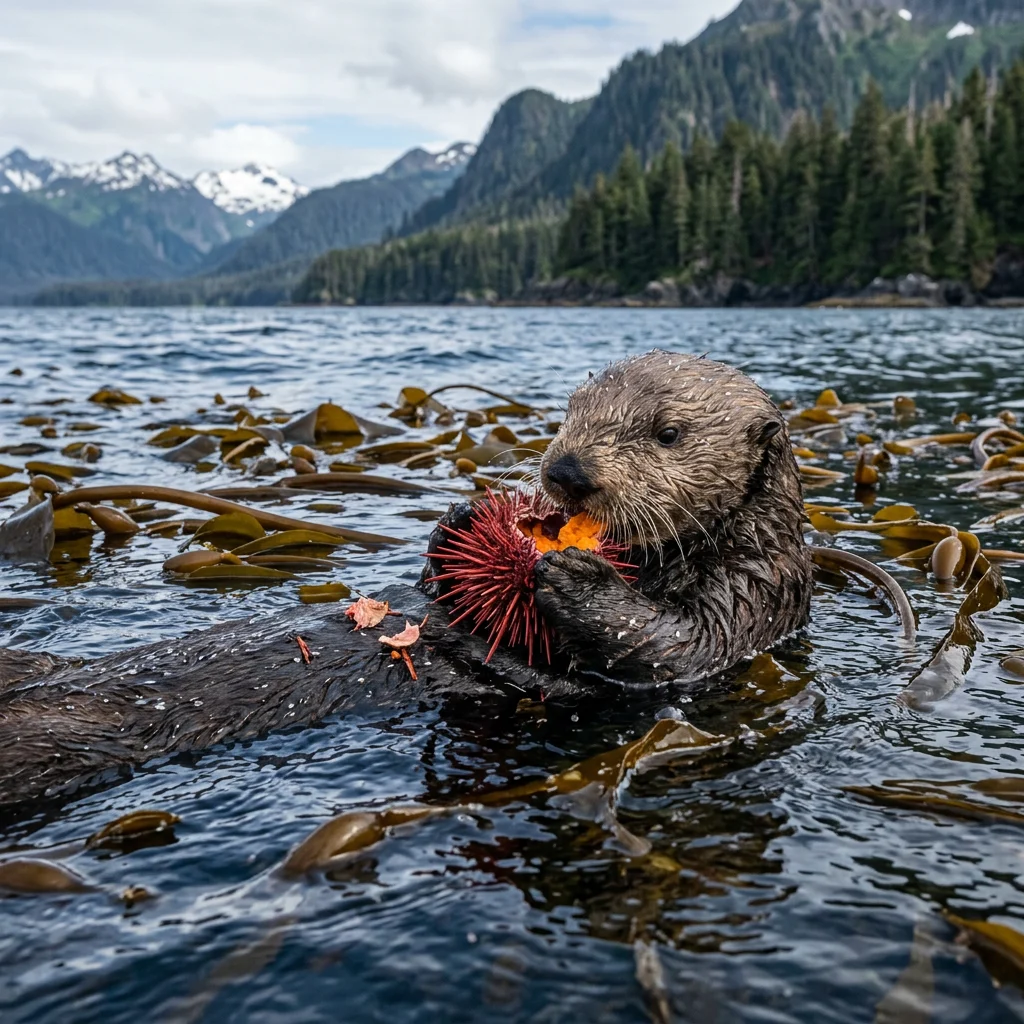
Sea otters and people. Otters eat them whole-hog; people eat only the gonads.
Sea otters eat about a quarter of their body weight daily, and urchins are a staple wherever otters live, from the Aleutians to central California. Humans are the other major mammal predator: the global uni trade lands roughly 75,000 tonnes of urchins a year, and Japan consumes about 80 to 90 percent of the supply. See do sea otters eat sea urchins? and can you eat sea urchins?
Do starfish eat sea urchins?
Some do. The sunflower sea star was the West Coast’s most important invertebrate urchin predator.
This giant, which usually has 16 to 24 arms, swallows urchins whole. Sea star wasting syndrome, which began in 2013, killed up to 5.75 billion sunflower stars, a 90.6% decline, with only a handful seen in Oregon and California since 2018; the IUCN listed it as Critically Endangered in 2020. Other large sea stars also eat urchins occasionally. See starfish.
| Animal | Group | Urchins targeted |
|---|---|---|
| Sea otter | Mammal | All sizes |
| Humans | Mammal | Large, commercially valuable species |
| Sunflower sea star | Echinoderm | Purple and red urchins |
| California spiny lobster | Crustacean | Purple urchins, especially in reserves |
| American lobster | Crustacean | Green urchins (Gulf of Maine) |
| Rock and Jonah crabs | Crustacean | Juvenile green urchins |
| Helmet shells (Cassis) | Snail | Caribbean urchins, including Diadema |
| Gulls, eiders | Birds | Intertidal and shallow urchins |
How long have people been eating sea urchins?
People have eaten sea urchins for thousands of years, and the remains are preserved in shell middens along many coasts. On Amchitka Island in the Aleutians, a classic 1978 study in Science by Charles Simenstad, James Estes and Karl Kenyon re-examined the layered remains of an Aleut village midden spanning about 2,500 years of occupation. They found that the kinds of prey people ate changed over time, and argued that the shift was best explained by local overhunting of sea otters, which allowed urchins and other grazers to increase in the nearshore community the villagers relied on. In other words, people were already eating urchins, and already changing the balance between otters, urchins and kelp, long before commercial fisheries.
Today humans are the most efficient urchin predator on Earth. According to a review of global sea urchin markets by the Icelandic research institute Matís, world landings peaked at about 120,000 tonnes in 1995 and have since fallen to around 75,000 tonnes a year, as traditional suppliers such as Japan, Chile, the United States and Canada caught less. Japan consumes roughly 80 to 90 percent of the global supply, mostly as uni, the gonads served raw in sushi. France is the main European market, but its own harvest is much lower than in the 1970s and 1980s, and much of its supply is now imported. In parts of the Mediterranean, heavy harvesting of the purple urchin Paracentrotus lividus has led to closed seasons and bans in some regions. Unlike most natural predators, which take whatever urchins they can manage, fishers target the largest, fattest animals, which can reshape the size structure of urchin populations.
Which other sea stars eat urchins?
The sunflower sea star gets most of the attention because of its role in North Pacific kelp forests, but it is not the only sea star that eats urchins. Several large, fast-moving species elsewhere take them, especially juveniles and small adults, either swallowing them whole or pushing their stomachs out over the prey to digest it externally. In parts of the north-east Atlantic and Mediterranean, the spiny starfish Marthasterias glacialis is reported to eat urchins. Sea stars are slow by most standards, but for an urchin moving on tube feet, a sea star is a fast and persistent hunter. Their effect also comes partly from fear: urchins that detect the scent of a predatory star often stop feeding and move off, which can protect kelp even when few urchins are actually eaten. The 2013 wasting disease epidemic, which hit more than 20 species of sea stars from Mexico to Alaska, removed a whole layer of these predators from the Pacific coast at once.
Do lobsters and crabs eat sea urchins?
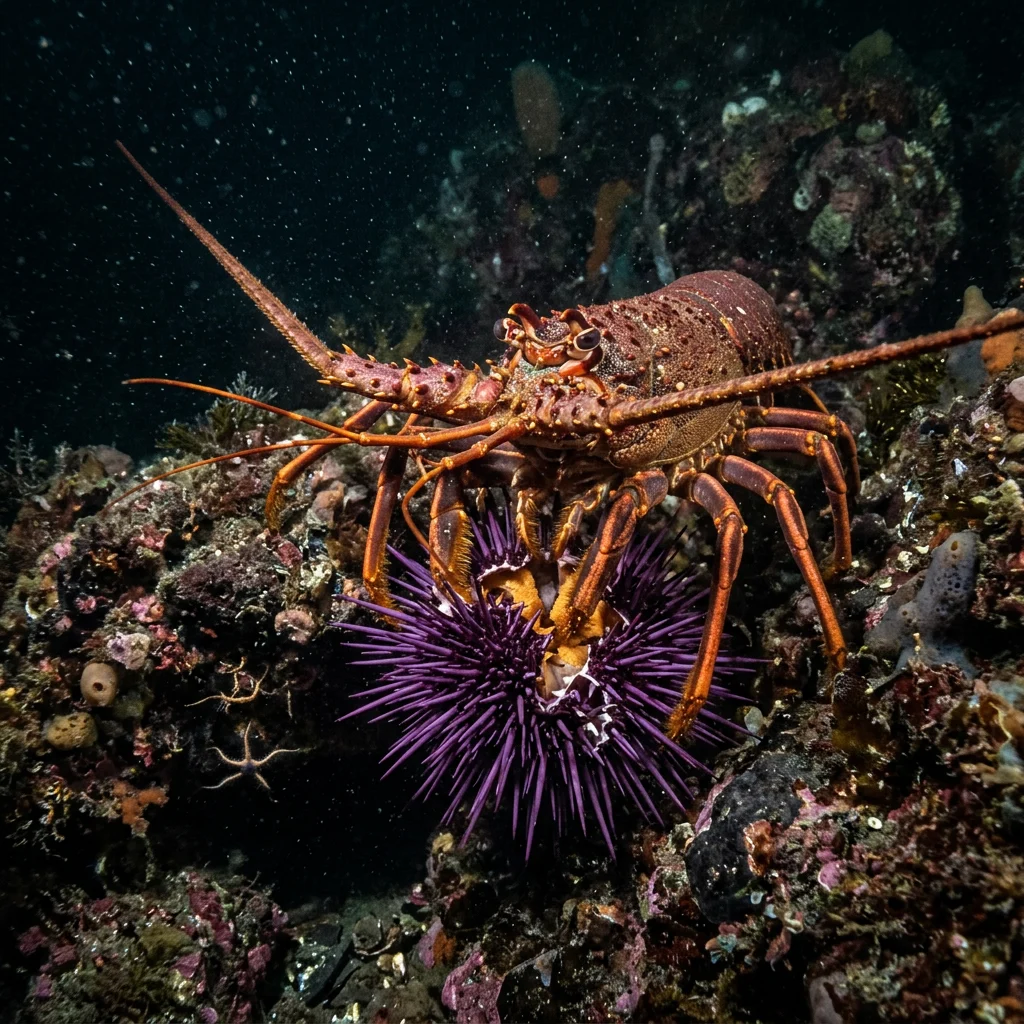
Yes. Lobsters can handle adults; crabs mostly take juveniles.
In southern California, large spiny lobsters (Panulirus interruptus) are important urchin predators, and inside marine reserves, where lobsters grow large, they eat more and bigger urchins. In the Gulf of Maine, after the urchin fishery thinned green urchins in the 1990s, crabs moved into recovering kelp beds and now prey heavily on young urchins, helping to keep the urchins from returning. Lobsters there also eat urchins. See lobsters.
How did crabs stop urchins coming back in Maine?
The Gulf of Maine offers one of the clearest examples of a non-fish predator controlling urchins. Maine’s commercial harvest of green sea urchins (Strongylocentrotus droebachiensis) began in 1987 on the south-west coast and spread north-east toward Canada. Landings peaked in 1993, and by 1995 urchins ranked second only to lobster in value among Maine’s fisheries, supporting more than 1,500 full-time divers and draggers. Then the harvest collapsed. A study by Robert Steneck and colleagues at the University of Maine, published in the Bulletin of Marine Science in 2013 and drawing on 36 years of data, found that the fishery’s value had fallen by about 84 percent and no full-time urchin fishers remained.
Removing the urchins let kelp and other seaweeds take over reefs that had been bare rock, and the new seaweed beds became nursery habitat for Jonah crabs (Cancer borealis). With large predatory fish such as cod already depleted, crab numbers rose, and the crabs ate the remaining young urchins. When researchers tried to break this “lock” by releasing 51,000 adult urchins onto plots off Cape Elizabeth in 2000 and 2001, large crabs moved in and wiped them out in both years. The authors described the reefs as flipped and locked into a seaweed-dominated state for nearly two decades, and suggested that restoring the predators of crabs might be needed before urchins could recover. It is an unusual story, because elsewhere the concern is usually too many urchins, but it shows how strongly a single invertebrate predator can control them.
Which lobsters eat sea urchins around the world?
Lobsters are among the most important urchin predators on temperate reefs, and their role has been revealed largely through marine reserves. In southern California, the California spiny lobster (Panulirus interruptus) hunts at night, prying at the soft membrane around an urchin’s mouth or crushing smaller individuals. Inside reserves, where lobsters live longer and grow larger, they eat more urchins and bigger ones, which helps keep purple urchins from forming barrens. In New Zealand, long-term studies at the Cape Rodney–Okakari Point marine reserve near Leigh, the country’s first no-take reserve, found that the recovery of rock lobsters (Jasus edwardsii) and large snapper after protection was followed by a decline in kina, the local urchin, and the return of kelp forests to areas that had been barrens.
The same lobster species is now central to efforts in Tasmania, where the long-spined urchin Centrostephanus rodgersii has spread south with warming water. Research led by Scott Ling of the University of Tasmania showed that large rock lobsters are among the few predators able to tackle this heavily armed urchin, and that heavily fished reefs, which lack big lobsters, are much more likely to flip into barrens. Fisheries managers have since considered protecting or restocking large lobsters as one way of building resistance to the urchin. On the Atlantic coast of North America, the American lobster (Homarus americanus) also eats green urchins, alongside crabs and fish, although in modern Maine crabs appear to do more of the work.
Do birds eat sea urchins?
Yes, mostly in the intertidal zone and shallows.
Gulls pick urchins out of tide pools at low tide and may drop them on rocks to break them open. Common eiders, large sea ducks of the North Atlantic, dive for small green urchins and swallow them whole, crushing them in the gizzard. Oystercatchers also take small urchins on rocky shores. Maine fisheries biologists list birds among the main predators of juvenile urchins.
Do octopuses eat sea urchins?
Occasionally. Urchins are not a favourite, but octopuses will eat them.
Octopuses prefer crabs, shrimp and molluscs, but they are generalists and some populations take urchins. See octopus.
Do any other animals eat urchins occasionally?
A long tail of other animals eat urchins now and then. Octopuses are generalist predators that prefer crabs, shrimps and clams, but they can pull apart or drill into small urchins when other prey is scarce. Some sea turtles with crushing jaws, such as loggerheads, may take urchins along with crabs and molluscs, but urchins are not a major part of any turtle’s diet. Arctic and sub-Arctic seabirds, wading birds and gulls take urchins where they are exposed at low tide, and in the Caribbean large helmet shells hunt urchins, including the long-spined Diadema antillarum. Many of these predators matter most for juveniles and for urchins living in the intertidal zone, where they cannot easily hide.
The common thread is that almost every predator of sea urchins has either a way to defeat the spines, a body tough enough to ignore them, or a strategy of attacking urchins while they are still small. That is why the most important urchin predators differ so much from place to place: otters in the North Pacific, lobsters in New Zealand and Tasmania, crabs in Maine, sea stars along the Pacific coast and people almost everywhere. For how predators actually get past the spines, see sea urchin predators.
Which animals eat urchins in different parts of the world?
Because urchins live on rocky and coral reefs from the poles to the tropics, the cast of predators changes from region to region. In the North Pacific, from the Aleutians to California, the key predators of adult urchins have been sea otters, sunflower sea stars, large California sheephead and spiny lobsters, with crabs, smaller sea stars and fish taking juveniles. Since sunflower stars collapsed and otters remain absent from most of their former range south of Alaska, many of those coasts now rely on lobsters, sheephead and human divers to keep urchins in check.
In the north-west Atlantic, the story centres on the green sea urchin. Historically, large cod, wolffish and other groundfish ate urchins, along with lobsters, crabs, eiders and gulls. As groundfish were fished down in the twentieth century, urchins expanded across the rocky seabed; then, after the urchin fishery of the 1990s, Jonah crabs and other crabs took over as the main predators of young urchins in Maine. In the north-east Atlantic and Mediterranean, the edible purple urchin Paracentrotus lividus and the black urchin Arbacia lixula are eaten by sea breams of the genus Diplodus, wrasses, sea stars, crabs and, intensively, by people. Studies in Mediterranean marine reserves have found that where large fish recover, urchin numbers tend to fall and algal forests return.
On tropical reefs, fish dominate: triggerfish, large wrasses such as tuskfish and hogfish, pufferfish and porcupinefish. Non-fish predators there include helmet shells, crabs, octopuses and the occasional bird on exposed reef flats. In southern Australia and New Zealand, rock lobsters and large snapper and wrasse are the main urchin predators, and marine reserves in both countries have shown that protecting them can turn urchin barrens back into kelp. Across all of these regions, one rule holds: wherever large predators have been heavily fished, urchins tend to become more numerous and more exposed.
Having several different predators also makes a reef more resilient. When one predator disappears, as sunflower stars did after 2013, others can partly fill the gap, but only if they are still present in good numbers and at large sizes. The Pacific coast learned this the hard way: with sea otters long gone from most of California and large sheephead and lobsters thinned by fishing, the loss of a single sea star species left purple urchins with too few enemies, and kelp paid the price. Protecting a mix of urchin predators, rather than relying on any one of them, is now a common theme in kelp forest management.
What animals eat sea urchins?
Sea otters, humans, sunflower sea stars, lobsters, crabs, helmet snails, gulls and eider ducks, as well as many fish.
Do starfish eat sea urchins?
Some do. The sunflower sea star was a key urchin predator before sea star wasting syndrome killed about 90% of them.
Do lobsters eat sea urchins?
Yes. California spiny lobsters and American lobsters both eat urchins.
Do birds eat sea urchins?
Yes. Gulls, common eiders and oystercatchers eat urchins in shallow water and tide pools.
Do sea turtles eat sea urchins?
Rarely. Loggerheads, which crush hard-shelled prey, may take them, but urchins are not a major turtle food.
What eats baby sea urchins?
Crabs, small fish, birds and lobsters. Juveniles under about an inch have the most predators.
Who eats the most sea urchins?
People. Global landings are around 75,000 tonnes a year, mostly for the Japanese uni market. Among wild animals, sea otters, lobsters and sea stars are the main predators of adults.
- Oregon State University (2020). Sunflower sea star decline and IUCN listing.
- Maine Department of Marine Resources. Predators of green sea urchins (lobsters, crabs, fish and birds).
- SeaWorld Parks. Sea otter diet.
- Steneck, R.S. et al. (2013). Ecosystem flips, locks, and feedbacks: the lasting effects of fisheries on Maine’s kelp forest ecosystem. Bulletin of Marine Science 89; University of Maine summary.
- Simenstad, C.A., Estes, J.A. & Kenyon, K.W. (1978). Aleuts, sea otters, and alternate stable-state communities. Science 200: 403–411.
- Matís (2017). Markets for sea urchins: a review of global supply and markets.
- Galloway, A.W.E. et al. (2023). Sunflower sea star predation on urchins can facilitate kelp forest recovery. Proc. R. Soc. B.
- Shears, N.T. & Babcock, R.C. (2002). Marine reserves demonstrate top-down control of community structure on temperate reefs. Oecologia 132.
- Ling, S.D. et al. (2009). Overfishing reduces resilience of kelp beds to climate-driven catastrophic phase shift. PNAS 106.
- Animal Diversity Web. Strongylocentrotus franciscanus account: juvenile sheltering and size.
Blane Perun has been exploring Earth’s oceans and marine life for over 25 years. Founder of TheSea.Org in 1999, underwater photographer, coral aquaculture pioneer, and explorer of 80+ countries.
About Blane Perun →